Federal subsidy for transmission network costs 2027 to 2029: what grid operators and suppliers implement on 1 January
Three duties that applied once in 2026 come back, this time for every year to 2029: transmission system operators publish their charge with and without the subsidy, distribution system operators a notional network charge, and electricity suppliers a notice on the bill. Preliminary 2027 transmission charges already include the subsidy; without legal certainty by 7 December, the transmission system operators expect higher final figures.
The federal subsidy for transmission network costs is a payment of EUR 5.525 billion a year from the German federal government to the four transmission system operators for 2027 to 2029 (Section 24d EnWG). Under the act as passed, it lowers their charges from 1 January 2027 compared with a calculation without it. The Bundestag and the Bundesrat cleared the act in November; as of 24 November it had not been promulgated. For each of the three years, transmission system operators publish their charge with and without the subsidy, distribution system operators publish a notional network charge for standard consumption cases, and electricity suppliers point out the subsidy on the bill (Section 118(5b) EnWG). Preliminary 2027 transmission charges average 3.54 cents per kilowatt hour at extra-high voltage and the transformation level with the subsidy and 6.52 cents without it, after 2.86 cents in 2026; without legal certainty by 7 December, the transmission system operators expect higher final figures.
Passed, not yet promulgated: the status on 24 November
The act has cleared the Bundestag and the Bundesrat (Federal Council) and still does not apply. On Thursday, 12 November 2026, the Bundestag accepted the government bill unchanged in its second and third readings (Bundesrat printed paper 656/26), and on Friday, 20 November, the Bundesrat decided not to call the mediation committee (printed paper 656/26(B)). Under Article 78 of the Basic Law that completes the parliamentary stage. Two steps remain: signature by the Federal President and promulgation in the Federal Law Gazette (Bundesgesetzblatt). Article 2 of the act puts it into force on the day after promulgation.
On 24 November the Bundestag's documentation system (DIP) listed procedure 338789 at the stage "Bundesrat did not call the mediation committee" and showed no promulgation date. Up to issue 353 of the same day, the official feed of the Federal Law Gazette, Part I, contained no subsidy act.
A second date matters to grid operators and suppliers. On 1 October the transmission system operators calculated their preliminary 2027 charges with the subsidy and published them on netztransparenz.de with a caveat: if there is no legal certainty by Monday, 7 December 2026, they expect the final transmission charges and the 2027 surcharge for special network use to rise accordingly. Their notice does not say whether the Bundestag's decision is enough for them or whether they wait for promulgation.
Last year they did not wait for promulgation. Their final 2026 price sheet is dated 5 December 2025 and states that it was calculated with the EUR 6.5 billion subsidy under Section 24c EnWG; the act was only signed on 8 December and promulgated on 11 December 2025 (Federal Law Gazette 2025 I No. 317). Distribution system operators can only close their final price sheet once the final transmission charges are on netztransparenz.de.
What Section 24d and Section 118(5b) EnWG regulate
Two parts make up the act. Section 24d of the Energy Industry Act (EnWG) covers the money: entitlement, instalments, split, contract and calculation. Section 118(5b) EnWG covers who publishes what and what goes on the bill. Both carry the 2026 rules forward (Section 24c and Section 118(5a)) with one change that alters the workload: in 2026 the transparency duties applied "once", now they apply in every calendar year from 2027 to 2029. The government expects no additional compliance cost because it continues a 2026 rule.
| Role | Duty or right | Provision | Period |
|---|---|---|---|
| Transmission system operator | request the subsidy early enough for payment on the 15th of each month from February to November; share according to the revenue cap | Section 24d(2) and (3) | 2027 to 2029 |
| Transmission system operator | deduct the subsidy from the total revenue caps and use all of it to lower charges | Section 24d(5) | each year's calculation |
| Transmission system operator | publish the uniform charge with and without the subsidy on its website | Section 118(5b) sentence 1 | 2027 to 2029 |
| Distribution system operator | publish its network charge and a notional charge for standard consumption cases on its website | Section 118(5b) sentence 2 | 2027 to 2029 |
| Electricity supplier | point out the subsidy and the distribution operator's publication with the bill | Section 118(5b) sentence 3 | bills for 2027 to 2029 |
| Transmission system operator | right to one mid-year adjustment if an instalment fails: only jointly, announced six weeks ahead | Section 24d(6) sentences 1 to 3 | once a year |
| Distribution system operator | right to adjust on the same date, only if the transmission system operators adjust | Section 24d(6) sentence 4 | with the transmission system operators |
Transmission system operators: contract, ten instalments, two charges
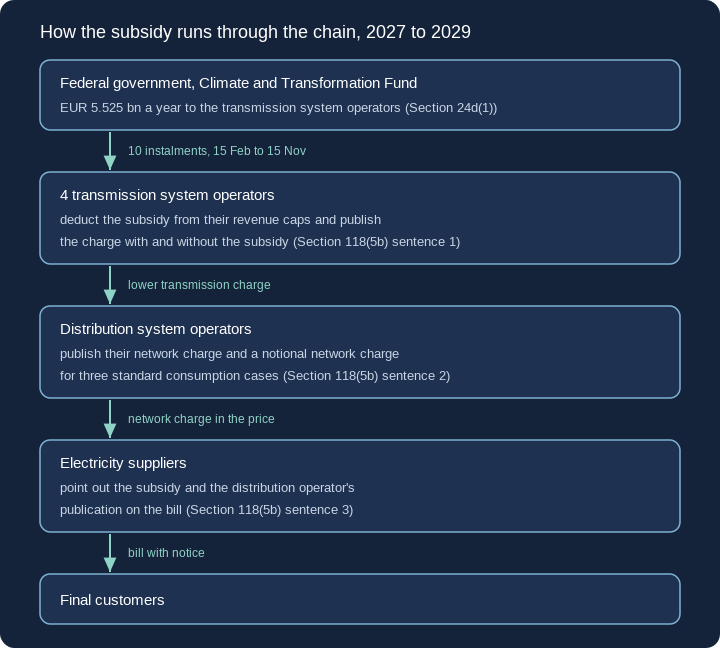
Germany's four transmission system operators (TSOs) with control area responsibility have a statutory claim against the federal government, but the money only comes on request. It is paid in ten equal instalments on the 15th of a month, in the first year from Monday, 15 February 2027, to Monday, 15 November 2027 (Section 24d(1) and (2)). According to the explanatory memorandum, each request has to arrive early enough for the transfer to land on those dates; monthly instalments rather than one annual payment reflect that the operators do not bill their network customers annually.
Each operator's share follows its portion of the sum of all four revenue caps, specifically the caps behind the publication of charges under Section 20(1) (subsection 3). A public-law contract with the federal government sets out the payment details; the Federal Ministry for Economic Affairs and Energy concludes it in agreement with the Finance Ministry (subsection 4).
In their calculation, the operators deduct the subsidy from the total of the revenue caps that feed into the uniform charges and use it to lower the transmission charges paid by final customers and distribution system operators (subsection 5). By determination, the Federal Network Agency (BNetzA) may set further rules. Exact settlement comes only with the approval of the regulatory accounts: surpluses and shortfalls do not change the subsidy but run through the regulatory account, and BNetzA checks how the money was used when it reviews the revenue caps (explanatory memorandum). If BNetzA moves to an annual plan-versus-actual reconciliation in the new regulatory framework for transmission system operators (procedure GBK-25-01-1#2), the memorandum says the same applies; the operators had suggested this in their comments on the ministry's draft bill.
On their website, the operators publish two uniform charges for each year, one with and one without the subsidy (Section 118(5b) sentence 1). For 2027 the gap is wide: an average of 3.54 cents per kilowatt hour at extra-high voltage and the transformation level with the subsidy and 6.52 cents without (ZfK, 1 October 2026, preliminary figures). That is 24 percent more than the 2.86 cents of 2026, even with the subsidy in place; at the hearing, Christine Janssen of 50Hertz attributed 18 to 19 of those 24 percentage points to the cut in the subsidy (ZfK, 6 November 2026). In committee, the government put the reduction of transmission charges achieved by the subsidy at 46 percent (Bundestag printed paper 21/9154).
If an instalment fails
Section 24d(6) covers the case where the federal government does not pay an instalment or is legally prevented from paying it. In that case the operators may adjust their charges once a year, on the first day of a month, only jointly, and with six weeks' notice to BNetzA and on their joint website. Distribution system operators may adjust their network charges on the same date if the transmission system operators adjust; Section 24d sets no notice period of its own for them. If network charges rise mid-year this way, BDEW's implementation guide says a supplier can pass that on only through a formal price change, not as a pass-through item.
Distribution system operators: the notional charge and the cascade
Every operator of an electricity distribution network publishes, for each year from 2027 to 2029, a notional network charge for standard consumption cases next to its actual charge (Section 118(5b) sentence 2). Which cases, the act does not say. The explanatory memorandum names three that operators can use "in the interest of the least bureaucratic approach possible"; an operator that picks other cases should be able to say why. Neither the act nor the memorandum sets the format of the comparison. According to BDEW's implementation guide, customers should be able to see how strongly the subsidy works in their network area.
The three standard consumption cases
Household
Low voltage, 3,500 kilowatt hours a year
Business
Low voltage, 50 megawatt hours a year
Industry
Medium voltage, 24 gigawatt hours a year and 6,000 utilisation hours
The cascade of notional price sheets
It gets harder one level down. A distribution system operator supplied from an upstream distribution network can only calculate its notional charge if it knows the notional upstream costs, meaning its upstream operator's prices without the subsidy. BDEW's implementation guide of 15 September 2026 therefore recommends publishing a notional price sheet with annual energy and capacity prices next to the valid one, or sending those prices directly to downstream operators. No statutory deadline applies; the order follows from the chain: first the final transmission charges, then the upstream distribution operator's notional price sheet, then the downstream operator's calculation. If the final transmission charges appear in early December as they did last year, all steps share just under four weeks before the turn of the year.

Actual network charges follow the usual calendar. The 2027 network charges had to be published as preliminary figures by 15 October, and according to the explanatory memorandum on Section 24d the final ones must be fixed by 1 January. If the transmission system operators raise their charges because legal certainty is missing on 7 December, distribution system operators recalculate in December. What applies if the act is promulgated shortly afterwards, the act and the memorandum leave open; the mid-year adjustment under Section 24d(6) covers only failed instalments.
How much of the subsidy reaches a given network depends on the share of upstream costs, and that share varies from network to network. For 2027, the government expects network charges for households to be about 16 percent lower than without the subsidy, 20 percent lower for businesses and 27 percent lower for industrial customers (printed paper 21/9154); BDEW writes in its position paper that the relief will arrive with regional differences. For each network area, the notional network charge makes that difference public.
Suppliers: the notice on the bill
Electricity suppliers have to point out to the final customers they supply, "with the bill for the respective calendar year", the subsidy under Section 24d and the distribution system operator's publication (Section 118(5b) sentence 3). An amount is not required. According to BDEW's implementation guide, a general notice of the subsidy and its dampening effect on the electricity price is enough, together with a reference to the network operator's website.
In the billing system that means a text block that depends on the billing period and the network area, because according to the explanatory memorandum it refers to the information of the responsible distribution system operator. Neither the act nor the memorandum answers whether a general reference to "your network operator" is enough or whether its name and web address belong on the bill. They also leave open which bills count as "the bill for the respective calendar year": the Federation of German Consumer Organisations (vzbv) reads it as the annual bill, and none of the sources says anything about monthly bills for metered-demand customers or final bills after a change of supplier. A rolling annual bill that spans the turn of the year falls under both notice duties, the one for 2026 (subsection 5a, subsidy under Section 24c) and the one for 2027; each supplier decides how the text reads in that case.

Alongside the notice, Section 118(5) EnWG applies; it came in with the 2026 subsidy and has no end date. It covers contracts outside default supply: if the balance of cost components the supplier cannot influence falls below the balance in the calculation of the current price, the supplier has to factor that into the next contractual price change. Instead of a price change, it may pass on a reduction unchanged under Section 41(6) EnWG without prior notice, in which case no special termination right arises; for fixed-price contracts whose guarantee includes network charges, BDEW takes the view that the pass-through duty does not apply. In default supply, Section 5a(1) sentence 1 of the Electricity Default Supply Ordinance (StromGVV) gives the default supplier a right to recalculate; BDEW reads it to mean that lower network charges have to be reflected in the next price change there too. The duty to recalculate without delay under sentence 2 covers only electricity tax, concession fees and levies, not network charges, so BDEW considers an adjustment after 1 January legally possible. Suppliers changing prices on 1 January had to announce the default supply price change by 20 November.
Whether 2027 brings a reduction at all depends on the network. Transmission charges rise compared with 2026; according to Verivox calculations quoted by the vzbv, the cut in the subsidy raises the household electricity price by an average of 0.25 cents per kilowatt hour net. In August, the Federal Association of New Energy Industries (bne) described what that means for customer service: suppliers would have to explain why network charges rise despite the subsidy.
Timeline to October 2028
Just under two weeks remain until the transmission system operators' caveat date, just under three months until the first instalment. For the publications under Section 118(5b) the act sets no separate deadline; linking them to the final charges is the obvious choice.
Bundesrat lets the act pass
No mediation committee. Signature and promulgation are pending; entry into force follows the day after.
Caveat date of the transmission system operators
Without legal certainty, the transmission system operators expect higher final 2027 transmission charges and a higher surcharge for special network use. Last year the final price sheet came on 5 December.
Notional price sheets and notional network charge
No statutory deadline. Upstream distribution system operators pass on their notional prices once the final transmission charges are out; the notional network charge can then be published together with the final one.
The subsidy period begins
Final network charges of all operators are fixed. The notice duty covers supplies from this day; the notice belongs on the bill for 2027.
First instalment to the transmission system operators
On request, then on the 15th of each month until Monday, 15 November 2027.
Same round for 2028 and 2029
Preliminary charges from the transmission system operators on 1 October, again with and without the subsidy, and from the distribution system operators by 15 October. Whether the full EUR 5.525 billion arrives depends on the federal budgets for 2028 and 2029; according to the memorandum, a cut would need an amendment to the EnWG.
Which records document the implementation
Neither Section 24d nor Section 118(5b) requires a record file. According to the explanatory memorandum, checks take place at the transmission system operators: BNetzA reviews the use of the subsidy as part of their revenue caps. For publications and bill texts the act provides no regular review, but the responsible regulator can ask, for example after a complaint. What serves as evidence then differs by role.
| Role | What serves as evidence | Who may ask |
|---|---|---|
| Transmission system operator | payment requests and receipts per instalment, split by revenue cap, deduction in the charge calculation, reconciliation in the regulatory account | BNetzA for revenue caps and regulatory accounts |
| Distribution system operator | calculation of the notional charge per consumption case, notional price sheet with the date it was passed on, archived version of the website | regulator, downstream operators |
| Electricity supplier | approved text block with validity period, test bill per bill type, balance calculation under Section 118(5) per product | regulator, customers with a complaint |
What happens if a duty is not met
There is no specific administrative offence in the act; it changes only Section 24d, Section 118 and the table of contents of the EnWG. Under Section 65 EnWG, the regulator can require a company to stop conduct that breaches the act and order measures so that it meets its obligations. It can enforce its orders with coercive fines under Section 94 EnWG, between EUR 1,000 and EUR 10 million. Under Section 54 EnWG the regulator is BNetzA; for grid operators with fewer than 100,000 customers connected directly or indirectly, whose network does not extend beyond one federal state, the state regulators take over the tasks listed in Section 54(2). For the transmission system operators, missing a step has a second, purely practical consequence: without a request, the federal government pays no instalment.
Dispute over the amount and the information duties
On the information duties, the associations asked for opposite things, and the Bundestag followed neither. On 13 August 2026 BDEW wrote that, in light of the government's aim to cut red tape, exempting distribution system operators from the notional charge should be considered, and the suppliers' notice duty dropped along with it. Henning Herbst of the vzbv called the information duties good at the hearing on 6 November but said they "reichen allein nicht aus" (are not enough on their own, ZfK); the vzbv proposes a rule like the one for the 2022 cut in the EEG levy, with a fixed date for passing on the relief.
The bne considers the whole instrument cumbersome. In its statement of 12 August it said the subsidy creates recurring work for grid operators and suppliers, on price sheets, billing systems, bill notices and customer communication, and that cutting electricity tax for everyone would be simpler; Section 24d(6), it added, shifts the federal government's financing risk onto suppliers and customers at short notice. BDEW, for its part, wants the same subsection read only as a last-resort legal safeguard, not as a reservation on the payment. The transmission system operators welcome the act and count on its term to 2029:
"Die vorgesehene mehrjährige gesetzliche Absicherung bis 2029 ist wichtig, denn Verlässlichkeit ist gerade für Unternehmen und ihre Investitionsentscheidungen von großer Bedeutung." (The planned multi-year legal safeguard to 2029 is important, because reliability matters a great deal, especially for companies and their investment decisions.)
Christine Janssen, 50Hertz, Bundestag hearing on 6 November 2026 (ZfK)On the amount, the Bundesrat asked on 16 October for last year's level, as did the IG Metall union at the hearing on 6 November: EUR 6.5 billion instead of 5.525 billion a year (printed paper 509/26(B)), so that transmission charges fall as far as in 2026. In its counter-statement the government conceded that a larger sum would lower charges further, but called the cut part of budget consolidation (Bundestag printed paper 21/8826). The Bundestag did not take up the demand.
What stays open until 2029
Three years of planning certainty, as the government promises, apply to the rule, not to every figure in it. Four points are open:
- Whether the preliminary 2027 transmission charges hold depends on legal certainty by 7 December. If the transmission system operators raise them, every downstream price sheet changes with them.
- For 2027 the EUR 5.525 billion is in the government's draft business plan of the Climate and Transformation Fund; for 2028 and 2029 the money is to be "given priority". If less is available, the explanatory memorandum says the EnWG would be amended for that year and the entitlement reduced accordingly. How that would affect a calculation that already runs in October of the year before, the memorandum leaves open.
- From 1 January 2029, BNetzA wants its new network tariff system AgNes to make generation plants, storage and electrolysers pay network costs alongside consumers. The transmission system operators therefore want clarity on how the 2029 subsidy will work in the new system; neither the act nor the memorandum provides it.
- In the European Commission's draft reform of the EU Electricity Market Regulation, the transmission system operators see a possible conflict with the subsidy, without naming the provision. They ask the ministry to push for an amendment so that a subsidy stays legally secure in the long run.
What to get done by 1 January
What was built as a one-off task in 2026 now comes back every year to 2029. If you set up calculation, publication and bill text as a standing process rather than a year-end project, you build nothing new in 2028 and 2029 and only recalculate.
The next five weeks
-
Track the final transmission charges and promulgation
Compare the final transmission charges on netztransparenz.de with the preliminary ones as soon as they appear (last year on 5 December); if they differ, recalculate the price sheet and the notional network charge. Also watch DIP procedure 338789 and the Federal Law Gazette: only the promulgation date settles when the act applies.
-
TSOs: contract and first request
Conclude the public-law contract with the federal government for 2027 to 2029, record the split by the revenue caps behind the publication and time the request for the first instalment so the money arrives on 15 February. Show both 2027 charges side by side on the website.
-
Distribution system operators: notional price sheet first
Calculate notional annual capacity and energy prices once the final upstream figures are available (the transmission charges or the upstream distribution operator's notional price sheet) and pass them to downstream operators. Then calculate the three consumption cases and publish them with the final network charge.
-
Suppliers: text block and balance calculation
Approve the 2027 bill notice, settle the wording for rolling bills across the turn of the year and check it on one test bill per bill type. Document the balance calculation under Section 118(5) per product.
-
Prepare customer service
A short answer to why the network charge can rise despite the subsidy.
Deadline, market roles, systems
Applies from Federal subsidy for transmission network costs 2027 to 2029
Applicability: Applies only once promulgated; the Bundestag passed the government bill unchanged on 12 November 2026, and the Bundesrat did not call the mediation committee on 20 November 2026 (BR-Drs. 656/26(B)). The act enters into force on the day after promulgation; 1 January 2027 is the start of the period the subsidy and duties cover.
Procedure: Bundesrat did not call the mediation committee (20 November 2026, BT-Drs. 21/8236). Procedure in the Bundestag's DIP ↗
If the deadline is missed: Regulator can enforce The act as passed does not provide for a specific administrative offence. The regulator can enforce the publication duties by order under Section 65 EnWG, backed by coercive fines under Section 94 EnWG. Legal basis ↗
- Electricity grid operatorcheck applicabilityUnder the act as passed, prepares a notional network charge without the subsidy for publication alongside the 2027 charge.Typically affected: Regulatory management, controlling, Grid usage and customer billing
- Transmission system operatorcheck applicabilityCalculates the 2027 transmission charges including the subsidy and, under the act as passed, publishes them with and without it.Typically affected: Regulatory management, controlling, Grid usage and customer billing
- Suppliercheck applicabilityUnder the act as passed, plans the subsidy notice on the bill and allows for the risk of higher final charges.Typically affected: Grid usage and customer billing
A classification for typical market roles, not a review of your individual case and not legal advice. Whether an obligation applies to your company (thresholds, exemptions) is for your legal department or counsel to confirm. The calendar doesn't replace your own deadline review. Information as of: 24 November 2026.
Further reading
Frequently asked questions
A payment of EUR 5.525 billion a year from the federal Climate and Transformation Fund to the four German transmission system operators with control area responsibility, set out in Section 24d EnWG as passed. Operators deduct it from their revenue caps, so the uniform transmission charges and, through upstream costs, the network charges of distribution system operators are lower than they would be without it. Compared with 2026, transmission charges still rise, provisionally from 2.86 to 3.54 cents per kilowatt hour, partly because the 2026 subsidy was larger at EUR 6.5 billion.
Not yet (status 24 November 2026). On 12 November 2026 the Bundestag passed it unchanged, and on 20 November the Bundesrat did not call the mediation committee, so the act has been adopted. It still has to be signed and promulgated in the Federal Law Gazette. It enters into force on the day after promulgation; the subsidy and the duties cover the calendar years 2027 to 2029.
The network charge that a standard consumption case would pay if the transmission charge were calculated without the subsidy. Under Section 118(5b) sentence 2 EnWG, distribution system operators publish it for each year from 2027 to 2029 next to their actual charge. The explanatory memorandum names three cases: a household with 3,500 kWh and a business with 50 MWh at low voltage, and an industrial customer with 24 GWh and 6,000 utilisation hours at medium voltage.
A notice of the subsidy under Section 24d EnWG and of the publication by the responsible distribution system operator, with the bill for each calendar year from 2027 to 2029 (Section 118(5b) sentence 3 EnWG). The act does not require an amount; BDEW's implementation guide considers a general notice of the subsidy and its dampening effect sufficient.
The transmission system operators published their preliminary 2027 charges with a caveat: without legal certainty by 7 December 2026 they expect higher final transmission charges and a higher surcharge for special network use. If an instalment fails during the year, Section 24d(6) EnWG lets them adjust their charges once, on the first day of a month, with six weeks' notice; distribution system operators may follow on the same date.
Preliminary figures from 1 October 2026 average 3.54 cents per kilowatt hour at extra-high voltage and the extra-high to high voltage transformation level, calculated with the subsidy and subject to the act arriving in time. Without the subsidy the figure would be 6.52 cents; in 2026 it was 2.86 cents. Final values follow before the turn of the year; last year they came on 5 December.
Let's collaborate
One contact, a team behind it
Thirty minutes on what you're working on, whether grid, metering, market processes, IT architecture or AI. Afterwards you'll know how we'd approach it and who would sit at the table.
Energy and measurement technology since 2010 · innobu GmbH since 2014 · Based in Schleswig-Holstein, Germany
Whoever pitches also delivers: whoever leads the first call stays your contact right through to the steering committee, with established partners in the project. Direct: info@innobu.com