
Congestion income 2027: what Germany's transmission system operators report by 31 October
The advance notice under Article 4 of the ACER methodology lists cost categories, projects, expected income, movements on the internal account and the amount meant to lower network charges. The Federal Network Agency (BNetzA) decides by 31 December, by which point the provisional 2027 transmission charges have long been published.
Congestion income is what transmission system operators earn from allocating cross-zonal capacity; under Article 4 of ACER's methodology on the use of congestion income, Germany's four transmission system operators tell the Federal Network Agency by 31 October 2026 how they plan to use their 2027 income. Article 19 of Regulation (EU) 2019/943 sets the order: first the availability of allocated capacity and the maintenance or expansion of cross-border capacity, network charge reductions only after that. In 2025 transmission system operators collected EUR 1,482.55 million at Germany's borders; the four large ones spent EUR 815.37 million on availability and EUR 705.81 million on line projects such as Ultranet and SuedOstLink, drew EUR 158.84 million from internal accounts to cover it and used nothing to lower network charges. The Federal Network Agency decides on the use by 31 December 2026 and can require changes.
Content and timing of the advance notice
The notice due at the Federal Network Agency by 31 October 2026 is a plan for next year. ACER's methodology on the use of congestion income, adopted with Decision 38/2020 of 23 December 2020, sets 31 October in Article 4(6) unless the regulator picks an earlier date. Germany's regulator has not; its 2026 deadline calendar for electricity network charges lists, in the column for transmission system operators, the planned use of congestion income for 2027 as due on 31 October.
Article 4(1) spells out what goes in. Each operator names which of the nine cost categories in Article 3 it will direct the income to. Categories (i) to (v) cover system operation: measures that keep allocated capacity firm, compensation for curtailed transmission rights, hedging products, remuneration of non-nominated transmission rights and the regional coordination centres. Categories (vi) to (ix) cover network investment: ongoing investment in assets with cross-zonal effect (vi), capital costs of past investment (vii), operating and maintenance costs of such assets (viii) and other costs of optimising them (ix). For (vi) the operator lists the individual projects. Then come indicative amounts: the income it expects, how much it plans to spend, how much should count towards network charges and the new and cumulated amounts it plans to place on the separate internal account, with an estimate covering several years. For categories (vi) to (ix) it has to explain why they maintain or raise cross-zonal capacity, for instance with the EU Ten-Year Network Development Plan (TYNDP) or the German network development plan (Article 4(3)).
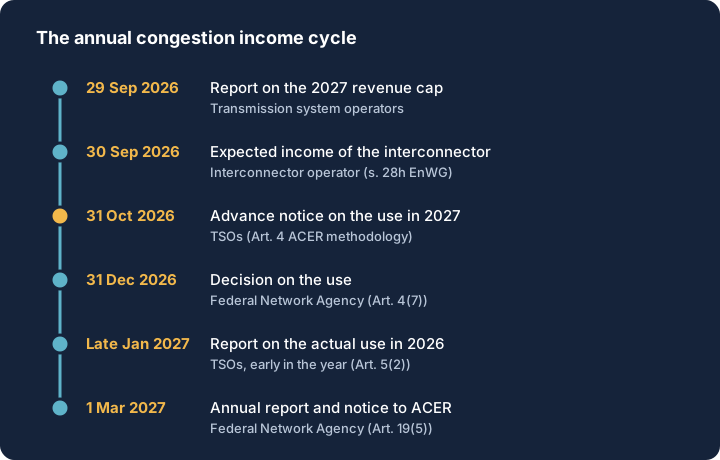
At a minimum, the methodology requires the notice every two years, covering one or two following years. In Germany it is due every year, which has an advantage for the operators: a two-year plan for income that moves by hundreds of millions from one year to the next would be out of date the day it was sent.
Where the income comes from and how much it swings
Congestion income arises at borders where transmission capacity cannot carry all the trade, and every German external border is one of them. In coupled day-ahead and intraday markets, traders buy energy and transport capacity in one step; whatever price difference remains between bidding zones goes to the transmission system operators. In its report for 2025 the regulator lists four components: those price differences in short-term trading, income from monthly and yearly auctions of long-term transmission rights minus the payouts to their holders, and income from the European balancing platforms.
| Year | Total income | Availability (a) | Capacity (b) | Internal account (+ added, - drawn) | Network charges |
|---|---|---|---|---|---|
| 2022 | 2,188.51 | 1,400.32 | 424.49 | +1.43 | 0.00 |
| 2023 | 1,558.22 | 737.24 | 360.54 | +300.06 | no amount |
| 2024 | 1,110.79 | 494.14 | 408.70 | +77.54 | no amount |
| 2025 | 1,482.55 | 815.37 | 705.81 | -158.84 | 0.00 |
The columns never add up to the total because the regulator does not show how Baltic Cable AB uses its share. Running only the subsea cable to Sweden, the company falls outside the pattern of the four large operators; more on that under the open issues. For independent interconnector operators, Section 28h of the Energy Industry Act (EnWG) requires them to hand their congestion income to the transmission system operator responsible for the control area and to report the income they expect for the current year to that operator and the regulator by 30 September. Neither gain nor loss may result for the receiving operator, and for its return on equity it is treated as if it had never received the money.
What Article 19 allows the money to be used for
Network charges come last. Article 19(2) of Regulation (EU) 2019/943 sets the priority objectives: (a) guaranteeing the actual availability of allocated capacity, including firmness compensation for holders of transmission rights whose capacity was curtailed, and (b) maintaining or increasing cross-zonal capacity, by making better use of existing interconnectors, through coordinated remedial actions such as redispatch and countertrading, or by investing against congestion on interconnectors.
The market design reform, Regulation (EU) 2024/1747, added a point (c): compensation for operators of offshore wind farms in an offshore bidding zone connected to two or more bidding zones, where transmission system operators fail to provide the promised capacity. It is capped at the congestion income of the interconnectors concerned. Germany has no offshore bidding zone, so (c) stays empty in the 2027 notice. Under Article 19(4), ACER's methodology only covers (a) and (b) in any case.
Only once the priority objectives are "adequately fulfilled" may the income go into network charges (first sentence of Article 19(3)). Whether that is the case is for the regulator to decide, not the operator, and the regulator has to explain its view in its annual report. None of the four reports the German regulator has published since 2022 shows an amount above zero for network charges.
What happened to EUR 1.48 billion in 2025
In 2025 the operators spent more than they took in. EUR 815.37 million went into availability, EUR 705.81 million into line projects, and they drew EUR 158.84 million from internal accounts holding income from earlier years to cover it. Nothing went towards lower network charges, according to the regulator's report of March 2026.
Where the EUR 705.81 million went is in the project list: the projects add up exactly to the amount under point (b). Ultranet, the direct-current link between North Rhine-Westphalia and Baden-Württemberg, carries the largest share with EUR 231.47 million at Amprion and EUR 57.79 million at TransnetBW. TenneT put EUR 165.83 million and 50Hertz EUR 94.90 million into SuedOstLink, TransnetBW EUR 81.25 million into SuedLink and Amprion EUR 48.43 million into A-Nord. What remains is spread over border lines to France, the Netherlands, Belgium and Switzerland and the Eichstetten grid reinforcement up to the national border.

| Operator | Project | Amount |
|---|---|---|
| Amprion | Ultranet | 231.47 |
| TenneT | HVDC SuedOstLink Wolmirstedt to Isar | 165.83 |
| 50Hertz | HVDC SuedOstLink Wolmirstedt to Isar | 94.90 |
| TransnetBW | SuedLink | 81.25 |
| TransnetBW | Ultranet | 57.79 |
| Amprion | A-Nord | 48.43 |
| Amprion | Tiengen (DE) to Beznau (CH) | 13.77 |
| TransnetBW | Eichstetten grid reinforcement to the national border | 7.51 |
| Amprion | Uchtelfangen (DE) to Vigy (FR) | 4.10 |
| Amprion | Niederrhein (DE) to Doetinchem (NL) | 0.67 |
| Amprion | ALEGrO (DE to BE) | 0.09 |
2024 ran the other way: the operators put EUR 77.54 million on their internal accounts, and in 2023 the EUR 300.06 million set aside came entirely from Amprion. Anyone planning to draw on the account again in 2027 needs a clean balance: how much is left after the 2025 withdrawal, and which projects is it earmarked for? Without that update, the multi-year estimate under Article 4(1)(e) cannot be given with any credibility.
Five open issues in the 2027 notice
Forecasting the income
The hardest part of the notice is forecasting the income itself. Between 2022 and 2024 it fell from EUR 2,188.51 million to EUR 1,110.79 million, and in 2025 it rose again to EUR 1,482.55 million. ACER saw this coming: under Article 4(1)(c) the regulator may excuse operators from giving indicative amounts for firmness measures and costly remedial actions, since those costs depend on real-time operation.
Double funding through network charges
An investment paid for with congestion income must not also be recovered through network charges, as cost category (vi) of the methodology states. In practice the project list in the notice has to be checked against the report on the 2027 revenue cap adjustment the operators filed by 29 September, so that no project is funded both from congestion income and through the revenue cap.
The provisional charges are already out
On 1 October the four operators published provisional 2027 charges averaging 3.54 cents per kilowatt hour, up from 2.86 cents this year, calculated with a federal subsidy of EUR 5.525 billion (ZfK, 1 October 2026). A decision on congestion income follows only by 31 December. Any relief from congestion income the regulator allowed at that point is therefore not in the provisional figures.

A new income stream from the balancing platforms
Since Germany joined the European platforms for automatic and manual frequency restoration reserve (PICASSO, MARI), congestion income also arises from cross-border exchange of balancing energy. Since the 2025 report it appears as a component of its own. For the 2027 forecast that is one more series without much history, and ACER's 2020 methodology defines its scope as income from capacity allocation in trading; it does not mention income from the balancing platforms explicitly.
Baltic Cable
The operator of the subsea cable to Sweden is the special case the regulator explains in every report. On 11 March 2020 the Court of Justice of the EU ruled that a company operating only an interconnector may use part of its congestion income as revenue and for operation and maintenance; the ruling concerned the old Regulation (EC) 714/2009, and the regulator considers it transferable. Baltic Cable invests the surplus in agreement with the regulator, and an investment in the Greenlink interconnector between Ireland and Great Britain has been made; the regulator does not publish the amount, citing business secrets. Ruling chamber 4 is handling the surplus income for 2020 to 2022 in proceedings BK4-24-023. None of this changes the notices of the four large operators, but it explains why the totals in the regulator's reports never add up.
Fallbacks when the numbers do not hold
The methodology assumes from the start that forecasts will be wrong. Under Article 4(2) the amounts in the notice are non-binding, and operators may correct them during the year. Allocation under Article 5(1) is based on the income actually collected and the costs efficiently incurred, not on the figures announced.
The Federal Network Agency reviews and decides
It can request changes or, after hearing the operator, decide itself which cost categories the income goes to and what the multi-year estimate for the internal account is (Article 4(7)).
Spending exceeds income
The internal account is reduced by the difference. If it would go negative it is set to zero. Where the operator keeps the account only as a reporting line rather than in its books, the shortfall is carried forward to later years (Article 5(4) and (6)).
The balance flows into network charges
If the regulator identifies no efficient use, or the priority objectives need less, the account balance is used to set network charges (Article 5(7)).
Actuals report and annual report
The operators report the actual use early in the year (for 2025 the deadline calendar set 31 January 2026); the regulator publishes its report under Article 19(5) by 1 March and informs ACER.
Article 5(7) is how saved money can still end up in network charges. We do not expect that in Germany: as long as lines like SuedLink and SuedOstLink are under construction, the regulator is likely to keep finding an efficient use.
The fight over earmarking in the EU grids package
From 2028, part of the income could be reserved for cross-border projects. In its European Grids Package (COM(2025) 1005 to 1007), the European Commission proposed that operators set aside 25 percent of the congestion income they do not need for redispatch or offshore compensation for such projects. None of this is law yet, so it does not bind the 31 October notice, but it matters for the multi-year estimate of the internal account.
Sweden led the opposition; it relies heavily on congestion income to manage bottlenecks in its own grid (E&E News, 24 June 2026). On 26 June 2026 the Council agreed a softer position: 10 percent from 1 January 2028, rising by five percentage points a year to 25 percent in 2031, with money left unused for eight years released for use under the existing EU electricity market rules (Brussels Times, 26 June 2026).
"As a result, fewer funds would be available for other grid expansion projects and for reducing tariffs."
Austrian Chamber of Labour, position paper on the European Grids Package, March 2026 (our translation)The Chamber of Labour wants the earmarking dropped altogether, because less money would otherwise be left for other grid projects and for lower tariffs. In Germany congestion income has not gone into network charges lately anyway. We see a different question here: whether domestic lines with a cross-border effect, such as Ultranet, would count as cross-border projects under the earmark. How Parliament and Council settle it in trilogue is open.
What applies if the notice is missing
The ACER methodology sets no sanction of its own. The Federal Network Agency decides on the use of congestion income by 31 December and can require changes. It can enforce the reporting duty under Section 56(1) sentence 2 and Section 94 EnWG with coercive fines of EUR 1,000 to EUR 10 million. Whether and how it acts in a given case is at its discretion.
What to do now
Shortly before 31 October the work is less about new numbers than about checking them against what the regulator already has.
For transmission system operators by 31 October
-
Check the project list against the revenue cap report
Check every category (vi) project against the 29 September report so that no investment is funded both from congestion income and through the revenue cap, and explain any differences in the notice.
-
Attach the justification for each project
For categories (vi) to (ix), Article 4(3) requires evidence of the cross-zonal effect, per asset or per group of assets; the TYNDP, the network development plan and action plans under Article 15 of Regulation (EU) 2019/943 are the obvious sources.
-
Update the internal account
Balance after the 2025 withdrawal, planned movement in 2027, multi-year estimate. If the EU grids package arrives with an earmark, the estimate changes from 2028; it is worth modelling that case internally now.
-
Plan for a mid-year update
With income swinging by hundreds of millions a year, corrections under Article 4(2) are to be expected. Decide who triggers it.
For distribution system operators and suppliers
Do not count on relief from congestion income in 2027. For your pricing, 7 December 2026 matters more: if the law on the federal subsidy for 2027 to 2029 has not passed by then, the transmission operators say they expect higher final charges (ZfK, 1 October 2026), and that passes through upstream costs into the distribution operators' 2027 network charges. That and the 2027 levies are the items still open this autumn.
Deadline, market roles, systems
31 October 2026Congestion income 2027: report the planned use to the Federal Network AgencyRegulatory ruling · adopted
Applicability: Only transmission system operators that earn congestion income from allocating cross-zonal transmission capacity.
If the deadline is missed: Regulator can enforce The ACER methodology sets no sanction of its own. The Federal Network Agency decides on the use by 31 December and can require changes; it can enforce the reporting duty under Section 56(1) sentence 2 and Section 94 EnWG with coercive fines of EUR 1,000 to EUR 10 million. Legal basis ↗
- Transmission system operatorrole obligationSubmits the planned use of the 2027 congestion income to the Federal Network Agency by 31 October.Typically affected: Regulatory management, controlling
A classification for typical market roles, not a review of your individual case and not legal advice. Whether an obligation applies to your company (thresholds, exemptions) is for your legal department or counsel to confirm. The calendar doesn't replace your own deadline review. Information as of: 21 October 2026.
Further reading
Frequently asked questions
Congestion income is what transmission system operators earn from allocating cross-zonal transmission capacity. It arises when a border is congested and electricity trades at different prices on either side. Germany's transmission system operators collected about EUR 1.48 billion in 2025.
By 31 October 2026. The basis is Article 4(6) of ACER's methodology on the use of congestion income (Decision 38/2020); the Federal Network Agency lists the date in its 2026 deadline calendar for electricity network charges. The agency decides on the use by 31 December.
Under Article 19(2) of Regulation (EU) 2019/943, first for guaranteeing the actual availability of allocated capacity and for maintaining or increasing cross-zonal capacity, and since the 2024 market design reform also for compensating offshore generators in offshore bidding zones. Only once these objectives are adequately met may the income lower network charges; the rest goes to a separate internal account.
That is unlikely. The Federal Network Agency's reports for 2022 to 2025 show no amount used for network charges, and for 2025 it states explicitly that none was used. The provisional 2027 transmission charges of 3.54 cents per kilowatt hour were published on 1 October 2026; they are not final yet.
No. Under Article 4(2) of the ACER methodology the forecasts are non-binding and may be updated during the year. Under Article 5(1) the income is allocated on the basis of the congestion income actually collected and the costs efficiently incurred.
The ACER methodology sets no sanction of its own. The Federal Network Agency decides on the use by 31 December and can require changes. It can enforce the reporting duty under Section 56(1) sentence 2 and Section 94 EnWG with coercive fines of EUR 1,000 to EUR 10 million.
Let's collaborate
One contact, a team behind it
Thirty minutes on what you're working on, whether grid, metering, market processes, IT architecture or AI. Afterwards you'll know how we'd approach it and who would sit at the table.
Energy and measurement technology since 2010 · innobu GmbH since 2014 · Based in Schleswig-Holstein, Germany
Whoever pitches also delivers: whoever leads the first call stays your contact right through to the steering committee, with established partners in the project. Direct: info@innobu.com