
Price Change on 1 January 2027: Default Supply Notice by 20 November
A default supplier (Grundversorger) that changes its general electricity or gas prices on 1 January 2027 needs three things on the same day: a public notice, a letter to every customer and the change on its own website. The CHP levy and offshore grid levy for 2027 have been fixed since 26 October, the surcharge for special grid use only with a reservation; distribution grid fees have been published since mid-October, some as estimates. Still open are the federal subsidy for transmission costs, the 2027 carbon price, passed by the Bundestag but not yet by the Bundesrat, and the electricity tax for households.
The default supply notice period is the rule in Section 5(2) of the German default supply ordinances for electricity and gas (StromGVV, GasGVV) under which default suppliers must announce a change to general prices publicly at least six weeks in advance; for 1 January 2027 the last day is Friday, 20 November 2026. A change only takes effect at the start of a month. On that same day the letters to customers must be sent and the change must be on the supplier's website, each stating the scope, reason and conditions of the change, the special termination right and the price components shown separately. A supplier that announces later cannot charge the new price from 1 January. For household customers on special contracts, Section 41(5) of the Energy Industry Act (EnWG) requires one month's notice, which for the turn of the year means 1 December 2026.
Timeline to 20 November
Six weeks before 1 January 2027 is Friday, 20 November 2026. By the end of that day the public notice, the mailing and the online publication must all have happened, and since printing, enveloping and a newspaper notice have lead times of their own, pricing should be settled two weeks ahead, on 6 November in the plan below. The ordinances only allow changes at the start of a month; a supplier that misses 20 November can move the change to 1 February 2027 at the earliest, and then has to give notice by Monday, 21 December 2026.
Two inputs are now on the table, both with a caveat. Distribution system operators published their 2027 grid fees by 15 October (Section 20 EnWG). Where the fees were not yet fixed, they gave estimates. The transmission system operators published the 2027 levies on Monday, 26 October, because the 25th fell on a Sunday: CHP levy 0.451 cents, offshore grid levy 1.143 cents and the surcharge for special grid use 2.027 cents per kilowatt hour up to 1 GWh, 3.621 cents in total against 2.946 cents this year. The operators published the surcharge with a reservation: if there is no legal certainty on the federal subsidy by 7 December, they expect it to rise accordingly.
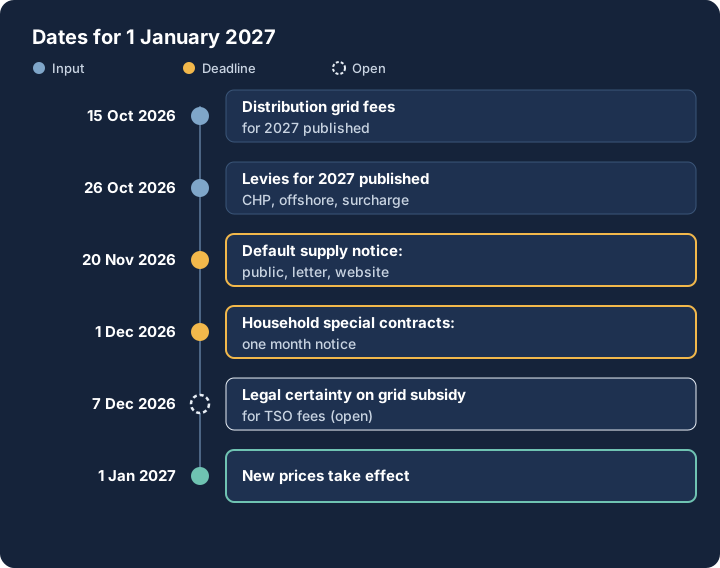
Between the notice on 20 November and 7 December, the date by which the transmission operators want clarity on the federal subsidy, lie two and a half weeks. No default supply deadline falls into that window, but the 1 December date for special contracts does, and so does part of the cost risk.
Three channels on one day
A public notice on its own is not enough. Section 5(2) sentence 2 StromGVV, worded identically in the GasGVV, requires the default supplier to send "a letter to the customer at the same time as the public notice" and to publish the changes on its website. A supplier that runs the newspaper notice on 20 November but hands the letters to the post office the following Monday has not met the condition for 1 January.
Section 36(1) sentence 2 EnWG also applies online: general prices may not differ by the date on which the default supply contract was concluded. One price sheet for existing customers and another for new ones, as some suppliers introduced during the energy crisis, has been prohibited since 29 July 2022, with a transition period that ended on 1 November 2022. Whoever sets the 2027 price sets it for all household customers in default supply in that grid area.
What the letter must contain
The letter has to state the scope, reason and conditions of the change, point to the termination right and list the price components "in a clear form". Which components those are is set out in Section 2(3) of both ordinances, and since 1 January 2026 electricity and gas differ there.
| Component | Electricity | Gas |
|---|---|---|
| Tax | electricity tax | energy tax |
| Concession fee | yes | yes |
| Levies and surcharges | each separately (levies under Section 12(1) of the Energy Financing Act, surcharge for special grid use) | no separate listing required |
| Grid and metering fees | each separately, metering where part of the contract | no separate listing required |
| Carbon cost under the BEHG | not applicable | required only until 31 Dec 2025 |
| Default supply cost share | price minus VAT and charges, named separately | no separate listing required |

"Reason" and "conditions" are where letters become open to challenge. A line such as "due to higher costs" says neither which costs nor by how much. A letter holds up better when it shows the change per component in cents per kilowatt hour and attributes the rest to the cost share the supplier controls itself. For gas, the duty to show carbon costs separately ended with 2025, and grid fees were never a required item. A supplier that names them as the reason for a change should still quantify them in the letter, or the reason stays unsupported.
Special contracts: one month's notice
Supply contracts outside default supply fall under Section 41(5) EnWG: household customers must be informed at least one month before a price change, other final customers at least two weeks before, and directly, meaning a message to the customer and not just a website update, with the reason, conditions and scope. For 1 January 2027 that means 1 December 2026, a Tuesday, for household customers. Under the EnWG, household customers include business customers with up to 10,000 kilowatt hours a year, so small businesses in the mass market count too.
A supplier that passes on a statutory change in the VAT rate (up or down) or a lower balance of taxes, charges, levies and grid fees unchanged needs no notice under Section 41(6) EnWG, and the customer gets no special termination right. The exception does not cover increases in components other than VAT.
Before any increase under a special contract, the supplier therefore checks whether the contract reserves a right to change prices and whether a price guarantee is running. Section 41(5) only governs how a supplier exercises a right to change prices that the contract reserves; whether it has that right is a matter for the contract. On 5 October 2026 the Higher Regional Court of Hamm (case 2 VKl 2/23), in a collective action brought by the Federation of German Consumer Organisations (vzbv), declared price increases from 2022 despite a price guarantee invalid; the ruling is not yet final.
What is still open on 20 November
Three inputs are not fixed on notice day, and the default supplier carries the risk for each one until its next price change. The largest affects electricity only. On 1 October the four transmission system operators published a provisional average grid fee at extra-high and high voltage of 3.54 cents per kilowatt hour for 2027, against 2.86 cents this year; only part of it reaches the household price, and the share differs by region. That figure assumes a federal subsidy of EUR 5.525 billion, approved by the cabinet in early September and about one billion less than in 2026. Without it the fee would be 6.52 cents. The operators expect correspondingly higher final fees if there is no legal certainty by 7 December 2026. Default suppliers feel this fee through the distribution grid fees, which include the provisional transmission fee.
For gas, the Bundestag decided on 15 October to keep the carbon price under the Fuel Emissions Trading Act within a corridor of 55 to 65 euros per tonne in 2027. The Bundesrat vote and promulgation were still outstanding on 2 November 2026, so gas suppliers price with a value from a corridor that has been passed but is not yet in force, and should record which value they used. Electricity tax for households remains at the standard rate of 2.05 cents per kilowatt hour; a cut for households is being discussed in the coalition, but there is no cabinet decision. As a benchmark for your own result: the comparison portal Verivox expects household electricity grid fees to rise by 1.9 percent on average in 2027. For gas it expects retail price increases of 10 to 20 percent, depending on the tariff, driven by wholesale prices.
What happens if an input changes after 20 November is covered by Section 5a StromGVV in two steps. If electricity tax, concession fee, levies or grid fees change, the default supplier may recalculate at any time. If the balance of electricity tax, concession fee and levies falls, it must do so without delay; grid fees are not part of that balance. Between 15 October and 31 December that duty only arises once all charges for the following year are fixed. Section 5a GasGVV has the same two steps for energy tax and concession fee, but without that window. In both ordinances paragraph 2 expressly leaves the duties under Section 5(2) untouched, so even a recalculated reduction needs notice, letters and six weeks before the next start of a month. If transmission fees rise after 7 December and distribution operators pass that on in their fees, the default supplier carries the difference until a new price change applies, so until 1 February at the earliest.
Terminations after the letter
Under Section 5(3) StromGVV and GasGVV the customer can terminate without notice period as of the date the change takes effect. If, within one month of the termination reaching the supplier, the customer proves a new supply contract, the price change never takes effect for that customer. Separately, default supply can be terminated at any time with two weeks' notice under Section 20 StromGVV, with no extra fee.

For billing, the month after termination has a practical effect: for customers who have terminated and are still supplied in January, the system must be able to bill the old price beyond 1 January, retroactively if proof of the switch only arrives in January. Market communication adds to this. For electricity, deregistrations arrive faster since the 24-hour supplier switch, and the peak around the turn of the year falls in the weeks with the most staff on leave. Customer service and market communication therefore need their own staffing plan for December and January.
The dispute over clear letters
Regulator, consumer groups and suppliers have argued about when a price letter is clear enough since the energy crisis. On 29 August 2025 the Federal Network Agency found that an electricity supplier had breached Section 41(5) sentences 1 and 3 EnWG by not informing final customers "in a simple and understandable way", and ordered it to reverse price changes. When that did not happen, it imposed a coercive fine of EUR 100,000 on 31 March 2026 and one of EUR 175,000 on 31 July 2026. The complaint was about content, not the one month period. The case concerned special contracts. For default supply letters, Section 5(2) of the ordinances requires scope, reason and conditions as well, plus a clear form.
Consumer advice centres read the required content strictly. If the letter lacks the reason, the scope or the reference to the special termination right, the increase may be invalid in their view, the Berliner Zeitung reported on 17 October 2026, citing the Verbraucherzentrale. During the energy crisis the Verbraucherzentrale already criticised letters in which the decisive information was "hidden between supposed advertising". The law asks for completeness and clarity at once, and a letter that itemises every cost line is harder for many customers to read. The courts have not settled the question. Our recommendation: new total price, date and termination right on page one, and on page two the table of components with old and new amounts.
If the deadline is missed
The consequence is a matter of civil law: the customer does not owe the new price before the change takes effect, and can reclaim any excess paid under general civil law. Under Section 5(2) StromGVV and GasGVV a change to general prices only takes effect if it was announced publicly at least six weeks in advance; with a later notice the new price does not apply from 1 January 2027, but at the earliest from the next start of a month for which the six weeks are met. For household customers on special contracts Section 41(5) EnWG requires one month's notice but states no express consequence. The Federal Network Agency takes up breaches of Section 41(5) under Section 65 EnWG with orders it can enforce through coercive fines, as in the 2025 and 2026 proceedings. Because the civil law effect of late notice is open, suppliers do best to treat 1 December as a hard limit.
Systems and records
On 20 November three systems have to show the same price: the billing system with the price master data from 1 January, the mail-merge run with the default supply customer base, and the portal with the price sheet. In SAP IS-U or S/4HANA Utilities that means price keys valid from 1 January 2027 for every grid area in which the company is default supplier, and instalments from January that already reflect the new price. Letters go to every default supply customer, including those who only came into default supply shortly before 20 November.
What the default supplier should be able to show in a dispute is created on the same day: a dated copy of the public notice, a mailing log with the number of letters and the hand-over to the postal service, an archived copy of the website with a timestamp, and the pricing file that documents reason and conditions. Assembling these only when the arbitration board asks means rebuilding them from the print order and the postage invoice.
What default suppliers should do by 20 November
From 2 November there are eighteen days left for a chain of pricing, sign-off, printing and three publications. The order follows backwards from the outgoing mail.
The next three weeks
-
By Friday, 6 November: close the pricing
Put in the grid fees per grid area, the 2027 levies and procurement costs. The distribution grid fees include the provisional transmission fee; record with a date that you rely on it, and for gas which carbon price you assumed.
-
By Tuesday, 10 November: approve letter and price sheet
Sample letter with the required content from the section above, every component in cents per kilowatt hour; the same figures in the price sheet for the website.
-
By Friday, 13 November: prepare print, notice and portal
Book the print provider and the newspaper for 20 November, prepare the portal page, create the price master data and instalments from January in the billing system.
-
Friday, 20 November: everything on one day
Notice, post office hand-over and online publication; file the copy of the notice, the mailing log and a timestamped screenshot.
-
1 and 18 December: special contracts and customer service
Inform household customers on special contracts by 1 December and other final customers two weeks before 1 January, so by 18 December. Prepare customer service for special terminations and proofs of switching that can arrive until the end of January.
-
After 7 December: recheck the grid subsidy
If the subsidy law is in place, nothing to do. If not, recalculate the gap to the final transmission fees and decide whether a second change on 1 February is needed; Monday, 21 December would be the last notice day for it.
Deadline, market roles, systems
20 November 2026Price change on 1 January 2027: notice deadline in default supplyLaw · adopted
Applicability: Default suppliers of electricity and gas changing prices on 1 January 2027; special contract suppliers with household customers (one month notice).
If the deadline is missed: Civil-law consequence Under Section 5(2) StromGVV and GasGVV a change to general prices only takes effect after public notice at least six weeks in advance; with later notice the new price does not apply from 1 January 2027. For household customers on special contracts Section 41(5) EnWG requires one month's notice but states no express consequence. The Federal Network Agency takes up breaches of Section 41(5) EnWG under Section 65 EnWG: on 29 August 2025 it ordered one electricity supplier that had not informed final customers in a simple and understandable way (Section 41(5) sentences 1 and 3, not the one month period) to reverse price changes (case 522-4.07.01/8#1) and then imposed coercive fines of EUR 100,000 (31 March 2026) and EUR 175,000 (31 July 2026); the decisions are not yet final. Legal basis ↗
- Supplierrole obligationDefault suppliers finish 2027 pricing early enough that publication, customer letters and online notice go out by 20 November 2026 at the latest.Typically affected: Grid usage and customer billing, SAP IS-U / S/4HANA Utilities, Customer and grid connection portal
A classification for typical market roles, not a review of your individual case and not legal advice. Whether an obligation applies to your company (thresholds, exemptions) is for your legal department or counsel to confirm. The calendar doesn't replace your own deadline review. Information as of: 1 November 2026.
Further Reading
Frequently Asked Questions
The rule in Section 5(2) StromGVV and GasGVV under which a change to general prices only takes effect at the start of a month, and only if the default supplier announced it publicly at least six weeks before. On the same day it must send letters to customers and publish the change online.
By Friday, 20 November 2026, exactly six weeks before 1 January. A supplier that announces later can charge the new price from 1 February 2027 at the earliest, and for that must give notice by Monday, 21 December 2026.
The scope, reason and conditions of the change, the reference to the right to terminate without notice as of the date the change takes effect, and the price components under Section 2(3) of the ordinances in a clear form. For electricity these are electricity tax, concession fee, each levy, grid and metering fees and the default supply cost share.
Under Section 41(5) EnWG the supplier must inform household customers at least one month before the price change and other final customers at least two weeks before. For 1 January 2027 that is 1 December 2026 for household customers. If it only passes on lower taxes or charges unchanged, no notice is needed.
The announced price still applies from 1 January. The default supplier can recalculate a higher cost item under Section 5a StromGVV, but the new change again needs six weeks' notice and the start of a month. Until then it carries the difference.
No. Section 2(3) GasGVV required the BEHG costs to be shown separately only until 31 December 2025. Energy tax and concession fee are still shown separately; carbon costs are part of the energy price. As a reason for a change they should still be explained in the letter.
Let's collaborate
One contact, a team behind it
Thirty minutes on what you're working on, whether grid, metering, market processes, IT architecture or AI. Afterwards you'll know how we'd approach it and who would sit at the table.
Energy and measurement technology since 2010 · innobu GmbH since 2014 · Based in Schleswig-Holstein, Germany
Whoever pitches also delivers: whoever leads the first call stays your contact right through to the steering committee, with established partners in the project. Direct: info@innobu.com