Six deadlines for German gas network operators to 2028: cooperation agreement, L-gas market conversion, gas storage
After that come five dates for gas distribution system operators from the gas cooperation agreement and Section 19a EnWG, from the final 2027 network charges in December to the long-term gas and hydrogen forecast on 1 March 2028. Which day applies to a network depends on where it sits in the cascade below the transmission grid.
The gas cooperation agreement (Kooperationsvereinbarung Gas, KoV) is the contract through which gas network operators in Germany organise their cooperation under Section 20(1b) EnWG; version KoV XV, as amended on 27 March 2026, has applied since 1 October 2026 and sets four of the six deadlines that gas network and storage operators face up to March 2028. Final 2027 network charges are published by gas transmission system operators by 2 December, by distribution system operators directly downstream that have their own downstream networks by 12 December and by all other distribution system operators by 16 December 2026. The internal order of capacity for 2028 goes to the transmission system operator by 15 July 2027, biogas costs (plan 2028, actual 2026) and, under Section 19a EnWG, the costs of converting from L-gas to H-gas are due by 31 August 2027, and the long-term gas and hydrogen forecast up to 2050 is due on 1 March 2028. For gas storage, the Gas Storage Fill Level Ordinance requires 80 percent on 1 November 2026, 45 percent in six facilities, and 30 percent on 1 February 2027, 40 percent in four Bavarian facilities; the fill level rules expire at the end of 31 March 2027. The KoV sets no sanction of its own, and the regulator can enforce the duty to cooperate under Section 65 EnWG; conversion costs that the regulator has found unnecessary may not be passed on.
Six dates in one cascade
Four of the six deadlines are not in any statute. They sit in a contract: the gas cooperation agreement, published by the industry associations BDEW, VKU and GEODE and used by gas network operators in Germany to organise their cooperation. The duty behind it is in Section 20(1b) sentence 5 EnWG, which obliges gas network operators to cooperate, "in particular within a cooperation agreement" (our translation), so that a shipper needs only one entry and one exit contract across several networks. Section 19a EnWG supplies the fifth deadline, Section 35b EnWG together with the Gas Storage Fill Level Ordinance the sixth. All six are in force; none comes from a draft.
| Date | Obliged party | Content | Legal basis | If missed |
|---|---|---|---|---|
| Sun, 1 Nov 2026 and Mon, 1 Feb 2027 | Gas storage operators | Fill level 80 percent (six facilities 45), on 1 February 30 percent (four facilities 40) | Section 35b(1) EnWG, Section 1 GasSpFüllstV | no specific sanction; failing to release unused capacity is an administrative offence (Section 95(1) no. 4a) |
| Wed, 2 Dec 2026, Sat, 12 Dec and Wed, 16 Dec 2026 | Gas TSOs, directly downstream and further downstream DSOs | Publish final 2027 network charges, by level | KoV Section 6 nos. 5 and 6 | no specific sanction; supervision under Section 65 EnWG |
| Thu, 15 Jul 2027 | DSOs directly below the transmission network | Internal order of firm exit capacity for 2028 | KoV Section 11 no. 3 | no specific sanction; supervision under Section 65 EnWG |
| Tue, 31 Aug 2027 | Operators with biogas feed-in | Biogas costs: forecast 2028 with pooling amount, actual 2026 | KoV Section 7 no. 2, Section 20b GasNEV | no specific sanction; supervision under Section 65 EnWG |
| Tue, 31 Aug 2027 | Operators converting from L-gas to H-gas | Conversion costs: actual 2026, plan 2028 | Section 19a(2) EnWG, KoV Section 10 no. 2 | unnecessary costs cannot be pooled; order, coercive fine, fine up to EUR 1 million |
| Wed, 1 Mar 2028 | DSOs directly below the transmission network; downstream networks 20 working days earlier | Long-term gas and hydrogen forecast to 2045 and for 2050 | KoV Section 16 no. 2 | upstream operator sets forecast values |
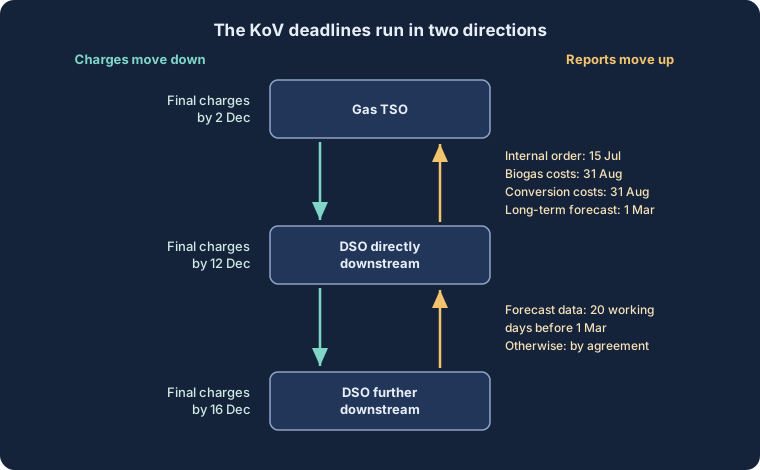
The KoV dates run in two directions. Charges travel down: each level builds the charges of the level above into its own and needs them earlier for that reason. Orders, cost reports and the forecast travel up, and each level needs the figures of the networks below before it can report itself. A municipal utility with its own gas network below a regional utility therefore has shorter deadlines for reports going up than the calendar shows, because it has to deliver before its upstream operator does; for charges coming down it has the latest date but the fewest days.
Gas storage: fill levels on 1 November 2026 and 1 February 2027
On 1 November 2026 every gas storage facility in Germany has to hold 80 percent of its working gas volume, and six facilities only 45 percent. Section 35b(1) sentence 2 EnWG names 90 percent for that day, but that figure does not apply. Section 35b(3) lets the Federal Ministry for Economic Affairs set different values by ordinance, and it did so with the Gas Storage Fill Level Ordinance (Gasspeicherfüllstandsverordnung, Federal Law Gazette 2025 I No. 130), in force since 6 May 2025. Responsibility lies with the storage operator, not the network operator. It has to put terms into its contracts that let users reach the fill levels; the gas itself is injected by the storage users who have booked capacity.
| Reference date | Section 35b(1) EnWG | Section 1 GasSpFüllstV |
|---|---|---|
| 1 October | 80 percent | no value of its own |
| 1 November 2026 | 90 percent | 80 percent; 45 percent in Bad Lauchstädt, Frankenthal, Hähnlein, Rehden, Stockstadt and Uelsen |
| 1 February 2027 | 30 percent | 30 percent; 40 percent in Bierwang, Breitbrunn, Inzenham-West and Wolfersberg |
The ordinance gives its own reason for the exceptions: the six facilities at 45 percent have "significantly reduced injection and withdrawal rates" and a particular geographical location (our translation). For the four Bavarian facilities the February value is above the standard one; the text of the ordinance gives no reason for that. Anyone checking a deadline calendar against the legal basis should not enter 1 November 2026 as a 90 percent date.

Besides the reference dates, Section 35b gives the storage operator three duties. By 1 April it submits to the Federal Network Agency (Bundesnetzagentur) the fill level curve showing which level is needed when to meet the targets (para. 4). If the curve is reached or undercut, it reports fill levels and evidence per storage user electronically to the agency. And if it becomes clear that the targets will be missed because users are not using their firm bookings, it releases that capacity pro rata to the market area manager (para. 5). In that case the market area manager procures filling instruments and can also buy and inject gas itself (Section 35c).
Under current law, winter 2026/27 is the last one with these rules. Section 35i EnWG applies Sections 35a to 35e and 35g and 35h only until the end of 31 March 2027, and the ordinance expires at the end of the same day. Whether targets apply again for storage year 2027/28 depends on an extension by the legislature; the statute does not contain one as of today. Storage operators negotiating user contracts for 2027/28 now should give the clauses under Section 35b(6) a rule for what happens if the targets lapse or are extended.
Gas network charges 2027: final by 2, 12 and 16 December
The final 2027 gas network charges are not fixed until December, and they come in three steps. Gas transmission system operators publish by Wednesday, 2 December 2026, distribution system operators directly downstream of a TSO that have their own downstream networks by Saturday, 12 December, and all other downstream DSOs by Wednesday, 16 December (KoV Section 6 nos. 5 and 6). Provisional figures were due earlier: TSOs send theirs in text form by 30 September, the first DSO level by 6 October and everyone further down by 10 October.
Section 20(1) EnWG sets a separate deadline alongside. Under it, all network operators had to publish their 2027 charges by 15 October 2026 and, where these had not yet been determined, the level expected from the revenue cap. What went online on 15 October could therefore be a provisional figure, since the final upstream values only arrive in December. Our article on the publication of network charges by 15 October covers that step; December is the second round, with the final upstream values.
Operators calculate through the cost block "Wälzung" (cascaded costs), which every operator except the TSOs keeps (Section 6 no. 2). It holds the charges payable to upstream networks, and within them the pro rata biogas costs under Section 7 and the pro rata costs of the L-gas market conversion under Section 10. It is passed on as a whole, whichever network and price component it comes from (no. 3). So the cost reports from August 2027 end up, through the TSOs' pooling amounts, in every distribution network's price sheet for 2028.
We see 12 December as the tightest date. In 2026 it falls on a Saturday, the KoV does not move it, and between the TSOs' final charges and the operator's own publication there are seven working days. For the networks further down, two remain between 12 and 16 December. Where a complex cascade makes that impossible, Section 6 no. 6 provides for the operators involved to agree among themselves; Section 21(2) GasNEV stays unaffected.
Internal capacity order for 2028 by 15 July 2027
By Thursday, 15 July 2027, every gas network operator directly downstream of a transmission system operator submits its internal order for order year 2028 (KoV Section 11 no. 3). It orders the maximum firm exit capacity to be kept available at interconnection points or exit zones, calculated under Sections 13 and 14, online or using a data sheet (no. 1). By accepting, the TSO commits to keep that capacity available and to order it in turn from the networks above.
Figures from downstream networks
The directly downstream operator agrees dates with its own downstream networks so that it can meet 15 July (no. 3 sentence 2).
Submission to the TSO
The order states the capacity per interconnection point or exit zone and the period.
Acceptance or rejection
Acceptance covers at least the last value of permanent firm capacity in the previous year; only the part above that can be rejected (nos. 4 to 6).
Case-by-case review and offers
Result of the review for the unconfirmed part, plus offers of temporary firm or interruptible capacity (nos. 6 and 8).
If a network orders more than the year before and the additional capacity is not enough, the upstream operator allocates it in a fixed order: first demand for protected customers under Section 53a EnWG, then for system-relevant gas power plants, then the conversion of interruptible or temporary capacity into permanent firm capacity, and finally other demand (no. 7). A gas network that is more likely to shrink as heat planning and heat pumps take hold faces the opposite question. Ordering less lowers the charges paid upstream, but the next year's acceptance is then guaranteed only up to that lower value, and anything above it depends on free capacity (nos. 5 and 7). The TSO publishes the ordered and agreed values per interconnection point and names the downstream operator (no. 9).
Biogas costs by 31 August 2027
By Tuesday, 31 August 2027, operators with biogas feed-in report their forecast biogas costs for 2028, including the pooling amount, and their actual biogas costs for 2026 to the gas TSO whose network theirs is connected to, directly or across several levels (KoV Section 7 no. 2(a)). An identical report goes in parallel to the Federal Network Agency on its data form (no. 2(b)). Section 20b GasNEV pools these costs nationwide, such as connecting biogas plants, their maintenance and operation, extended balancing and payments for avoided network costs. Only costs backed by "firm knowledge", above all from signed contracts, go into the forecast (our translation).
From the reported pooling amount, the TSO makes twelve equal monthly instalments and pays them out in 2028; the difference between forecast and actuals for the earlier year is settled with interest (nos. 3 and 4). By 1 October the TSOs publish the nationwide biogas pooling amount for the following year, in euros per kWh/h per year (no. 6). On the page of its Ruling Chamber 9, the Federal Network Agency provides the "EHB Kostenwälzung Biogas (Stand 19. August 2026)" data form. It is submitted encrypted through the agency's energy data portal; according to the agency's biogas page, an operator with no biogas-related costs does not have to send a nil return.
Today's rules still cover the 2027 report, but not with certainty the 2028 forecast it contains. The GasNEV expires at the end of 31 December 2027 (Article 15(2) of the Act of 22 December 2023), and the provisions of the Gas Network Access Ordinance that Section 20b refers to already lapsed at the end of 31 December 2025. Ruling Chamber 9 states that ongoing costs from older biogas connections still fall under Section 20b. Whether the 2028 forecast is settled under the same rules depends on the successor rules for ARegV, StromNEV and GasNEV that the Federal Network Agency is developing in the NEST determinations for gas. How new biogas plants have been connected since 2026 is set out in the ZuBio determination.
L-gas market conversion: costs by 31 August 2027
On the same 31 August 2027, every gas network operator whose network is being converted from L-gas to H-gas reports to the competent regulator the necessary conversion costs of 2026 and those planned for 2028 (Section 19a(2) sentence 1 EnWG). The KoV puts a second report on the same day: plan and actuals also go to the TSO, together with the pooling amount the operator reports to the regulator on its data form (KoV Section 10 no. 2). For operators supervised by the Federal Network Agency, the "EHB Marktraumumstellung" data form and a guide are on Ruling Chamber 9's page.
At first the converting operator bears the costs; since 2017 they have been pooled across all gas networks nationwide (Section 19a(1)). Eligible costs include the appliance survey, adapting appliances, customer installations and connections, the EUR 100 refund per new appliance under Section 19a(3) and non-capitalisable extra measures such as temporary H-gas links (KoV Section 9 no. 2). Where costs for customer installations without standard gas appliances exceed EUR 10,000 per connection, the operator notifies the adjustment to the regulator in advance (Section 9 no. 1(c)). According to the Federal Network Agency, the levy was EUR 0.6713 per kWh/h per year for 2025 and EUR 0.7189 for 2026.

Proving that the costs were necessary is the network operator's job, and the regulator can find that some were not; those costs may then not be passed on (Section 19a(2) sentences 3 to 5). The 31 August report therefore needs auditable documents in a standardised form, the scope of which the operator agrees with the regulator (KoV Section 9 no. 3). Operators that run the conversion through contractors need the contractors' invoices per connection by the summer.
An end to the reports is in sight. According to the Federal Network Agency, the current network development plan has the conversion finished by the end of 2029, and from 1 October 2029 no more Dutch L-gas is to flow into Germany. Because Section 19a(2) asks about the previous year, a network's reporting duty, as we read it, does not end with its last converted appliance but with the first year in which no conversion costs arise.
Long-term gas and hydrogen forecast by 1 March 2028
By Wednesday, 1 March 2028, distribution system operators directly downstream of a TSO report their long-term forecast; their own downstream networks must send them their figures at least 20 working days earlier (KoV Section 16 no. 2). Since the KoV does not count Saturdays, Sundays or public holidays as working days, that works out to Wednesday, 2 February 2028. The date comes back every even year because the TSOs turn the forecasts into the scenario framework for the gas and hydrogen network development plan, whose draft the coordination body submits to the Federal Network Agency by 30 June of every even year (Section 15b(4) EnWG). BDEW, VKU and GEODE publish the questionnaire all operators use by 1 September of the preceding odd year at the latest, so for 2028 by 1 September 2027 (Section 16 no. 4).
Operators report each calendar year to 2045 and 2050, separately for gas and hydrogen, as capacity and volume by sector (nos. 5 and 6). Figures cover the operator's own network and every network below it. Hydrogen comes with a rating in three firmness grades plus secured demand: grade II needs a written letter of intent or a meeting record the customer has approved, grade I a network planning concept agreed along the cascade or an agreement with a financial component, and demand counts as secured with a capacity reservation, a connection contract or substantial public funding (nos. 7 to 10). Large customers expecting hydrogen demand of 20 MWh/h or more are shown separately.
The KoV asks operators to take the municipal heat plans already available into account (no. 5(c)), and for many networks the date comes too early for that. Municipalities with more than 100,000 inhabitants had to draw up their heat plans by 30 June 2026; all others have until 30 June 2028 (Section 4(2) of the Heat Planning Act, WPG). For the forecast due on 1 March 2028, the heat plan the KoV refers to may therefore still be missing in smaller municipalities. For this case the KoV allows a fallback: without a heat plan the operator may use a comparable estimate of its own, but may place standard-load-profile heat customers in that area no higher than the grade of the other customers there (nos. 7 to 9, no. 11). How heat plans and gas networks connect is covered in our article on municipal heat planning.
What happens if a deadline is missed
Consequences differ by legal basis, and for the four KoV dates they are weaker than the number of dates might suggest. The KoV sets no sanction of its own for any of them. The duty to cooperate within it comes from Section 20(1b) sentence 5 EnWG, and the regulator can enforce that duty under Section 65 EnWG. For the long-term forecast the KoV deals with a failure itself: the downstream operator explains why it could not produce the forecast, and the upstream operator sets suitable values (Section 16 no. 2). With charges and capacity orders, a late network mostly hurts its neighbours in the cascade, which are calculating with its figures.
Section 19a carries more weight. Costs the regulator has found unnecessary may not be passed on (para. 2 sentence 5). Under Section 65(2) EnWG the regulator can order the report and enforce it with coercive fines under Section 94. Because Section 19a sits in the grid connection part of the EnWG, a breach is at the same time an abuse of market position for a network operator under Section 30(1) sentence 2 no. 1, which Section 95(1) no. 4 threatens with a fine of up to EUR 1 million (Section 95(2) no. 3). For DSOs with fewer than 100,000 customers whose network stays within one federal state, abuse supervision lies with the state regulator (Section 54(2) no. 8).
For gas storage, Section 35b(1) sets no specific sanction for a missed fill level. Under Section 95(1) no. 4a, however, a storage operator commits an administrative offence if it does not release unused storage capacity or injection and withdrawal capacity to the market area manager under para. 5, or does so incompletely or late. All of this describes what the rules provide; it is not an assessment of any individual case.
What gas network operators should plan for now
The six dates spread across 16 months but draw on the same people and the same data: regulatory management, grid planning, fixed-asset accounting and network billing. We recommend converting each date to your own level in the cascade before it goes into the annual plan.
The steps to March 2028
-
December 2026: align the price sheet with your level
Schedule the sign-off of final 2027 charges for the day after the final upstream values arrive. Directly downstream networks with their own downstream networks publish by 12 December, in practice by Friday, 11 December.
-
Spring 2027: determine 2028 capacity demand
Work out demand per interconnection point or exit zone from network calculation and load profiles, agree a delivery date before 15 July with downstream networks, and record whether a lower order is intended.
-
Summer 2027: two cost reports from one source
Pull 2026 actuals and 2028 plans for biogas and the market conversion from fixed-asset accounting and project billing, use the agency's data forms in their current version, and send the TSO the same figure as the authority.
-
From September 2027: prepare the long-term forecast
Get the associations' questionnaire, collect the heat plans of the municipalities in your network area, record hydrogen interest by grade with evidence, and give your own downstream networks a date 20 working days before 1 March 2028.
-
Storage operators: contracts for 2027/28
Steer by the ordinance's values until 31 March 2027, submit the fill level curve by 1 April 2027, and set out in new user contracts what applies if the rules lapse.
Deadline, market roles, systems
1 November 2026Gas storage: 80 per cent fill level on 1 November, 30 per cent on 1 FebruaryLaw · adopted
Applicability: Only operators of gas storage facilities. The fill level rules expire on 31 March 2027 unless extended.
If the deadline is missed: Regulator can enforce Section 35b(1) EnWG sets no specific sanction. Failing to make unused storage capacity available to the market area manager under Section 35b(5) is an administrative offence under Section 95(1) no. 4a EnWG. Legal basis ↗
- Storage operatorrole obligationManages injection so that 80 per cent (45 per cent at the six named facilities) is reached on 1 November 2026 and 30 per cent (40 per cent at the four named) on 1 February 2027, and reports unused capacity to the market area manager.Typically affected: Grid control system / SCADA, Trading and procurement system (ETRM)
2 December 2026Gas network charges 2027: final charges along the cascade (2, 12 and 16 December)Technical rule · adopted
Applicability: Applies to gas network operators that apply the gas cooperation agreement. The level (transmission, directly downstream, further downstream) determines the date. The deadline under Section 20(1) EnWG of 15 October applies alongside.
If the deadline is missed: Regulator can enforce The cooperation agreement is a contract among gas network operators; Section 20(1b) sentence 5 EnWG obliges them to cooperate within it. The agreement sets no specific sanction for the missed date. The regulator can enforce the duty to cooperate under Section 65 EnWG. Legal basis ↗
- Gas grid operatorrole obligationIncorporates the final upstream charges and publishes its own final 2027 charges by 2, 12 or 16 December 2026 depending on its level.Typically affected: Regulatory management, controlling, Grid usage and customer billing, Customer and grid connection portal
15 July 2027Submit the internal capacity order for 2028 to the gas TSOTechnical rule · adopted
Applicability: Applies to gas DSOs directly downstream of a gas TSO; operators further downstream supply their data to them by agreed dates.
If the deadline is missed: Regulator can enforce The cooperation agreement is a contract among gas network operators; Section 20(1b) sentence 5 EnWG obliges them to cooperate within it. The agreement sets no specific sanction for the missed date. The regulator can enforce the duty to cooperate under Section 65 EnWG. Legal basis ↗
- Gas grid operatorrole obligationDetermines the 2028 capacity requirement per interconnection point or exit zone, collects the values of downstream networks and submits the internal order by 15 July 2027.Typically affected: Regulatory management, controlling, Grid control system / SCADA
31 August 2027L-gas market area conversion: report actual and planned costs to the regulatorLaw · adopted
Applicability: Only gas network operators whose network is converted from L-gas to H-gas as part of the market area conversion, as long as conversion costs arise.
If the deadline is missed: Fine possible Costs the regulator has found unnecessary may not be passed on (Section 19a(2) sentence 5 EnWG). The regulator can order the report under Section 65(2) EnWG and enforce it with coercive fines under Section 94 EnWG. For network operators a breach is also an abuse of their market position (Section 30(1) sentence 2 no. 1 EnWG). The regulator can require it to stop (Section 30(2)) and can also establish it after the fact (Section 30(3)); for distribution system operators with fewer than 100,000 customers whose network does not extend beyond one federal state, the state regulatory authority is responsible (Section 54(2) no. 8). Section 95(1) nos. 4 and 3(b) EnWG threaten fines of up to EUR 1 million for the abuse and for breaching an order to stop it (Section 95(2) no. 3). Those affected can apply for abuse proceedings (Section 31) and claim removal, injunctive relief or, where there is fault, damages (Section 32 EnWG). Legal basis ↗
- Gas grid operatorrole obligationReports the 2026 conversion costs and the planned 2028 costs with proof of necessity; also applies to gas TSOs.Typically affected: Regulatory management, controlling, Grid usage and customer billing
31 August 2027Report biogas costs for nationwide cost pooling (plan 2028, actual 2026)Technical rule · adopted
Applicability: Only gas network operators into whose network biogas plants feed (biogas feed-in network operators). The cost basis is Section 20b GasNEV, which expires at the end of 2027; whether the 2028 date stays depends on the successor rule.
If the deadline is missed: Regulator can enforce The cooperation agreement is a contract among gas network operators; Section 20(1b) sentence 5 EnWG obliges them to cooperate within it. The agreement sets no specific sanction for the missed date. The regulator can enforce the duty to cooperate under Section 65 EnWG. Legal basis ↗
- Gas grid operatorrole obligationReports planned 2028 and actual 2026 biogas costs to the gas TSO and via the data form to the Federal Network Agency.Typically affected: Regulatory management, controlling, Grid usage and customer billing
1 March 2028Report the long-term gas and hydrogen forecast to the gas TSOTechnical rule · adopted
If the deadline is missed: No direct legal consequence If a downstream operator cannot determine the forecast, it must give reasons and the upstream operator sets suitable forecast values (KoV Section 16 no. 2). The agreement sets no further sanction. Legal basis ↗
- Gas grid operatorrole obligationCollects the forecasts of downstream networks, prepares the long-term gas and hydrogen forecast and reports it to the gas TSO by 1 March 2028.Typically affected: Grid planning, GIS, load flow, Regulatory management, controlling
A classification for typical market roles, not a review of your individual case and not legal advice. Whether an obligation applies to your company (thresholds, exemptions) is for your legal department or counsel to confirm. The calendar doesn't replace your own deadline review. Information as of: 27 October 2026.
Further reading
Frequently asked questions
The Kooperationsvereinbarung Gas (KoV) is the contract through which the operators of gas networks in Germany organise their cooperation, so that a shipper needs only one entry and one exit contract across several networks. The duty to cooperate is in Section 20(1b) sentence 5 EnWG. BDEW, VKU and GEODE publish it; version KoV XV, as amended on 27 March 2026, has applied since 1 October 2026. It covers the cascading of charges, the internal capacity order, the nationwide pooling of biogas and conversion costs and the long-term forecast.
80 percent of working gas volume, and 45 percent in the Bad Lauchstädt, Frankenthal, Hähnlein, Rehden, Stockstadt and Uelsen facilities. That is set by Section 1 of the Gas Storage Fill Level Ordinance of 5 May 2025, which departs from the 90 percent in Section 35b(1) sentence 2 EnWG. On 1 February 2027 the figure is 30 percent, and 40 percent in Bierwang, Breitbrunn, Inzenham-West and Wolfersberg. The ordinance and the fill level rules in the EnWG apply until the end of 31 March 2027.
It depends on the operator's level in the cascade. Gas transmission system operators publish by 2 December 2026, distribution system operators directly downstream of a TSO that have their own downstream networks by 12 December 2026, and all other downstream distribution system operators by 16 December 2026 (KoV Section 6 nos. 5 and 6). The publication under Section 20(1) EnWG by 15 October, if necessary based on expected values, applies alongside.
With the internal order, a downstream gas network operator orders once a year from the upstream operator the firm exit capacity that the upstream operator must keep available at interconnection points or exit zones in the following year. The operator directly downstream of a gas TSO submits it by 15 July, so for order year 2028 by Thursday, 15 July 2027. The TSO answers within 10 working days; if it rejects part of the order, it reports the result of its case-by-case review by 15 October (KoV Section 11).
Two kinds. Operators with biogas feed-in report biogas costs under Section 20b GasNEV, as a forecast for 2028 and as actuals for 2026, to the gas TSO and in parallel to the Federal Network Agency via its data form (KoV Section 7 no. 2). Operators whose network is converted from L-gas to H-gas report the necessary conversion costs for 2026 and the planned costs for 2028 to the competent regulator (Section 19a(2) EnWG) and on the same day to the gas TSO (KoV Section 10 no. 2).
The long-term forecast is the report in which gas distribution system operators state how capacity and volume for gas and for hydrogen will develop in their network, year by year to 2045 and for 2050. It feeds into the scenario framework of the German gas and hydrogen network development plan. DSOs directly downstream of a TSO report it by 1 March of every even year, next by 1 March 2028; their own downstream networks deliver at least 20 working days earlier (KoV Section 16 no. 2).
The KoV sets no sanction of its own for its dates. The duty to cooperate within it comes from Section 20(1b) sentence 5 EnWG, and the regulator can enforce that duty under Section 65 EnWG. For the long-term forecast, the upstream operator sets forecast values if the downstream operator does not deliver. Conversion costs under Section 19a EnWG carry more weight: costs the regulator has found unnecessary may not be passed on, and a breach can be pursued as an abuse of market position with a fine of up to EUR 1 million.
Let's collaborate
One contact, a team behind it
Thirty minutes on what you're working on, whether grid, metering, market processes, IT architecture or AI. Afterwards you'll know how we'd approach it and who would sit at the table.
Energy and measurement technology since 2010 · innobu GmbH since 2014 · Based in Schleswig-Holstein, Germany
Whoever pitches also delivers: whoever leads the first call stays your contact right through to the steering committee, with established partners in the project. Direct: info@innobu.com