Municipal heat planning: what the 30 June 2026 deadline means for large cities
This is a practical analysis of municipal heat planning as a legal planning process and of what the deadline means for utilities, industry and municipalities: what applies to large cities by 30 June 2026, how the WPG's four-step method works from the suitability check to the target scenario, what the zoning of the city into district-heating, hydrogen network, review and decentralised areas means, how the plan meshes with the Building Energy Act, where the process stands in June 2026 and how it is funded, and what utilities should do now. It is deliberately separate from the generation technology, the large heat pumps and power-to-heat plants that follow from the plan, and from the gas distribution grids' transformation plan, which sit close by and are touched only where the heat plan connects to them.
Municipal heat planning is the first nationwide heat-planning obligation. The Heat Planning Act, the Wärmeplanungsgesetz (WPG), full name the Act on Heat Planning and the Decarbonisation of Heat Networks, has been in force since 1 January 2024, and it requires all 84 large German cities over 100,000 inhabitants to deliver a municipal heat plan by 30 June 2026, all smaller municipalities by 30 June 2028; about 10,700 municipalities are covered in total, with the goal of a climate-neutral heat supply by 2045 at the latest. The plan follows a four-step method: a suitability check (section 14 WPG) that screens out sub-areas ruled out for a heat or hydrogen network from the start, an inventory analysis of heat demand, supply structure and greenhouse-gas emissions per sub-area, a potential analysis of locally available renewable heat, unavoidable waste heat and storage and saving potential, and a target scenario plus the zoning into prospective heat supply areas with an implementation strategy. The zoning uses four area categories: district-heating area (section 3 no. 18), hydrogen network area (section 3 no. 23, the exception in practice), area for decentralised heat supply (section 3 no. 6, individual heating such as heat pumps) and area under review (section 3 no. 10, still open). The zoning is a forecast, not a connection obligation and not a building requirement; the heat plan is explicitly legally non-binding under section 3 no. 20 WPG, and binding effect arises only through a separate area designation under section 26 WPG. The plan steers the link to the Building Energy Act, the Gebäudeenergiegesetz (GEG): the 65-percent-renewables rule for heating systems in existing buildings applies in large cities from 30 June 2026 at the latest and in smaller municipalities from 30 June 2028 (GEG section 71(8)), earlier only through an advance area designation under section 26 WPG. In June 2026 the Competence Centre for Municipal Heat Transition (KWW) expects the large cities to meet the deadline; six of the ten largest cities had adopted their plan or were in final public display, about 80 percent of mid-size municipalities and over half of small ones were already working on the plan or finished. Funding runs since end 2023 not via the Kommunalrichtlinie but via federal connexity funds to the Länder, EUR 500 m for 2024 to 2028. Nationwide about 14 percent of households are supplied by near- or district heating.
What applies to large cities by 30 June 2026
By 30 June 2026, all 84 German cities with more than 100,000 inhabitants must have a municipal heat plan, the kommunaler Wärmeplan, in place; smaller municipalities have until 30 June 2028. The basis is the Heat Planning Act, the Wärmeplanungsgesetz (WPG), whose full name is the Act on Heat Planning and the Decarbonisation of Heat Networks. It has been in force since 1 January 2024 and creates, for the first time, a nationwide obligation to plan the heat supply across the whole country.
The plan answers a single strategic question: how the heat supply of each district is to become climate-neutral by 2045 at the latest. It is not a one-off study but a structured planning process whose result, the zoning of the city into prospective heat supply areas, is the foundation on which utilities, building owners and the municipality itself can take their next decisions. About 10,700 municipalities are covered in total, which makes this one of the largest planning exercises the heat transition demands.
The two-stage deadline reflects capacity rather than ambition. Large cities have more administrative resources and denser networks, so they go first, by 30 June 2026; the much larger number of smaller municipalities follows by 30 June 2028. The deadline matters far beyond the planning desk, because it is also the moment from which the Building Energy Act starts to bite in a given city, a link set out further below. For a utility, this is the point at which the strategic picture of where heat networks make sense, and where they do not, finally has a legal footing.
The four steps of heat planning
The heat plan is produced according to a method laid down in the WPG, so it is not a free-form report but a structured, data-driven process with defined intermediate results that the responsible planning body has to publish. Four steps build on one another: a suitability check, an inventory analysis, a potential analysis and a target scenario that leads into the zoning of the area and an implementation strategy.
The first step is the suitability check (section 14 WPG). This is a rough pre-screening of which sub-areas are ruled out for a heat or hydrogen network from the very start, for example because they are too thinly built up or too far from any feasible network. Those sub-areas are then planned as decentralised through a shortened procedure, which spares the municipality from running the full analysis where the answer is already clear. The second step, the inventory analysis, records the present heat demand, the supply structure and the greenhouse-gas emissions for each sub-area, so the plan starts from a factual picture of how the city is heated today.
The third step, the potential analysis, looks forward: it maps the locally available renewable heat and the unavoidable waste heat, together with the storage and saving potential of each sub-area. This is where the question of which renewable sources a district could realistically draw on is answered. The fourth step brings the strands together in a target scenario, which is then translated into the zoning of the city into prospective heat supply areas and into an implementation strategy with concrete measures and a timeline.
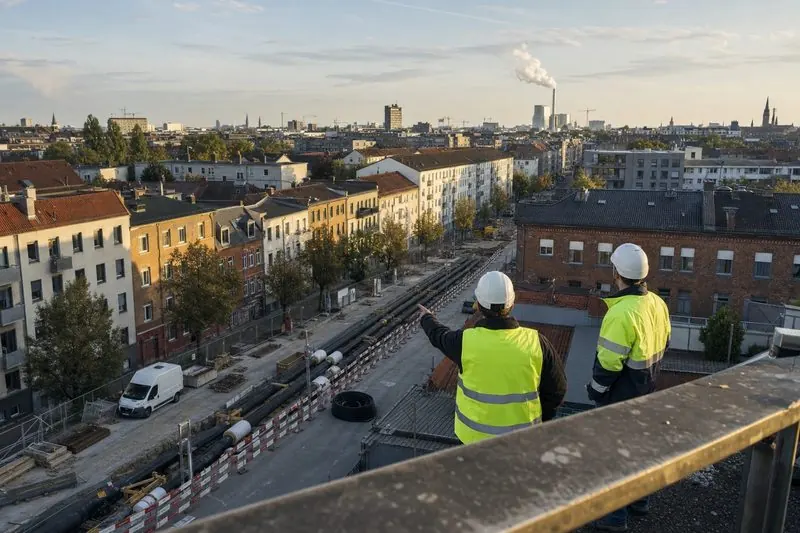
Each of these steps produces an intermediate result that has to be made transparent, which is what turns heat planning from an internal exercise into a shared planning basis. The figure below shows the three specialists at the centre of that work, reviewing the colour-coded heat map and the city plan that the inventory and potential analyses feed into.

District-heating, review, decentralised: what the zoning means
The core result for utilities is the zoning of the city area into prospective heat supply areas. The WPG knows four categories, and they effectively decide the supply logic of a whole district. A district-heating area (section 3 no. 18) is one where a heat network exists or is planned and a significant share of final consumers is to be supplied through it, so this is the Fernwärme, the district heating, that carries the heaviest investment. A hydrogen network area (section 3 no. 23) provides supply through a hydrogen network and is the exception in practice.
The other two categories cover the rest of the map. An area for decentralised heat supply (section 3 no. 6) is one that is predominantly not supplied through a heat or gas network, so it relies on individual heating systems such as heat pumps. An area under review (section 3 no. 10) is still open, because the facts needed to decide are not yet sufficiently known, and it is the category that keeps a planning option alive where the analysis cannot yet settle the answer.
The single most important point about this zoning is what it does not do. The zoning is a forecast, not a connection obligation and not a building requirement. The heat plan is explicitly a legally non-binding, strategic specialist plan under section 3 no. 20 WPG, so the assignment of a district to one category or another does not by itself oblige any owner to connect to a network or to change a heating system. Binding effect arises only through a separate area designation under section 26 WPG, a distinct legal act that the municipality has to take deliberately. For a district-heating area, the climate-neutral generation that then follows, the large heat pumps and power-to-heat plants that supply the network, is a separate topic, covered in the analysis of power-to-heat and large heat pumps for district heating.

How it meshes with the Building Energy Act
The heat plan itself is legally non-binding, but it steers the point in time from which the 65-percent-renewables rule of the Building Energy Act, the Gebäudeenergiegesetz (GEG), applies to heating systems in existing buildings. In the large cities that is 30 June 2026 at the latest, in smaller municipalities 30 June 2028 (GEG section 71(8)). From that date, every newly installed heating system in these municipalities must use at least 65 percent renewable energy.
A municipality that wants to move faster can bring the obligation forward through an advance area designation under section 26 WPG, in which case the rule takes effect one month after the decision is published. The mere zoning of an area, by contrast, produces no obligation; it is the area designation under section 26, not the heat plan as such, that creates the binding effect. This is the distinction utilities and owners most often confuse, and it is worth stating plainly: the plan informs, the designation obliges.
For owners this means that, until the relevant deadline, fossil heating systems remain permissible under the transitional rules of the GEG, and only from the deadline does the renewables quota apply to a newly installed system. Several heating options can meet the 65-percent requirement, among them a connection to a heat network, a heat pump and a solar-thermal hybrid system, so the rule sets a target and leaves the route open. Which of these options is realistic in a given district depends, in turn, on the zoning from the heat plan, which closes the loop between the planning process and the obligation on the individual building.
Status in June 2026 and funding
Shortly before the deadline, the large cities are on track to meet it. According to the Competence Centre for Municipal Heat Transition (KWW), whose head is Robert Brückmann, the large cities will deliver: six of the ten largest cities had adopted their plan or were in final public display, about 80 percent of mid-size municipalities and over half of small ones are already working on the plan or finished. Concrete adoptions illustrate the pace: Munich adopted its plan on 26 November 2025, Stuttgart as early as 2023, Essen on 25 March 2026 and Düsseldorf on 7 May 2026, while Hamburg, Frankfurt and Dortmund are in the final stretch.
Baden-Württemberg was the front-runner, ahead of the federal law. Under its state climate act, the KlimaG BW, urban districts and large district towns there already had to plan by 31 December 2023, with 103 municipalities under obligation, so the south-west had completed a first round of municipal heat plans before the WPG deadline applied elsewhere. That head start is one reason several of the most advanced examples sit in that region.
The funding model changed with the WPG. Since the end of 2023, heat planning is no longer funded via the Kommunalrichtlinie, whose earlier 90-percent grant ended in mid-December 2023 when the WPG came into force. Instead, the federal government provides the Länder with EUR 500 m as a connexity settlement for the years 2024 to 2028, in five tranches of EUR 100 m each through a fixed value-added-tax amount, and the Länder pass the money on to the municipalities. The stakes behind all of this are large: nationwide about 14 percent of households are supplied by near- or district heating today, and the heat plans will decide how far that share grows.
What utilities should do now
For a utility, the heat plan is the entry ticket to any robust network-investment decision. The zoning into a district-heating area or a decentralised area defines the future business field and the order in which the build-out should happen, so the plan is not a compliance task for the municipality to handle alone but a shared data basis that will run through the heat planning data space, one that utilities should help shape and whose data quality they should secure. Treating it as someone else's paperwork is the most expensive mistake on offer.
The practical work starts with the data base. A utility should bring its heat-consumption figures, its network inventory and its load profiles into the process as a reliable foundation for the inventory and potential analyses, because the quality of the zoning is only as good as the data behind it. The second step is to prioritise build-out areas: from the zoning, derive a concrete sequence of districts and realistic connection-rate targets, so that the billions in network investment go first where the heat plan shows the strongest case.
The third step is to factor in the legal effect of an area designation. It is worth checking where an advance area designation under section 26 WPG would create investment certainty, by triggering the obligation and so the demand earlier, and where an area under review should deliberately stay open until the facts are clearer. The fourth step is citizen communication: making transparent early on which districts will be a heat network, an area under review or decentralised gives owners the planning certainty they need and reduces the friction that derails build-out later.

Beyond the plan itself, two adjacent processes deserve a place in the utility's roadmap. The day-to-day operation of a district-heating network, once built, is increasingly run with a digital twin and AI for utilities, and the heat plan also has to mesh with the gas distribution grids' transformation plan, which decides the parallel question of where the gas network is wound down. Both sit alongside the wider regulatory framework of the energy transition that shapes the economics of the build-out.
Further reading
Frequently asked questions
By 30 June 2026, all 84 German cities with more than 100,000 inhabitants must have a municipal heat plan in place; all smaller municipalities have until 30 June 2028. The basis is the Heat Planning Act, the Wärmeplanungsgesetz (WPG), in force since 1 January 2024, which for the first time creates a nationwide obligation to plan the heat supply. About 10,700 municipalities are covered in total. The plan answers a single strategic question: how the heat supply of every sub-area is to become climate-neutral by 2045 at the latest. It does not yet oblige any individual building owner to do anything; it sets the strategic direction.
The core result of the heat plan is the zoning of the city into prospective heat supply areas. The WPG knows four categories: a district-heating area (section 3 no. 18), where a heat network exists or is planned and a significant share of consumers is to be supplied through it; a hydrogen network area (section 3 no. 23), the exception in practice; an area for decentralised heat supply (section 3 no. 6), with individual heating such as heat pumps; and an area under review (section 3 no. 10), still open because the necessary facts are not yet sufficiently known. The zoning is a forecast, not a connection obligation and not a building requirement.
No. The heat plan is explicitly a legally non-binding, strategic specialist plan under section 3 no. 20 WPG, and the mere zoning of an area creates no obligation for property owners. Binding effect arises only through a separate area designation under section 26 WPG. Until the relevant deadline, fossil heating systems remain permissible under transitional rules; from the deadline the renewables quota of the Building Energy Act applies to newly installed heating systems. A municipality that wants to act faster can trigger the obligation earlier through an advance area designation under section 26, which then takes effect one month after publication.
The heat plan steers the point in time from which the 65-percent-renewables rule of the Building Energy Act, the Gebäudeenergiegesetz (GEG), applies to heating systems in existing buildings. In the large cities that is 30 June 2026 at the latest, in smaller municipalities 30 June 2028 (GEG section 71(8)). From that date, every newly installed heating system in these municipalities must use at least 65 percent renewable energy. Earlier application is possible only through an advance area designation under section 26 WPG, which then takes effect one month after publication. The plan itself remains legally non-binding; it only sets the timing of the GEG obligation.
Since the end of 2023, heat planning is no longer funded via the Kommunalrichtlinie, whose earlier 90-percent grant ended in mid-December 2023 with the WPG coming into force. Instead, the federal government provides the Länder with EUR 500 m as a connexity settlement for 2024 to 2028, in five tranches of EUR 100 m each through a fixed value-added-tax amount. The Länder pass the funds on to the municipalities. Baden-Württemberg was the front-runner: there, urban districts and large district towns already had to plan by 31 December 2023 under the state climate act KlimaG BW, with 103 municipalities under obligation.