Biogas grid access from 2026: the ZuBio ruling
The BNetzA ZuBio ruling (case ref. BK7-24-01-010) governs biogas grid access and quality from 2026 and so replaces the matching rules of the expiring GasNZV. It deliberately does not regulate the grid connection, that is, who bears the connection costs. The old Section 33 rules continue only transitionally, provided the assessment-cost advance reaches the network operator by 31 December 2026 at the latest. This article explains what ZuBio actually regulates, what the Section 33 gap is, what changes for feed-in operators on capacity and quality, which deadlines apply, which risks threaten the economics, and what plant operators should do now. For the wider picture, our GasNZV replacement 2026 overview places the four pillars KARLA, GaBi, GeLi Gas 3.0 and ZuBio in context.
ZuBio is the Federal Network Agency ruling BK7-24-01-010 of 12 September 2025, effective 1 January 2026. It takes over the biogas rules on grid access, formerly Section 34 GasNZV, and on gas quality, formerly Section 36 GasNZV, and moves them out of the expiring GasNZV into a dedicated ruling. It does not regulate the grid connection, formerly Section 33, and it does not regulate balancing, which moves into GaBi Gas 2.1. ZuBio is one of four parts of the GasNZV replacement alongside KARLA, GaBi and GeLi Gas 3.0. The core of the topic is a gap: ZuBio secures access and quality, but it does not settle who pays for the grid connection. Because the GasNZV expires on 31 December 2025, the old Section 33 cost rules only continue transitionally, and only if the advance payment for the assessment costs reaches the network operator by 31 December 2026 at the latest. The date of receipt is decisive. A statutory successor rule is expected with the EU gas package transposition but is still in procedure. For feed-in operators the access stays priority where the grid is compatible, but capacity can be restricted on justified grounds and firm, unlimited capacity comes only against additional cost. New is the proof that methane emissions stay at or below 0.2 percent during upgrading. The risks are real: connection costs may rise sharply once the transition lapses, and the industry warns of a market slump. Whoever pays the assessment-cost advance early, documents the receipt and checks legacy protection is prepared when the rules take full effect.
What ZuBio regulates
ZuBio reorders biogas grid access. The Federal Network Agency ruling moves the biogas rules out of the expiring gas network access ordinance (GasNZV) into a dedicated ruling from 1 January 2026. But it covers only grid access and quality, not the grid connection.
At its core, ZuBio is the Federal Network Agency ruling with the case reference BK7-24-01-010, decided by the agency's chamber 7 on 12 September 2025 and effective from 1 January 2026. It takes over two areas that were previously governed by the GasNZV: grid access, formerly Section 34 GasNZV, and the gas quality requirements, formerly Section 36 GasNZV. Both move into a dedicated ruling because the GasNZV itself expires on 31 December 2025. What the ruling deliberately leaves out matters just as much. The grid connection, formerly Section 33, is not part of ZuBio, and neither is balancing, which moves into the separate GaBi Gas 2.1 ruling. So ZuBio answers the question of how biogas reaches the market through the grid and at what quality, but not the question of who builds and pays for the physical connection to the grid.
ZuBio does not stand alone. It is one of four parts of the GasNZV replacement that the Federal Network Agency has set out in parallel rulings, alongside KARLA on the network access and capacity model, GaBi on balancing and GeLi Gas 3.0 on supplier switching. Together these rulings replace the ordinance level that the GasNZV used to provide. For biomethane operators the practical effect is that the biogas-specific rules they relied on no longer sit in a single ordinance but are split across this new structure, with the connection rules left to a statutory successor that has not yet arrived.
The Section 33 gap: access yes, connection open
The core of the topic is a gap. ZuBio secures grid access and quality, but it does not regulate who pays for the grid connection. Because the GasNZV has expired, the favourable old cost rule now hangs on a deadline.
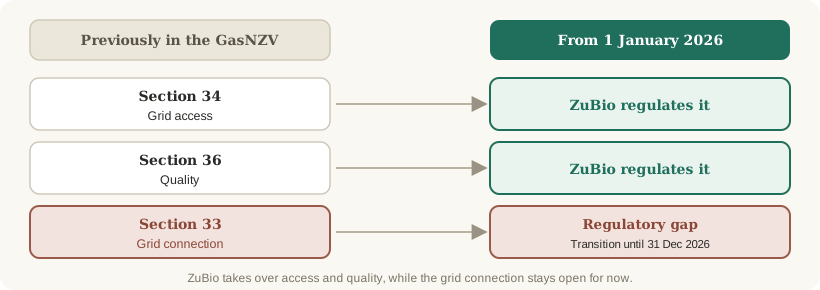
In detail, ZuBio takes over grid access and quality but says nothing about the grid connection, that is the physical line from the plant to the grid and the question of who bears its cost. This used to be Section 33 GasNZV, which set out a cost-sharing arrangement that was favourable for plant operators. With the GasNZV expiring on 31 December 2025 and ZuBio not picking the connection up, the old Section 33 rules only continue on a transitional basis. The condition is narrow: the advance payment for the assessment costs has to reach the network operator by 31 December 2026 at the latest. The date of receipt is decisive, not the date of dispatch, so a payment sent late or held up in processing can miss the window.
The reason for the gap is timing. The connection rules are meant to find a statutory home as part of the transposition of the EU gas package, but that legislation is still in procedure and not yet adopted. Until the successor rule arrives, operators face a period in which the access side is settled by ZuBio while the connection side rests on a transitional bridge with a fixed expiry. For projects that are planned now but connected later, this is the decisive uncertainty, because the cost regime that applies to the connection depends on whether the advance payment lands in time and on what the successor rule eventually says.
What changes for feed-in operators
Grid access is now conditioned. Priority remains, but only where the grid is compatible, and firm capacity costs extra. On the quality side a methane-emissions limit is added.

The priority grid access that biomethane enjoyed remains in place, but it is now explicitly conditioned: it applies only where the feed-in is grid-compatible. On justified grounds, network operators may restrict the available capacity, a conditionally firm capacity, and in the extreme they may refuse feed-in where it is technically impossible or economically unreasonable. Firm, unlimited capacity is still available, but only if the plant operator bears the additional cost that comes with it. That shifts a planning decision onto the operator: accept a conditional capacity and the associated curtailment risk, or pay for firm capacity and price that into the project.
On the quality side, the gas has to meet the DVGW rules, and the producer bears the cost for ensuring quality at the feed-in point. New under ZuBio is the requirement to prove that methane emissions stay at or below 0.2 percent during upgrading, which puts a measurable environmental condition on the feed-in. The split of duties is worth noting: while the producer carries the quality cost at the feed-in point, the network operator bears odorisation and the gas quality measurement.
- Priority grid access remains, but only where the feed-in is grid-compatible.
- Network operators may restrict capacity on justified grounds (conditionally firm capacity) and, in the extreme, refuse feed-in if it is technically impossible or economically unreasonable.
- Firm, unlimited capacity is available only if the plant operator bears the additional cost.
- Quality follows the DVGW rules; the producer bears the cost at the feed-in point.
- New proof that methane emissions stay at or below 0.2 percent during upgrading.
- The network operator bears odorisation and gas quality measurement.
Deadlines and the transition
The dates decide which cost regime applies. Whoever pays the advance in time secures the old connection rules. After that, less favourable conditions can follow. The reference to the EU gas package transposition runs alongside, as the EnWG amendment 2026 is the vehicle that is meant to bring the statutory connection successor.
- 1 January 2026: ZuBio applies to biogas grid access and quality.
- 31 December 2026: the advance payment for the assessment costs must reach the network operator for the old Section 33 connection rules to continue; the date of receipt is decisive.
- 10 years legacy protection under DVGW G 260 and G 262 for legacy plants, that is plants connected before 1 January 2026 or with a connection contract signed before that date.
- Separate expiry: the GasNEV feed-in charge and the related cost allocation expire on their own track, with the position from 2028 still unclear.
The transition therefore has two layers. The first is the connection cost regime, which hinges on the 31 December 2026 advance-payment receipt and on the still-awaited statutory successor. The second is legacy protection on the quality side, where plants connected before 1 January 2026, or with a connection contract signed before that date, keep ten years of protection under the DVGW rules G 260 and G 262 and so do not have to meet the new requirements immediately. A separate point that operators often miss is the GasNEV feed-in charge and the cost allocation that go with it: these run out on their own timetable, and what applies from 2028 is not yet settled. Treating these tracks together rather than separately leads to wrong assumptions about which costs and revenues a plant can count on.
Challenges and risks
The economics are at stake. Cost caps and open connection financing hit smaller plants in particular. An honest view has to take up the warnings of the industry rather than presenting ZuBio only as orderly progress. The wider context of certifying green gases is set out in our piece on guarantees of origin for gas and hydrogen.

In detail, the risks lie on several levels. First, connection costs may rise sharply once the transitional rule lapses, because the favourable Section 33 cost-sharing no longer applies and the statutory successor is not yet in force. According to the industry, a widely cited cost cap sits far below real investment costs, which hits smaller plants the hardest; the trade press ZfK reports this concern. It is important to read this as an industry statement, not as a confirmed regulatory value. Second, the new capacity restriction and the network operator's refusal right increase planning uncertainty, because a project can no longer assume unconditional firm capacity. Third, the connection right itself is at risk if a gas network is decommissioned as part of the heat transition, which removes the very infrastructure a feed-in plant depends on.
Taken together, these points feed an industry warning of a market slump for biomethane. The local distribution grid transformation that may decommission gas networks is itself a planning exercise, set out in our article on the gas grid transformation plan (GTP). A balanced view recognises both the value of moving the biogas rules into a clear, dedicated ruling and the real gaps that come from the open connection financing, the conditioned capacity and the uncertain future of the gas grid in heat-transition areas.
Read the cost figures with care: The cost-cap figures cited in the debate are an industry statement, reported for example by the ZfK, not a confirmed regulatory value. Whoever bases a business case on a single quoted cap, without checking it against the actual connection offer and the still-awaited statutory successor rule, risks planning on a number that does not hold. At the same time the 31 December 2026 advance-payment deadline for the old Section 33 rules is fixed, so the pressure to act in time remains real.
ZuBio brings the biogas rules on access and quality into a clear, dedicated ruling and at the same time leaves the connection open. The decisive risk is economic: connection costs that may rise once the transition lapses, conditioned capacity that can be restricted, and a connection right that is at risk where the gas grid is decommissioned. The industry warns of a market slump, and the often-quoted cost cap should be read as an industry statement, not a regulatory value. Whoever sees both, the order ZuBio creates and the real gaps, and acts on the deadlines, can do the groundwork in a targeted way.
What companies should do now
ZuBio is a deadline and economics task with lead time. Whoever secures the advance payment and implements the new duties early avoids costly surprises. This turns the open transition into a concrete plan.
- Pay the assessment-cost advance early and document that it reaches the network operator by 31 December 2026, so you keep the favourable old Section 33 connection rules. The date of receipt is decisive, so allow time for processing rather than paying at the last moment.
- Check legacy protection, commissioning dates and the methane-emissions proof. Confirm whether your plant qualifies for the ten-year legacy protection under DVGW G 260 and G 262 and set up the measurement to prove that methane emissions stay at or below 0.2 percent during upgrading.
- Price in the additional cost for firm capacity and consider a cluster connection. Decide whether to accept conditional capacity with its curtailment risk or pay for firm capacity, and evaluate whether bundling several plants into a cluster connection lowers the per-plant cost.
- Track the legislative procedure for the connection successor rule. The statutory successor to the Section 33 connection rules is expected with the EU gas package transposition; assign responsibility to follow it so you are not caught out when the transitional bridge ends.
Further reading
Frequently asked questions
ZuBio is the Federal Network Agency ruling BK7-24-01-010 of 12 September 2025. It takes over the biogas rules on grid access, formerly Section 34 GasNZV, and on gas quality, formerly Section 36 GasNZV, and moves them out of the expiring GasNZV into a dedicated ruling. It does not regulate the grid connection, formerly Section 33, and it does not regulate balancing, which moves into GaBi Gas 2.1. ZuBio is one part of the GasNZV replacement alongside KARLA, GaBi and GeLi Gas 3.0.
ZuBio applies from 1 January 2026, the day after the GasNZV expires on 31 December 2025. From that date its rules on grid access and quality govern the feed-in of biomethane into the gas grid. The grid connection is the exception: the old Section 33 cost rules only continue transitionally if the advance payment for the assessment costs reaches the network operator by 31 December 2026 at the latest.
ZuBio secures grid access and quality but does not regulate who pays for the grid connection, formerly Section 33 GasNZV. Because the GasNZV expires on 31 December 2025, the old cost-sharing rules only continue on a transitional basis, and only if the advance payment for the assessment costs reaches the network operator by 31 December 2026. The date of receipt is decisive. A statutory successor rule is expected as part of the EU gas package transposition but is still in procedure.
Gas quality follows the DVGW rules, and the producer bears the cost at the feed-in point. New under ZuBio is the proof that methane emissions stay at or below 0.2 percent during upgrading. Legacy plants keep ten years of legacy protection under DVGW G 260 and G 262. The network operator bears odorisation and gas quality measurement.
Operators should pay the assessment-cost advance early and document that it reaches the network operator by 31 December 2026, so they keep the old Section 33 connection rules. They should check legacy protection, commissioning dates and the methane-emissions proof, price in the additional cost for firm capacity and consider a cluster connection. They should also track the legislative procedure for the connection successor rule.