The integrated Gas and Hydrogen Network Development Plan 2025: scenarios, conversion and process
This is a practical analysis of the first integrated NEP and of what it means for operators, industry and traders: the scenario-based approach with three equally weighted scenarios plus a security-of-supply scenario, the integrated gas-down hydrogen-up modelling, the conversion of existing pipelines over new build, the relationship to the already approved hydrogen core network that the NEP stretches over time and plans beyond, and the process up to the regulator's confirmation. It is deliberately separate from the capacity booking model and from the distribution-level transformation plan, which sit close by and are touched only as cross-references. It sets out what the plan decides, what the scenarios show, and what operators and traders should do during the consultation window.
The Gas and Hydrogen Network Development Plan (Netzentwicklungsplan Gas und Wasserstoff, NEP) 2025 is the first integrated network development plan in which the gas transmission network and the hydrogen transport network are planned together. The legal basis is sections 15a to 15d EnWG, newly drafted by the 2024 EnWG amendment. It is prepared by the transmission system operators (Fernleitungsnetzbetreiber, FNB) and the regulated hydrogen transport operators through their joint coordination office KO.NEP, and it is synchronised with the electricity NEP, with common assumptions on power plant and electrolyser locations. The reason for the integration is that a substantial part of the future hydrogen infrastructure will be built from converted methane pipelines, so both energy carriers have to be planned together. The first draft was published on 3 March 2026, with public consultation from 3 to 27 March 2026 and a workshop on 11 March 2026. The scenario framework (Szenariorahmen) was approved by the BNetzA on 30 April 2025, after consultation from 2 to 30 September 2024 with 65 statements, and for the first time the plan is scenario-based rather than demand-based: three equally weighted scenarios for 2037 and 2045, plus a methane security-of-supply scenario for 2030 modelled as scenario 4. Scenario 1 is a rapid hydrogen ramp-up with no fossil methane by 2045, scenario 2 is broad electrification with hydrogen mainly in power and industry and no methane by 2045, scenario 3 is a slow path where methane stays relevant longer, with residual methane in power and CCS or CCU even after 2045. The guiding principle is to build the hydrogen network largely from converted methane pipelines: in the approved core network about 60 percent comes from conversion and 40 percent from new build, with commissioning by 2032, all H2-ready, with conversion examples such as Heidelberg to Esslingen and the southern Rhine Valley line Freiburg to Offenburg. The build-out proposal to 2037, in addition to the core network, comprises 7,007 km and about EUR 20.1 bn of hydrogen and 364 km and EUR 2.9 bn of methane. The approved hydrogen core network of 9,040 km and EUR 18.9 bn, with a starter network of 2,199 km and EUR 4.1 bn of which over 500 km was realised by the end of 2025, is a review object rather than part of the build-out proposal, and the NEP stretches individual core-network measures over time, also to protect the amortisation account. In 2037 scenarios 1 and 2 lie above the core network's hydrogen demand and scenario 3 below, while in 2045 all scenarios go beyond it. In mid-2026 the revised second draft, with the 2045 hydrogen modelling and the market-based instruments (MBI), is submitted to the BNetzA for confirmation, and the actual confirmation follows afterwards, once the regulator may demand changes and consults the final draft. The NEP decides, for the whole transmission and hydrogen transport level, which routes are built, converted, stretched or decommissioned, and when.
The first integrated NEP: gas and hydrogen in one plan
The Gas and Hydrogen Network Development Plan (Netzentwicklungsplan Gas und Wasserstoff, NEP) 2025 is the first network development plan that plans the gas transmission network and the hydrogen transport network together, as a single integrated plan rather than two separate ones. That integration is the legally new property. With the 2024 EnWG amendment, the duty to integrated network development planning for both energy carriers was introduced in sections 15a to 15d EnWG, newly drafted for that purpose. The first draft was published by the coordination office KO.NEP on 3 March 2026 and has been in consultation since. The amendment that created this duty is the legal basis, covered separately in the article on the EnWG amendment and the gas and hydrogen package.
The reason for planning both carriers as one is structural. A substantial part of the future hydrogen infrastructure will not be built from scratch but converted from existing methane pipelines, so the future of the methane network and the build-out of the hydrogen network are physically the same lines. Planning them separately would mean planning the same assets twice, with the risk of contradictory decisions. The legislator therefore required that the falling methane demand and the rising hydrogen demand be modelled in one coordinated plan, including import points, storage, power plants and electrolysers.
The plan is prepared jointly by the transmission system operators (Fernleitungsnetzbetreiber, FNB) and the regulated hydrogen transport operators, through their common coordination office KO.NEP. This is the same set of operators who run the long-distance transport level, now working under one process rather than along separate gas and hydrogen tracks. KO.NEP coordinates the inputs, the modelling and the consultation, and it is the body that submits the drafts to the regulator.
Finally, the Gas and Hydrogen NEP is synchronised with the electricity NEP of the transmission grid operators, in timing and in content. The two plans share common assumptions on power plant and electrolyser locations, so that electricity, gas and hydrogen planning mesh rather than diverge. That matters because hydrogen will be produced by electrolysers fed from the power grid and consumed in part by hydrogen-ready power plants, so the three networks have to assume the same map of where generation, electrolysis and demand sit.
The scenario framework: three paths plus security of supply
Before the network can be modelled, the assumptions have to be fixed, and that is the job of the scenario framework (Szenariorahmen). The BNetzA approved the Gas and Hydrogen scenario framework 2025 on 30 April 2025, with changes, after a public consultation that ran from 2 to 30 September 2024 and drew 65 statements. The approved framework is the agreed set of inputs from which the operators then build the NEP, and its approval is what allowed the first draft to be prepared. On the electricity side the same procedure is running now: the 2027 draft scenario framework is open for comment until 28 September 2026, and its assumptions mostly concern the distribution grid.
The decisive change is that the plan is now scenario-based instead of demand-based. The framework contains, for the first time, the three equally weighted scenarios that the EnWG now requires, for the target years 2037 and 2045. Rather than modelling a single best-estimate demand path, the operators model three equally plausible futures and plan a network that has to work across all of them. This is a fundamental shift in method: the network is no longer planned against one forecast but stress-tested against a range.
To the three main scenarios the operators added a fourth, a methane security-of-supply scenario for 2030, proposed by the FNB and modelled as scenario 4. While the three core scenarios look out to 2037 and 2045, this fourth scenario addresses the near-term supply situation during the ramp-up phase, when methane is still doing most of the work and security of supply has to be assured even as the system begins to shift. It is a deliberately short-horizon check on the years before the transformation gathers pace.
The practical consequence of this design is a much larger analytical effort than in earlier network development plans. Modelling three equally weighted scenarios across two target years, plus a separate methane scenario for 2030, multiplies the number of variants that have to be computed and compared. For operators and stakeholders this means the plan carries more cases to read and respond to, and the consultation has to engage with a spread of outcomes rather than a single number.
Gas down, hydrogen up: what the scenarios show
The three scenarios are built to span the full bandwidth of the transformation, from a fast hydrogen ramp-up to a slow path on which methane stays relevant much longer. Scenario 1 assumes a rapid and far-reaching hydrogen ramp-up across all sectors, with methane use falling quickly and no fossil methane left in Germany by 2045. It is the most ambitious path, in which hydrogen replaces gas broadly and early, and the hydrogen network is correspondingly large.
Scenario 2 follows a different route to a similar endpoint. Here the system relies on broad electrification, with hydrogen concentrated mainly in the power and industry sectors rather than spread across all uses, but methane consumption again falls to zero by 2045. The difference from scenario 1 is less about the destination than about the mix of how decarbonisation is achieved: more direct electrification, hydrogen reserved for the harder-to-electrify uses.
Scenario 3 is the slow path. Methane remains significant for longer, and residual methane stays in the power sector even after 2045, paired with CCS or CCU to handle the remaining emissions. This is the scenario in which the gas network keeps a meaningful methane role well into the future, and it is the link to carbon management, which is covered in the article on CCS and CCU and the new CO2 transport infrastructure, where the residual emissions of exactly this kind of generation are captured and stored.
Across all three scenarios, the models also fix where the hydrogen comes into the network: feed-in from electrolysers, withdrawal from and injection into storage, and imports across cross-border points. These hydrogen sources are aligned with the power plant and electrolyser locations of the electricity NEP, so the assumed map of supply and demand is consistent across the energy carriers. The result is a coordinated picture of methane going down and hydrogen coming up, modelled as one system rather than two.
Conversion over new build: how the H2 network takes shape
The guiding principle of the NEP is to build the hydrogen network largely from converted methane pipelines rather than by laying a parallel new network. As methane demand falls, lines that are no longer needed for natural gas are repurposed for hydrogen, with targeted new build only where conversion cannot deliver the required route or capacity. This is the most cost-effective way to create a hydrogen transport system, because it reuses the steel that is already in the ground and the rights of way that already exist.
The approved core network already shows the proportions. About 60 percent of the core network is created by converting existing natural gas pipelines, and about 40 percent by new build, with commissioning planned step by step up to 2032. The same logic carries into the build-out beyond the core network: conversion first, new build where necessary, and every measure executed H2-ready so that the asset can carry hydrogen when the time comes. Concrete examples in the draft include the conversion of sections from Heidelberg to Esslingen and the southern Rhine Valley line from Freiburg to Offenburg.

The build-out proposal puts numbers on the scale beyond the core network. By 2037, in addition to the core network, the NEP proposes 7,007 km of hydrogen lines at about EUR 20.1 bn, alongside 364 km of methane lines at EUR 2.9 bn. The asymmetry is the headline: the hydrogen build-out dwarfs the methane build-out, which confirms in figures the gas-down hydrogen-up direction of the whole plan. The methane network is being maintained where it is still needed, while the investment weight shifts decisively to hydrogen.
For operators and shippers, the practical reading is that the hydrogen network of the future is, to a large degree, today's gas network with a changed purpose. That has consequences for where capacity will be available and when, which is the subject of the booking side covered in the article on the hydrogen core network and capacity booking, where the core network functions as the starter network and capacity is marketed and booked.
The core network in the NEP: review, stretching, planning beyond
The already approved hydrogen core network is the starting point of the NEP, not part of its build-out proposal. The approved core network comprises 9,040 km at EUR 18.9 bn, with commissioning planned up to 2032, and a starter network of 2,199 km at EUR 4.1 bn that is already realised or in realisation, of which over 500 km was in the ground by the end of 2025. In the NEP this core network is a review object: the plan checks it against the scenarios for the first time, rather than adding it again to the new build-out figures.
The scenario comparison is the substance of that review. For 2037, scenarios 1 and 2 lie above the hydrogen demand assumed for the core network, while scenario 3 lies clearly below it. For 2045, all three scenarios go beyond the core network. In other words, in the faster futures the core network is too small even by 2037, while in the slow future it is more than enough for a while, and by 2045 every path needs more than the core network provides. This is exactly the kind of stress test that scenario-based planning is for.
The first draft confirms the core network almost at its current scope, but it stretches individual measures over time. Rather than holding every commissioning date, the NEP moves some of them later to follow the real market ramp-up and to protect the amortisation account, the financing mechanism that has to be kept in balance as costs accrue ahead of revenues. That account and the ramp-up charge are covered in the article on the hydrogen amortisation account and the ramp-up charge, and the stretching in the NEP is one of the levers that keeps it sustainable.
The reasons for the stretching are concrete rather than a matter of ambition. They include updated route planning, the requirements of procurement law under the SektVO, and the still pending acceleration of building law, since the Hydrogen Acceleration Act is not yet through the legislative process. Together these factors push some commissioning dates back, and because industry, power plants and traders align their hydrogen procurement to those dates, the stretching directly moves the timetable on which billions of euros of supply and siting decisions depend.
Process and timeline: two drafts to confirmation
The NEP 2025 is published in two stages, and the difference between them matters for anyone reading the plan. The diagram below shows the path from the scenario framework through the two drafts to the regulator's confirmation, the multi-stage process that turns the operators' modelling into a binding plan.
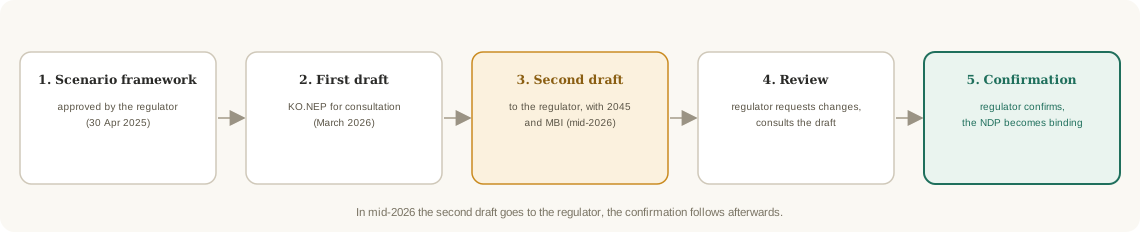
The first draft, published on 3 March 2026, contains the modelling for 2037 and the methane security-of-supply scenario for 2030. It went into public consultation from 3 to 27 March 2026, with a workshop on 11 March 2026 at which the operators presented the draft and took feedback. This first stage is the one stakeholders can shape directly, because it is open while the modelling is still being completed.

The revised second draft is expected in mid-2026 and completes the plan. It adds the hydrogen modelling for 2045 and the modelling of the market-based instruments (MBI), and it is the draft that is submitted to the BNetzA for confirmation. This is the point to read carefully: mid-2026 is the date of submission, not of the confirmation itself. The often-quoted regulator confirmation in mid-2026 is, more precisely, the moment the revised second draft goes to the BNetzA.
The confirmation (Bestaetigung) follows afterwards. The BNetzA may demand changes, the operators then have to amend the plan promptly, and the regulator consults the final draft before it confirms the NEP and makes it binding. So the actual confirmation lies after mid-2026, not on it. For operators, industry and traders this leaves a clear set of actions now: respond during the consultation window, bring your own demand into the modelling, and check the commissioning dates and route proximity that your own procurement and siting decisions depend on, while the plan can still be shaped.
Further reading
Frequently asked questions
The Gas and Hydrogen Network Development Plan (Netzentwicklungsplan Gas und Wasserstoff, NEP) 2025 is the first network development plan in which the gas transmission network and the hydrogen transport network are planned together as a single integrated plan. The legal basis is sections 15a to 15d EnWG, newly drafted by the 2024 EnWG amendment. It is prepared by the transmission system operators (Fernleitungsnetzbetreiber, FNB) and the regulated hydrogen transport operators through their joint coordination office KO.NEP, and its first draft has been in public consultation since 3 March 2026.
Because a substantial part of the future hydrogen infrastructure will be built from converted methane pipelines, the legislator decided that both energy carriers have to be planned in a coordinated way rather than separately. The 2024 EnWG amendment therefore introduced the duty to integrated network development planning in sections 15a to 15d EnWG. The Gas and Hydrogen NEP is also synchronised with the electricity NEP, with common assumptions on power plant and electrolyser locations, so that electricity, gas and hydrogen planning fit together.
For the first time the plan is scenario-based rather than demand-based. The scenario framework (Szenariorahmen), approved by the BNetzA on 30 April 2025, contains three equally weighted scenarios for the target years 2037 and 2045, plus a methane security-of-supply scenario for 2030 proposed by the operators and modelled as scenario 4. The three main scenarios span the range from a rapid hydrogen ramp-up to a slow path where methane stays relevant longer.
The approved hydrogen core network of 9,040 km and EUR 18.9 bn, with commissioning by 2032, is the starter network and a review object, not part of the build-out proposal. The NEP subjects it to a scenario-based review for the first time: in 2037 scenarios 1 and 2 lie above the core network's hydrogen demand and scenario 3 below, while in 2045 all scenarios go beyond it. The core network stays almost at its current scope, but the NEP stretches individual measures over time to follow the real market ramp-up and protect the amortisation account.
The NEP 2025 is published in two stages. The first draft of 3 March 2026 covers the 2037 modelling and the methane scenario. The hydrogen modelling for 2045 and the market-based instruments (MBI) follow in the revised second draft, which is expected to be submitted to the BNetzA in mid-2026 for confirmation. The actual confirmation (Bestaetigung) follows afterwards: the regulator may demand changes, the operators have to amend, and the BNetzA consults the final draft before it confirms the plan.