
EEG and EnFG settlement 2027: ten deadlines from the switch notice to the funding requirement
All ten dates are set in the Renewable Energy Sources Act (EEG) and the Energy Financing Act (EnFG), and all of them come back every year. Each one feeds the next: what plant operators deliver by 28 February goes to the transmission system operator by 31 May as the distribution system operator's final settlement, both settle the year in August, and on 30 September the transmission system operators report the funding requirement for 2028. Meanwhile the Bundestag is debating the EEG 2027 bill, which widens the 28 February data deadline and tightens the consequence of missing biomass proof.
The EEG and EnFG settlement calendar consists of ten annual deadlines through which plant operators, distribution system operators, grid users and transmission system operators settle a year's support payments and levies; for the year 2026 they run from 30 November 2026 to 30 September 2027. The key dates are 28 February for plant operators' per-installation settlement data (Section 71 EEG), 31 March for reports on reduced levies (Section 52 EnFG), 31 May for the distribution system operators' final settlement to the transmission system operator with an audited aggregate (Sections 50, 55 EnFG), and 31 August for the year-end settlement between the two, with payments balanced by 15 September (Section 19 EnFG). Missing a date usually costs money rather than a fine: the support claim only falls due once the data are in, biomass plants without proof drop to the market value, and reduced levies rise to 100 percent. The EEG 2027 bill keeps the dates but would cut the claim to zero instead of the market value when biomass proof is missing.
Ten deadlines from November 2026 to September 2027
Settling one EEG year takes ten months and involves four roles. Plant operators and their direct marketers deliver in winter, suppliers and other grid users in March; the distribution system operator sends its final settlement to the transmission system operator in May, and at the end of August both settle the year for good. First comes a date that strictly belongs to the next year: anyone switching the sales form on 1 January has to say so by the end of November.
| Date | Duty | Who | Source | Legal consequence |
|---|---|---|---|---|
| Mon, 30 Nov 2026; for any other first of the month: notice before the preceding month begins | Notify a first assignment or a change of sales form as of 1 Jan 2027, with balancing group for direct marketing | Plant operators, in practice often via the direct marketer | Section 21c(1) and (2) EEG | Payment of €10 per kW and month to the grid operator, also for the following month (Section 52(1) no. 9, (2), (4) no. 2 EEG) |
| Sun, 31 Jan 2027, every year | Publish the number of quarter-hours and hours in 2026 in which the applicable value fell to zero because of negative prices | Transmission system operators | Section 51a(4) EEG | No specific sanction; oversight by the Federal Network Agency (Section 85(3) EEG with Section 65 EnWG) |
| Sun, 28 Feb 2027, every year | All data for the 2026 final settlement, per installation, to the grid operator | Plant operators; direct marketers often supply them | Section 71(1) no. 1 EEG | The payment claim only falls due once and insofar as the data are provided (Section 26(2) EEG) |
| Sun, 28 Feb 2027, every year | Submit the feedstock logbook (liquid biomass) and, where relevant, the environmental expert's report for 2026 | Operators of biomass plants | Section 44c(2) and (6) EEG | The claim falls to the market value for the whole year (Section 44c(8) EEG) |
| Wed, 31 Mar 2027, every year | Report withdrawal points, final consumers, reason and volumes with reduced levies in 2026 | Grid users; for supply under the supplier framework contract usually the supplier | Section 52(2) EnFG | The reduced levy claim rises to 100 percent (Section 53(1) no. 3 EnFG) |
| Mon, 31 May 2027, every year | Notification under Section 52(1) for 2026 withdrawals into storage and charging points with reduced levies, latest date | Grid users: storage operators, charging point operators | Section 21(7) EnFG | The levy claim rises by 20 percentage points (Section 53(2) EnFG) |
| Mon, 31 May 2027, every year | 2026 final settlements for EEG and KWKG, per installation and in aggregate, to the upstream TSO, the aggregate version audited | Distribution system operators | Section 50 no. 2, Section 55(1) EnFG | Oversight by the Federal Network Agency, orders under Section 65 EnWG, fine of up to €200,000 for breaching an enforceable order; estimate by the TSO (Sections 61 to 63 EnFG) |
| Sat, 31 Jul 2027, every year | Data for the European Commission's transparency database, address and register number, to the TSO | Plant operators with more than €100,000 in EEG payments for 2026 whose register entries are missing or unpublished | Section 71(4) EEG | No specific sanction; oversight by the Federal Network Agency (Section 85(3) EEG with Section 65 EnWG) |
| Tue, 31 Aug 2027, every year; payments by Wed, 15 Sep 2027 | Send the 2028 CHP forecast; 2026 year-end settlement between DSO and TSO, payments and volume differences balanced by 15 Sep | Distribution and transmission system operators | Section 50 no. 3, Section 19(1) no. 2, (2) and (3) EnFG | Oversight and orders as for 31 May; estimate (Sections 61 to 63 EnFG) |
| Thu, 30 Sep 2027, every year | Determine the 2028 EEG and KWKG funding requirements and report them to the economics ministry, BAFA and the Federal Network Agency | Transmission system operators | Section 4 EnFG | Oversight, orders under Section 65 EnWG, fine of up to €200,000 for breaching an enforceable order (Sections 62, 63 EnFG) |
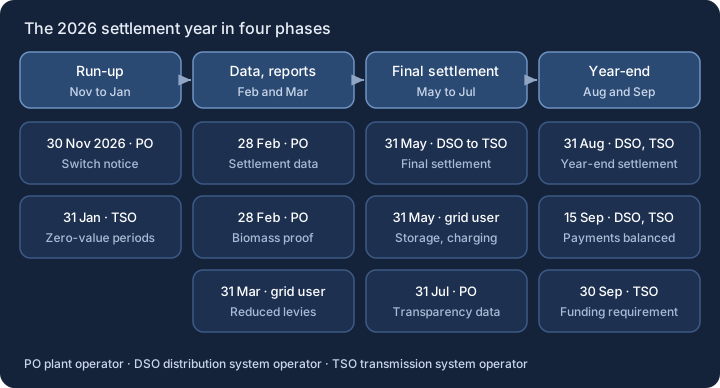
All ten deadlines are current law; none comes from a draft. Three of them fall on a weekend in 2027: 31 January, 28 February and 31 July. Anyone delivering through a portal or market communication should plan for the Friday before rather than rely on the date moving to Monday.
Change of sales form by 30 November
For a switch on 1 January 2027, the notification period ends on Monday, 30 November 2026. Section 21c(1) EEG requires notice to the grid operator "before the start of the preceding calendar month" (our translation), and that applies to every first of the month: anyone moving into direct marketing on 1 February notifies by 31 December. It covers the first assignment to a sales form and every switch between forms, for example from the feed-in tariff to the market premium, or from supported to other direct marketing.
A notice names the new sales form, for direct marketing the balancing group the electricity is assigned to, and for a percentage split the percentages (Section 21c(2)). For a switch into or out of the fallback tariff, the fifth-last working day of the preceding month is enough. Installations below 200 kilowatts with no other assignment are deemed assigned to the feed-in tariff in its unpaid-offtake variant; installations at the end of their support period default to the variant for post-support installations. Where the Federal Network Agency has set a procedure and format, grid operators, direct marketers and plant operators must use it (Section 21c(3) with Section 85(2) no. 3).
A forgotten notice gets expensive through Section 52 EEG. Anyone who fails to notify an assignment or switch under Section 21c pays the grid operator €10 per kilowatt of installed capacity and calendar month, plus the following month (Section 52(1) no. 9, (2), (4) no. 2); for a 3-megawatt installation that is €30,000 a month. Grid operators may offset the payment against the support claim and the instalments (Section 52(6)), and the plant operator loses its claim to the payment for decentralised feed-in for the whole calendar year (Section 52(7)). Measured by what one missed notice costs, we see 30 November as the most expensive deadline in the calendar, so a direct marketer taking on many installations at the turn of the year should not hold the notices until the last day.
If the EEG 2027 enters into force on 1 January as planned, the monthly rule stays. The bill replaces the feed-in tariff as a sales form with "grid operator offtake", drops the special deadline for the fallback tariff and lowers the threshold for automatic assignment to 100 kilowatts. How assignment works technically for remotely controlled installations is covered in the article on direct marketing with remote control via the smart meter gateway.
Zero-value periods for 2026 by 31 January
By Sunday, 31 January 2027, the transmission system operators publish on their joint website how many quarter-hours and hours in 2026 saw the applicable value fall to zero because of negative prices (Section 51a(4) EEG). They receive the figures from the power exchanges by 15 January (subsection 3). There are three series, since older versions of Section 51 apply to older installations: quarter-hours under today's rule, hours under the version of 24 February 2025 and hours under the version of 31 December 2022.
For 2025 the TSOs published 199 quarter-hours, 557 hours under the 2025 version and 518 hours under the 2022 version. In the middle series the figure rose from 260 hours in 2023 to 425 in 2024 and 557 in 2025. For installations whose applicable value drops to zero at negative prices, Section 51a(1) extends the support period by the number of those quarter-hours, rounded up to full calendar days. Solar installations count only half under subsection 2; the result is converted into full-load quarter-hours, and the law sets for each month how many of them it uses up, from 73 in December to 508 in June. How the rule works for new PV installations is explained in the article on the Solar Peak Act.
For plant operators the publication creates no duty, but it does create a data need: the figures are needed to recalculate the end of support and to plan the extended period in financing and marketing. There is a second link to the final settlement. Anyone who sold electricity under the fallback tariff in a month with negative prices must report, along with the Section 71 data, the volume fed in during the negative-price period; otherwise the claim for that month drops by 5 percent per affected calendar day (Section 51(3) EEG).
Settlement data and biomass proof by 28 February
By Sunday, 28 February 2027, plant operators provide the grid operator, per installation, with all data it needs for the 2026 final settlement (Section 71(1) no. 1 EEG). That expressly includes data for commercial offtake. Numbers 2 and 3 also require information on electricity tax exemptions, regional guarantees of origin and, for biomass plants, the type and quantity of feedstock; in the current text, the 28 February date only appears in number 1.
Money depends on this date. The plant operator's payment claim only falls due "once and insofar as" the data obligations under Section 71(1) have been met (Section 26(2) EEG, our translation); for the monthly instalments this applies from March of the year after commissioning. Late data mean the operator pre-finances its own claim. For installations in direct marketing, the direct marketer often supplies the data in practice, but the duty stays with the plant operator.
Operators of biomass plants have to submit their proof for 2026 on the same day. Anyone using liquid biomass for start-up, ignition and support firing proves the share of electricity from it with a copy of the feedstock logbook (Section 44c(2) EEG, for installations under Sections 42 to 44). Where the claim depends on the conditions in Section 44b(2) or Section 44c(4) or (5), such as high-efficiency cogeneration, a report by an accredited environmental verifier is required (Section 44c(6)). For series-produced CHP units up to 2 megawatts, manufacturer documents on output and power-to-heat ratio are enough (subsection 7). Both proofs apply from the first calendar year after the claim was first made, and personal data in the logbook that the proof does not need are blacked out by the operator (subsection 9).
A missing biomass proof hurts more than late settlement data: the claim for biomass electricity falls to the market value for the whole calendar year (Section 44c(8)). All biomass plants share the same cut-off date, so the reports fall into the same weeks, and in 2027 that date is a Sunday. Commissioning the verifier only in February puts a whole year of support above the market value at stake.
Reduced levies by 31 March, storage and charging points by 31 May
Anyone who claimed reduced levies on grid withdrawals in 2026 tells the grid operator that collects the levies four things by Wednesday, 31 March 2027: the withdrawal points with reduced levies, the final consumers who benefit, the reason for the reduction and the volumes withdrawn, broken down by those three features (Section 52(2) EnFG). This duty lies with the grid user. For supply under the supplier framework contract that is usually the supplier, who then has to collect the information from its customers. Where the transmission system operator collects the levies (Section 12(2) or (3)), the privileged company reports itself and the deadline moves to 31 May (Section 52(2a)).
If the report is missing or late, the reduced levy claim rises to 100 percent (Section 53(1) no. 3 EnFG), and the receiving grid operator charges the full levy. What the levies cost in 2027 is covered in the article on the 2027 levies published on 25 October.

Storage and charging points have a rule of their own. Electricity withdrawn for intermediate storage and later fed back is exempt from the levies, and so are storage losses; charging points for electric vehicles count as storage to the extent that electricity flows from the vehicle back into the grid (Section 21(1) to (3) EnFG). Only if the grid user has met its reporting duties and the volumes are metered or separated per 15-minute interval in line with metrology law does the reduction apply (Section 21(4)). How the Federal Network Agency handles that separation is set out in the article on MiSpeL and bidirectional charging.
The notification under Section 52(1), whether and why levies drop at a withdrawal point, is required by law "without undue delay". For storage and charging points, Section 21(7) EnFG sets 31 May of the following year as the latest date, so Monday, 31 May 2027 for 2026. Missing it adds 20 percentage points to the levy for that year (Section 53(2)). The annual volume report under Section 52(2) by 31 March is unaffected, which leaves a storage operator that is itself the grid user with two dates.
Final settlement to the TSO by 31 May
By Monday, 31 May 2027, distribution system operators send their upstream transmission system operator the 2026 final settlements for all payments under the EEG and the KWKG, per installation and in aggregate (Section 50 no. 2(a) EnFG). For each installation that means the register number, the relevant volumes, certain avoided grid charges and, for KWKG payments, the full-load hours reached since continuous operation began. On top comes the aggregated levy settlement with total grid withdrawals and the categories for which a reduction or cap applied (point b).

An auditor must audit the aggregated final settlement, and each audit comes with a separate audit opinion (Section 55(1) and (2) EnFG). If the settlement changes afterwards, the same auditor re-audits and adds to the opinion. So an audited settlement has to be in place by 31 May, and the auditor can only start once the plant operators' February data are complete. If data are missing or late, the transmission system operator may estimate them, traceably and with safety margins in favour of the levy accounts; the duty to report remains (Section 61 EnFG).
We see the effort less in the number of installations than in the special cases that pile up during the year: a change of sales form mid-year, an installation registered late, a missing biomass proof that pushes the payment down to market value. Each of these has to be right in the per-installation settlement before the auditor signs.
Transparency data by 31 July
Plant operators that received more than €100,000 in total payments under Section 19(1) or Section 50 EEG for their installations in 2026 check by Saturday, 31 July 2027, whether their data in the market master data register are published and complete. If not, they send the data to the transmission system operator, together with their address and register number (Section 71(4) EEG). By 31 December the TSOs enter name, register number (or, failing that, the VAT identification number), total payments, company size, NUTS-2 region and economic sector into the European Commission's transparency database (Section 71(2)).
For most plant operators the register does the work, because the TSOs take the information from the final settlements and the published register data (Section 71(3)). Only those whose data are missing there, or are not published under Section 15 of the Market Master Data Register Ordinance, have to report. Where the TSOs provide form templates, the report must use them (subsection 6), and evidence must be provided on request (subsection 7). Municipal utilities with their own wind or solar parks should not check the threshold per installation: it applies to the sum of payments to one operator.
Year-end settlement and CHP forecast by 31 August
As of Tuesday, 31 August 2027, distribution and transmission system operators settle the year 2026 (Section 19(1) no. 2 EnFG), and by Wednesday, 15 September, they balance the resulting payments (subsection 2). Also by 15 September they balance the difference between the EEG volumes the DSO passed on to the TSO during the year and the volumes in the 31 May final settlement, separately per energy source and valued at its annual market value (subsection 3).
Together with the year-end settlement, the DSO delivers the forecast for the following year 2028: the expected CHP volumes, split into installations under Sections 6, 9 and 35 KWKG and tendered installations under Sections 8a and 8b with their award levels, the bonuses expected under Sections 7a to 7c KWKG, total grid withdrawals and the withdrawals subject to levies that it collects (Section 50 no. 3 EnFG). TSOs need these figures for the 2028 levies and instalments, which they publish in October.
Funding requirement for 2028 by 30 September
By Thursday, 30 September 2027, the transmission system operators determine the EEG and KWKG funding requirements for 2028 and report them (Section 4 EnFG): to the Federal Ministry for Economic Affairs and Energy the EEG requirement and the expected equalisation claim from the EEG account for the current year (Section 6 EnFG), to the Federal Office for Economic Affairs and Export Control (BAFA) the KWKG requirement, and to the Federal Network Agency both requirements and the offshore connection costs. In addition, the agriculture ministry receives the total follow-up support paid for small manure plants in the previous year. Publication follows by 25 October (Section 51(1) EnFG).
According to the TSOs' publication of 26 October 2026, the EEG funding requirement for 2027 is €17.524 billion; for 2026 it was €16.152 billion, excluding the account balance. Since 2023 the federal budget pays this amount rather than a surcharge on the electricity price. For the current year 2026 the same publication expects an equalisation claim under Section 6(1) sentence 2 EnFG of €2.000 billion; that is the federal government's claim against the TSOs, which arises when the EEG account ends the year in surplus.
What the EEG 2027 bill changes in these deadlines
The federal government introduced the EEG 2027 bill to the Bundestag on 7 September 2026 as printed paper 21/7867; it is meant to enter into force on 1 January 2027. As of mid-October, the second and third readings were planned for the sitting weeks of 9 to 20 November (topagrar, 14 Oct 2026). It leaves the EnFG dates alone and changes three things in the EEG deadlines.
Section 71(1) will name 28 February in its opening words, so the date will apply to all information under subsection 1, including electricity tax exemptions and biomass feedstock; regional guarantees of origin disappear. According to the explanatory memorandum, the reason is that the TSOs have to pass the information to the Federal Network Agency by 15 September. Section 44c(8) no longer cuts the claim to the market value when biomass proof is missing, but to zero; the memorandum speaks of a "stronger incentive" and refers to new biomass plants. In Section 21c the monthly rule stays, the special deadline for the fallback tariff goes, automatic assignment only applies below 100 kilowatts, and installations below 25 kilowatts state on first assignment to other direct marketing whether they claim the new bonus under Section 50c. What the bill means for small installations is explained in the article on the EEG 2027 and small PV systems.
The disputed point is how often installations under the new contracts for difference may still change their sales form. Exiting state support is allowed only once in the first ten years (Section 21e EEG 2027). The Bundesrat criticised this in its opinion, the federal government rejected the criticism; both texts are in printed paper 21/8298 of 30 September 2026 (quotes in our translation).
"However, this comes at the expense of flexibility for plant operators and thus also reduces incentives to use unsupported sales forms such as PPAs, even though strengthening market instruments outside EEG support is the aim."
"Wider switching options would probably lead to a one-sided and purely opportunistic shift of revenue opportunities during high-price phases from the state to plant operators and would effectively undermine the clawback mechanism."
For the calendar this means the monthly rule in Section 21c stays in the bill, but an installation under a contract for difference could leave the hedge under Section 21e only once; according to the counter-statement it can still switch to other direct marketing as long as the clawback continues. Whether that holds is up to the Bundestag.
What happens if a deadline is missed
For the duties of plant operators and grid users, the EEG and EnFG provide no fine but financial consequences. Without the 28 February data the payment claim does not fall due (Section 26(2) EEG), missing biomass proof cuts it to the market value (Section 44c(8)), and a missing switch notice costs €10 per kilowatt and month (Section 52 EEG). Reduced levies rise to 100 percent without the 31 March report (Section 53(1) no. 3 EnFG), and for storage and charging points by 20 percentage points without the notice by 31 May (Section 53(2) with Section 21(7)).
Grid operators are subject to oversight. The Federal Network Agency monitors whether distribution and transmission system operators run the equalisation mechanism properly and determine the funding requirements correctly (Section 62(1) EnFG), and can issue orders under Section 65 EnWG for that purpose (Section 62(3)). Failing to comply with an enforceable order is an administrative offence with a fine of up to €200,000 (Section 63 EnFG). A receiving grid operator may estimate missing data without the reporting duty lapsing (Section 61 EnFG). For the publications under Section 51a and the transparency data under Section 71(4) EEG, the law sets no specific sanction; the Federal Network Agency can order remedies under Section 85(3) EEG with Section 65 EnWG. This is a general outline of the statutory consequences, not an assessment of your individual case.
What to do by late November and in spring
The next deadline is five weeks away and mainly concerns direct marketers and utilities' generation units. For distribution system operators, the real work starts in January when they request the data for the final settlement. All deadlines with roles and systems are also in the energy transition deadline calendar.
Next steps by role
-
Notify switches for 1 January
Plant operators and direct marketers: send every assignment and switch as of 1 Jan 2027, with balancing group, to the grid operator by Monday, 30 November 2026; distribution system operators check receipt and reassign the installations on the first of the month.
-
Commission the environmental verifier now
Biomass plant operators: plan the report and feedstock logbook for 2026 so that both reach the grid operator before Friday, 26 February 2027.
-
Send the data request in January
Distribution system operators: write to plant operators and direct marketers with a 28 February deadline, track the year's special cases (switches, fallback tariff, negative prices, register gaps) separately and book the auditor for April and May.
-
Collect the levy reports
Suppliers: ask customers with reduced levies by early March and file the Section 52(2) report by 31 March; storage and charging point operators agree with the supplier who makes the Section 52(1) notification by 31 May.
-
Check the €100,000 threshold
Plant operators with several installations: add up the 2026 EEG payments and check the register data before 31 July.
Deadline, market roles, systems
30 November 2026EEG: report a change of sales form for 1 January 2027 by end of NovemberLaw · adopted
If the deadline is missed: Money is lost Anyone not notifying the assignment or switch under Section 21c must make a payment to the network operator under Section 52(1) no. 9 EEG. Legal basis ↗
- Electricity grid operatoraffectedProcesses switch notifications and reassigns installations as of the first of the month.Typically affected: Market communication gateway (EDIFACT, AS4, API), Grid usage and customer billing
- Direct marketeraffectedTriggers the switch notification for newly contracted installations in time before the preceding month.Typically affected: Trading and procurement system (ETRM), Market communication gateway (EDIFACT, AS4, API)
- Plant operator (generation)role obligationNotifies the network operator by 30 November 2026 of a switch into direct marketing or between sales forms as of 1 January 2027.Typically affected: Plant master data and MaStR
31 January 2027Negative prices: TSOs publish zero-value periods of 2026Law · adopted
If the deadline is missed: Regulator can enforce The EEG sets no specific sanction. The Federal Network Agency monitors the TSOs' duties and can order remedies under Section 85(3) EEG with Section 65 EnWG. Legal basis ↗
- Transmission system operatorrole obligationDetermines the 2026 zero-value quarter-hours and hours and publishes them by 31 January 2027.Typically affected: Regulatory management, controlling, Customer and grid connection portal
- Plant operator (generation)affectedUses the published figures to check the support period extension under Section 51a EEG.Typically affected: Plant master data and MaStR, Regulatory management, controlling
28 February 2027EEG: data for the 2026 final settlement to the network operator (28 February)Law · adopted
If the deadline is missed: Money is lost The plant operator's payment claim only falls due once and insofar as it has met its data obligations under Section 71(1) EEG (Section 26(2) EEG). Legal basis ↗
- Electricity grid operatoraffectedCollects the data by 28 February and needs them for the final settlement to the TSO by 31 May.Typically affected: Grid usage and customer billing
- Direct marketeraffectedProvides settlement data for the installations it markets where it supplies them on the plant operator's behalf.Typically affected: Trading and procurement system (ETRM)
- Plant operator (generation)role obligationProvides the network operator with per-installation data for the 2026 final settlement by 28 February 2027.Typically affected: Plant master data and MaStR
28 February 2027Biomass: prove feedstock logbook and environmental expert report for 2026Law · adopted
If the deadline is missed: Money is lost Without proof in the prescribed form, the claim to the market premium or feed-in tariff for biomass electricity falls to the market value for the whole calendar year (Section 44c(8) EEG). Legal basis ↗
- Plant operator (generation)role obligationCompiles the 2026 feedstock logbook and expert report and submits them to the network operator by 28 February 2027.Typically affected: Plant master data and MaStR, Regulatory management, controlling
31 March 2027EnFG: report reduced levies for 2026 to the network operator (Section 52(2) EnFG)Law · adopted
If the deadline is missed: Money is lost If the report is not made or is late, the reduced levy claim rises to 100 percent (Section 53(1) no. 3 EnFG). Legal basis ↗
- Electricity grid operatoraffectedReceives and checks the reports and charges the full levy without a timely report (Section 53(1) no. 3 EnFG).Typically affected: Grid usage and customer billing
- Supplierrole obligationCompiles the 2026 data on withdrawals with reduced levies and reports it to the network operator by 31 March 2027.Typically affected: SAP IS-U / S/4HANA Utilities, Grid usage and customer billing
31 May 2027EnFG: final settlement of EEG and KWKG payments for 2026 to the TSOLaw · adopted
If the deadline is missed: Regulator can enforce The Federal Network Agency monitors that network operators run the equalisation mechanism properly (Section 62(1) EnFG) and can issue orders under Section 65 EnWG for this (Section 62(3) EnFG); failing to comply with an enforceable order is an administrative offence under Section 63(1) no. 2 EnFG (fine of up to EUR 200,000). If data are missing or late, the receiving network operator may estimate them; the duty to report remains (Section 61 EnFG). Legal basis ↗
- Electricity grid operatorrole obligationPrepares the 2026 EEG and KWKG final settlements per installation, has the aggregated settlement audited and sends it to the TSO.Typically affected: Grid usage and customer billing, SAP IS-U / S/4HANA Utilities, Regulatory management, controlling
- Transmission system operatoraffectedReceives and checks the final settlements of downstream DSOs; it may estimate missing data (Section 61 EnFG).Typically affected: Grid usage and customer billing, Regulatory management, controlling
31 May 2027EnFG: report on storage and charging points with reduced levies for 2026Law · adopted
If the deadline is missed: Money is lost If the report is not made in time, the reduced levy claim for the year rises by 20 percentage points (Section 53(2) EnFG with Section 21(7)). Legal basis ↗
- SupplieraffectedAgrees with storage and charging point operators who makes the report.Typically affected: SAP IS-U / S/4HANA Utilities
- Storage operatorrole obligationReports 2026 storage withdrawals with reduced levies by 31 May 2027.Typically affected: Grid usage and customer billing, Plant master data and MaStR
- Charge point operatorrole obligationReports 2026 withdrawals via bidirectional charging points with reduced levies by 31 May 2027.Typically affected: Charging backend (OCPP, PKI), Grid usage and customer billing
31 July 2027EEG transparency: plant operators above EUR 100,000 report missing dataLaw · adopted
Applicability: Only plant operators with more than EUR 100,000 in EEG payments in the previous year whose market master data register entries are unpublished or incomplete.
If the deadline is missed: Regulator can enforce Section 71(4) EEG sets no specific sanction. The Federal Network Agency monitors the reporting duties and can order remedies under Section 85(3) EEG with Section 65 EnWG. Legal basis ↗
- Plant operator (generation)check applicabilityChecks whether 2026 payments exceeded EUR 100,000 and register data are complete, and otherwise reports to the TSO by 31 July 2027.Typically affected: Plant master data and MaStR, Regulatory management, controlling
31 August 2027EnFG: CHP forecast for 2028 and 2026 year-end settlement with the TSOLaw · adopted
If the deadline is missed: Regulator can enforce The Federal Network Agency monitors that network operators run the equalisation mechanism properly (Section 62(1) EnFG) and can issue orders under Section 65 EnWG for this (Section 62(3) EnFG); failing to comply with an enforceable order is an administrative offence under Section 63(1) no. 2 EnFG (fine of up to EUR 200,000). If data are missing or late, the receiving network operator may estimate them; the duty to report remains (Section 61 EnFG). Legal basis ↗
- Electricity grid operatorrole obligationDelivers the 2028 CHP forecast and the 2026 year-end settlement to the TSO and settles payments by 15 September.Typically affected: Grid usage and customer billing, SAP IS-U / S/4HANA Utilities
- Transmission system operatoraffectedSettles with downstream DSOs on 31 August and balances payments by 15 September.Typically affected: Grid usage and customer billing
30 September 2027Determine and report the EEG and KWKG funding requirement for 2028 (Section 4 EnFG)Law · adopted
If the deadline is missed: Regulator can enforce The Federal Network Agency monitors that the TSOs determine and report the funding requirements properly (Section 62(1) no. 1(a) EnFG) and can issue orders under Section 65 EnWG for this (Section 62(3) EnFG); failing to comply with an enforceable order is an administrative offence under Section 63(1) no. 2 EnFG (fine of up to EUR 200,000). Legal basis ↗
- Transmission system operatorrole obligationDetermines the 2028 EEG and KWKG funding requirements and offshore connection costs and reports them to the ministry, BAFA and the Federal Network Agency.Typically affected: Grid usage and customer billing, Regulatory management, controlling
A classification for typical market roles, not a review of your individual case and not legal advice. Whether an obligation applies to your company (thresholds, exemptions) is for your legal department or counsel to confirm. The calendar doesn't replace your own deadline review. Information as of: 27 October 2026.
Further reading
Frequently asked questions
The EEG final settlement is the grid operator's annual closing statement on the payments to the plant operator for the previous year. It reconciles the monthly instalments with the actual claim and carries the installation's number in the market master data register (Section 26 EEG). The plant operator supplies the data for it by 28 February (Section 71(1) no. 1 EEG).
By Monday, 30 November 2026. Section 21c(1) EEG requires notice before the start of the calendar month preceding the switch; for a switch into or out of the fallback tariff, the fifth-last working day of the preceding month is enough. Without notice, the plant operator owes the grid operator €10 per kilowatt and month, also for the following month (Section 52 EEG).
The payment claim only falls due once and insofar as the plant operator has delivered the data (Section 26(2) EEG); from March of the year after commissioning this also applies to the instalments. For biomass plants without proof under Section 44c, the claim falls to the market value for the whole year; the EEG 2027 bill would cut it to zero.
The grid user claiming the reduction, which under the supplier framework contract is usually the supplier. It reports withdrawal points, final consumers, reason and volumes for the previous year to the grid operator by 31 March. Where the transmission system operator collects the levies, the privileged company reports itself by 31 May. Without a report the claim rises to 100 percent (Section 53 EnFG).
The final settlements for EEG and KWKG payments of the previous year, per installation with register number and volumes and in aggregate, plus the aggregated levy settlement (Section 50 no. 2 EnFG). An auditor must audit the aggregated version and issue an audit opinion (Section 55 EnFG). Missing data may be estimated by the TSO (Section 61 EnFG).
€17.524 billion, published by the transmission system operators on 26 October 2026; for 2026 it was €16.152 billion excluding the account balance. The requirement is determined and reported to the ministry, BAFA and the Federal Network Agency every year by 30 September (Section 4 EnFG), so for 2028 by 30 September 2027. It is paid from the federal budget.
Let's collaborate
One contact, a team behind it
Thirty minutes on what you're working on, whether grid, metering, market processes, IT architecture or AI. Afterwards you'll know how we'd approach it and who would sit at the table.
Energy and measurement technology since 2010 · innobu GmbH since 2014 · Based in Schleswig-Holstein, Germany
Whoever pitches also delivers: whoever leads the first call stays your contact right through to the steering committee, with established partners in the project. Direct: info@innobu.com