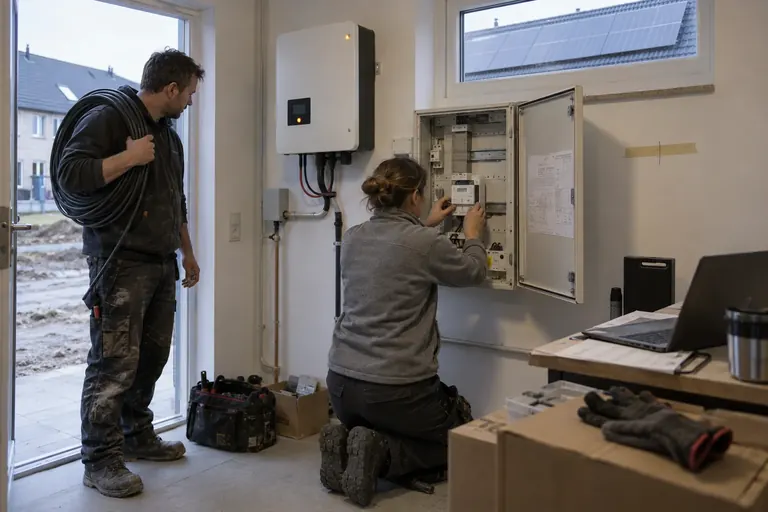
EEG 2027 draft: small PV systems without a fixed feed-in tariff
On 24 September 2026 the Bundestag held its first reading of the government's draft EEG 2027. Nothing has been passed. If the draft goes through as written, a new 10 kW rooftop system commissioned from January 2027 gets money from the grid operator for three years at most and then has to go to market. For a municipal utility that means roughly 135,000 extra cases a year across Germany, each needing a gateway and a correct market assignment.
Under the German government's draft of the EEG 2027 (Bundestag printed paper 21/7867, cabinet decision on 29 July 2026, first reading on 24 September 2026), new photovoltaic systems below 25 kilowatts would no longer receive a fixed feed-in tariff, subject to the Bundestag's decision and state aid approval by the European Commission. Instead the grid operator would pay a temporary transition payment of the reference value minus one cent, around 5.2 cents per kilowatt hour according to the Bundestag, for at most 36 months. After that the systems are meant to sell their power through direct marketing, supported by a bonus of 1.5 cents per kilowatt hour for up to 48 months, or hand it to the grid operator for free. Rooftop systems below 100 kilowatts would cap their feed-in at 50 percent of installed capacity permanently, and mandatory smart meter installation would start above 2 kilowatts. Systems commissioned by 31 December 2026 stay under the old rules. The law is planned to take effect on 1 January 2027, and at municipal utilities the small-system segment turns into a mass business: short payment periods, more installations, many switches between marketing routes.
What the government draft provides for small PV
Under the government draft, the fixed feed-in tariff ends for new PV systems below 25 kilowatts. The cabinet adopted the bill on 29 July 2026 and sent it to the Bundestag on 7 September as printed paper 21/7867. The first reading took place on 24 September, and the Committee on Economic Affairs and Energy now has it.
The reasoning sits right at the front of the bill. Small systems, it says, are now often economic without extra support thanks to lower costs, "provided they achieve high self-consumption" (our translation). So the segment is supposed to focus on self-consumption, with a battery, a heat pump or a wallbox. Anyone who still feeds in should do it through direct marketing.
| Item | EEG today (commissioned by 31 Dec 2026) | Government draft EEG 2027 |
|---|---|---|
| Payment | Fixed feed-in tariff for 20 years | Temporary transition payment, reference value minus 1 cent, 36 months at most |
| Afterwards | not applicable | Direct marketing without market premium, bonus of 1.5 ct/kWh for up to 48 months, or free offtake |
| Feed-in cap | 60 percent as long as no smart meter with control is installed | 50 percent permanently, smart meter or not |
| Mandatory smart meter | above 7 kW | above 2 kW |
Nothing changes for existing systems. Anything commissioned by 31 December 2026 stays, under section 100(1) of the draft, under the EEG as it reads on that day. Expect installers and grid connection teams to be busy in the last quarter of 2026. Plug-in solar devices up to 2 kilowatts and 800 volt-amperes are exempt from both the transition payment and the cap.
Systems from 100 kilowatts upward face a different part of the reform, the clawback contribution. We covered it in our piece on EEG 2027 and contracts for difference, and the parallel grid connection rules in our article on the 2026 grid package. This one stays with the small systems. That's where the volume is.
Transition payment, bonus, free offtake: the new path of a system
The draft replaces the feed-in tariff with a new sales route called "grid operator offtake". It comes in three variants, and every one of them ends up at the grid operator.
The temporary transition payment is the entry point. It equals the reference value minus one cent per kilowatt hour (section 53(1)); the Bundestag puts it at around 5.2 cents. Under section 25(2) it runs until the end of the 36th calendar month after commissioning. Who gets it depends on size and year: systems below 50 kilowatts commissioned before 1 January 2028, below 25 kilowatts before 1 January 2029, below 7 kilowatts before 1 January 2031. The door closes in steps, from the top down.

Direct marketing comes next. Below 25 kilowatts there's no market premium; the draft releases these systems into "other direct marketing". To get them started, section 50c grants a bonus of 1.5 cents per kilowatt hour fed in, until the end of the 48th month after the system is first assigned to direct marketing at the latest. The claim is against the grid operator. Not against the direct marketer.
Can't find a direct marketer, or don't want one? Then there's free offtake. The grid operator takes the power from systems below 100 kilowatts and pays nothing for it. The government expects more owners to skip feed-in altogether and build zero-export systems, and the draft lowers the hurdles for that.
There is a safety valve. Section 85(2) no. 2a lets the Bundesnetzagentur extend the transition payment for systems below 25 kilowatts up to 31 December 2032 if direct marketing can't yet be done at reasonable cost. The draft's own examples: technical equipment and grid operator billing processes that are "not yet sufficiently fit for mass business and digitalised" (our translation). The regulator is told to look explicitly at how far the mandatory rollout has got.
You can read that as insurance. Or as an admission that the timetable is tight.
Grid operators: shorter payments, more cases
EEG settlement stays with the distribution system operator; it just gets more granular. Instead of one payment stream over 20 years, the operator will manage up to three phases per system, each with its own legal basis and its own rate.
The government thinks the effort is small. The explanatory memorandum says handling the transition payment "essentially" matches today's feed-in tariff, only with a different reference value and three years instead of 20. The software modules are to come from the IT vendors.
We're more cautious. On its own, the transition payment really is a variant of something familiar. What's new is how the pieces interact: a payment run that stops dead after 36 months, a bonus tied to the first assignment to direct marketing that lapses whenever the system switches back to grid operator offtake, and the rule on negative prices. Under section 51 the payment drops to zero in quarter hours with a negative spot price; systems below 100 kilowatts in grid operator offtake are only caught from the year after a smart meter is installed. So the billing system has to know, for every single system, when the gateway went in.
There's a formal requirement too. Under section 26(3) of the draft, final statements and advance payments must carry the plant's number from the German market master data register and, on request, be issued "in digital form fit for mass business" (our translation). And for systems whose support has expired and which predate 2021, a separate variant of grid operator offtake runs until the end of 2032, with the deduction halved once a smart meter is fitted.
The 50 percent cap hits the grid side differently. Section 9(2b) of the draft requires operators of rooftop systems below 100 kilowatts to limit active power feed-in at the connection point to half of installed capacity, "permanently and regardless of whether a smart meter is installed and of the sales route". Today a gateway with control lifts the 60 percent limit set by the solar peak law. Under the draft it no longer would. For grid planning that's good news, because the midday peak in the local grid halves in a predictable way. For the connection process, the cap becomes a checkpoint that should be documented at commissioning.
Metering: mandatory installation from 2 kilowatts
The default metering point operator gets more mandatory cases. Article 3 of the draft amends section 29(1) no. 2 of the Metering Point Operation Act: generation systems above 2 kilowatts, rather than above 7 kilowatts as today, get a smart meter and a control device.
Section 10b explains why the two belong together. A system in direct marketing has to give the direct marketer its actual feed-in at any time and allow remote control. Today that applies above 25 kilowatts; the draft deletes the threshold and simply says "plant operators". How this works through the smart meter gateway is covered in our article on direct marketing with remote control via the SMGW. With the draft, that chain moves into the single-family house.
The government also expects a quarter of the roughly 135,000 newly direct-marketed systems per year to ask for early installation. That's 33,750 installations on customer request each year, at a fee of around 100 euros. None of those appointments are in the rollout plan.
And the rollout plan is already full. On 30 June 2026 the Bundesnetzagentur counted 3.17 million smart meters across 54.1 million metering points, with 26.1 percent of mandatory cases equipped. Since March it has opened supervisory proceedings against 434 companies, 150 of which have been closed. The quota for generation systems already counts in kilowatts, as our piece on the rollout quota for generation capacity explains. The 2 to 7 kilowatt segment brings lots of installations with little capacity behind them.
Bad for the quota. Bad for the fitter's diary, too.
Market communication: direct marketing as a mass business
The biggest change lands in market communication. Direct marketing today is a business for systems from 100 kilowatts, with manageable volumes. The draft estimates that scrapping the feed-in tariff will add around 135,000 direct-marketed systems every year, plug-in devices not included. It adds that the trend is "hard to predict because of the system change" (our translation).
Each of these systems goes through assignments: grid operator offtake with transition payment, then a switch to a direct marketer, maybe later a switch between marketers or back to offtake. Under section 21c of the draft the grid operator has to be told about each switch, and the first assignment to other direct marketing also triggers the bonus notification. Since June 2025 these processes run at the generating market location inside the GPKE rulebook; the details are in our article on integrating the MPES processes into GPKE. So the processes exist. They were built for a different volume.

Direct marketers said in spring where it gets stuck. Lumenaza told the trade paper ZfK in March 2026 that the technology exists and the gap lies elsewhere: "The biggest challenge right now is communication and processes" (our translation) between metering point operator, grid operator and direct marketer. The German utilities association BDEW supports mandatory direct marketing, but only from 2030, after the MaBiS hub goes live and the rollout is further along.
At a utility, two data streams meet here that often sit in separate systems today. Assignment switches in market communication, and payment claims in EEG settlement. If they drift apart, the grid operator pays a bonus for a month in which the system wasn't direct-marketed at all. Or fails to pay when it was.
The fight over small systems: market or tariff?
Few parts of the bill draw this much fire. The positions face each other with dates and wording attached.
The government writes in its memorandum that the previous "produce and forget" model for smaller systems "is therefore no longer appropriate". And: there will be "no protection of legitimate expectations for new systems to be operated permanently without direct marketing if power is fed into the grid" (our translation).
The German Solar Industry Association BSW-Solar pushed back on 24 September 2026. The draft, it said, provides new systems below 25 kilowatts with "only a payment of 5.2 cents per kilowatt hour limited to three years". Private owners would then have to market their solar power directly, "for which neither the technical nor the economic conditions are foreseeably in place" (our translation). When the cabinet adopted the bill on 29 July, the association had already rejected the transition payment as a substitute for 20 years of fixed tariff.
The Länder chamber is split. Ahead of the Bundesrat plenary on 25 September 2026, its urban development committee recommended, according to pv magazine, keeping "the feed-in tariff for PV systems below 25 kilowatts" and extending and raising the transition payment. The economic affairs committee wanted to hold back parts that aren't time-critical until a full impact assessment is available.
From the supplier side comes qualified support. Filip Thon, CEO of Eon Energie Deutschland, called the move away from fixed payments right, pv magazine reports. Not the 50 percent cap, though: "A blanket feed-in cap would limit exactly the flexibility we need in the energy system" (our translation).
The National Regulatory Control Council aims elsewhere. In its opinion attached to the printed paper, it suggests raising the threshold for the clawback contribution from 100 to the 200 kilowatts EU law allows, "thereby avoiding gold-plating".
We're not going to settle this. For a grid operator's planning, something else matters: the draft may still change a lot before it's passed, especially in the 25 kilowatt segment. But the work in billing and in the rollout shows up in almost every variant now on the table.
An opening for a multi-utility's retail arm
If the draft passes as written, a six-figure number of small systems will need a direct marketer every year. The draft itself expects supply might run short, otherwise it wouldn't have let the Bundesnetzagentur extend the transition payment if "not enough direct marketing companies" serve the segment yet.
A multi-utility has things for this role that a national player would have to build first. Its retail arm knows the customers in the supply area, runs a balancing group and often already supplies the residual power to the same household. Local direct marketing for small systems, bundled with a battery, a heat pump tariff or a home energy management system, is an obvious extension. Whether to build it, partner or buy, we worked through in our article on HEMS and the virtual power plant at a municipal utility.

Nobody gets rich on this. A 10 kW system with a battery and a heat pump feeds in little, and the bonus ends after four years. The business only works if assignment, meter data intake and billing run without manual work. Then there's a contract detail: under section 10b(7) of the draft, direct marketer and plant operator agree a threshold at which output is curtailed, for example at negative prices, plus a cost rule for when curtailment doesn't happen. That's a product feature, not small print.
Which leaves unbundling. The grid operator sees every new system first, during the connection process. Retail may not get preferential use of that information. A utility offering direct marketing has to reach customers through its retail channels, not through the connection portal. And in the local grid the principle from our piece on grid-serving flexibility under §14c EnWG still holds: in a bottleneck, grid first, market second, even for your own retail customers.
What to prepare before January
With a planned start on 1 January 2027, waiting for the law to appear in the Federal Law Gazette isn't an option. Preparation can be set up so it still holds if the bill changes.
Five steps before the turn of the year
-
IT and billing: ask your vendor
Ask your EEG billing vendor now when the modules for grid operator offtake, transition payment and the section 50c bonus will ship, and how they use the gateway installation date for the negative-price rule. Plan test time for December. January is too late, because the first systems under the new rules can go live from 1 January.
-
Grid connection: plan for the year-end rush
Expect more commissionings before 31 December 2026.
-
Metering: put the 2 to 7 kW segment into rollout planning
Use the market master data register to estimate how many new systems per year in your area will fall into this band, and reserve fitting capacity and control boxes for them. Early installations on customer request come on top.
-
Market communication: test the volume
Run assignment switches at the generating market location with realistic volumes, not ten test cases. Settle how the assignment gets from market communication into EEG billing, and who resolves differences when the two don't match.
-
Management: ask retail
Does the company want to be a direct marketer for small systems? The answer doesn't have to be ready by January. The question does.
At a multi-utility in northern Germany we have been supporting the grid portfolio of around 40 initiatives since 2024. Regulatory changes due on 1 January have never failed there because of the rule itself, but because of the question of which system has to deliver first. This article reflects the government draft. We'll update it once the Bundestag has decided.
This article is a general classification of the government draft for typical market roles. It is not legal advice and not an assessment of your individual case. Whether and how an obligation applies to your company depends on the final text of the law.
Deadline, market roles, systems
1 January 2027EEG 2027 (government draft): no fixed tariff for new PV below 25 kWplanned
Applicability: Under the draft this only affects new systems commissioned from 1 January 2027. Existing systems stay under the old rules; plug-in solar devices up to 2 kW are exempt.
- Electricity grid operatorcheck applicabilityPrepares EEG settlement for grid operator offtake, transition payment and bonus and checks the 50 percent cap at commissioning; the bill may still change in parliament.Typically affected: Grid usage and customer billing, SAP IS-U / S/4HANA Utilities, Market communication gateway (EDIFACT, AS4, API)
- Default metering point operatorcheck applicabilityPlans the 2 to 7 kW segment into the mandatory rollout with control devices, plus early installations for direct marketing; status government draft.Typically affected: Gateway administration and CLS management, Field service and work orders
- Suppliercheck applicabilityConsiders offering direct marketing for small systems in its own area; status government draft.Typically affected: Market communication gateway (EDIFACT, AS4, API), Grid usage and customer billing
A classification for typical market roles, not a review of your individual case and not legal advice. Whether an obligation applies to your company (thresholds, exemptions) is for your legal department or counsel to confirm. The calendar doesn't replace your own deadline review. Deadline calendar as of: 23 September 2026.
Further Reading
Frequently Asked Questions
No. As of 26 September 2026 there is a government draft, Bundestag printed paper 21/7867. The cabinet adopted it on 29 July 2026, and the Bundestag held its first reading on 24 September 2026 and referred it to the Committee on Economic Affairs and Energy. Entry into force is planned for 1 January 2027. Core parts are also subject to state aid approval by the European Commission.
Under the government draft, the temporary transition payment is a variant of the new grid operator offtake. The grid operator pays the reference value minus one cent per kilowatt hour for power fed in, around 5.2 cents according to the Bundestag, until the end of the 36th calendar month after commissioning at the latest. It applies to systems below 50 kilowatts commissioned before 2028, below 25 kilowatts before 2029 and below 7 kilowatts before 2031.
Systems commissioned by 31 December 2026 stay, under section 100(1) of the draft, under the EEG as it reads on that day. They keep the fixed feed-in tariff for 20 years.
Under the government draft, yes. Section 9(2b) requires rooftop systems below 100 kilowatts to cap feed-in at 50 percent of installed capacity, permanently and regardless of whether a smart meter is installed and of the sales route. Plug-in solar devices up to 2 kilowatts are exempt.
The draft lowers the threshold for mandatory smart meters and control devices at generation systems from above 7 to above 2 kilowatts. The government estimates around 94,000 additional private installations a year as a result, about 47,000 of them with a control device. Early installations on customer request for direct marketing come on top.
The grid operator. Under section 50c of the draft, operators of systems below 25 kilowatts that sell their power through other direct marketing have a claim against the grid operator for 1.5 cents per kilowatt hour fed in, until the end of the 48th month after the first assignment to direct marketing at the latest.