EEG 2027 and Contracts for Difference: the support system from 100 kW
The model sounds like fiscal policy but is above all a data task. What the EU enforces from July 2027, how the refinancing contribution works and why 31 December 2026 becomes a cut-off date is set out in this article. The political frame of the reform is described in the piece on the grid package 2026 and the EEG reform, the consumer-facing EU rule in the piece on the EU electricity market design and consumer rights.
From 17 July 2027 Germany may only support new renewable plants directly through two-sided Contracts for Difference or equivalent instruments. That is set by the reformed EU electricity market regulation, implemented through the EEG 2027, which is meant to take effect on 1 January 2027. The leaked draft applies a production-based claw-back from 100 kilowatts of installed capacity. The principle reverses the previous one-way street: if the annual market value is below the reference price, the state still pays a market premium. If it is above, the operator pays back a refinancing contribution. The fixed feed-in tariff is abolished for all new plants, and for plants below 25 kilowatts support ends entirely. EU law allows plants up to 200 kilowatts to be exempted, which is why associations want to raise the threshold from 100 to 200 kilowatts. The 31 December 2026 cut-off is hard: plants commissioned by then keep the old one-sided support for 20 years with no repayment obligation. Above all the shift is a digitalization project, because the refinancing contribution is settled on a quarter-hour basis and needs metering, market communication and direct marketing as one continuous data chain. Meanwhile the industry warns of investment uncertainty in the tens of billions of euros.
What the EU enforces from July 2027
The rebuild of the support system is not a German idea but an EU requirement. The reformed electricity market regulation stipulates that direct price support for new renewable investments may only run through two-sided Contracts for Difference or equivalent instruments. Germany has to implement this, and the vehicle is the EEG 2027.
Affected are new plants for onshore wind, offshore wind, solar and geothermal energy. The requirement applies to new support contracts from 17 July 2027, while the EEG 2027 itself is meant to take effect on 1 January 2027. The timeline is tight, and a draft from January 2026 running to roughly 442 pages is still in inter-ministerial review.
How the two-sided Contract for Difference works
The two-sided Contract for Difference reverses the previous one-way street. Until now money flowed in one direction only, from the state to the operator. In future it can also flow back. The reference remains the reference price, the value with which a plant emerges from the auction.
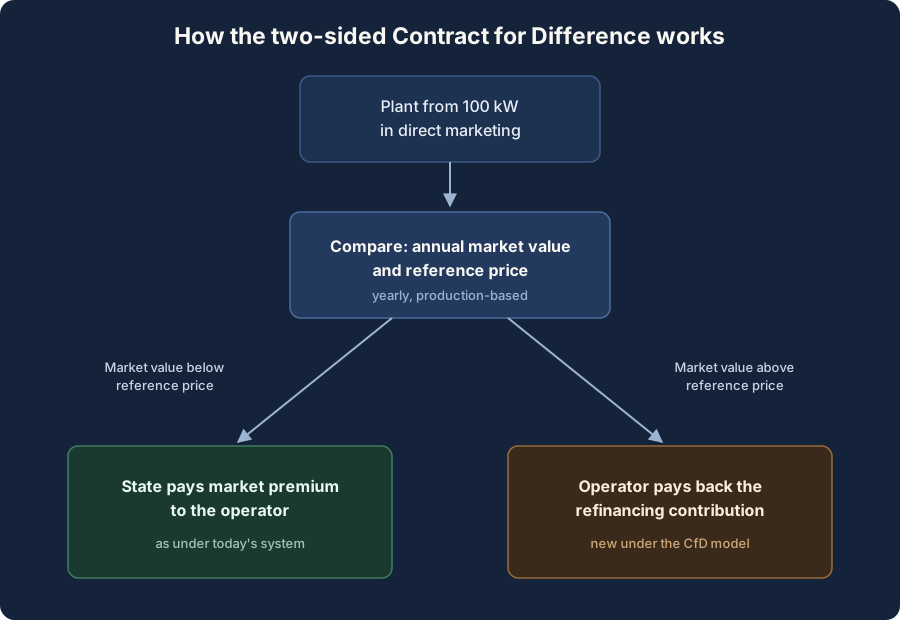
The draft settles on a production basis, so not as a flat sum but by the volume actually fed in. A quarter-hour adjustment is meant to prevent plants from switching off at low spot prices by guaranteeing a minimum payment. This keeps the market signal intact without destroying the incentive to feed in.
A one-time exit from support is possible until the end of the tenth year of operation. Anyone who exits forfeits the support claim permanently. This rule prevents cherry-picking, the move into free marketing only in the lucrative high-price years and back into support as soon as prices fall.
The 100-kilowatt threshold and what happens below it
Not every plant falls under the new mechanism. The threshold in the draft sits at 100 kilowatts, and that is exactly what is disputed. The line decides which plants carry the new settlement burden and which stay outside it.
- The production-based claw-back applies from 100 kilowatts of installed capacity, while smaller plants are spared.
- EU law allows member states to exempt plants up to 200 kilowatts. Associations such as BDEW therefore call for raising the threshold from 100 to 200 kilowatts to free small plants from the settlement burden.
- For new plants below 25 kilowatts support ends entirely. The rationale: self-consumption now carries the plant economically.
- The direct marketing obligation is lowered below 100 kilowatts after a transition of roughly 36 months, which pushes smaller plants into market marketing.
- Biomass plants are exempt from the refinancing contribution.
The debate around 25 kilowatts is the politically most sensitive. If the feed-in tariff for small rooftop plants falls away, the calculation shifts noticeably for households and small businesses. How new market and tariff models affect controllable consumers and generators is set out in the piece on the tariff models in the controllable electricity market.
Why CfD is above all a digitalization project
The refinancing contribution sounds like fiscal policy but is above all a data task. Anyone settling on a production-based, quarter-hour basis needs continuous digital processes from the meter to the invoice. This is exactly where it is decided whether the model works in practice.

To make the quarter-hour settlement possible at all, the draft extends the smart meter rollout to generation plants above 2 kilowatts. The smart metering system delivers the time series needed, and the generation rollout quota already in force counts kilowatts rather than installation cases. What deadlines and sanctions now drive the rollout is described in the piece on the smart meter rollout and the BNetzA sanctions.
The refinancing contribution has to be settled and documented cleanly between operator, direct marketer and grid operator. That extends market communication by a new money flow. Mandatory direct marketing at the same time pushes even smaller plants into forecasting, schedule management and spot market participation. How remote control and the smart meter gateway work together is shown in the piece on direct marketing via the smart meter gateway. The value of a plant thereby shifts from the guaranteed payment to data-driven marketing.
The 31 December 2026 cut-off and the investment uncertainty
Between the old and the new system lies a hard cut. A single date decides whether a plant ever has to pay a refinancing contribution or not. That drives project planning through 2026.

Plants commissioned by 31 December 2026 keep the existing one-sided support for 20 years with no repayment obligation. The date is hard because the EU state-aid authorisation for the old system expires at the end of 2026. Anyone who pulls commissioning ahead of the turn of the year secures the predictable model, and anyone who lands just behind plans under new rules.
The industry reacts critically. The German Renewable Energy Federation and the solar association BSW-Solar warn against the loss of the feed-in tariff for small plants and against the extra complexity for small systems. According to the German Renewable Energy Federation, investment decisions in the tens of billions of euros are pending for 2027 and 2028 alone, in an industry with around 436,000 employees. Without a reliable frame these decisions stall.
What operators and direct marketers should prepare now
The draft is not final, but the direction is clear. Anyone who sets up the data processes now avoids manual workarounds later. Four steps separate early preparation from late repair.
- Check the metering concept: plan smart metering systems for generation plants above 2 kilowatts early, because without quarter-hour measurement data the refinancing contribution cannot be settled cleanly.
- Absorb the settlement logic: build the calculation of the refinancing contribution into your own systems instead of tracking it manually, because the settlement runs annually and retrospectively per plant.
- Prepare direct marketing: set up forecasting and schedule processes for smaller plants too, because the direct marketing obligation slips below 100 kilowatts after the transition.
- Check the cut-off and alternatives: for projects commissioned by the end of 2026, check whether the cut-off is realistically reachable, and align calculations from 2027 to the CfD model and possible power purchase agreements.
Further reading
Frequently asked questions
A two-sided Contract for Difference aligns a plant's revenue to a fixed reference price, in both directions. If the annual market value is below the reference price, the state pays the difference as a market premium. If the market value is above it, the operator pays the difference back as a refinancing contribution. Support is thereby capped on the upside and secured on the downside.
The leaked EEG 2027 draft applies the production-based claw-back to plants from 100 kilowatts of installed capacity. Smaller plants are exempt from the mechanism, and biomass is explicitly exempt. EU law allows member states to exempt plants up to 200 kilowatts, which is why associations such as BDEW call for raising the threshold from 100 to 200 kilowatts.
For new plants below 25 kilowatts support ends entirely. The rationale: falling costs have made small plants economically viable through self-consumption. Associations such as the German Renewable Energy Federation and BSW-Solar criticise this sharply, because the feed-in tariff is a decisive factor in the investment decision for many households and small businesses.
Plants commissioned by 31 December 2026 keep the existing one-sided support for 20 years with no repayment obligation. The date is hard because the EU state-aid authorisation for the old system expires at the end of 2026. Projects commissioned from 2027 fall under the new CfD model with a possible refinancing contribution.
The refinancing contribution is settled on a production-based, quarter-hour basis. That requires smart metering systems, clean measurement data and extended market communication between operator, direct marketer and grid operator. The smart meter rollout is therefore extended to generation plants above 2 kilowatts, and mandatory direct marketing pushes even smaller plants into forecasting and schedule management.