HEMS and virtual power plants at German utilities: build, partner or buy
Since April 2026, finished platforms for HEMS, Section 14a control and direct marketing have been on the table at German municipal utilities. Signing one decides more than an app.
A home energy management system (HEMS) controls a household's PV, battery, heat pump and wallbox by price, grid signal and self-consumption, and a virtual power plant pools many such households for the electricity market. For German multi-utilities (Stadtwerke running grid, metering and retail under one roof), the operating question becomes urgent with the MiSpeL ruling taking effect on 1 October 2026 and the enforcement of Section 14a module 3: build it in-house, run it with a partner or buy it as a platform. What matters is who owns the data, the control access and future flexibility revenue, not which app looks best. Five criteria carry the decision: data control, lock-in and exit, interoperability, unbundling between grid, metering and retail, and the dependency on the smart meter rollout, which stood at 5.9 percent of all metering points on 30 June 2026.
Who owns the customer interface in the home?
Whoever runs the HEMS holds three things: the household's consumption and generation data, access to the controllable devices, and the revenue their flexibility will earn. The app on top is the smallest part of it.
The German utility trade paper ZfK put it bluntly in May 2026. For municipal utilities, the question is who owns the HEMS. Nicolai Kretz of evm, a regional utility around Koblenz, called it the heart of a new kind of systems sales. And the hurdle mentioned most often in the sector is not technical. It is getting retail, grid and IT to agree.
A HEMS on its own does not pay. That is in the same ZfK piece, and the vendors' own offers agree: HEMS, dynamic tariff, procurement optimisation and marketing as one bundle. So whoever decides on the HEMS decides on the virtual power plant as well.
What the market for white-label apps looks like, who integrates which devices and why Sections 41a and 14a of the German Energy Industry Act drive it, we covered in our piece on prosumer platforms and white-label apps . This one picks up the question after that. Which operating model fits a multi-utility, and how do you tell before you sign?
Why the decision is due now
Four developments meet in autumn 2026. None forces a utility into a HEMS. Together, though, they shift who will control the devices in its customers' basements two years from now.
Section 14a, module 3
Grid operators have to offer time-variable grid fees for controllable consumption devices. On 28 May 2026 the Bundesnetzagentur, Germany's regulator, announced first proceedings against operators that do not, with a deadline of 30 September 2026 to fix the gaps.
MiSpeL takes effect
Batteries and charge points may charge from the grid and feed in subsidised PV power without losing the subsidy. PV systems up to 30 kW get a flat-rate option. Above that, the split needs quarter-hour values.
EEG amendment 2027
New systems below 25 kW would lose the fixed feed-in tariff and move into direct marketing after a transition payment, with feed-in capped at 50 percent. None of this is law yet, and EU state aid approval is pending.
New offers to utilities
Heartbeat AI offers its platform to municipal utilities, enercity builds a virtual power plant with Kraken, Tibber launches Grid Rewards for EVs in intraday trading.
The third one is underrated. If mandatory direct marketing for small PV arrives as drafted, every new rooftop system needs a direct marketer. Whoever runs the HEMS in that house is first in line with the customer. Everyone else sells the leftovers.
And module 3? It pushes from the other side. A time-variable grid fee is only more than a price sheet if something in the house reacts to it.
Three routes: build, partner, buy
In practice utilities choose between three operating models, and most end up with a mix. The examples below are publicly documented. They illustrate models, not a ranking.

Build
Your own platform means full data control and full responsibility. That covers integrating every inverter, every battery and every wallbox, the control logic, round-the-clock operation and market access. How big the device question alone is shows in a vendor statement from Heartbeat AI in April 2026: by its own account, its platform covers about 60 percent of PV manufacturers, half of the batteries, almost all heat pumps and 70 percent of EVs. That is where a company stands after years of building nothing else.
For a single utility, that is a software house of its own. For a group of utilities, maybe not.
Partner
Here the utility and its partner split the roles by contract. Two examples from this year. On 5 June 2026, enercity, the Hanover utility, and Kraken announced they would jointly develop a virtual power plant: enercity brings its power and heat generation portfolio, Kraken the technology, experience with aggregated assets and access to European markets. On 1 June 2026, Stadtwerke Tübingen started a pilot with Zählerfreunde and the Trianel Digital Lab that tests HEMS, PV, heat pump, e-mobility and dynamic tariff as one system and shares the results across the Trianel network of municipal utilities.
What separates this from buying is the contract, not the software.
Buy
Buying means the utility uses a finished platform, usually under its own brand. Heartbeat AI, part of 1Komma5°, has offered municipal utilities a platform with HEMS, Section 14a control, dynamic tariff and direct marketing since April 2026, at around 15 euros of software fee per household and month according to ZfK. gridX and greenblocks rolled out the HEMS liya with evm and say a utility can launch it in twelve weeks without building its own software.
| Model | Example | What is on record |
|---|---|---|
| Partner | enercity and Kraken | Joint development of a virtual power plant, announced 5 June 2026 |
| Partner | Stadtwerke Tübingen, Zählerfreunde, Trianel Digital Lab | Pilot on HEMS and dynamic tariffs since June 2026, results shared in the Trianel network |
| Buy | Heartbeat AI | Platform for municipal utilities since April 2026, about 15 euros per household and month |
| Buy | gridX with greenblocks at evm | White-label HEMS with Section 14a control, launch in twelve weeks according to the vendor |
The table will not tell you which route is right. Criteria will.
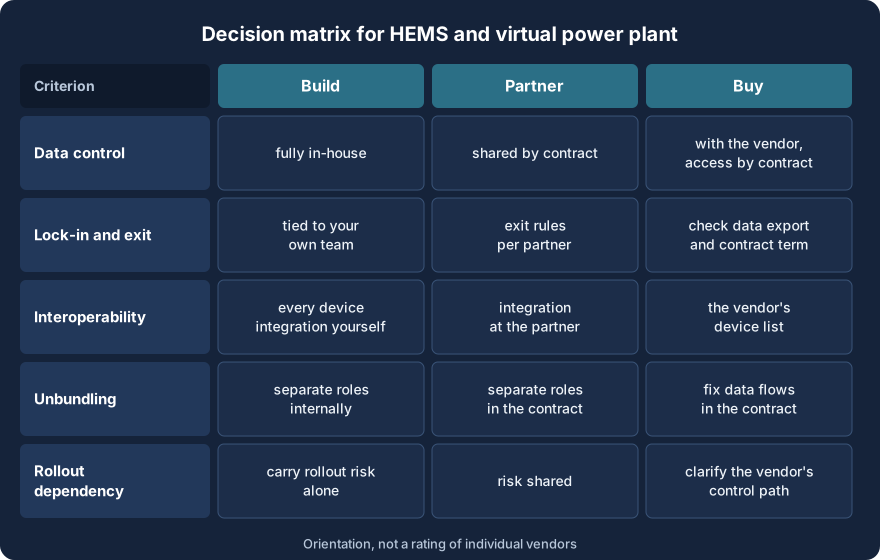
Five criteria for the decision matrix
Five questions separate the models cleanly. Price and feature list matter too, but they change with every offer. These five do not.
Data control
Where do the quarter-hour values, device states and forecasts live, and who may use them for what? If you build, the answer is simple. If you buy, it is in the contract, and only there. So ask for the right to export all data at any time, completely and in a documented format, and ask what the vendor itself may do with it.
Lock-in and exit
This is the one most often forgotten. What happens to 3,000 controlled households when the contract ends after five years? Do the devices keep working if the vendor's cloud stops answering? The installer PEAK.Energy asked this in public in May 2026: what still works sensibly if you no longer want the service or the tariff? It belongs in every tender.

Interoperability
A HEMS talks to devices through manufacturer interfaces, cloud APIs or open standards such as EEBUS under IEC 63380 . It talks to the grid through the smart meter gateway, the CLS channel and the control box. The more of that runs on open standards, the easier a later switch. The more runs through a vendor's cloud, the faster you get started today. Both are legitimate. Just know which price you pay for what.
Unbundling
In a multi-utility, three roles meet at the same meter cabinet. That deserves its own section, see below.
Rollout dependency
On 30 June 2026 the Bundesnetzagentur counted 3.17 million smart metering systems across 54.1 million metering points, which is 5.9 percent. 434 metering point operators are under supervisory proceedings. Many flexibility products need a smart metering system all the same; Tibber's Grid Rewards says so explicitly. A business model built on your own rollout grows exactly as fast as that rollout. No faster.
Unbundling: grid, metering and retail on one device
In a customer's basement, three roles meet that often sit under one roof in a German multi-utility. The grid operator sends the grid-serving control command under Section 14a. The default metering point operator runs the gateway the command travels through. Retail sells the dynamic tariff and the HEMS that distributes the command to the devices in the house.
Technically, that is one chain. Legally, they are separate roles. Section 6a of the Energy Industry Act (EnWG) requires commercially sensitive information from grid operation to stay confidential and to be disclosed only in a non-discriminatory way. Section 3(4) of the Metering Point Operation Act (MsbG) requires the metering point operator to act transparently and without discrimination and refers to accounting unbundling under the EnWG.
What does that mean for the HEMS decision? Something uncomfortable first. What your own grid knows about congestion in the low-voltage network, and what your own metering business sees at a metering point, is not a head start your own retail arm may use exclusively. A retail HEMS product has to work with the same signals a third-party provider would get.
The same separation applies once a partner or platform vendor comes in. The contract should spell out which data flows in which role. Whether and how far unbundling obligations apply to a particular company depends on its size and structure, and has to be settled in-house.
General orientation for typical market roles, not an assessment of your individual case and not legal advice.
From leading a Section 14a programme at a multi-utility in northern Germany, we take one sequence away: first the control chain between grid and metering has to work, through the Section 14a control box and grid control and clean CLS management . Then the product. The other way round gets expensive.
The argument over the operating system in the basement
Two positions on the platform question met in public this year. Both are worth reading before a utility signs anything.
Heartbeat AI states its ambition openly. In the ZfK interview of 13 April 2026 the company said it did not want to keep the technology to itself but to make Heartbeat AI the standard operating system for every household. In May, 1Komma5° reported more than 100,000 controlled systems and named 20 gigawatts of controllable capacity by 2030 as its goal.
What still works sensibly if you no longer want to use the service or the tariff?
PEAK.Energy, blog post of 26 May 2026 (paraphrased)PEAK.Energy, an installation company, pushed back on 26 May 2026. Not against energy management, it says, but against unnecessary lock-in. Once control, visualisation and tariff are tightly coupled, switching gets hard. The actual intelligence runs as a service rather than locally, and owning the hardware does not mean controlling the system. PEAK.Energy therefore prefers manufacturer-independent systems with open interfaces.
Both have a point. A platform that controls a very large number of devices without the customer lifting a finger is a real lead that a single utility will struggle to close. And a platform whose exit nobody has settled is a risk that only shows up five years later. You do not resolve that tension with a verdict on a vendor. It goes into the contract.
Challenges and risks
The biggest uncertainty is regulation that has not been passed. The 2027 EEG amendment is a government draft. Whether mandatory direct marketing for small PV arrives as described is up to the Bundestag and the European Commission. A business model resting on that alone rests on a draft.
- The economics come late. In the ZfK round in May, utilities expected two to three years before the models pay off, depending on how fast the rollout goes.
- The rollout stands at 5.9 percent. Any product that needs a smart metering system reaches only a small share of customers today.
- Device variety never goes away. No vendor integrates everything, and every new inverter generation starts over.
- Inside the house. Retail, grid, metering and IT need to agree on a target picture before anyone picks a vendor.
That last risk is the most common one. And the only one no vendor can fix.
What utilities should decide now
Decide on roles and contracts, not on apps. A sensible order looks like this.
Five steps to the decision
-
Agree a target picture across all roles
Settle which role the utility wants at the customer interface: platform operator, retail brand on someone else's platform, or partner in a group. Retail, grid, metering and IT sign off on it together, otherwise procurement ends up deciding.
-
Control chain first
Without a working chain of gateway, CLS channel and control box, any HEMS stays a tariff calculator.
-
Settle the exit before the entry
Write into the requirements what happens to data, device integrations and controlled households when the contract ends. Ask about local operation if the cloud fails. And about the export format.
-
Document data flows between roles
Record which signals from grid and metering the HEMS product uses, and whether a third-party provider would get them the same way.
-
Measure with a pilot
A pilot with a few hundred households, clear metrics and an end date tells you more than any presentation. Measure device coverage, controllability, customer retention and the effort in your own service team. The Tübingen approach of sharing results across a group lowers the cost of that insight for everyone involved.
Once these five are answered, the choice between build, partner and buy often turns out not to be that hard. The hard part was the question before it.
Further reading
Frequently asked questions
A home energy management system automatically controls a household's PV system, home battery, heat pump and wallbox by electricity price, grid signal and self-consumption. In Germany it can take the grid-serving control command under Section 14a of the Energy Industry Act from the control box and distribute it to the individual devices.
The HEMS works inside a single household. The virtual power plant pools many households or assets into one portfolio and uses it on electricity markets, for example in intraday trading or direct marketing. In offers to utilities, both usually come as one package.
Publicly documented examples include Heartbeat AI, which has offered a platform to municipal utilities since April 2026, gridX with greenblocks, who rolled out the HEMS liya with evm, and Kraken, which is developing a virtual power plant with enercity. There are also group approaches such as the pilot of Stadtwerke Tübingen, Zählerfreunde and the Trianel Digital Lab. The list is not complete.
The Bundesnetzagentur ruling on the market integration of storage and charge points lets a battery charge from the grid and feed in subsidised PV power at the same time without losing the subsidy. PV systems up to 30 kW get a flat-rate option; for larger systems it is not permitted and the split is based on metered values.
Because in a German multi-utility the grid operator, the default metering point operator and retail all work on the same device. Section 6a EnWG and Section 3(4) MsbG require confidentiality and non-discriminatory handling. A retail HEMS product therefore may not get exclusive access to information from grid or metering. Whether and how far these obligations apply in a given case has to be settled within the company.
Four points carry the most weight: the right to export all data at any time, completely and in a documented format; a rule for the controlled households when the contract ends; commitments on local operation if the cloud fails; and a clear statement of which data the vendor may use for its own purposes.