
Grid Package 2026: Who May Connect at the Bottleneck Before the Grid Is Built
The grid package (Netzpaket) aims to speed up the grid connection procedure and synchronise grid and renewables expansion. The federal cabinet adopted it on 29 July 2026 together with the EEG reform, which ends the fixed feed-in tariff for new plants. By mid-October 2026 the Bundestag had not passed either bill, and the redispatch proviso remained the main point of dispute. On 21 April 2026, EWE and EnBW presented flexible connection agreements (FCA) as a counter-proposal.
The grid package is a government bill that aims to speed up the German grid connection (Netzanschluss) procedure and synchronise grid and renewables expansion. The federal cabinet adopted the bill on 29 July 2026 (Bundestag printed paper 21/7866). After the first reading on 24 September and the hearing in the economic affairs committee on 7 October 2026, the Bundestag had not taken a final vote by mid-October 2026, and the redispatch proviso remains the main point of dispute. The connection backlog is real: at the end of 2024 the transmission grid operators held around 650 connection requests for large battery storage with a combined capacity of roughly 226 gigawatts. The package replaces pure first-come-first-served with prioritised connections, introduces digital connection portals from 1 January 2028 for capacity information from 135 kilowatts, and adds the contested redispatch proviso (Redispatch-Vorbehalt), which would let distribution system operators designate grid areas as capacity-limited for up to six years above a 5 percent curtailment threshold, where new solar and wind plants waive compensation for up to 20 percent of their annual output. On 21 April 2026, EWE and EnBW presented flexible connection agreements (FCA) as a counter-proposal: a connection at the bottleneck without a waiting time in exchange for at most 200 curtailment full-load hours per year, a five-year term and six-monthly transparency, with the connection priority for renewables kept. Both models accept temporary curtailment as the price for a faster connection, and both are contested. Regardless of which prevails, the shared capability is making bottlenecks and remaining capacity transparent, data-based and contract-ready.
Why the connection right is being reformed at all
The German grid connection has become the bottleneck of the energy transition: more renewables and storage want to connect than the grid expansion can absorb in any foreseeable time. For large battery storage alone, connection requests of around 226 gigawatts were on file at the end of 2024, a multiple of the capacity installed today. The grid package, adopted by the federal cabinet on 29 July 2026, therefore aims to speed up the connection procedure and synchronise grid and renewables expansion, rather than leaving plants to wait years for the full grid build-out.

The guiding idea is simple: connect faster by not guaranteeing every plant the full power at every moment, but accepting temporary curtailment instead. The EEG reform runs in parallel and points in the same direction, ending the fixed feed-in tariff for new solar and replacing it with direct marketing and two-sided contracts for difference. The legislative question this article follows is not how curtailment works, but under which legal terms renewables and storage may connect at all before the grid is finished.
What the grid package actually changes
The grid package reaches deep into the connection procedure and replaces long-settled principles. Instead of pure first-come-first-served, grid operators (Netzbetreiber) would be allowed to prioritise connection requests by legally defined criteria, backed by a maturity assessment from the transmission grid operators. On top of this come transparency and digitalisation obligations and the option to levy construction cost subsidies on renewable plants too, which was largely excluded before.

The package would let grid operators bring forward more mature projects and hold back immature requests, replacing the windhund (first-come-first-served) principle with prioritised connections. The status matters: the cabinet adopted the bill on 29 July 2026, but by mid-October 2026 it was not yet law, and the redispatch proviso is the piece the Bundestag is still fighting over. New in the government bill is a fixed cap: first-segment solar plants connected from 1 January 2027 may feed in at most 70 percent of their installed capacity at the connection point, onshore wind 280 watts per square metre of rotor area.
The redispatch proviso: faster connection in exchange for waiving compensation
The most contested element is the redispatch proviso (Redispatch-Vorbehalt). Under the government bill, distribution system operators may designate substations and line sections as capacity-limited for up to six years when more than 5 percent of generation was curtailed there in the previous year; the first draft had set 3 percent. New first-segment solar plants and onshore wind turbines would receive a connection there only if they waive compensation for Redispatch 2.0 curtailment, capped at 20 percent of annual output (18 percent in wind energy areas). The redispatch mechanism itself is not the subject of this article; how distributed flexibility is dispatched is explained in our Redispatch 3.0 congestion management analysis.
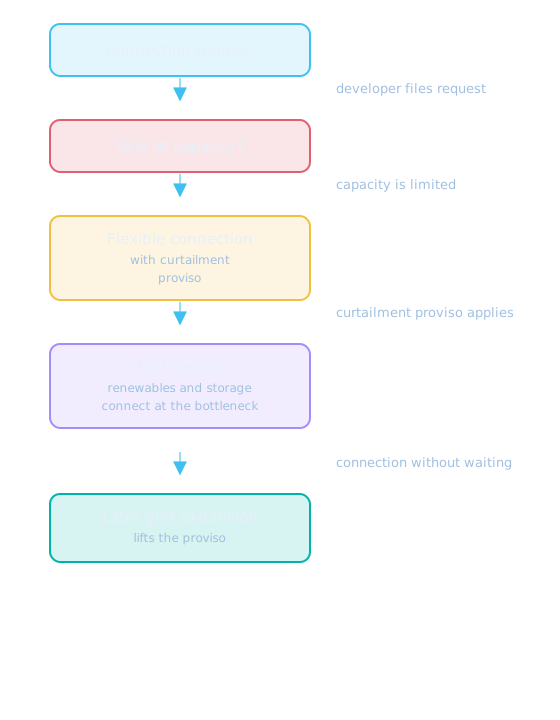
The trigger is a blanket 5 percent curtailment threshold based on the previous calendar year. In capacity-limited areas new plants lose compensation for curtailed feed-in up to a fifth of their annual output. Fraunhofer IEE (Professor Martin Braun) took issue with the design rather than the concept, starting with the first draft: the threshold, as the sole criterion and built on a single prior year, is too coarse and creates a revenue risk that is hard to calculate. The institute calls for forward-looking grid simulations and regional capacity transparency instead.
The proviso accepts temporary curtailment as the price for a faster connection, which is the same trade-off the FCA model makes. The difference lies in how the trade-off is defined: a blanket area designation from backward-looking statistics on the one side, a contractually capped number of hours on the other. That distinction is the heart of the debate that follows.
The FCA model from EWE and EnBW as a counter-proposal
EWE and EnBW presented flexible connection agreements (FCA) on 21 April 2026 as an alternative to the blanket redispatch proviso. The core is a connection at the local bottleneck without a waiting time, in exchange for a contractually limited and transparently defined curtailment risk rather than a sweeping area designation. The connection priority for renewables is explicitly kept.
The 200-hour cap corresponds to roughly 8 to 12 percent of the typical annual operating hours of a German wind turbine, and hours with negative exchange prices are not counted toward it. Instead of a flat area designation from last year's statistics, grid operators would have to make capacity limits transparent every six months. A plant operator facing a bottleneck then has three options: wait for the grid expansion, relocate the site, or connect immediately under an FCA.
Redispatch proviso versus FCA: the lines of the debate
Both models accept temporary curtailment as the price for a faster connection, but they differ in transparency, predictability and fairness. The proviso works with a blanket area designation and backward-looking statistics; the FCA model works with a contractually capped number of hours and forward-looking transparency. Associations and researchers position themselves clearly, and the FCA model is not uncontested either.
BDEW and BEE criticise the draft bill for hard-to-calculate investment risks, and Fraunhofer IEE calls for forward-looking grid simulations instead of a one-year threshold. The BEE welcomes the FCA standardisation but holds the 200-hour limit to be not viable and sees in it a second redispatch proviso under another name. There are international precedents for flexible connections: the United Kingdom (ENA curtailable connections via DERMS since 2023) and the Netherlands (non-firm grid connections) already use them to stretch scarce capacity.
What grid operators, municipal utilities and developers should prepare now
Regardless of which model prevails, everything comes down to the same capability: making bottlenecks and remaining capacity transparent, data-based and contract-ready. Whoever builds capacity transparency, digital connection portals (the grid connection portal duty under Section 8(7) EEG already covers systems up to 30 kW) and a flexible contract logic early can connect without a break after the law passes, rather than retrofitting under time pressure once it does.
-
Build capacity and bottleneck transparency
Regional, forward-looking grid data is the shared precondition of both models. Treat capacity transparency as the foundation, not as a reporting afterthought, so connection decisions rest on data rather than on last year's statistics.
-
Prepare the digital connection portals and status processes
The portal obligation for capacity information from 135 kilowatts applies from 1 January 2028. Build the portals and status deadlines now, with a first response within three months, rather than under time pressure later.
-
Design a reusable flexible contract logic
Treat the curtailment proviso, full-load-hour caps and transparency deadlines as a reusable process, not as a one-off case, so that whichever model passes can be applied without rebuilding the workflow.
-
Watch the regulation actively
Track the Bundestag deliberations on the grid package and the EEG reform, above all any change to the redispatch proviso. The final law will define the terms of every future connection.
The reform will only work on a data and contract foundation that exists before it is needed. Whoever builds capacity transparency, the connection portals and a flexible contract logic now turns a regulatory waiting state into a usable basis. The same controllable assets behind the control box and Section 14a grid control and the bundling logic of virtual power plants point to the same shift toward a flexible, data-coordinated grid.
Deadline, market roles, systems
1 January 2027Grid package: system-serving connection capacity instead of maximum outputLaw · not yet adopted
If the deadline is missed: Regulator can enforce Under the government bill (Bundestag printed paper 21/7866) the new duties carry no fine of their own. Duties such as the transmission system operators' submission of procedure rules or the monthly capacity map (Sections 17a and 17c of the draft EnWG) could be enforced by the regulator under Section 65 EnWG. Legal basis ↗
- Electricity grid operatorcheck applicabilityMay adopt the transmission operators' prioritisation principles for connection requests and publishes available connection capacity on a map; the bill may still change in parliament.Typically affected: Customer and grid connection portal, Grid planning, GIS, load flow
- Transmission system operatorcheck applicabilitySubmits joint procedure rules for transmission grid connections to the Federal Network Agency by 1 January 2027 and may include prioritisation principles; the bill may still change.Typically affected: Customer and grid connection portal
A classification for typical market roles, not a review of your individual case and not legal advice. Whether an obligation applies to your company (thresholds, exemptions) is for your legal department or counsel to confirm. The calendar doesn't replace your own deadline review. Information as of: 25 October 2026.
Further reading
Frequently asked questions
The grid package (Netzpaket) is a government bill that aims to speed up the grid connection (Netzanschluss) procedure and synchronise grid and renewables expansion. The German Federal Ministry for Economic Affairs and Energy (BMWE) published a first draft on 30 January 2026. The federal cabinet adopted the bill on 29 July 2026 (Bundestag printed paper 21/7866). After the first reading on 24 September and the hearing in the economic affairs committee on 7 October 2026, the Bundestag had not taken a final vote by mid-October 2026, and the redispatch proviso remains the main point of dispute. It replaces pure first-come-first-served with prioritised connections, introduces digital connection portals and adds a contested redispatch proviso.
The redispatch proviso (Redispatch-Vorbehalt) is the most contested element of the grid package. It would let distribution system operators designate grid areas as capacity-limited for up to six years when more than 5 percent of generation was curtailed there in the previous year; the first draft had set 3 percent. New first-segment solar plants and onshore wind turbines in those areas would receive a connection only if they waive compensation for Redispatch 2.0 curtailment, with the waiver capped at 20 percent of annual output. The redispatch mechanism itself is not the subject of this reform debate; it is explained separately in our Redispatch 3.0 analysis.
Flexible connection agreements (FCA) are a counter-proposal that EWE and EnBW presented on 21 April 2026 as an alternative to the blanket redispatch proviso. The core idea is a connection at the local bottleneck without a waiting time, in exchange for a contractually capped and transparently defined curtailment risk of at most 200 full-load hours per year. The contract runs for five years with automatic renewal, grid operators must publish capacity limits every six months, and the connection priority for renewables is kept.
Both models accept temporary curtailment as the price for a faster connection, but they differ in transparency, predictability and fairness. The redispatch proviso works with a blanket area designation triggered by a backward-looking 5 percent statistic from a single year. The FCA model works with a contractually capped number of curtailment hours and forward-looking, six-monthly transparency. The FCA model is itself contested: the BEE welcomes the standardisation but considers the 200-hour limit not viable.
Regardless of which model prevails, everything comes down to the same capability: making bottlenecks and remaining capacity transparent, data-based and contract-ready. Whoever builds capacity transparency, digital connection portals and a flexible contract logic early can connect without a break after the law passes, rather than retrofitting under time pressure. The digital connection portal obligation applies from 1 January 2028 for capacity information from 135 kilowatts.
Let's collaborate
One contact, a team behind it
Thirty minutes on what you're working on, whether grid, metering, market processes, IT architecture or AI. Afterwards you'll know how we'd approach it and who would sit at the table.
Energy and measurement technology since 2010 · innobu GmbH since 2014 · Based in Schleswig-Holstein, Germany
Whoever pitches also delivers: whoever leads the first call stays your contact right through to the steering committee, with established partners in the project. Direct: info@innobu.com