Controllability check: what the TSO report due 30 November 2026 brings
By 30 November 2026, 50Hertz, Amprion, TenneT and TransnetBW hand the overall report under Section 12(2c) of the Energy Industry Act (EnWG) to the Federal Network Agency (BNetzA) and the Federal Ministry for Economic Affairs and Energy. It holds every distribution system operator's test results and the default metering operators' reports on smart meter deployment, for the first time including remotely controllable plants below 100 kW and checks of reactive power control and regulation.
The overall report under Section 12(2c) EnWG is the annual evaluation of every German electricity grid operator's controllability checks, which the four transmission system operators submit to the Federal Network Agency and the economics ministry by 30 November; in 2026 the deadline falls on Monday, 30 November. The first report of November 2025 covered around 120,000 plants from 100 kW: 73 percent of solar, 86 percent of wind and 47 percent of biomass capacity proved controllable, and only 57 percent of capacity between 100 kW and 1 MW. The Federal Network Agency says it writes to every grid operator with a rate below 100 percent. If the 2026 report arrives on 30 November, the transmission system operators may amend the guidelines for the 2027 check until 30 January 2027.
What is due by 30 November
Section 12(2c) EnWG requires the transmission system operators with control area responsibility to submit the overall report "by the end of 30 November of each calendar year". This year's report is the second one; the first is dated 30 November 2025 and is available as a PDF from the Federal Network Agency.
By law, the report has three parts. First, the results of every grid operator's tests and of the default metering operators' checks, including the plausibility checks. Second, an assessment of how far grid operators meet their duty under Section 12(2a) EnWG and metering operators their deployment duty under Section 29(1) no. 2 in conjunction with Section 45(1) of the Metering Point Operation Act (MsbG). Third, recommendations on how transmission and distribution operators can improve their ability to control plants. Within three months of receipt, the Federal Network Agency publishes the assessment and recommendations, which for the 2026 report means by the end of February 2027.
For municipal utilities, the key sentence sits further down in paragraph 2c: every distribution system operator and every default metering operator "is obliged to contribute to the preparation of the overall report". Four large grid operators sign the report, but its numbers come from the distribution operators' survey forms, and annex 2 of the first report listed individual data per grid operator. By law, the Federal Network Agency only has to publish the sections with the assessment and recommendations.
The chain of deadlines behind the report
For distribution system operators the 2026 check closed on 31 October, apart from follow-up questions. The transmission system operators write the report due on 30 November; distribution operators and default metering operators remain obliged to contribute under Section 12(2c) sentence 3 EnWG. Their guidelines under Section 12(2d) EnWG set the steps before it, for 2026 in version 2.00 dated 30 January 2026.
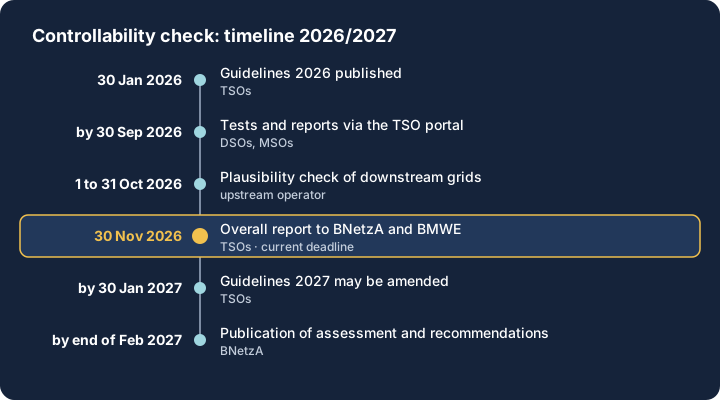
All tests had to be done and the survey forms uploaded to the transmission operators' data portals by 30 September. From 1 to 31 October every upstream operator checked the figures of the grids below it and reported back to the downstream operator and the default metering operator. Three questions from the guidelines guide this: does it have its own experience of controllability in the downstream grid, does the share of controllable plants look plausible, and does the plant list match the known master data.
Each grid operator decides how to test, within two limits. A test on a single plant should not exceed 60 minutes, and the simultaneously requested change in active power across all plants must not exceed 10 MW unless the responsible transmission operator agrees to more. Start and end should avoid quarter-hour boundaries, where market-driven switching already causes frequency jumps. No compensation is paid to the plant operator for the test, unless it coincides with an adjustment that was needed anyway, such as redispatch.
What was new in the 2026 check
A grid operator that looked good in the 2025 report can look worse in 2026 without anything in its grid getting worse, because the second check measures more. Since 1 January 2026, Section 12(2a) and (2b) EnWG also require tests for plants below 100 kW, to the extent the grid operator can control them remotely at any time.
Exemptions are now drawn more precisely. A plant needs no separate test if the grid operator adjusted it successfully in redispatch after 30 September of the previous year, or if it passed a remote-control test during its operating permit procedure. Emergency generators and other plants that do not feed into the grid (Section 29(5) MsbG) stay out; reserve power plants prove their controllability in their regular trial runs.
One clarification matters for utilities that also run a direct marketing business: the guidelines only count commands from the grid operator. Market-based control "or control by the direct marketer is not sufficient in connection with the controllability check", chapter 4.1.4 says. A plant that sales reliably curtails at negative prices still does not count as tested in the survey form unless the command came from the grid operator. If the plant operator carries out a grid operator command, even one given by phone, that is enough. If the connecting grid operator has handed control to another grid operator, that operator runs the test and the connecting operator records the result in its survey form.
What the first report showed
Measured by installed capacity, no energy source was fully controllable in 2025, and small plants did worst. A plant counted as controllable if it passed a test between 1 May and 30 September or was controlled successfully in grid operation; a plant without a test counted as not controllable.
| Size class | Solar | Wind | Biomass | Storage | Conventional | All |
|---|---|---|---|---|---|---|
| 100 kW to 1 MW | 60% | 73% | 50% | 20% | 35% | 57% |
| 1 to 10 MW | 82% | 86% | 47% | 27% | 37% | 82% |
| over 10 MW | 79% | 100% | 30% | 77% | 81% | 78% |
| all classes | 73% | 86% | 47% | 74% | 77% | - |
Source: Report of the German transmission system operators on the controllability of plants under Section 12(2c) EnWG, reporting year 2025, table 3. The "other" category (hydro, geothermal, waste and more) stood at 50 percent.
The report calls the causes technical, organisational and economic, and in many cases unknown. Around 42 percent of the capacity with ripple control could not be controlled, about 11.8 GW, and many of these plants sit together in control groups. With telecontrol, around 14 percent counted as not controllable, about 17.9 GW; the transmission operators suspect that part of this is survey errors, since, based on operational experience and talks with distribution operators, part of these plants is controlled successfully in day-to-day operation. What surprised them was that around 30 percent of telecontrol can only be addressed in groups, which drags the rates down further.

For storage and conventional plants, a large part of the missing controllability came down to no functional test being possible during the test window. As general reasons, the report lists missing capacity and processes at some grid operators, plants not running on the test date and weather with too little feed-in for a meaningful test. Add missing telecontrol, weak LTE links and cases where the connecting operator judged retrofitting uneconomic. In many cases the cause stayed unknown. Smart metering systems played practically no role: 130 plants from 100 kW had one, and almost all of them were controlled via telecontrol. For this size class the deployment duty under the Metering Point Operation Act only starts in 2028; details are in our piece on remote control via the smart meter gateway from 2028.
Who delivers, who checks, who reports
A municipal utility often holds three of the four roles under one roof: grid operation, default metering and, as upstream operator, the plausibility check for smaller neighbouring grids.
| Role | Duty | 2026 date |
|---|---|---|
| Distribution system operator (connecting grid) | tests adjustment and actual value retrieval at every plant, fills in the survey form, enters the default metering operator's figures | 30 Sep |
| Default metering operator | checks every year how far metering points are equipped with smart metering systems and control units and reports to the grid operator; both agree the exchange bilaterally | in time before 30 Sep |
| Upstream grid operator | checks the plausibility of results from directly downstream grids and reports back; the DSO directly below the TSO also passes on its downstream grids' results | 1 to 31 Oct |
| Transmission system operator | provides survey form and portal, evaluates, writes the overall report, may amend the guidelines | 30 Nov, guidelines by 30 Jan 2027 |
Last year's report barely evaluated the metering side, because no deployment duty applied to plants from 100 kW in 2025. In chapter 4.3, though, the transmission operators write that they gained the impression that future checks should also look at whether grid operators use the technology rolled out. For default metering operators the report matters for another reason: together with the overall report it shows whether the Federal Network Agency can withdraw default responsibility under Section 12(2g) EnWG (see the next section; for the procedure, our piece on the fallback metering operator under Section 11 MsbG).
What the law provides for breaches
Section 12 EnWG gives the Federal Network Agency different tools for grid operators and metering operators, and none of them applies automatically. For a grid operator that does not meet its duty under paragraph 2a, the agency can order compliance under Section 65 EnWG. If a downstream distribution operator breaches it persistently or repeatedly, paragraph 2e lets the agency withdraw remote control of the plants in its grid, and grid management to the extent linked to it, and transfer both to the upstream distribution operator. If the operator later proves it can do the job, the agency can hand the task back.
For the default metering operator the hardest step is in paragraph 2g: withdrawal of default responsibility and appointment of a fallback metering operator. The law knows two cases. In the first, the overall report or other information shows that the deployment duties in the grid area are missed by at least 25 percent (no. 1). In the second, the metering operator fails to meet its checking duties or its contribution duty, or does not meet them sufficiently, so this cannot be established (no. 2). In both cases the gap must also be capable of contributing significantly to a not insignificant threat to or disruption of the security or reliability of the electricity supply system in at least one control area. Contributing therefore does not protect an operator whose deployment lags far behind. The agency must give the operator a chance to comment first.
Paragraph 2h obliges the grid operator to disconnect a plant or stop its feed-in if the metering operator breaches its duties of proper metering point operation remote control is significantly impaired as a result and the plant operator has not already demonstrably taken the plant out of operation; Section 52a(2) to (7) of the Renewable Energy Sources Act (EEG) applies accordingly. The plant operator can then claim damages from the metering operator, unless the latter is not responsible for the breach. Separately, a plant operator that breaches its technical duties under the EEG owes payments to the grid operator under Section 52 EEG.
This overview describes what the law provides. Whether and when the agency takes one of these steps depends on the individual case and cannot be read from the report alone.
What happens after the report
On its topic page the Federal Network Agency says it writes to all grid operators with a controllability rate below 100 percent, citing Section 12(2a) EnWG, and points out the poor status to those with particularly low rates. The second report is the first that allows a comparison with the previous year; whether the transmission operators will compare figures per grid operator is open.
Overall report with the agency and the ministry
The transmission operators submit it jointly, with results per control area and recommendations.
Guidelines for the 2027 check
Within two months of the report the transmission operators may amend the guidelines; in 2026 they appeared on 30 January.
Publication by the Federal Network Agency
No later than three months after receipt, the agency publishes the sections with the assessment and recommendations.
Tests and reports for the third check
The date comes from the guidelines and holds only if the 2027 guidelines keep the chain of deadlines. The law fixes the report due by 30 November 2027.
First-report recommendations point to where the 2027 guidelines might go. The transmission operators advise reviewing how control groups are composed and separating well-reachable plants from poorly reachable ones, replacing ripple control with more reliable technology in the medium to long term (distribution operators named telecontrol), and running commissioning tests in full even where a shorter test would speed up grid connection. For "other" and conventional plants, where EEG and CHP Act sanctions partly do not apply, they argue for new penalties; that is a demand on the legislator, not an existing rule.
Where the rate misleads
What the controllability rate measures is proof, not actual controllability, and the transmission operators say so themselves. A plant without a test counts as not controllable even if it would probably have responded. A plant in a control group gets the group result if it is not metered individually. And because the market master data register lists units rather than plants, the report counts units, so its numbers may differ from your own plant count.
Then there is the effort. BDEW had called for a substantial slimming of the requirements during the legislative process and wrote in February 2026 that this did not happen because the legislative period ended early. A guest article in the trade paper ZfK in April 2025 said the guidelines were loosely worded, questions of interpretation were likely in practice, and the tight timeline forced many grid operators to rebuild processes. In the report, the transmission operators admit that the procedure involved "a not inconsiderable administrative effort" and drew some criticism.
The criticism does not change the duty, and chapter 4.1 of the report gives the reason. When Redispatch 2.0 was introduced, plants did not respond to the curtailment signal and kept feeding in. The requesting grid operator assumed the curtailment had worked and balanced it with extra upward redispatch, which upset the system balance. That is why, according to the report, redispatch with distribution grid plants balanced by the grid operator has not been possible so far; the balance responsible parties currently handle balancing in the market.
How balancing through the balance responsible parties is settled is covered in our piece on redispatch without balancing. For the controllability check this means: better controllability is one precondition for grid operators to balance redispatch with distribution grid plants themselves in future.
What grid operators should do now
Apart from answering follow-up questions, you cannot change the 2026 report any more. What you do in the next ten months goes into the 2027 report, and the weeks before the new guidelines at the end of January are a good time to take your own results apart.
Before the 2027 check
-
Analyse results plant by plant
Assign every plant without "controllable" status to a cause: no test, no equipment, faulty device, communication, group result, cause unknown. The "unknown" category was large in 2025 and only shrinks with site visits.
-
Work through the plausibility feedback
Whatever your upstream operator flagged in October belongs in the master data before the transmission operator prefills the next survey form from the market master data register.
-
Split control groups
Take plants that can be metered individually out of large ripple control groups. Where individual metering already exists, this improves the rate without new hardware; the transmission operators suggest using the dissolution of control groups in Redispatch 2.0 at the same time.
-
Plan retrofits where ripple control fails
For plants that fail repeatedly, draw up a plan for telecontrol or control via the smart meter gateway, with costs and an order based on operational relevance. Our piece on the rollout quota for generation plants shows how the deployment duties for generation add up.
-
Put the data exchange with the metering operator in writing
Agree format and date of the annual deployment report bilaterally, even if both roles sit in the same company.
-
Have the 2027 test plan ready before the test season
Read the 2027 guidelines from February (in 2025 the test window opened on 1 May), match test windows to feed-in forecasts and settle the 10 MW limit with the transmission operator if it slows your tests. In 2025 plants went untested because some grid operators lacked capacity and processes during the test window.

How much work this is depends on the number of plants and the technology. A grid operator with a few dozen plants from 100 kW has a manageable list; one that runs thousands of plants in ripple control groups faces a retrofit over several years. In our view the plan for it should be in place when the Federal Network Agency's letter arrives.
Deadline, market roles, systems
30 November 2026Controllability: TSOs' overall report under Section 12(2c) EnWGLaw · adopted
Applicability: TSOs with control area responsibility prepare the report; electricity DSOs and default metering operators contribute. Process and data format are set by the TSOs' guidelines under Section 12(2d) EnWG.
If the deadline is missed: Exclusion or loss of role If a default metering operator fails its check or contribution duty and it therefore cannot be established whether the deployment obligations are missed by at least 25 percent in a way that could significantly endanger system security in a control area, the Federal Network Agency can withdraw its default responsibility under Section 12(2g) no. 2 EnWG. It can order network operators to comply under Section 65 EnWG. Legal basis ↗
- Electricity grid operatorrole obligationContributes to the overall report: reports controllability test results by 30 September and, as an upstream operator, checks downstream data by 31 October.Typically affected: Grid control system / SCADA, Regulatory management, controlling
- Transmission system operatorrole obligationPrepares the overall report jointly with the other TSOs and submits it to the Federal Network Agency and the ministry by 30 November.Typically affected: Regulatory management, controlling, Grid control system / SCADA
- Default metering point operatorrole obligationChecks the status of smart metering system and control unit deployment every year and passes it to the network operator for the overall report.Typically affected: Gateway administration and CLS management
A classification for typical market roles, not a review of your individual case and not legal advice. Whether an obligation applies to your company (thresholds, exemptions) is for your legal department or counsel to confirm. The calendar doesn't replace your own deadline review. Information as of: 15 November 2026.
Further reading
Frequently asked questions
The controllability check is the annual test in which every German electricity grid operator proves under Section 12(2b) EnWG that it can adjust connected generation plants and storage by remote control and retrieve their actual feed-in. It covers plants from 100 kW and, since 2026, smaller ones where the grid operator can control them remotely at any time. The transmission system operators' guidelines set the procedure and data format.
The report contains the results of all tests and of the default metering operators' checks, including plausibility checks, an assessment of how far the duties under Section 12(2a) EnWG and Section 45(1) MsbG are met, and recommendations. The transmission system operators submit it to the Federal Network Agency and the Federal Ministry for Economic Affairs and Energy by 30 November.
Not under the 2026 guidelines: tests and reports ran until 30 September, the plausibility check by upstream operators until 31 October. The duty to contribute under Section 12(2c) sentence 3 EnWG still applies, for instance when the transmission system operators query implausible data sets.
The Federal Network Agency publishes the sections with the assessment and recommendations no later than three months after receipt. By its own account it writes to every grid operator with a controllability rate below 100 percent. The transmission system operators may amend their guidelines within two months of the report, so by 30 January 2027 if the report arrives on 30 November 2026.
If a downstream distribution system operator persistently or repeatedly breaches its control duty, the Federal Network Agency can withdraw remote control from it and transfer it to the upstream operator (Section 12(2e) EnWG). It can withdraw default responsibility from a default metering operator if its deployment duties are missed by at least 25 percent (Section 12(2g) no. 1 EnWG) or this cannot be established because it does not sufficiently meet its checking or contribution duties (no. 2), and in each case this could contribute significantly to a not insignificant threat to or disruption of system security in at least one control area.
No. The 2026 guidelines require the command to come from the grid operator. Market-based control by the direct marketer does not count for the controllability check. If the connecting grid operator has handed control to another grid operator, that operator runs the test and the connecting operator records the result in its survey form.
Let's collaborate
One contact, a team behind it
Thirty minutes on what you're working on, whether grid, metering, market processes, IT architecture or AI. Afterwards you'll know how we'd approach it and who would sit at the table.
Energy and measurement technology since 2010 · innobu GmbH since 2014 · Based in Schleswig-Holstein, Germany
Whoever pitches also delivers: whoever leads the first call stays your contact right through to the steering committee, with established partners in the project. Direct: info@innobu.com