
Redispatch without balancing: what draft BK8-26-001-A asks of distribution grid operators from 2027
A grid operator curtails a cluster of wind farms. It doesn't replace the missing energy itself; the direct marketer's balancing group does, and the money flows through the plant operator. How much, the Bundesnetzagentur is now writing down.
The cost reimbursement for redispatch without balancing is the flat rate a German distribution system operator pays the plant operator under Section 14(1b) of the Energy Industry Act (EnWG) when the plant's balancing responsible party buys back the curtailed energy itself; the Bundesnetzagentur's draft ruling BK8-26-001-A is open for comment until 21 October 2026 and is meant to apply from 1 January 2027. Per quarter hour, the reimbursement is a blended price of 72.5 percent ID-AEP and 27.5 percent reBAP plus €1.35 per MWh for overhead, applied to the curtailed energy. Grid operators may pass the full cost on only for measures announced at least 30 minutes in advance, or for late ones up to 20 percent of their annual curtailed energy. Above that they retain €3.90 per MWh from 2028.
What the consultation is about
Draft BK8-26-001-A came out on 1 October 2026, and Ruling Chamber 8 takes comments until Wednesday, 21 October. It wants to settle two things. What a distribution system operator pays when a balancing responsible party absorbs the effect of a redispatch measure. And how much of that it gets back through grid fees.
The law behind it is ten months old.
On 23 December 2025 an amendment to German energy law took effect (Federal Law Gazette 2025 I No. 347) and rewrote Section 14 EnWG in paragraphs 1 to 1c. Until the end of 2031, distribution system operators have to balance redispatch measures in a targeted way only for plants that ruling BK6-23-241 of 7 May 2026 assigns to them. For all others, balancing is deemed done, and the grid operator owes the plant operator an appropriate reimbursement instead.
Who is out? Plants the grid operator already balances itself in the schedule-based model under BK6-23-241, and plants on the feed-in tariff whose power the transmission system operator markets under Section 19(1) No. 2 of the Renewable Energy Sources Act. Everything else is in, which means most directly marketed wind and solar parks connected to distribution grids. Not a niche.
Comments go as a PDF to Poststelle.BK8@BNetzA.de. Mark trade secrets and attach a redacted version, because the chamber posts every submission online.
Why a reimbursement is needed at all
Because balancing in the distribution grid never worked. It became mandatory on 1 October 2021, never got past pilot projects, and even those ended on 1 August 2023 after repeated large deviations in the system balance. That is the Bundesnetzagentur's own account, in its own draft.
What followed was a stopgap designed by the industry association BDEW. Balancing responsible parties rebalance, grid operators pay them a blended price of 72.5 percent ID1 and 27.5 percent reBAP, and Ruling Chambers 6 and 8 accepted this in their Communication No. 11 of 13 November 2023. It was meant to last a few months. It lasted almost three years.

At the end of 2025 lawmakers gave up, at least until 2031. They suspended balancing in the distribution grid and told the regulator to set the costs as flat rates, since proving them case by case "can be difficult and laborious", as the draft puts it. Honest, at least.
How much energy are we talking about? In 2025 congestion management covered about 30.3 TWh, roughly a third of curtailed renewable output was caused by distribution grid bottlenecks (a quarter the year before), and the federal government puts the cost of congestion management at about €3.08 billion. The distribution share keeps growing. Every one of those curtailments becomes a billing case under BK8-26-001-A.
What the draft calculates
Two components, both in euros per MWh, both multiplied by the curtailed energy of the quarter hour: a blended price and a flat overhead fee. The real change is in the index.
72.5%
of the blended price now comes from ID-AEP instead of ID1
€1.35/MWh
goes on top as an overhead fee
€3.90/MWh
stays with the grid operator from 2028 if it is late too often
ID-AEP is calculated by the transmission system operators responsible for the control areas: a volume-weighted average of the last trades in a quarter-hour product, up to 500 MW. So it captures trading right up to delivery, while ID1 stops 30 minutes before. Consultancy Consentec called it appropriate in its expert report for BK6-23-241, and almost everyone agreed in the consultation on the key issues paper. One of the few points nobody fought over.
reBAP keeps its 27.5 percent. It stands in for cases where notice comes too late and the balancing group sits in imbalance energy for a while before the trader can react.
And the €1.35? A second Consentec report on the costs of several balancing responsible parties, weighted average, range €0.70 to €2.60 per MWh. The chamber deliberately took the mean rather than any individual trader's costs. If yours are higher, that's your problem.
The blended price keeps its sign. If it turns negative in a quarter hour, say with negative intraday prices at midday, the plant operator pays the grid operator. Plant operators objected at the workshop on 20 August 2026. The draft doesn't budge.
Market-driven curtailment and unavailability reduce the curtailed energy only if they were reported before the measure began. Reports after that don't count.
The 30-minute line and the retained amount
This is where the incentive sits, and it's not in the billing but in the revenue cap. The key issues paper of 8 June 2026 had mixed the two, with four case types and measure-by-measure evidence. None of that survived.
On time means the advance notice reaches the plant operator at least 30 minutes before the measure starts. What counts is arrival in the recipient's sphere. For those measures the reimbursement can be passed on in full as a volatile cost component, under Section 11(5) of the Incentive Regulation Ordinance until 2028 and under RAMEN Strom from 2029.
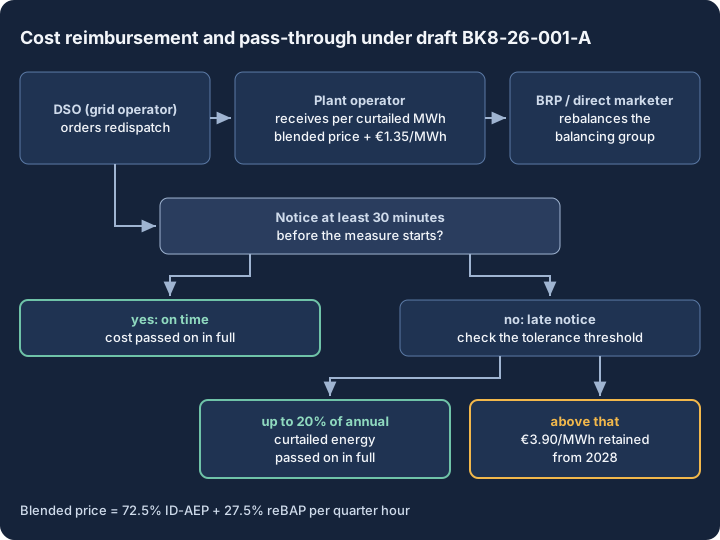
And if notice is late? The grid operator still passes the cost on, up to a tolerance threshold of 20 percent of its annual curtailed energy from negative measures. Only above that does a retained amount of €3.90 per MWh kick in, first for calendar year 2028.
That number wasn't pulled from the air. The chamber took every measure ordered by distribution system operators in 2025, measured the gap between reBAP and ID-AEP in the first four quarter hours, and scaled it to the average duration: 6.8 hours for solar, 6.7 for wind. After an hour, the assumption goes, a trader can trade again.
Grid operators in the middle of a cascade get some relief. Anything requested by an upstream operator under Section 14(1c) EnWG stays fully passable and is left out of the threshold. Only operators that request and order a measure themselves carry the retained amount.
Transparency from 2027
Two numbers per quarter, public, on the operator's own website: curtailed energy from measures it ordered because of its own congestion, and the share of that announced on time.
They must be up three months after the quarter ends, stay up for three years, and go to the chamber with the annual application on the regulatory account balance. Below 10 GWh in a quarter, the duty lapses.
Sounds like paperwork. It's really the first public ranking of which grid operators warn their market partners in time. Direct marketers will read it.
Without delay versus 30 minutes: the dispute over notice
The 30 minutes have been contested since the key issues paper. The draft didn't end the fight. It moved it, from billing to pass-through.
BDEW wrote on 1 July 2026 that the proposed logic leads "zu einer deutlichen Erhöhung der Komplexität in der operativen Abwicklung" (to a marked increase in operational complexity) and to a "sachlich nicht gerechtfertigten Benachteiligung kurzfristig erforderlicher Redispatch-Maßnahmen" (an objectively unjustified disadvantage for redispatch measures needed at short notice). The law requires notice "unverzüglich nach Kenntniserlangung", without delay once the operator knows. It says nothing about 30 minutes. BDEW wants the "vollständige Wälzbarkeit sämtlicher Redispatch-Kosten" (full pass-through of all redispatch costs) preserved.
Direct marketers see it the other way. At the workshop on 20 August 2026, according to the draft, they considered "einen Vorlauf von 30 Minuten für erforderlich, um überhaupt handelsseitig auf Redispatch-Maßnahmen reagieren zu können", 30 minutes being the minimum to react through trading at all. They also said some grid operators today send information on their measures almost exclusively in the last quarter hour or afterwards.
On this point the chamber has picked a side. It "verwies darauf, dass die Netzbetreiber in der Pflicht seien, die Prozesse und die Kommunikation mit den Marktteilnehmern zu verbessern" (pointed out that grid operators are obliged to improve processes and communication with market participants), the draft says, citing the controllability checks under Section 12(2b) EnWG.
Grid operators answered at the same workshop with the weather: sudden wind fronts can't be planned to the minute.
What is still open in the draft
Until 21 October one number is most open to change: the 20 percent. The chamber set it as a flat allowance for cases where the lead time can't be met through no fault of the operator. Whether it is enough only an operator that knows its own rate for 2025 and 2026 can say, and whoever brings that data has the strongest argument in the proceedings.
Then proof. The draft ties timeliness to arrival in the plant operator's sphere but doesn't say who creates the timestamp there when a service provider or three grid operators sit in the chain.
Plant operators wanted grid operators to settle directly with the balancing responsible party, since they lack the data. Rejected. The law names the plant operator, and the chamber stays out of contracts with direct marketers. Who carries negative blended prices there is for the two parties to sort out.
Taking part in the consultation is voluntary, and there is no sanction. Anyone who submits nothing by 21 October 2026 can no longer bring objections into this proceeding, though; Ruling Chamber 8 then publishes the final ruling, targeted for year end.
What grid operators should do now
Run the numbers first, write second. Until 21 October a figure from your own dispatch data carries more weight than any objection in principle. After that it's about systems that have to work on 1 January.
Five steps, before 21 October and after
-
Measure your own rate
How many of the measures you ordered yourself in 2025 and 2026 had 30 minutes' notice, measured at arrival with the plant operator rather than at sending? Your call-off timestamps hold the answer. Under 20 percent late, the retained amount barely touches you. Above that, project the 2028 figure before you comment.
-
Comment with data
A rate convinces the chamber more than a reference to Section 13a.
-
Switch the billing
ID-AEP instead of ID1, the flat fee, payments in both directions: price data feeds, billing logic and credit notes all change on 1 January 2027.
-
Flag cascade cases
Requests from upstream operators stay out of the threshold. For that they have to be recognisable as such in your systems, and today they often aren't.
-
Prepare quarterly reporting
Above 10 GWh a quarter? Then the first report, for January to March 2027, is due at the end of June.
Direct marketers start elsewhere: with their contracts with plant operators and the question of who carries negative blended prices. Next comes their own intraday logic, which has to move to ID-AEP, closely related to what our piece on AI in balancing group management describes. And the next step is already coming. Redispatch 3.0 brings small flexibility into congestion management, and the same billing questions will come back there.
Deadline, market roles, systems
21 October 2026Redispatch without balancing: consultation on cost reimbursement closesConsultation · open
If the deadline is missed: No direct legal consequence Comments are voluntary. Anyone who submits nothing by 21 October 2026 can no longer bring objections into this consultation; Ruling Chamber 8 then publishes the final ruling. Legal basis ↗
- Electricity grid operatoraffectedCan comment until 21 October and models which reimbursements arise without targeted balancing.Typically affected: Regulatory management, controlling, Grid usage and customer billing
- Balance responsible partycheck applicabilityAssesses how the reimbursement affects balancing groups.Typically affected: Trading and procurement system (ETRM)
- Plant operator (generation)check applicabilityAssesses whether reimbursement for curtailed plants is calculated differently.Typically affected: Plant master data and MaStR
A classification for typical market roles, not a review of your individual case and not legal advice. Whether an obligation applies to your company (thresholds, exemptions) is for your legal department or counsel to confirm. The calendar doesn't replace your own deadline review. Deadline calendar as of: 13 October 2026.
Further Reading
Frequently Asked Questions
When a German distribution system operator does not balance a redispatch measure itself, the balancing responsible party of the plant operator does it. Under Section 14(1b) EnWG the grid operator pays the plant operator an appropriate reimbursement for this as part of the financial compensation. The Bundesnetzagentur sets its level as a flat rate in ruling BK8-26-001-A.
Wednesday, 21 October 2026. Comments go as a PDF by email to Ruling Chamber 8 of the Bundesnetzagentur. Trade secrets must be marked and a redacted version submitted as well, because the Bundesnetzagentur publishes all comments.
For each quarter hour, 72.5 percent comes from the ID-AEP intraday price index and 27.5 percent from reBAP, the uniform cross-control-area imbalance price. A flat overhead fee of €1.35 per MWh is added. Both components apply to the curtailed energy of that quarter hour. The blended price can be negative.
Notice counts as on time if it reaches the plant operator at least 30 minutes before the measure starts. For later notices the grid operator can still pass on the full cost for up to 20 percent of its annual curtailed energy from negative redispatch. Above that it retains €3.90 per MWh from calendar year 2028.
The draft sets 1 January 2027 as the date of notification. From then on the reimbursement, cost pass-through and transparency rules apply. The retained amount applies for the first time to calendar year 2028. The ruling expires on 31 December 2031.
Plants the distribution system operator already balances itself under ruling BK6-23-241, and plants whose power the transmission system operator markets under Section 19(1) No. 2 EEG, which means plants on the feed-in tariff.
Let's collaborate
One contact, a team behind it
Thirty minutes on what you're working on, whether grid, metering, market processes, IT architecture or AI. Afterwards you'll know how we'd approach it and who would sit at the table.
Energy and measurement technology since 2010 · innobu GmbH since 2014 · Based in Schleswig-Holstein, Germany
Whoever pitches also delivers: whoever leads the first call stays your contact right through to the steering committee, with established partners in the project. Direct: info@innobu.com