Grid development scenarios 2027: what follows the consultation
Submissions closed on 28 September 2026. What the regulator does with them now, and what comes back to grid operators.
A scenario framework is the set of assumptions on generation, consumption and gas demand that grid operators submit and that the Bundesnetzagentur approves as the calculation basis for the network development plans. The 2027 version ran for public comment from 31 August to 28 September 2026. That was the planning cycle's first formal participation window, and section 12a(3) EnWG bars third parties from challenging the approval on its own. Operators aim for approval six months after the 30 June 2026 filing. The previous cycle took ten. Binding afterwards is the approved text, not the consulted draft: the electricity draft carries 34.8 TWh of distribution grid losses and puts estimated net consumption for 2040 somewhere between 855.4 and 1,056.1 TWh.
What ended on 28 September
Nobody can file anything now. Since 28 September 2026 the Bundesnetzagentur has stopped taking submissions on the electricity and gas/hydrogen scenario frameworks 2027 to 2040/2045, open since 31 August along with an accompanying document. In their own draft, the transmission system operators call that window the first formal chance to get into grid planning at all.
Both drafts arrived on time, 30 June 2026. Electricity runs under section 12a EnWG, gas and hydrogen under section 15a ff. EnWG. Running the two consultations together was new, and every association welcomed it. Over 400 people sat in on the online briefing of 10 September.
The deadline matters less than what it closes off. Section 12a(3) EnWG says the approval cannot be challenged independently by third parties. Think an assumption is wrong? The consultation was the place to say so. Afterwards there is no appeal.
Next time anyone gets a formal say is the draft network development plan. Until then the regulator works alone.
The timetable up to approval
The regulator is examining the drafts and will weigh what public participation produced. No approval date has been published. The gas and hydrogen transmission operators do name a target in the draft itself: six months after filing, counted from 30 June 2026.
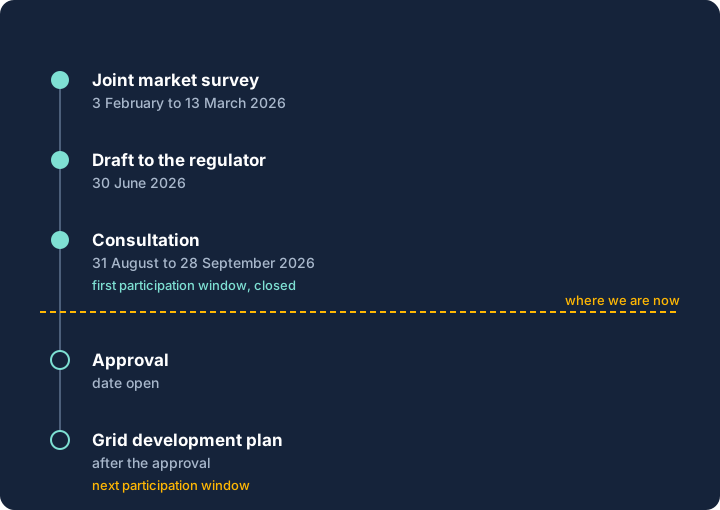
Last cycle missed it. The draft for the 2037/2045 network development plan went over on 28 June 2024, consultation ran that September, approval came on 30 April 2025. Ten months.
Approval around the turn of the year is the optimistic read. Spring 2027 is what the last cycle actually did. Hold both windows open.
Then the plans get written. The previous round gives a marker there too: approval at the end of April 2025, first draft plan in early December, a good seven months apart. For methane and hydrogen, our piece on the integrated Gas and Hydrogen Network Development Plan 2025 covers what that document then holds.
What the associations objected to
Direction is not what the published submissions fight about. They fight about the spread between the paths, and about how far single assumptions carry. Three lines land directly on grid operators: the classification of the lowest electricity scenario, the treatment of biomethane and electrolysers, and how much of the hydrogen modelling stays visible.
VKU speaks for more than 1,600 municipal utilities and local public enterprises. Two things it welcomes outright. Scenario B is the first scenario agreed between electricity and gas network operators, and the regional scenarios of distribution operators are built in more firmly than before.
The objection follows immediately. Scenario A undershoots the renewables targets. Call that path robust, VKU argues, and grid development slows, with effects running all the way down to the distribution level. It wants the classification explained in the open.
| Association | Welcomes | Wants revised |
|---|---|---|
| VKU | Scenario B as the first jointly agreed scenario, stronger use of the regional scenarios | An open rationale for scenario A, wider spreads plus a sensitivity analysis, economic recognition of grid-serving storage |
| BDEW | Consulting on both frameworks at once as an integrated view | Revisions on biomethane and on electrolysers |
| BVEG | The scenario-based approach for methane and hydrogen | Clarity on offtake of domestic production after 2029, transparency on pressure assumptions and on withdrawal capacity during low-wind periods |
Two more VKU points bite. Paths B and C sit close together, so the spread teaches less than it should. And where classic peak shaving goes, grid-serving instruments have to pay: service fees to operators of grid-serving storage, for instance. Otherwise distribution operators carry the duty and little else.
Maturity grades and the long-term forecast on the gas side
Whatever decides the regionalisation on the gas and hydrogen side comes from distribution network operators. Most methane end users hang off their networks. That makes their long-term forecast a central input, and for 2027 it was extended.
Demand now runs to 2050, not just to the target year, and for the first time it is split by sector: power generation and conversion, industry, commerce, households, transport. That is the real step forward this cycle.

Second change: likelihood. Reported hydrogen demand and large-customer projects carry a maturity grade now. Section 16 of the gas cooperation agreement holds the definitions, agreed in the negotiating delegation of BDEW, VKU and GEODE.
| Grade | What it requires |
|---|---|
| Secured demand | A concrete capacity reservation or booking, a contract on the technical parameters of the grid connection, or substantial public funding |
| Grade 1 | Very likely: an agreed grid planning concept or a written agreement with a financial component, plus heat customers in published hydrogen network areas from municipal heat planning |
| Grade 2 | Likely: a written letter of intent or released meeting record showing interest in hydrogen supply |
| Grade 3 | Possible: hydrogen supply conceivable in principle, no loss of methane demand indicated, areas still under review in municipal heat planning |
And then the part that hurts. Transmission operators went back over the grade 1 and secured-demand ratings in distribution network areas, together with the distribution operators, looking hardest where projects had been unknown to them and are meant to stand by the 2035 modelling year. Rate a project too generously and it drops out of the regionalisation.
Municipal heat planning sits inside gas network planning now, as a criterion in the maturity definitions rather than as background. The capacity side shows the same pattern, where booking in the hydrogen core network has run on its own rules since early 2026.
What becomes binding once the framework is approved
Approval turns the assumptions into the binding basis for the market and grid calculations behind the next network development plan. The approved version, not the consulted draft. And the regulator does change things: last cycle it amended the frameworks and approved them, by its own account.
How long such decisions last shows in one line of the current draft. Distribution grid losses: 34.8 TWh across all scenarios, in line with the 2025 approval, roughly double today. A figure from the last approval, standing unchanged in the next draft.
Cross-border capacity repeats it. The regulator noted in 2025 that extra transmission capacity without concrete evidence of where it sits can pre-commit connection points. Operators adopt the reasoning and recommend adding nothing beyond known project plans.
How wide is the decision still open? Estimated net electricity consumption for 2040 runs from 855.4 TWh in path A to 1,056.1 TWh in path C, against 466.0 TWh in the 2025 reference. New data centres climb from 4.2 TWh to 141.8 TWh under paths B and C. VKU calls even that rather conservative and wants the sensitivity to a faster ramp-up made visible.
Hydrogen spreads wider still. Electrolysis feed-in for 2040 runs from 17 GW in scenario 3 to 51 GW in scenario 1. The extra 2035 variant, which operators added beyond what the law asked of them, works with 10 GW and tests which hydrogen transport network is the minimum in 2035, and which methane lines can be converted by then.
For electricity distribution operators the approved volumes reach their own planning through the regional scenarios. We wrote that linkage up in our piece on the 2027 scenario framework in the distribution grid.
Challenges and risks
A scenario framework is a planning frame, not a forecast. Set the assumptions too low and expansion comes late. Too high and capital sits in the wrong place.
This autumn's practical problem is the open approval date. Six-month target against ten months last time: half a year in which nobody knows which volumes the next planning round calculates with.
Four points follow from the submissions and from the draft itself:
- Path A called robust would slow grid development down to the distribution level. That is VKU's worry, and it lands on investment decisions, not paperwork.
- Volumes set too high produce misplanning. Operators say so themselves: capacity without a concrete location can pre-commit connection points.
- Paths B and C sit too close for the spread to teach much. There is still no sensitivity analysis for missing individual targets.
- On the gas side the regionalisation is only as good as data the distribution operators reported themselves, and that was then re-checked.
None of it is settled by a submission. It is settled in the approval.
What utilities should do now
Window shut. The work is not. What happens over the coming months decides whether your planning stands on the approved framework or runs after it.

The coming months
-
Keep your own submission to hand
File your input, and your association's, where you can set it beside the approval when that is published. Which objections the regulator took up and which it dropped only shows in the comparison.
-
Diary both approval windows
Turn of the year 2026/2027, and spring 2027.
-
Hold regional scenarios and the grid expansion plan against the approved volumes
Once the approved version lands, put your regional scenarios next to it. Where your assumptions differ, write down the difference and why, instead of quietly taking the new numbers. For the grid expansion plan under section 14d EnWG, that derivation is exactly where the questions come back.
-
Recheck the maturity grades on the gas side
Test whether your reported hydrogen projects really carry the criteria in section 16 of the gas cooperation agreement, and whether the rating matches municipal heat planning where you operate. A report that fails the check disappears from the regionalisation. So does the network you planned around it.
-
Start collecting arguments for the network development plan
The draft network development plan is the next formal say you get. Start at publication and you write in two weeks what could have grown over months.
-
Put the cycle in the regulatory calendar
Under section 12a EnWG the next scenario framework is due by 30 June 2028, with the consultation following in the late summer after it. That is not a date you catch by accident.
Further reading
Frequently asked questions
The Bundesnetzagentur evaluates the submissions it received, examines the drafts and then approves the scenario framework, amending it where it sees reason to. Only the approved version is the basis for the market and grid calculations behind the network development plan, not the draft that was consulted on. The regulator has not published a date for the approval.
The gas and hydrogen transmission operators state a target of six months after submission in the draft itself, counted from 30 June 2026, which points to the end of 2026. The previous cycle took longer: ten months passed between submission on 28 June 2024 and approval on 30 April 2025. Plan for both windows.
No. Under section 12a(3) EnWG the approval of the scenario framework cannot be challenged independently by third parties. Objections to individual assumptions therefore belong in the consultation. The next formal chance to take part comes with the draft network development plan.
The long-term forecast is how distribution grid operators report future methane and hydrogen demand in their own networks. For the 2027 framework it was extended: demand now runs to 2050 and is broken down by sector for the first time, covering power generation and conversion, industry, commerce, households and transport. It is what the regionalisation is built on.
The maturity grades sort reported hydrogen projects by how likely they are to happen, from secured demand through grade 1 (very likely) and grade 2 (likely) to grade 3 (possible). The definitions sit in section 16 of the gas cooperation agreement. Transmission operators re-checked the grade 1 and secured-demand ratings for projects in distribution network areas.
Under section 12a EnWG the transmission system operators draw up a scenario framework every two years and submit it to the regulator by the end of 30 June of each even calendar year. The next draft is therefore due by 30 June 2028.
Let's collaborate
One contact, a team behind it
Thirty minutes on what you're working on, whether grid, metering, market processes, IT architecture or AI. Afterwards you'll know how we'd approach it and who would sit at the table.
Energy and measurement technology since 2010 · innobu GmbH since 2014 · Based in Schleswig-Holstein, Germany
Whoever pitches also delivers: whoever leads the first call stays your contact right through to the steering committee, with established partners in the project. Direct: info@innobu.com