Substation inspection robots: autonomous patrols, thermography and what grid operators settle before a pilot
On 5 November 2026 E.ON, enviaM and NEURA Robotics announced tests of humanoid robots on the Mitnetz Strom grid from 2027. From 14 January 2027 the new EU Machinery Regulation applies, which for the first time regulates autonomous mobile machinery explicitly. For heads of grid operations and maintenance the question is what a substation robot delivers today and what has to be settled before a pilot of their own.
A substation inspection robot is a mobile machine that follows a fixed route through the substation, reads gauges, takes thermal images and reports deviations; it replaces the routine walk-round, not the qualified electrician. In Germany, E.DIS began a pilot with such systems in 2021 and Bayernwerk in 2022, and there are still no reliable independent figures on the benefit. Units placed on the market from 14 January 2027 fall under the Machinery Regulation (EU) 2023/1230, with requirements for remote supervision and protection against tampering. Whether a pilot holds up depends on the link to the maintenance system, OT security under Section 5c EnWG, the risk assessment and co-determination.
What a substation inspection robot does
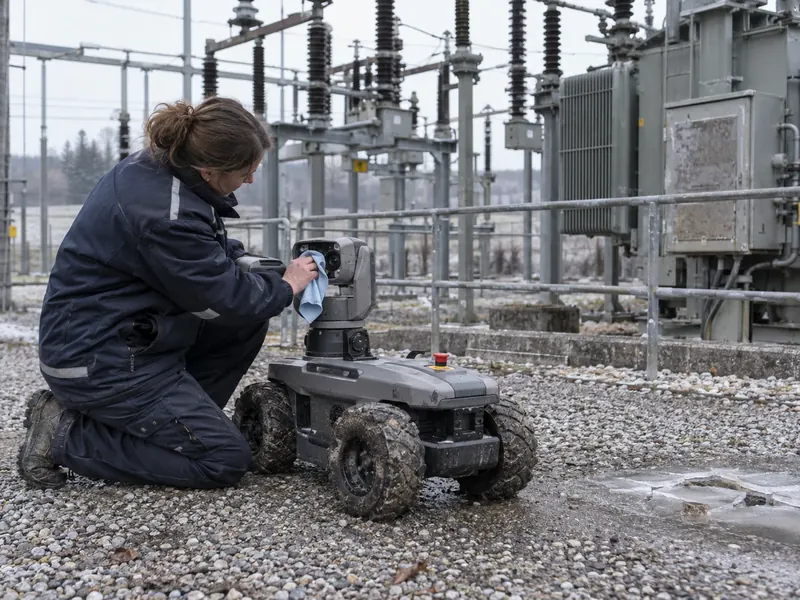
An inspection robot takes over the recurring walk-round. It drives a set route, stops at defined points, reads gauges, takes pictures and reports whatever deviates from the expected state; it does not switch, and it shouldn't. It is most useful in unmanned, remote sites, where the drive often takes longer than the round itself; Bayernwerk names shorter travel times explicitly as a goal.
E.DIS started in mid-July 2021 at its Altentreptow substation in Mecklenburg-Western Pomerania. According to the trade paper ZfK, the robots were to read analogue meters, check fences and doors and map the site in 3D with their cameras; the software came from the Darmstadt start-up Energy Robotics, now called Korial, and data travelled over 5G or LTE. Bayernwerk has used a robot since January 2022 that walks its inspection rounds on its own. In a press release from November 2023 the grid operator describes an AI model that spots holes in the fence against changing backgrounds, and an automatic door opener that lets the robot move between indoor and outdoor areas.
The designs differ more than the photos suggest. Four-legged robots such as Boston Dynamics' Spot or ANYbotics' ANYmal climb steps and kerbs; wheeled vehicles get by with simpler mechanics on gravel paths; rail-guided systems suit indoor switchgear with fixed walkways. TenneT trialled ANYmal for a week on an offshore converter platform back in 2018. Humanoid robots are still in training: NEURA Robotics wants to prepare its 4NE1 model for grid tasks in a training environment at TU Munich, and according to dpa first field experience at Mitnetz Strom is planned for the course of 2027. How drones fly power lines is covered in our piece on AI drone inspection of power grids; the robot on the ground covers the substation the drone only sees from above.
What the sensors measure
The value lies in repetition. A robot measures the same points from the same angle far more often than a six-monthly thermography survey, up to daily depending on the route, which produces time series that a single walk-round with a clipboard can't. What it measures depends on the payload.
- Zoom optics: analogue gauges such as SF6 density, oil level or operation counters, switch positions and LED states. The Spot robot that Avangrid announced in early 2024 for a pilot at two Connecticut substations carries a camera with 30x optical zoom.
- Thermography: thermal images of clamps, disconnectors, circuit breakers and transformers, usually read as a phase comparison in which the hot phase stands out against the other two.
- Acoustics: microphones record sound patterns. Avangrid's announcement included an optional acoustic sensor, and Korial names partial discharge as a use case, which is a vendor statement.
- Site: fence, doors, foreign objects, bird nests. At Bayernwerk, detecting holes in the fence was a focus of the AI work.

A documented finding from a pilot comes from a 2026 CIGRE paper. A Thai transmission utility used wheeled robots with optical and thermal cameras at two high-voltage substations, an outdoor site at 115, 69 and 22 kV and a compact indoor gas-insulated one. Over more than 150 rounds covering more than 600 check points, the robot found a temperature imbalance on a 22 kV disconnector, and feeder maintenance followed. Routine thermography there ran every six months, so the defect would have shown up at the next scheduled survey at the earliest. How many notifications in those 150 rounds turned out to be false alarms is not stated in the paper's summary.
Link to network control and maintenance
Without integration the robot is a camera on wheels whose images sit in a vendor portal. It starts to pay when a finding arrives as a notification in the maintenance system, with image, reading and the functional location of the asset, and when the control centre knows that a machine is moving through the site.
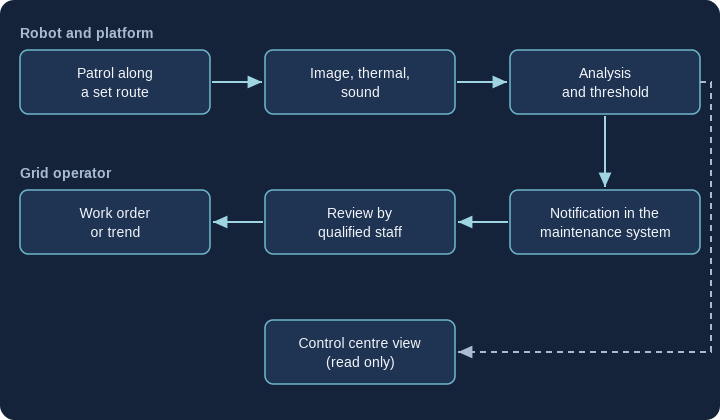
The interface to the maintenance system, SAP PM or S/4HANA Asset Management for instance, needs answers before purchase: which thresholds trigger a notification, who reviews it, and how does feedback from maintenance flow back so the analysis learns which findings were real? Vendors bring their own platforms with cloud fleet management. Korial points out that E.DIS, Bayernwerk and Avacon now work on the same platform, which saves duplicated development and ties three grid operators to one supplier.
For network control the line is simple: the robot may at most read data from the control system and never write to it, and it must have no effect on protection and control. On site it reads gauges whose values the control system often already knows and adds what is only visible there. Whether the control centre is notified before each round or sees the robot's position continuously belongs in the operating instructions. How communication in the switchgear network works under IEC 61850, and where an extra data stream would dock, is set out in our article on the IEC 61850 digital substation. Fixed sensors on individual assets are the other route, covered in our piece on transformer online monitoring. How measurement is built into the low-voltage grid is shown in our piece on digital secondary substations. The two approaches don't exclude each other: the transformer gets its dissolved gas analysis, and the robot walks the outdoor yard that nobody sees every day.
From calendar to measured condition
The robot supplies readings for condition-based maintenance, the decision stays with asset management, and without thresholds per asset type and trend analysis the data goes unused.
The US Electric Power Research Institute (EPRI) spent two years up to the end of 2023 testing robot platforms and payloads, among them Spot, Ghost Robotics and Indro Robotics; analysing defects and thermal anomalies was explicitly outside the project and ran separately. Automated image analysis is therefore the least independently tested part. The Thai pilot states its limits openly: lighting and viewing angle decide image quality, the robot misread untrained asset types or failed to read them, and fences hid gauges such as winding temperature. The authors consider the technology ready for practical use, as a support tool whose findings a person confirms.
Every false alarm costs a check by a qualified person. A pilot should therefore count the notifications that turned out to be wrong, not just the defects found.
IT/OT security: a new remote access path
From an OT security point of view, a robot with a radio module, cameras and a cloud platform is a new remote access path into a critical site. It belongs in the information security management system and the zone model before its first round, not after.
Since 6 December 2025 Germany's NIS2 implementation act has been in force, and the IT security of grid operators is now governed by Section 5c of the Energy Industry Act (EnWG). The Federal Network Agency (BNetzA) is revising its IT security catalogues. Until a new one is published, grid operators remain under the 2015 catalogue issued under Section 11(1a) EnWG in its old version. It requires an ISO/IEC 27001 certified management system for the systems needed for safe grid operation. Whether an inspection robot falls within scope is the grid operator's call; once it carries site data out or can be controlled from outside, there is a strong case that it does.
The IEC 62443 series provides the vocabulary: zones and conduits (separated network areas and the permitted connections between them), security levels, requirements for components and for the manufacturer's development process (IEC 62443-4-1). What that means for energy plants, and how the Cyber Resilience Act adds to it, is in our article on OT security under IEC 62443. For the robot the questions are concrete. Where are images and site maps stored, who has remote access, how do updates reach the device, and is its radio network separated from the substation network? A 3D map of a substation is sensitive information even if it carries no reading at all.
The Machinery Regulation adds the product side. Its Annex III, point 1.1.9, requires protection against corruption: connecting another device or remote access must not lead to a hazardous situation. Then there is the EU AI Act. High-risk AI includes systems intended as safety components in the operation of electricity supply (Annex III point 2); image analysis that documents gauges and whose findings a person checks controls nothing on the grid, which tends to speak against a high-risk classification under Annex III. A second route runs through Article 6(1): AI that acts as a safety component of the machine itself, for navigation and collision avoidance for instance, is high-risk if machinery law requires an assessment by a notified body for it. The grid operator has to check both per system, and our article on high-risk AI in energy infrastructure sets out the criteria.
Safety, Machinery Regulation and co-determination
The robot moves through a site with high voltage and with people. Risk assessment, access rules and the involvement of the works council or staff council therefore come before the first round, and for new units the Machinery Regulation applies from 14 January 2027.
| Rule | What it requires | Who acts |
|---|---|---|
| Machinery Regulation (EU) 2023/1230, applies from 14 Jan 2027 | Definition of "autonomous mobile machinery"; "where appropriate" a supervisory function that lets a supervisor stop the machine remotely or bring it to a safe state (Annex III point 3.2.4); movement and danger zones in the instructions (point 3.6.3.3) | Manufacturer; the grid operator asks for it in the tender |
| Section 5c EnWG with IT security catalogue | Adequate protection of the systems needed for safe grid operation, under the existing catalogues until the new one is out | Grid operator |
| Occupational safety and DIN VDE 0105-100 | Risk assessment for robot use; access, work and switching in electrical installations stay with instructed persons and qualified electricians | Grid operator as employer and plant operator |
| Section 87(1) no. 6 BetrVG | Co-determination on technical devices capable of monitoring employees' conduct or performance | Grid operator with a works council; for public-law municipal utilities the staff council under state law |
The Machinery Regulation hits the manufacturer first, who has to demonstrate the new requirements and affix the CE marking on that basis for units from 14 January 2027. For the grid operator it becomes a procurement check: anyone buying a robot placed on the market from 14 January 2027 asks for a declaration of conformity under the regulation, instructions that state movement and danger zones and, where provided for the autonomous mode, a supervisory function that lets the supervisor stop the machine. Units placed on the market earlier under the Machinery Directive may still be sold (Article 52) and come with a declaration under the directive. Anyone who later substantially modifies the robot, for instance with their own payload or control software, can take on manufacturer obligations under Article 18 if the change creates a new hazard (Article 3(16)). What counts is when the manufacturer places the unit on the market, not the delivery date; a robot built in 2026 and first made available in 2027 falls under the new regulation. Because the regulation leaves open when a supervisory function is needed ("where appropriate"), the tender should ask for it in every case.
Because the robot is meant for assets, co-determination is easily overlooked. But its cameras and microphones also capture the fitters working on site, which makes it a technical device under Section 87(1) no. 6 of the Works Constitution Act; the Federal Labour Court treats the mere capability to monitor as enough. A works agreement that sets out what the robot records, how long images are kept and that they are not used for performance monitoring is the usual route. What changes at municipal utilities with a staff council is covered in our piece on AI and co-determination at utilities. enviaM's chief executive Stephan Lowis says the planned humanoid robots could take targeted load off skilled staff.
What the pilot data does not show
The data for a business case isn't there yet. Almost all figures on inspection robots come from vendors or from grid operators presenting their own pilots, and no independent evaluation of a German pilot has been published.
Korial cites more than one million autonomous inspections on its platform and more than 35,000 hours of manual inspection saved, without saying how the hours were calculated. The business magazine ERP Today reports on an unnamed European grid operator with markedly shorter inspection cycles and fewer emergency callouts; we found no primary source from the operator, a vendor or a study, so we do not repeat the percentages. Anyone using such figures internally should treat them as a hypothesis for their own pilot to confirm or refute.
- Snow and low sun degrade the images; whether data capture and transmission work in all weather was still an open test question at the start of the E.DIS pilot.
- Older sites with stairs and narrow passages limit wheeled robots; four-legged models get further but are mechanically more complex.
- Every asset type needs a trained model for its gauges. A site that grew over four decades of equipment means many models.
- Platform lock-in: whoever maintains routes, check points and models in a vendor platform needs a way to take the data along.
What a grid operator should settle before a pilot
A pilot is worth running if it is clear beforehand which question it should answer and how failure would be recognised. Without that, it easily ends as a successful demonstration with no decision on roll-out.

Seven points before the first round
-
Set the goal and the metric
Head of grid and asset management: replace the walk-round, densify thermography, read gauges or secure the site. One goal, one or two metrics and their current value, such as site visits per month or thermography interval.
-
Choose the site
Grid operations: remote, few stairs, good radio coverage.
-
Settle the data path before buying
Maintenance and IT: which thresholds create a notification in the maintenance system, who reviews it, how does the control centre learn about the round, how does feedback come back, and in what format can routes, check points and images be exported if you change supplier?
-
Plan OT security
ISMS owner and OT security: define zone and conduit for the robot, remote access, cloud location, update path and the manufacturer's IEC 62443 evidence, and bring the robot into the scope of the ISMS.
-
Align the tender with the Machinery Regulation
Procurement: what counts is when the manufacturer places the unit on the market. For units from 14 January 2027: declaration of conformity under Regulation (EU) 2023/1230, supervisory function with remote stop (the regulation requires it "where appropriate", the tender always asks for it), instructions with movement and danger zones; where safety functions rely on machine learning, a notified body certificate.
-
Risk assessment and works agreement
Occupational safety and HR: safety distances, encounters with staff, recovery if the robot stalls in a danger zone; plus an agreement with the works or staff council on recording, retention and purpose of images, and a briefing for employees.
-
Write stop and scale-up criteria
Project lead, before the start and not after six months: for example the target value of the metric from point 1, a ceiling for false alarms per month and the number of rounds that must finish without anyone going on site.
Further Reading
Frequently Asked Questions
A substation inspection robot is a mobile machine on wheels, legs or rails that follows a set route through the substation, reads gauges, records images, thermal images and sound, and reports deviations. It replaces the routine walk-round, not the qualified electrician, and it does not switch anything.
E.DIS began a robot pilot at its Altentreptow substation in mid-July 2021, and Bayernwerk has used a robot for autonomous patrols since January 2022. According to the vendor Korial, E.DIS, Bayernwerk and Avacon now run robots on one shared platform. enviaM and Mitnetz Strom plan to test humanoid robots from NEURA Robotics on their grid in 2027.
Regulation (EU) 2023/1230 applies from 14 January 2027 and replaces the Machinery Directive. It defines autonomous mobile machinery, requires, where appropriate, a supervisory function that lets a supervisor stop the machine remotely, and, for all machinery, protection against corruption through connected devices or remote access. The obligations fall on the manufacturer; the grid operator asks for them in the tender and becomes obliged itself if it substantially modifies the robot.
Hardly. Most figures come from vendors or from the operators themselves. A 2026 CIGRE paper by a Thai grid operator reports more than 150 rounds and a finding on a 22 kV disconnector that, in the authors' view, might otherwise have gone unnoticed without the more frequent scans. We found no primary source for percentage figures on faster inspection cycles or fewer emergency callouts.
If its cameras or microphones also capture employees, it is a technical device under Section 87(1) no. 6 of the Works Constitution Act (BetrVG), and the works council has a say. The Federal Labour Court treats the mere capability to monitor as sufficient. Municipal utilities organised under public law apply the state's staff representation law.
That depends on the system's role. High-risk AI includes systems intended as safety components in the operation of electricity supply (Annex III point 2). Image analysis that documents gauges and whose findings a qualified person checks does not control anything on the grid. AI acting as a safety component of the machine (navigation, collision avoidance) is also high-risk via Article 6(1) if the machine needs an assessment by a notified body for it. The classification is made per system.
Let's collaborate
One contact, a team behind it
Thirty minutes on what you're working on, whether grid, metering, market processes, heat, IT architecture or AI. Afterwards you'll know how we'd approach it and who would sit at the table.
Energy and measurement technology since 2010 · innobu GmbH since 2014 · Based in Schleswig-Holstein, Germany
From the first call to the steering committee: whoever leads the first call stays your contact, with established partners in the project. Direct: info@innobu.com