AI and co-determination at German utilities: works councils, staff councils and Art. 26(7) AI Act
Germany's Works Constitution Act (BetrVG) has named artificial intelligence explicitly since June 2021. From 2 December 2027, Art. 26(7) of the AI Act requires employers to inform workers' representatives before any high-risk AI system is used at work. A GmbH or AG falls under the BetrVG; municipal enterprises (Eigenbetriebe) and public-law institutions (AöR) fall under their state's staff representation law. That puts the board and the heads of HR and IT on the hook, along with anyone moving AI from pilot into operations.
Co-determination on AI means that before a German municipal utility introduces an AI system able to capture employees' conduct or performance, it needs the consent of the works council under section 87(1) no. 6 BetrVG or, for municipal enterprises and public-law institutions, of the staff council under state law; from 2 December 2027, Art. 26(7) AI Act also requires informing workers' representatives before any high-risk AI system is used at work. The bar is low, because the Federal Labour Court treats objective suitability for monitoring as sufficient, and almost every enterprise AI system writes usage logs. In interim proceedings in 2024, the Hamburg Labour Court carved out only the special case of voluntary ChatGPT use through private accounts. At a utility, the AI Act duty mostly concerns Annex III no. 4 systems, such as dispatch software that assigns jobs by performance profile or call analytics in customer service.
Three rulebooks, one rollout path
A German utility that brings in AI deals with three bodies of law, and none of them replaces another. The Works Constitution Act or the state's staff representation act decides who co-determines. From December 2027 the AI Act stacks its own information duty on top. Which workers' representatives sit at the table is a question of legal form, not of size.
Why now? One number explains it. According to a PwC survey reported by the trade paper ZfK on 13 April 2026, 79 percent of energy companies use AI, and 61 percent of those are still experimenting. In an experiment, a handful of people try out a tool. In operations there are accounts and roles, plus logs and an admin console that can see usage data. That transition is exactly where co-determination kicks in.
It can be done without a fight. ZfK reported the same day on Stadtwerke Pforzheim: the works council was involved early, the employee side runs its own AI working group, and topics such as Copilot use and Teams transcription "could be agreed at an early stage" (our translation). Ask the works council only after the pilot and you're negotiating under time pressure. Usually about a system that's already live.
The BetrVG names AI
The Works Council Modernisation Act adds artificial intelligence to sections 80(3), 90(1) no. 3 and 95(2a).
Hamburg court on ChatGPT
First ruling on generative AI and co-determination, in interim proceedings; the group works council's applications fail.
Emotion recognition at work banned
Art. 5(1)(f) AI Act applies, with exceptions only for medical or safety reasons.
KI-MIG in force
The Federal Network Agency (BNetzA) becomes market surveillance authority for the AI Act.
Art. 26(7) for Annex III
Workers' representatives must be informed before any high-risk AI system is used at work.
Which law applies: GmbH or municipal enterprise
Start with the commercial register, not with the AI. Section 130 BetrVG excludes administrations and enterprises of municipalities and of other public-law corporations, institutions and foundations. A Stadtwerke GmbH wholly owned by the city still has a works council (Betriebsrat). A municipal enterprise or a Kommunalunternehmen organised as a public-law institution has a staff council (Personalrat).
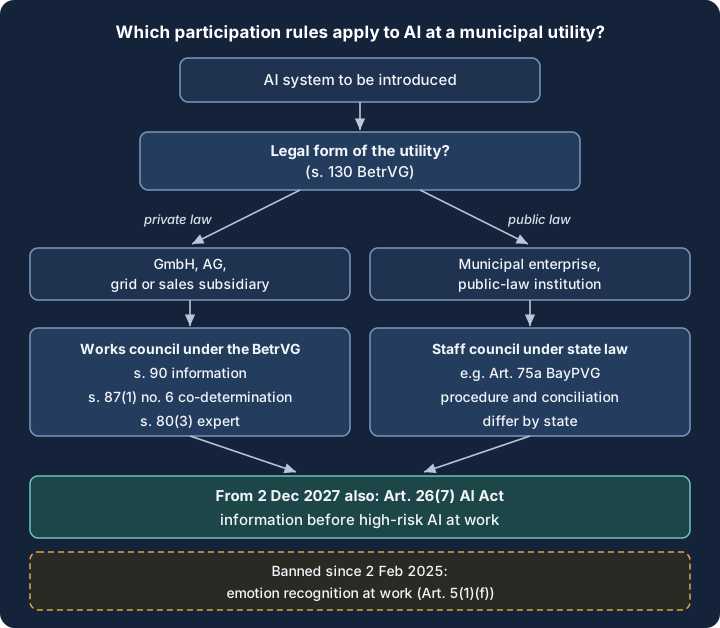
In a multi-utility group, things get messy fast. Holding, grid company and sales company often each have their own works council, and the city has a staff council. An AI system run centrally for all of them needs the right body. For Microsoft 365, the Federal Labour Court ruled on 8 March 2022 (1 ABR 20/21): where the software is used company-wide with central administration, the general works council is responsible, not each local council. If a system spans several companies, the same logic points to the group works council.
Sounds like a formality. It isn't. An agreement signed with the wrong body doesn't hold.
What the BetrVG requires for AI
For AI, the act works in two steps: inform and consult early, then co-determine where monitoring technology is involved. That second step is enforceable. If the parties can't agree, a conciliation committee (Einigungsstelle) decides under section 87(2).
Case law here is old and strict. On 13 December 2016 (1 ABR 7/15), an employer's Facebook page on which visitors could post about staff was enough for the Federal Labour Court. A Copilot tenant with usage reports, a chatbot with conversation logs or dispatch software with a job history per technician sits much closer to monitoring. We know of hardly any enterprise AI system that writes no logs.
Since 18 June 2021, the act mentions AI in three places:
- Section 90(1) no. 3: the employer informs the works council in good time about planned work processes "including the use of artificial intelligence", with the necessary documents. Under section 90(2), consultation must come early enough for suggestions and objections to change the plan.
- Section 80(3), second sentence: when the works council has to assess the introduction or use of AI, calling in an expert counts as necessary. The employer pays.
- Section 95(2a): selection guidelines for hiring, transfers and dismissals still need consent when AI draws them up.
People underestimate that sentence in section 80(3). In practice it means an outside expert for the works council joins every sizeable AI project, and that takes time no project plan contains unless someone puts it there.
What the Hamburg court decided, and what it did not
The Hamburg Labour Court's order of 16 January 2024 (24 BVGa 1/24) gets cited as proof that AI triggers no co-determination. It isn't. It describes the case where co-determination exceptionally doesn't apply.
Here are the facts, as summarised by the law firm Gleiss Lutz. A medical technology group briefly blocked ChatGPT and then allowed it again, with guidelines on the intranet. Nothing was installed. Staff used the tool voluntarily in the browser, where needed via private accounts, and the employer got no data from that use. The group works council sought an injunction to stop it. The court rejected every application.
Workplace order under section 87(1) no. 1 wasn't engaged, the court held, because AI tools concern how work is done. Under no. 6 there was no monitoring pressure: no system of the employer's own, no data on the employer's side, and browser use was already covered by a group works agreement. A concrete health risk under no. 7? Neither argued nor apparent.
A first-instance labour court, interim proceedings, very narrow facts. A utility that rolls out its own AI assistant with single sign-on and usage reporting is not that case. Gleiss Lutz itself notes that employer-owned AI systems, or employer access to the data they collect, can lead to a different result.
Staff council instead of works council
Municipal enterprises, public-law institutions and special-purpose associations fall under their state's staff representation act. That makes sixteen statutes with similar provisions but their own wording and procedures. The federal staff representation act covers federal bodies only and is no help to a municipal company.
Take Bavaria, where utilities can also be run as a Kommunalunternehmen under Art. 89 of the municipal code. Art. 75a(1) BayPVG gives the staff council co-determination over "the introduction, use and substantial modification of technical equipment for monitoring the behaviour or performance of employees" (no. 1, our translation) and over automated HR procedures (no. 2). Substantial modification is expressly covered. For AI that gets a new model every few weeks, that's no side issue.
| Question | Works Constitution Act | Staff representation law |
|---|---|---|
| Applies to | GmbH and AG, even when wholly owned by the city | Eigenbetrieb, AöR, Kommunalunternehmen, special-purpose association (s. 130 BetrVG) |
| Body | Works council, general or group works council | Staff council and further bodies under state law |
| Monitoring technology | Section 87(1) no. 6 BetrVG | State law, for example Art. 75a(1) no. 1 BayPVG |
| AI in the statute | Sections 80(3), 90(1) no. 3, 95(2a) since 2021 | Varies by state; where silent, the general technology provisions apply |
| If there's no agreement | Conciliation committee decides with binding effect (s. 87(2)) | Conciliation committee; on weighty matters the final say can rest with the accountable body, details by state |
That last row is the real difference. On 24 May 1995 (2 BvF 1/92), the Federal Constitutional Court required that on decisions of weight, a body accountable to parliament keeps the final word. States have implemented this differently. For an AI rollout in a municipal enterprise, that means the procedure can end differently than at the sister GmbH next door.
Since this summer there's a public model. The Land and city of Bremen concluded a service agreement on the use of AI with their central staff council, announced in the finance senator's circular no. 16/2026 of 29 June 2026. On 3 August 2026 the staff council summarised it like this: people make the final decisions, AI use is published and labelled, staff are entitled to training, and they are not liable for errors caused by "hallucinating" or poorly trained systems. Staff councils are involved in the rollout "early and comprehensively" (our translation). According to the staff council, Bremen is the first German state with such an agreement. For municipal companies in public-law form it's a usable template, not least because of the liability clause.
Art. 26(7) AI Act from 2 December 2027
Art. 26(7) of the AI Act is short. Before putting into service or using a high-risk AI system at the workplace, deployers who are employers inform workers' representatives and the affected workers that they will be subject to the use of the system. The information follows national rules and practice on informing workers. After the Digital Omnibus (Regulation (EU) 2026/1744), this applies to Annex III high-risk systems from 2 December 2027.
Which AI at a utility is in scope? Less of grid operations than many assume. Annex III no. 2 covers AI used as a safety component in electricity, gas and heat supply, but under the Commission's draft guidelines only under narrow conditions; we unpacked that in our piece on high-risk classification under Annex III. For co-determination, Annex III no. 4 matters more: AI for recruitment and candidate selection (point (a)), and AI that influences working conditions, allocates tasks based on individual behaviour or personal traits, or monitors and evaluates performance and behaviour (point (b)).

Three candidates stand out at a utility. Dispatch software for fault repair and installation crews that assigns jobs by each technician's performance profile. Call analytics that rate agents, which arrive quickly with AI in customer service. And ranking of job applications, for apprenticeships for instance. Whether a specific system is covered is a case-by-case assessment we don't make. But the list shows where to look.
The control room leaves an open question. Art. 26(7) speaks of workers who "will be subject to" the system. Whether staff operating a high-risk system in grid control fall under that, the wording doesn't clearly say. Informing them anyway costs one sheet of paper.
Recital 92 states that existing information and consultation obligations stay untouched, and Art. 2(11) allows national rules and collective agreements more favourable to workers. Art. 26(7) is a fallback duty. A utility with a works council can combine it with the information under section 90 BetrVG, provided it documents that step and also informs the affected staff directly.
One ban already applies. Since 2 February 2025, Art. 5(1)(f) has prohibited AI systems that infer the emotions of people at the workplace, except for medical or safety reasons. For voice analytics in a call centre that's the first question to ask, before any works agreement.
And the penalties? Breaches of deployer obligations under Art. 26 carry fines of up to €15 million or 3 percent of worldwide annual turnover under Art. 99(4)(e); under the KI-MIG, the BNetzA is the authority in charge. Section 17(2) KI-MIG rules out fines against authorities and other public bodies within the meaning of section 2(1) and (2) of the Federal Data Protection Act (BDSG). Whether a municipal enterprise or public-law institution that sells electricity in competition falls under that depends, among other things, on section 2(5) BDSG. That's a legal question for your legal department, not for a project team. Deployers of an Annex III no. 4 system must also, on request, explain the role the AI played in a decision (Art. 86); the KI-MIG sanctions failure to do so with up to €50,000 (section 15(2) and (3)).
Keep the logs, rule out performance monitoring
Here the AI Act and works agreements collide head-on. Art. 26(6) requires deployers to keep the automatically generated logs of a high-risk system for at least six months. Many works agreements on IT systems, on the other hand, forbid any analysis of usage data for performance or conduct monitoring and set short deletion periods.
Both can be reconciled, just not by accident. The agreement should state what the logs are for: human oversight, incident investigation, requests from the supervisory authority. And who may look at them, under which conditions, for example only under four-eyes control and with notice to the works council. Without that purpose limitation, a utility ends up choosing between breaching the AI Act and breaching its own agreement.
A works agreement is no free pass on data protection, either. On 19 December 2024 (C-65/23), the Court of Justice of the EU ruled that collective agreements cannot lower GDPR requirements and that courts review them against the GDPR in full.
A framework agreement instead of case-by-case talks
Negotiate every AI tool separately and you'll never stop negotiating. The best-known public alternative comes from IBM in Germany: a group works agreement on introducing and using AI systems, documented by the Hans-Böckler-Stiftung in November 2022 as portrait no. 026.
It doesn't define AI. It sorts systems into five risk classes instead. Classes 1 and 2, systems with no or little conduct and performance monitoring, get reviewed and listed on the intranet. Classes 3 and 4 are covered by a protocol note or a separate agreement. Class 5 is banned, for example systems that decide on individual HR measures. A questionnaire the employer has to answer gets each system to its class. According to the portrait, class 5 was fought over for a long time.

For a utility the model fits well, because it links up with the AI inventory the AI Act points towards anyway. A register listing each system with purpose, data sources, risk class and status of participation then serves governance and the works council at once. Our AI governance building blocks show how such a register can be set up.
The law firm CMS described another route on 12 June 2024: before the actual works agreement, a tolerance agreement with a fixed period, monitoring by an expert group and audit rights for the works council, to "build trust in the application" (our translation). That suits pilots. The tolerance period has to be fixed in the text, though, or the pilot turns into a permanent state without rules.
One point applies to both routes. Under section 77(5) BetrVG a works agreement can be terminated with three months' notice, but in matters subject to co-determination it continues to apply under section 77(6) until a new arrangement replaces it.
Is current law enough?
Unions and employer-side lawyers disagree, the courts have barely spoken, and no answer is in sight.
"The Works Constitution Act has not been fundamentally reformed in more than 50 years."
Christiane Benner, First Chair of IG Metall, 11 July 2025 (our translation)On 11 July 2025, IG Metall welcomed a Bundesrat resolution calling for a modernised works constitution. In Benner's words, works councils need "rights with which they can shape digitalisation, artificial intelligence and further training with foresight" (our translation). That goes beyond fending off surveillance: it's a say in how AI changes work.
The Hamburg Labour Court drew the opposite line on 16 January 2024. Using AI tools concerns "work performance and not the conduct of staff in the workplace", is how the law firm WBS renders the reasoning (our translation). No monitoring pressure, no co-determination right, even when the tool noticeably changes the job.
And CMS advised employers on 12 June 2024 to bring the works council in through a time-limited tolerance arrangement with audit rights, rather than settling everything before first use.
What utilities should do now
2 December 2027 is a little over thirteen months away. For a framework agreement with an expert, a conciliation committee in the background and council meetings once a month, that isn't much. Our order of play:
The coming months
-
Add two columns to the inventory
Responsible body and status of participation for each AI system. Nothing more.
-
Settle legal form and body
For every company in the group: BetrVG or staff representation act, local works council, general or group works council. In mixed set-ups with city, municipal enterprise and GmbH, one system runs through two procedures side by side. Plan for that from day one.
-
Negotiate a framework agreement with risk classes
Questionnaire, classes, a no-go zone, a procedure for updates and new modules. Budget for the section 80(3) expert instead of being surprised by one.
-
Write Art. 26(7) into the approval path
As a fixed step before go-live of any system that may fall under Annex III: information to the body and to affected staff, documented.
-
Tie logs to a purpose
Regulate retention under Art. 26(6) and the analysis ban in the same agreement, with clear access rights. Otherwise the two clash at the first incident.
-
Rule out emotion recognition
For any voice or call analytics in customer service, check whether the product infers employees' emotions. That has been banned since February 2025.
Training belongs here too. In its Omnibus version, Art. 4 AI Act requires deployers to take measures to support the development of AI literacy among their staff. A works council that understands the systems negotiates faster.
Our service AI governance for utilities runs from the inventory through roles and approval path to the paper for the works council; how a prototype then moves into regular operations is covered on AI for utilities. Case-specific legal questions stay with your legal department or law firm. More pieces on the topic are collected in the topic area AI in the energy industry, and the date is tracked in the energy transition deadline calendar.
Further Reading
Frequently Asked Questions
Co-determination on AI means that an employer needs the consent of the workers' representatives before it introduces an AI system that can capture employees' conduct or performance. In a GmbH or AG that is the works council under section 87(1) no. 6 BetrVG; in a municipal enterprise or public-law institution it is the staff council under the state's staff representation act. Separately, section 90 BetrVG requires the employer to inform the works council early about planned AI.
That depends on the legal form, not on the owner. A Stadtwerke GmbH or AG falls under the BetrVG even if the city owns all of it. Under section 130 BetrVG the act does not apply to municipal enterprises, public-law institutions and corporations; there the staff representation act of the relevant state applies.
Deployers who are employers must inform workers' representatives and the affected workers, before putting into service or using a high-risk AI system at the workplace, that they will be subject to the use of that system. Since the amendment by Regulation (EU) 2026/1744, this applies to high-risk systems under Annex III from 2 December 2027.
No. In interim proceedings on 16 January 2024 (24 BVGa 1/24), the Hamburg Labour Court found no co-determination right because staff used ChatGPT voluntarily through private accounts in the browser and the employer received no usage data. If a utility provides its own system with accounts, logs and usage reports, the situation is different: under Federal Labour Court case law, objective suitability for monitoring is enough.
Annex III no. 4 covers AI for recruitment and candidate selection, and AI that allocates tasks based on individual behaviour or that monitors and evaluates the performance and behaviour of employees. At a utility, candidates include dispatch software for field crews that assigns jobs by performance profile, call analytics in customer service that rate agents, or ranking of job applications. Whether a specific system is covered is a case-by-case legal assessment.
No. Recital 92 of the AI Act states that existing information and consultation obligations remain unaffected, and Art. 2(11) allows national rules and collective agreements that are more favourable to workers. The AI Act information comes on top of co-determination under the BetrVG or staff representation law.
Let's collaborate
One contact, a team behind it
Thirty minutes on what you're working on, whether grid, metering, market processes, IT architecture or AI. Afterwards you'll know how we'd approach it and who would sit at the table.
Energy and measurement technology since 2010 · innobu GmbH since 2014 · Based in Schleswig-Holstein, Germany
Whoever pitches also delivers: whoever leads the first call stays your contact right through to the steering committee, with established partners in the project. Direct: info@innobu.com