IEC 61850 in the digital substation: standardising protection and control
IEC 61850 is the international standard for communication in the protection and control of substations. This article explains the two communication levels, the station bus and the process bus, the message types GOOSE and sampled values, the configuration language SCL and the history of the editions. It also covers what the digital substation actually saves, how time synchronisation and cybersecurity connect, and what grid operators and municipal utilities should keep in mind.
IEC 61850 is the international standard for communication networks in substation automation. The first edition appeared in 2003, and the IEC committee TC 57 has worked on the series for around 30 years. In the digital substation the standard replaces classic copper wiring with communication over Ethernet, which cuts up to 80 percent of the copper cabling and up to 60 percent of the floor space according to manufacturers. The standard works on two levels: the station bus (IEC 61850-8-1) carries GOOSE messages and MMS reports between the protection devices, the process bus (IEC 61850-9-2) carries digitised current and voltage measurements as sampled values from the merging units. The configuration language SCL (IEC 61850-6) describes the plant in machine-readable form and is what makes cross-vendor engineering possible. Edition 2 appeared in 2009 and 2011, the consolidated Edition 2.1 of the core documents from 2020. Two topics decide the operation: precise time synchronisation via the Precision Time Protocol under IEEE 1588, and cybersecurity under IEC 62351, because protection commands now travel as network packets. The German transmission operators 50Hertz, Amprion, TenneT and TransnetBW are modernising their substations in this direction. The same digital infrastructure increasingly carries asset condition data too, for example from transformer online monitoring.
What the digital substation is
A substation connects two voltage levels and protects the grid when faults occur. Classically, hundreds of copper cores run for this between the transformers in the switchyard and the protection devices in the relay house. The digital substation replaces this wiring with a communication network under IEC 61850, in which measurements and switching commands travel as digital packets.
IEC 61850 is the international standard for communication networks and systems in substation automation. Instead of analogue signals over copper, digital messages travel over Ethernet and fibre. The goal behind it is interoperability: devices from different manufacturers should work together in one plant. The standard covers three areas, protection, control and measurement.
What matters is the perspective. The digital substation is not a single product but an architecture. Copper is replaced by communication, analogue transformer signals are digitised early, and the wiring in the cabinet gives way to a few network interfaces. The smaller plants in the distribution grid build on the same idea, for example the digital secondary substations in the low-voltage grid.
From Edition 1 to Edition 2.1: the history of the standard
IEC 61850 is not a new topic but a mature standard. The work of the IEC committee TC 57 reaches back around 30 years, and the first edition appeared in 2003. Since then the series has developed from pure station communication to the complete digital substation with a process bus.
Edition 1 defined the data models, the fast GOOSE messages and the configuration language SCL from 2003. Edition 2 followed with part 6 in 2009 and parts 8-1 and 9-2 in 2011, with clearer requirements for interoperability and testing. The consolidated Edition 2.1 of the core documents came from 2020 and cleared up ambiguities in Edition 2. The series now reaches beyond the substation, to distributed generation, wind, hydro and wide-area monitoring.
Station bus and process bus: the two communication levels
IEC 61850 works on two logical network levels. The station bus connects the protection and control devices with each other and with the station level. The process bus reaches deeper, down to the transformers and switchgear in the field. Both use Ethernet, but carry different message types.
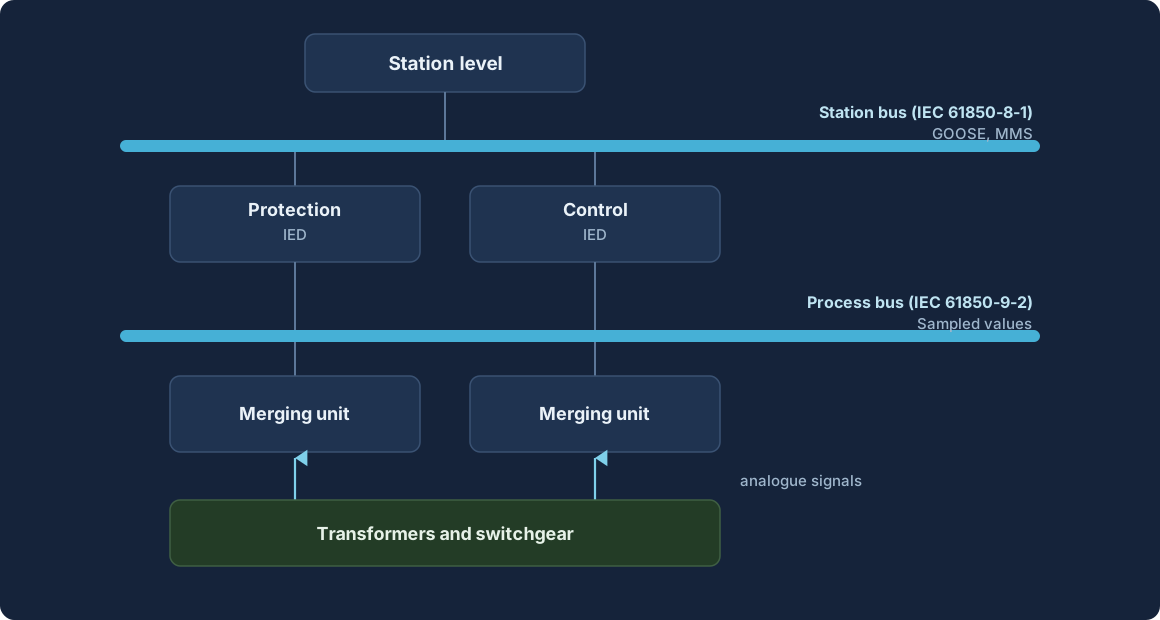
The station bus under IEC 61850-8-1 carries GOOSE messages for fast, time-critical events such as tripping and interlocking, plus MMS reports for control and monitoring. The process bus under IEC 61850-9-2 carries sampled values, the digitised current and voltage measurements as a continuous stream. Merging units digitise the transformer signals directly in the field and feed them into the process bus.
GOOSE replaces the control wiring, sampled values replace the measurement wiring. Together they turn the wired substation into a digital one.
From copper to fibre: what the digital substation saves
The biggest tangible advantage is the loss of copper wiring. Where several hundred inputs and outputs per cabinet used to be wired and tested, a few communication interfaces are enough in the digital substation. That saves material, floor space and time.

Less wiring means less installation, less testing effort and fewer sources of error during commissioning. The digital process bus needs Gigabit Ethernet for that, where classic station networks got by with slower links. A well-known early example is a 300 kV pilot at Statnett in Norway, which ran a process bus in parallel with the existing technology for two years and tested protection devices from three manufacturers against each other.
SCL: the language that makes interoperability possible
Interoperability does not come from shared protocols alone, but from a common description language. The Substation Configuration Language SCL describes the whole plant in machine-readable form: which devices exist, which functions they have and how they communicate.
SCL is XML-based and therefore readable by tools from different manufacturers. From the SCD file the tools derive the configuration of the individual devices, without manual duplication. Without SCL, IEC 61850 would be a protocol without end-to-end engineering. The language is what makes cross-vendor operation practical, and that is where the effort sits: the skill moves from the cable to the data model.
Time and security: synchronisation and cyber protection
Two topics decide safe operation. First, time: sampled values from different fields have to line up exactly. Second, security: the digital process bus opens attack surfaces that did not exist in the galvanically isolated copper world.
The Precision Time Protocol under IEEE 1588, PTP for short, synchronises the merging units to within a sub-microsecond, so the measurements come together in phase. Without this common time base, two merging units deliver values that cannot be compared. IEC 61869-9 defines the digital interfaces of the transformers and the sampling profiles, for example 4,800 Hz at 50 Hz.
Cybersecurity in the digital substation is not an add-on but a precondition. Protection commands now travel as network packets, no longer as galvanically isolated copper signals. The IEC 62351 series adds security to IEC 61850: part 6 secures GOOSE and sampled values through authentication and integrity, part 9 governs key management.
Anyone who considers the network architecture, the roles and the keys only after installation builds twice. The generic protection of energy plants under IEC 62443 and the Cyber Resilience Act provides the organisational frame into which the IEC 62351 mechanisms fit.
Where Germany stands: rollout and engineering 2026
The German transmission operators 50Hertz, Amprion, TenneT and TransnetBW are modernising their substations towards IEC 61850. The grid expansion for the energy transition also means a construction boom in substations, and new plants are increasingly built digital.

Engineering tools now integrate IEC 61850 with rule-based checking, to keep the complex data models manageable. At the VDE congress on protection and control on 28 and 29 April 2026 in Leipzig this was a central topic. The challenge is less the technology than the end-to-end, low-error engineering. The same logic applies one level down in the distribution grid, for example with a low-voltage SCADA and control system under Section 14a EnWG.
What grid operators and municipal utilities should keep in mind
Anyone who renews or builds a substation today decides for the next few decades. The move to IEC 61850 is less a product question than one of skills, processes and security. These four steps keep the changeover manageable.
-
Secure interoperability contractually
Do not assume interoperability, prove it in the tender and acceptance with SCL files and conformance tests. Only the test on real devices shows whether the data models of different manufacturers really fit together.
-
Plan time synchronisation and network architecture early
The Precision Time Protocol, the redundancy of the Ethernet rings and the Gigabit sizing belong in the basic planning, not at the end. A weak time base devalues the whole process bus.
-
Build in cybersecurity under IEC 62351
Plan roles, keys and network segmentation from the start. Protection commands as network packets need authentication and integrity, otherwise the digital advantage turns into a risk.
-
Build up digital engineering skills
Qualify staff and service providers for SCL engineering, configuration and testing. The work moves from the terminal diagram to the data model, and that is where the quality of the plant is decided.
IEC 61850 makes the substation digital and cross-vendor, saves copper, space and testing time, and shifts the effort into engineering. Anyone who plans interoperability, time synchronisation and security from the start builds a plant that lasts for decades.
Further reading
Frequently asked questions
IEC 61850 is the international standard for communication networks and systems in substation automation. It describes how protection, control and measurement devices from different manufacturers work together over Ethernet, and in the digital substation it replaces classic copper wiring with digital communication. The first edition appeared in 2003.
The station bus under IEC 61850-8-1 connects the protection and control devices with each other and with the station level. It carries GOOSE messages for fast events and MMS reports for control and monitoring. The process bus under IEC 61850-9-2 reaches deeper, down to the transformers in the field, and carries digitised current and voltage measurements as sampled values.
GOOSE (Generic Object Oriented Substation Event) are fast, cross-vendor messages between protection devices, for example for tripping and interlocking. Sampled values are digitised current and voltage measurements that a merging unit sends as a continuous stream over the process bus. GOOSE replaces the control wiring, sampled values replace the measurement wiring.
SCL is the XML-based description language for a substation defined in IEC 61850-6. It describes in machine-readable form which devices exist, which functions they have and how they communicate. The central file is the SCD (Substation Configuration Description). SCL is what makes cross-vendor engineering, and therefore real interoperability, possible.
Security is added by the IEC 62351 series. Part 6 secures GOOSE and sampled values through authentication and integrity, part 9 governs key management. Because protection commands travel as network packets in the digital substation, segmentation, roles and keys have to be planned from the start, not only after installation.
Let's collaborate
One contact, a team behind it
Thirty minutes on what you're working on, whether grid, metering, market processes, IT architecture or AI. Afterwards you'll know how we'd approach it and who would sit at the table.
Energy and measurement technology since 2010 · innobu GmbH since 2014 · Based in Schleswig-Holstein, Germany
Whoever pitches also delivers: whoever leads the first call stays your contact right through to the steering committee, with established partners in the project. Direct: info@innobu.com