
Regulatory account 2025: what network operators must file and evidence by 31 December 2026
The balance only reaches the revenue caps from 2028, spread over three years. Ruling Chamber 8 of the Federal Network Agency (BNetzA) published guidance on the capital cost mark-up for electricity distribution operators under its jurisdiction in August and followed up with version 1.1 of the data template on 22 September.
With the 2025 regulatory account application, every German electricity and gas network operator under incentive regulation, transmission system operators included, asks the competent regulator by 31 December 2026 to approve the balance by which its achievable revenue at actual volumes and certain actual costs deviated from the amounts in the 2025 revenue cap (Section 4(4) sentence 3 and Section 5 ARegV). Interest follows Section 5(2) ARegV and is set at 1.03 percent in the distribution operator template (1.026 percent in the transmission operator template); the balance then flows into the 2028 to 2030 revenue caps in three annuities. New for distribution operators that passed on grid costs in 2025 is sheet A6 with the first plan-actual reconciliation of the renewables grid cost pass-through; operators filing with Ruling Chamber 8 with a capital cost mark-up also answer the questions of its August 2026 guidance in a cover letter. If the application is missing, the regulator can order it and enforce it with coercive fines; as an abuse under Section 30 EnWG, a breach of the ARegV can also lead to a fine under Section 95 EnWG.
What the 31 December 2026 application covers
The duty sits in Section 4(4) sentence 3 of the Incentive Regulation Ordinance (ARegV), which says the application "must be filed once a year by 31 December", and Section 5 sets out what goes into it. It applies to every network operator under German incentive regulation, electricity and gas, distribution and transmission, and to operators in the simplified procedure as well: Section 24(3) ARegV exempts them from a handful of provisions, but Section 4(4) is not among them.
Interest accrues on the amount tied up on average during the year, meaning the mean of the account's opening and closing balance, at the ten-year average of the Bundesbank yield on outstanding domestic bonds (Section 5(2)). The distribution operator template sets that at 1.03 percent in sheet G, the transmission operator template at 1.026 percent. The regulator then spreads the balance as an annuity over three years, starting in the year after next following the application (Section 5(3) sentence 3), so for 2025 through surcharges or deductions on the 2028 to 2030 revenue caps. An operator that moved less power than planned in 2025 because a large industrial customer cut production gets the shortfall back three to five years later.
Where the application goes depends on Section 54 EnWG. Transmission system operators and operators with at least 100,000 customers or networks crossing a state border file with BNetzA (Ruling Chamber 8 for electricity, Ruling Chamber 9 for gas); smaller ones file with their state regulator, unless the state has delegated the task to BNetzA. For the 2024 regulatory account, Ruling Chamber 8's case list shows 175 electricity cases: 108 under federal jurisdiction, the four transmission system operators among them, and 67 handled on behalf of states. With 819 electricity distribution system operators taking part in the 2025 monitoring survey, the arithmetic says around 650 of them file with a state regulator. Ruling Chamber 8's template and guidance address the operators under its jurisdiction; anyone filing with a state follows that state's requirements.
Which items flow into the 2025 balance
The balance is built from individual differences, and the data for them comes from several systems in-house. The electricity template for distribution system operators asks for them sheet by sheet and adds them up in sheet F. On volumes the completion guide is unambiguous: sheet E1 asks for the actual physical volumes of the year and explicitly not the accrued volumes from the annual accounts.
| Sheet | Item | Legal basis | Data typically comes from |
|---|---|---|---|
| E1 | permitted vs. achievable revenue, with physical volumes, interval-metered capacity, Section 14a modules | Section 5(1) sentence 1 ARegV | network billing, energy data management |
| E2 | upstream network costs, actual vs. plan | Section 5(1) sentence 2 ARegV | upstream operator invoices, per market location or reporting point at the upstream operator or aggregated per voltage level |
| E3 | avoided network charges for distributed generation | Section 5(1) sentence 2 ARegV | generator billing; Ruling Chamber 8 accepts the calculation tool of the Bavarian state regulator as evidence, and it goes to the chamber with the template |
| E4 | conventional metering and the operator's share of smart meter charges | Section 5(1) sentences 3 and 4 ARegV, BK8-23/007-A | metering billing, device inventory |
| E6 | financial compensation under Redispatch 2.0 | Section 5(1) sentence 2 ARegV, BK8-18/0007-A | redispatch settlement |
| E7 | release of construction cost subsidies, connection contributions, investment grants | Section 5(1) sentence 2 ARegV | fixed asset accounting (liability items) |
| E8 | capital cost mark-up, plan vs. actual | Section 5(1a) ARegV | fixed asset accounting, imputed values by year of addition |
| E10 | other items, including grid losses | depends on the item | procurement, financial accounting |
E8 has a deadline rule of its own: Section 5(1a) ARegV requires the plan-actual reconciliation of the capital cost mark-up by 31 December of the following year, so for the 2025 mark-up on the same day as the application. The reconciliation requires that the operator filed a timely plan application for a 2025 capital cost mark-up. Ruling Chamber 8 spells this out in its guidance: without that application there is no actual reconciliation, even where investments were made, and the capital costs are not recognised in the regulatory account. In E6, 2025 stays with the financial compensation under Redispatch 2.0; what changes from 2027 is covered in our piece on redispatch without balancing.
What is new in the 2025 template
Distribution system operators that passed on grid costs in 2025 face a new calculation. 2025 was the first year of the renewables grid cost pass-through: 178 distribution system operators with around EUR 2.4 billion between them, according to the 2025 Monitoring Report. New sheet A6 compares the pass-through amount the operator calculated on the basis of its adjusted revenue cap and reported to the transmission system operator with the amount that results from the revenue cap as audited in the regulatory account. The operator enters the figures from its own provisional 2025 price sheet of 15 October 2024, from which the sheet recalculates the reported amount, and then the plan-actual differences of the individual cost items.
Under operative item 10 of ruling BK8-24-001-A it is only established in the regulatory account; once the 2025 balance is approved, it reduces or increases the pass-through amount for 2028 (t+3). The reasoning names 2028 as the earliest date (para. 141). The ruling does not say what applies if the decision is still missing when the pass-through is reported in autumn 2027; according to the A6 completion guide, the difference goes into the next pass-through after the regulatory account procedure is closed.
The template also changes a few smaller things you notice when you copy last year's file across. The company-wide query in the fixed asset schedule is gone; E1 has new fields for module 3 under Section 14a EnWG (energy prices for the low and the high tariff band, number of customers and annual consumption in all three bands); E4.b reflects the price caps after the 2025 amendment of the Metering Point Operation Act; and the capital cost mark-up sheets carry columns for explaining additions and deductions, for distribution and transmission system operators alike. Version 1.1 of 22 September 2026 fixes a formula error in E7. Ruling Chamber 8 requires the current template on the energy data portal, so anyone who started on version 1.0 of 14 September should move their entries over.
The August 2026 guidance
In August, Ruling Chamber 8 wrote down the issues that kept coming up when it checked the capital cost mark-up reconciliation in previous years. The paper covers electricity distribution operators that file with the chamber, under federal jurisdiction or on behalf of a state. The chamber expects the information and the explanations in a cover letter to the application; the list is expressly not exhaustive, and it reserves the right to ask more. Points 1 to 3 apply to every applicant with a capital cost mark-up, points 4 to 6 only where the situation exists:
Deviations and chamber practice
The operator states whether it departed from the chamber's guidance on the capital cost mark-up and confirms that its entries follow chamber practice: late capitalisation booked in imputed terms in the year it happens, the cost allocation keys of the base year unchanged, and in the columns for additions and deductions only what is new for 2025. Anyone who did it differently explains how.
Separate metering
Costs of the default metering point operator cannot be approved (Section 7(2) MsbG). The operator confirms explicitly that its actual acquisition and production costs do not stem from such investments.
450 MHz radio network
The operator answers whether set-up costs for the 450 MHz network are included in the capital costs and, if so, in which asset groups, vintages and amounts, with the allocation key and the revenue from the infrastructure.
Explain outliers
Acquisition and production costs more than 30 percent above the average since the 2021 base year need an explanation, especially in asset groups not directly attributable to the electricity grid: office and operations buildings, software, hardware, telephone lines, light vehicles, metering and control technology.
Document buildings
For a new build or complete refurbishment of an office or operations building the chamber wants an occupancy plan and the number of staff using space for the electricity network, and, if costs were allocated, the key. It also asks whether the lessor invested or an affiliated service company: investments by the service company are not recognised in the capital cost mark-up, which the chamber bases on Federal Court of Justice case law.
Fibre and ducts
For telecom investments it asks whether the lines were built for smart metering systems, about shared use by third parties, the shared-use share or revenue, and how the ducts are used.
Further situations need an explanation from those who have them: network transfers and structural changes, a switch from renting or leasing to own investment, and the purchase of second-hand assets.
Transmission system operators: own template, own cost blocks
Since the 2024 regulatory account, Germany's four transmission system operators have had their own template, because their queries and those for distribution operators had drifted too far apart; BNetzA is always the competent authority for them. Sheets on upstream network costs, avoided network charges and redispatch compensation are missing. Instead there is E5 for the capital costs of approved investment measures under Section 23 ARegV, a more detailed E8 on the capital cost mark-up with questions on investment measures and quantity structures, and sheet E9, which no distribution operator sees.
- E1 revenue with Section 14a modules and special customers under Section 19(2) StromNEV
- E2 upstream network costs, E3 avoided network charges
- E6 financial compensation under Redispatch 2.0
- A6 plan-actual check of the renewables pass-through
- E5 capital costs from investment measures
- E8 capital cost mark-up, more detailed than for DSOs
- E9 procedurally regulated costs, 15 items
- competent authority is always BNetzA
E9 collects costs that run through voluntary commitments and other procedurally regulated mechanisms: balancing capacity, grid losses, "use instead of curtail" as power-to-heat and under Section 13k EnWG, black start capability, domestic and foreign grid reserve, higher line utilisation, system-relevant gas power plants, phase shifters, rail flexibility and momentary reserve under BK8-25-002-A, plus three items the template only lists by abbreviation (KEI, ReDEM, AEP). For each item, costs, revenue and the amount in the revenue cap sit side by side. At a transmission system operator those figures live in different places: system operations, procurement of balancing capacity and loss energy, grid reserve settlement.
Gas network operators: same date, different framework from 2028
Gas network operators have the same duty. Gas distribution and transmission system operators also file their 2025 balance by 31 December 2026, with Ruling Chamber 9 via the energy data portal or with their state regulator. For them, RAMEN Gas opens the fifth regulatory period on 1 January 2028, a year ahead of electricity. Operative item 14.7 of that ruling keeps the ARegV as in force on 29 December 2023 for calculating, paying interest on and distributing fourth-period balances, so the 2025 balance flows into new revenue caps under the old rules. What else the switch means is set out in our piece on NEST Gas.
From balance to the 2028 revenue cap
Three years separate the business year from the first annuity, with an approval in the middle whose date the operator does not know. In its reasoning on the renewables pass-through, BNetzA assumes that the balance of year t is "as a rule approved in calendar year t+2" (BK8-24-001-A, para. 141), so in 2027 for the 2025 balance.
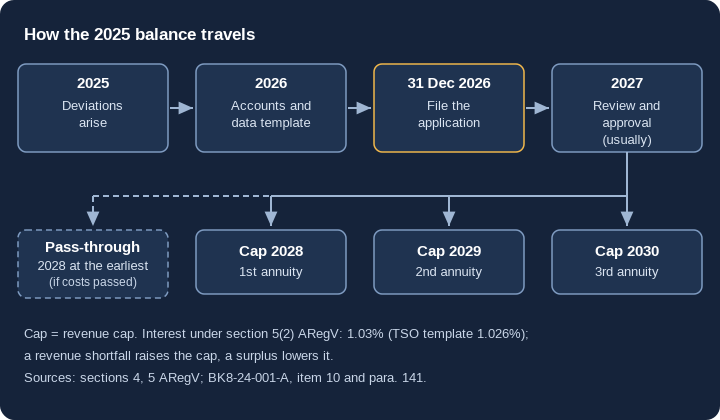
It can take longer, as a gas case shows: Ruling Chamber 9 decided the 2022 balance of a gas transmission system operator on 23 February 2026, departing from the application, and approved the adjustment of the 2025 to 2027 revenue caps retroactively, when the first of the three distribution years was already over. The chamber considered a provisional approval under Section 72 EnWG unhelpful, because the operator knew the likely amount from its own application. A deemed approval that would kick in after a set period without a decision was explicitly rejected by the Grand Ruling Chamber in RAMEN Strom (para. 1321), because network users have a legitimate interest in the review.
For balances from 2029, RAMEN Strom changes the interest rate to the imputed cost of debt used for the capital cost mark-up (item 14.4), because the chamber sees a balance in the operator's favour as, in principle, borrowed capital. Under item 14.7 the 2025 balance stays with the ten-year average under Section 5(2) ARegV. How operators report the adjustment of their revenue cap every 1 January under RAMEN, which the regulatory account checks later, is covered in our overview of regulatory deadlines for network operators from 2027.
Evidence the application needs
Formally, the application is plain: Ruling Chamber 8 wants it in writing and "without any particular formal requirements", with the data coming through the template on the energy data portal. In substance, Section 5(4) ARegV requires the balance and the data behind it, above all permitted and actually earned revenue, and for the capital cost mark-up the actual capital costs with acquisition and production costs and the useful lives under Annex 1 of the electricity or gas network charges ordinance.

What else the chamber wants to see is spread across the completion guide and the guidance. Sheet A1 checks revenue from the unbundled accounts against the revenue cap, A2 and A3 show the company's balance sheet and income statement by division and activity, A4 the fixed asset schedule of electricity distribution, in lease models also per lessor. For land and assets under construction, the chamber uses an opening balance of zero when it averages the year for interest (Higher Regional Court of Düsseldorf, VI-3 Kart 166/17 [V]); in the template, the book values of assets under construction are split by year of addition, because each year of addition carries its own interest rate.
Information and explanations on the guidance belong in the cover letter, explanations the template itself asks for, such as for an addition in the "other" category, go into sheet H ("Erläuterungen"), and for additions and deductions in the capital cost mark-up the template has had its own explanation columns since 2025. Ruling Chamber 8's deadline calendar lists the audit report on the annual accounts under Section 6b EnWG for 31 August, noting that there is no fixed deadline: it has to be submitted without delay once the accounts are adopted, so it should already be with the authority by December.
In addition, the operator reconciles the balance internally against its commercial accounts. In 2017 the energy committee of the German institute of auditors (IDW) recorded that surpluses on the regulatory account are an obligation to lower future charges and have to be shown as a provision, while shortfalls cannot be capitalised under the realisation principle; surcharges and deductions that affect the same future revenue cap are netted against each other. If the balance you file does not match the provision in the 2025 annual accounts, the reason for the gap should be clear in-house before the application goes out.
What applies if no application is filed
The ARegV sets no penalty of its own, but the application is mandatory under Section 4(4) sentence 3. The regulator can order it (Section 65(2) EnWG) and enforce it with a coercive fine of EUR 1,000 to EUR 10 million (Section 94 EnWG). Whether a late application only pushes the distribution back or makes the balance lapse is not expressly settled in the ARegV; Section 5(3) sentence 3 ties the start of the distribution to the application due by 31 December.
A breach of the ARegV is also an abuse of market position (Section 30(1) sentence 2 no. 1 EnWG). The regulator can require it to stop or establish it after the fact (Section 30(2) and (3)). For the abuse and for breaching an order to stop it, Section 95 EnWG provides for fines of up to EUR 1 million (subsection 1 nos. 4 and 3(b), subsection 2 no. 3). For transmission network operators and vertically integrated undertakings with total turnover above EUR 10 million, the range for breaching the order to stop goes up to 10 percent of total turnover (Section 95(5)). Those affected can apply for abuse proceedings (Section 31) and claim removal, injunctive relief or, where there is fault, damages (Section 32). This describes what the provisions say and is not an assessment of any individual case.
Where network operators wanted other rules
The RAMEN Strom consultation brought one counter-proposal on the 31 December date: a submission wanted 30 June of the following year so that the adjustment would take effect sooner, arguing that operators have their actual network charge revenue by the end of the first quarter (para. 676). Several submissions wanted the auditor-certified figure from the annual accounts instead of physical volumes; others asked for a deemed approval.
"For a return to an earlier deadline (around 30.06.) and a tighter schedule, the ruling chamber sees no reason."
Grand Ruling Chamber Energy, RAMEN Strom, reasoning para. 1321, 8 December 2025 (our translation)The chamber points to the longer review period, which it says avoids corrections and duplicate work, and to the flexibility it gives operators; it did not adopt the certified figures and left the calculation of achievable revenue at the ARegV status quo (para. 1312). Operators with revenue shortfalls bear the cost of that line, because their money comes back years later. When distribution operators did not have to pass on the higher transmission charges straight away in early 2024, the audit firm Ebner Stolz pointed out on 18 January 2024 that the late inflow can force operators to pre-finance with loans. For the 2025 balance this mostly concerns operators with large volume deviations, whose pre-financing can cost more than the 1.03 percent interest brings back.
What network operators should do by 31 December
The only deadline is 31 December 2026, a Thursday in the week after Christmas. The dates below are our suggestion for the five weeks from the end of November, not interim deadlines set by the regulator. Start on volumes in mid-December and you will be writing the cover letter between Christmas and New Year; the explanations come last because they build on the finished figures.
Settle authority and submission route
Check whether BNetzA, a delegated case or the state regulator is competent and use its current form, at Ruling Chamber 8 template version 1.1; put last year's application and the latest decision next to it. Ruling Chamber 8 does not prescribe a channel for the written application, so agree now with the competent body how you send it and how you prove receipt.
Volumes, revenue and pass-through
Pull physical sales volumes from energy data management and billing, not from the accrued annual accounts. Calculate interval-metered capacity to the day where use started mid-year, and module 3 by tariff band; add upstream network costs, avoided network charges and redispatch compensation. If you passed on costs in 2025, fill in A6 with the figures of the provisional 2025 price sheet and tell the colleagues who calculate the pass-through notification in autumn 2027 that the difference lands there, not in the balance.
Reconcile capital costs
Reconcile actual capital costs with fixed asset accounting, the 2025 unbundled accounts and fixed asset schedule, split assets under construction by year of addition and enter only additions and deductions that are new for 2025. Without a plan application for 2025 this step falls away, and the actual investments stay out of the regulatory account.
Cover letter and sign-off
If you file with Ruling Chamber 8 with a capital cost mark-up, answer the points of the guidance, confirm the separation from metering explicitly and write two or three sentences for every asset group above the 30 percent threshold. Management signs off before the holidays.
Submit and secure receipt
At BNetzA the template goes through the energy data portal and the written application with the cover letter to the chamber, on 31 December at the latest and better before Christmas. The receipt goes on file.
You will set the network charges that take up the first annuity in 2028 in autumn 2027; how that calculation works is shown in our piece on network charges 2027.
Deadline, market roles, systems
Due by Regulatory account: application for 2025
Applicability: All network operators under incentive regulation, including the simplified procedure (Section 24(3) ARegV does not exclude Section 4(4)). Depending on the operator, the Federal Network Agency or the state regulator is competent.
Submit to: Federal Network Agency or state regulatory authority. For distribution system operators with fewer than 100,000 connected customers whose network does not extend beyond one federal state, the state regulatory authority is responsible for the tasks listed in Section 54(2) EnWG, such as network charges and incentive regulation; otherwise the Federal Network Agency.
If the deadline is missed: Fine possible The ARegV sets no penalty of its own, but the application is mandatory under Section 4(4) sentence 3 ARegV; the regulator can order it under Section 65(2) EnWG and enforce it with coercive fines. Under Section 5(3) sentence 3 ARegV the balance is only spread from the second year after the application. For network operators a breach is also an abuse of their market position (Section 30(1) sentence 2 no. 1 EnWG). The regulator can require it to stop (Section 30(2)) and can also establish it after the fact (Section 30(3)); for distribution system operators with fewer than 100,000 customers whose network does not extend beyond one federal state, the state regulatory authority is responsible (Section 54(2) no. 8). Section 95(1) nos. 4 and 3(b) EnWG threaten fines of up to EUR 1 million for the abuse and for breaching an order to stop it (Section 95(2) no. 3); for transmission system operators and vertically integrated undertakings with a total turnover above EUR 10 million, breaching such an order can be fined up to 10 percent of total turnover (Section 95(5)). Those affected can apply for abuse proceedings (Section 31) and claim removal, injunctive relief or, where there is fault, damages (Section 32 EnWG). Legal basis ↗
- Electricity grid operatorrole obligationFiles the 2025 regulatory account application with the competent regulator.Typically affected: Regulatory management, controlling, Grid usage and customer billing
- Gas grid operatorrole obligationFiles the application for approval of the 2025 regulatory account balance with the competent regulator.Typically affected: Regulatory management, controlling, Grid usage and customer billing
- Transmission system operatorrole obligationFiles the 2025 regulatory account application with the Federal Network Agency.Typically affected: Regulatory management, controlling
A classification for typical market roles, not a review of your individual case and not legal advice. Whether an obligation applies to your company (thresholds, exemptions) is for your legal department or counsel to confirm. The calendar doesn't replace your own deadline review. Information as of: 24 November 2026.
Further reading
Frequently asked questions
The regulatory account is a balancing account that every German network operator under incentive regulation keeps itself. Each year it books how far the revenue it could earn at actual volumes deviated from its permitted revenue cap, plus the gap between certain actual costs and the amounts allowed for them in the cap, such as upstream network costs, avoided network charges or the capital cost mark-up (Section 5(1) and (1a) ARegV). Once approved, the balance plus interest is spread over the revenue cap of three years.
By 31 December 2026. Section 4(4) sentence 3 ARegV requires the application once a year by 31 December, and the revenue cap is adjusted from 1 January of the year after next, so from 2028. Ruling Chamber 8 of the Federal Network Agency (BNetzA) states that all network operators have to submit the application for approval of the 2025 balance to the competent regulator.
Yes. Section 24(3) ARegV exempts operators in the simplified procedure from a few provisions, including parts of Section 4(3), Section 15(1) and (2) and Sections 19, 21 and 23(6), but not from Section 4(4). Of the 175 electricity cases for the 2024 regulatory account at Ruling Chamber 8, 68 concern operators in the simplified procedure.
For electricity distribution system operators that passed on grid costs in 2025, mainly sheet A6: the plan-actual reconciliation of the renewables grid cost pass-through under operative item 10 of ruling BK8-24-001-A, because 2025 was the first pass-through year. There are also fields for revenue from module 3 under Section 14a EnWG, explanation columns for additions and deductions in the capital cost mark-up, and the company-wide query in the fixed asset schedule has been dropped. The current version is 1.1 of 22 September 2026.
From 2028. The balance plus interest is spread as an annuity over three calendar years through surcharges or deductions on the revenue cap, starting in the year after next following the application (Section 5(3) ARegV). For the 2025 balance that means the 2028, 2029 and 2030 caps. A revenue shortfall raises them, a surplus lowers them.
Yes, in substance. Operative item 14.7 of RAMEN Strom and RAMEN Gas provides that the ARegV as in force on 29 December 2023 applies to the calculation, interest and distribution of regulatory account balances from the fourth regulatory period. The 2025 balance therefore earns interest at the Section 5(2) ARegV rate, even though it flows into RAMEN revenue caps from 2028 for gas and from 2029 for electricity.
The ARegV sets no penalty of its own, but the application is mandatory under Section 4(4) sentence 3 ARegV. The regulator can order it under Section 65(2) EnWG and enforce it with coercive fines under Section 94 EnWG. A breach of the ARegV is also an abuse under Section 30(1) sentence 2 no. 1 EnWG, which the regulator can order to stop. Section 95 EnWG provides for fines of up to EUR 1 million; for transmission network operators and vertically integrated undertakings with total turnover above EUR 10 million, breaching an order to stop can be fined up to 10 percent of total turnover (Section 95(5)). This describes the provisions in general and is not an assessment of any individual case.
Let's collaborate
One contact, a team behind it
Thirty minutes on what you're working on, whether grid, metering, market processes, IT architecture or AI. Afterwards you'll know how we'd approach it and who would sit at the table.
Energy and measurement technology since 2010 · innobu GmbH since 2014 · Based in Schleswig-Holstein, Germany
Whoever pitches also delivers: whoever leads the first call stays your contact right through to the steering committee, with established partners in the project. Direct: info@innobu.com