
Nine regulatory deadlines for electricity and gas network operators to 2031: revenue cap, simplified procedure, capital costs, supply interruptions
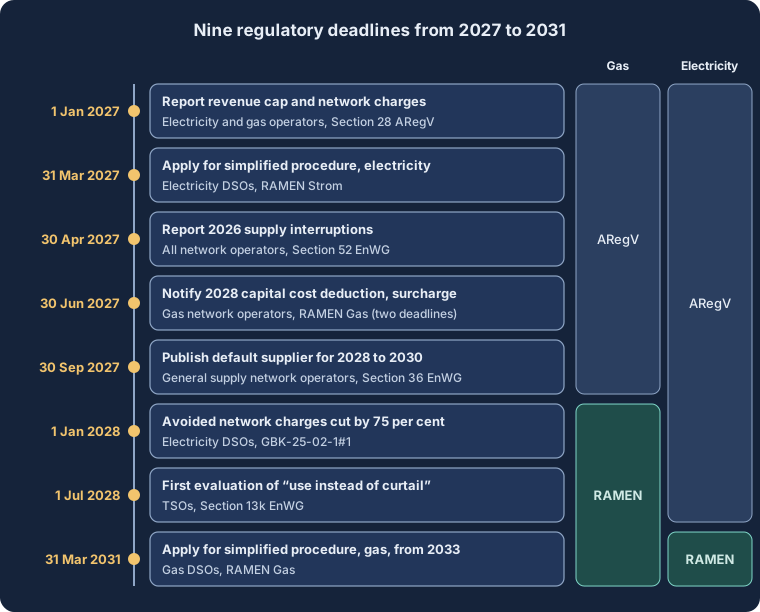
Eight more dates surround it, drawn from ARegV, the Energy Industry Act (EnWG) and three rulings of the Federal Network Agency, from the revenue cap report on New Year's Day 2027 to the first evaluation of "use instead of curtail" in July 2028. At the same time the framework changes: gas networks move to RAMEN Gas in 2028, electricity networks to RAMEN Strom in 2029.
The regulatory deadlines covered here are nine dates between 1 January 2027 and 31 March 2031 by which German electricity and gas network operators must report, notify, apply for or publish something with the regulator, or apply a ruling in their billing; they are set by Section 28 of the Incentive Regulation Ordinance (ARegV), the RAMEN Strom and RAMEN Gas rulings of 8 December 2025, Sections 13k, 36 and 52 EnWG and the Federal Network Agency's ruling on avoided network charges of 17 February 2026. On 1 January 2027 every network operator reports its adjusted revenue cap and the resulting change in network charges; small electricity DSOs apply for the simplified procedure for 2029 to 2033 by 31 March 2027; all network operators report their 2026 supply interruptions by 30 April 2027; and gas network operators notify the capital cost deduction and any capital cost surcharge for 2028 by 30 June 2027. General supply network operators publish the default supplier for 2028 to 2030 by 30 September 2027, avoided network charges are cut by 75 per cent from 1 January 2028, the transmission system operators evaluate "use instead of curtail" by 1 July 2028, and gas DSOs apply for the simplified procedure for the period from 2033 by 31 March 2031. Consequences range from supervisory orders and the abuse rules with fines of up to EUR 1 million to losing recognition of capital costs and being bound to the standard procedure for a whole regulatory period.
Nine deadlines between New Year 2027 and March 2031
Seven of the nine dates fall in the 18 months between 1 January 2027 and 1 July 2028, and they come from five different sources: the Incentive Regulation Ordinance, the two RAMEN rulings of the Federal Network Agency's Grand Ruling Chamber for Energy of 8 December 2025, three sections of the EnWG and the ruling of 17 February 2026 that phases out payments for decentralised generation. All nine are final; none comes from a draft. References to the rulings give the operative point (para.) or the paragraph number of the reasoning. Number nine, the gas application for the period from 2033, lies far out and is included because it follows the same paragraph as the electricity application in March 2027.
| Date | Obligated | Content | Basis | If missed |
|---|---|---|---|---|
| Fri, 01.01.2027 | electricity and gas network operators | report the adjusted revenue cap with changed cost shares, the change in network charges and the status of investment measures | Section 28 sentence 1 nos. 1, 4, 6 ARegV | order and coercive fine; as abuse, fine of up to EUR 1 million |
| Wed, 31.03.2027 | electricity DSOs below the threshold | apply for the simplified procedure or the very small operator rule for 2029 to 2033 | RAMEN Strom paras. 16.6, 16.9 | standard procedure with efficiency benchmarking for the whole period |
| Fri, 30.04.2027 | all electricity and gas network operators | report every supply interruption in 2026 | Section 52 EnWG | order, coercive fine; administrative offence only for ignoring an order |
| Wed, 30.06.2027 | gas distribution and transmission system operators | notify the self-calculated capital cost deduction for 2028 | RAMEN Gas para. 9.7 | order and coercive fine; as abuse, fine of up to EUR 1 million |
| Wed, 30.06.2027 | gas network operators with a capital cost surcharge | notify the capital cost surcharge for the 2028 revenue cap | RAMEN Gas para. 11.7 | costs not recognised, not even in the regulatory account |
| Thu, 30.09.2027 | general supply network operators, electricity and gas | publish the default supplier for 2028 to 2030 (cut-off 1 July) and notify the state authority | Section 36(2) EnWG | measures by the state authority; no administrative offence |
| Sat, 01.01.2028 | electricity DSOs | settle and plan avoided network charges with a 75 per cent cut | GBK-25-02-1#1, para. 2 | order and coercive fine under Sections 65, 94 EnWG |
| Sat, 01.07.2028 | TSOs; DSOs under Section 13k(8) | first evaluation of "use instead of curtail" with a report | Section 13k(9) EnWG | order, coercive fine |
| Mon, 31.03.2031 | gas DSOs below the threshold | apply for the simplified procedure or the very small operator rule for the period from 2033 | RAMEN Gas paras. 16.6, 16.9 | standard procedure for the whole period |
One caveat covers every RAMEN date. Operative point 19 of both rulings ties the procedural rules, including the 31 March application and the 30 June notices, only to network operators that fall under the Federal Network Agency's responsibility under Section 54(1) and (2) EnWG, including those it supervises on behalf of a state that has handed its regulatory tasks to the agency (Organleihe). State regulatory authorities keep their own procedures. A municipal utility with fewer than 100,000 connected customers in a state whose authority regulates it directly should check the dates there before they go into the annual plan.
Revenue cap and network charges: report on 1 January 2027
On 1 January 2027 every electricity and gas network operator tells the regulator how it has adjusted its revenue cap and which changes in cost shares lie behind it (Section 28 sentence 1 no. 1 ARegV), and how its network charges change as a result (no. 4). Operators with approved investment measures under Section 23 report on the same day how far those investments were carried out and became cost-effective (no. 6). In 2027 the date is a Friday and a public holiday, so the report has to be finished in the old year.
No new decision is needed. Under Section 4(3) ARegV the operator itself adjusts the revenue cap on 1 January when the consumer price index, the permanently non-controllable cost shares or the volatile cost shares change; for most non-controllable costs the year before last counts, for items such as upstream network costs and avoided network charges the year the cap applies to. Towards the regulator, the 1 January report is the counterpart to the price sheet published by 15 October; the calculation behind it is set out in our piece on network charges 2027.
The duty survives the change of framework. For gas from 2028 and for electricity from 2029, operative point 4.2 sentence 3 of the RAMEN rulings requires operators to report the adjustment "on 1 January of the calendar year" for all adjustable components of the revenue cap; the final check happens in the regulatory account. Separately, Section 28 sentence 2 ARegV asks every year by 31 March for the number of customers connected on 31 December and the location of the network by federal state, sent to the Federal Network Agency and the state regulatory authority. In 2027 that falls on the same day as the simplified procedure application.
Simplified procedure for electricity: apply by 31 March 2027
Electricity DSOs that want to use the simplified procedure or the very small operator rule in the fifth regulatory period must apply to the regulator by Wednesday, 31 March 2027 (RAMEN Strom para. 16.6 sentence 1, para. 16.9). Starting on 1 January 2029, the period runs for five years (paras. 2.2, 3.1), and the operator is bound to its choice for the whole period (para. 16.6 sentence 3). Approval follows within four weeks of receiving a complete application if the conditions are met; state authorities send their lists of participants to the Federal Network Agency by 31 May.
Only small operators may take part, and an operator is small if its adjusted revenue cap for the 2026 base year stays below a threshold in euros. It is set by the Federal Network Agency so that all DSOs up to that amount together cover 90 per cent of all adjusted revenue caps of the base year, net of upstream network costs and avoided network charges (para. 16.3). It publishes the figure in the first full calendar week of 2027, the week starting Monday, 4 January (para. 16.2). That leaves just under twelve weeks between threshold and deadline, and the year-end close and the 1 January report fall into the same weeks.
Whether the application pays can be worked out. An operator that can expect a score above the weighted average in the standard procedure gives up revenue for five years by applying; one that would land below it gains. Every operator knows its own score from the fourth period, but nobody knows the next average, because the ruling gives the scores of smaller operators in the standard procedure "particular" weight without stating a formula. The data collection exemption comes from draft ruling BK8-26-04#13, consulted on until 26 October 2026; our piece on the electricity efficiency benchmarking data collection explains it. For operators regulated by a state authority the draft mentions in a footnote that a different deadline may apply.
Very small operators are a separate case. An operator whose adjusted revenue cap net of upstream network costs and avoided network charges is EUR 500,000 or less can opt out of incentive regulation altogether, but only if the competent regulator introduces the rule for its area (para. 16.7). What counts is the adjusted 2026 revenue cap published under Section 23b EnWG (para. 16.8). Network users of a very small network can have its charges reviewed; a charge no higher than that of the adjacent upstream network is presumed lawful (para. 16.10).
2026 supply interruptions: report by 30 April 2027
Every electricity or gas network operator submits to the Federal Network Agency by Friday, 30 April 2027, a report on all supply interruptions in its network during 2026 (Section 52 sentence 1 EnWG). For each interruption it gives time and duration, extent and cause; it adds the measures it has taken to prevent future disruptions and the average interruption in minutes per connected final customer. According to the agency the duty applies regardless of the size or location of the network, and the 30 April date applies even where the general rulings on electricity from 2006 and gas from 2008 still name other deadlines.

Reports are filed per network area, meaning per network number, either through a web form in the energy data portal using the operator's company and control numbers or through the XML web service. From these the Federal Network Agency calculates indicators for interruptions longer than three minutes. For electricity in 2024 that gave a total SAIDI EnWG, the sum of low and medium voltage, of 11.68 minutes from the reports of 830 operators with 836 networks, of which 2.43 minutes at low voltage and 9.24 at medium voltage. For gas the 2024 figure was 1.55 minutes; the agency says it will no longer publish it "due to prioritisation", while the duty to report under Section 52 stays as it is.
This report shares only the raw data with the quality element. The data collection for the reliability quality element applies only to electricity DSOs in the standard procedure, counts planned interruptions at half weight and has its own deadline; our piece on quality regulation and SAIDI covers it. An operator feeding both from one outage database has to map the differences in interruption causes cleanly, or the totals in the two reports will not match and will stand out when the agency checks them.
RAMEN Gas: capital cost deduction and surcharge by 30 June 2027
Two notices fall due for gas network operators on Wednesday, 30 June 2027, both for the 2028 revenue cap, the first year of the fifth gas regulatory period. RAMEN Gas is addressed to gas distribution and transmission system operators (para. 1) and turns two figures that the regulator used to set or approve into notices from the operator. According to the reasoning, the date was chosen so that whatever is notified by 30 June can be checked before the provisional charges are published on 15 October (para. 1063).
Capital cost deduction (para. 9.7)
The regulator sets the period's revenue caps "initially without setting the capital cost deduction" (para. 9.7 sentence 1). The operator calculates the deduction for each year itself and notifies it by 30 June of the previous year. It equals the capital costs in the starting level of the 2025 base year minus the continued capital costs of the year in question; investments after the base year are left out (para. 9.1). Residual values, depreciation, return on capital, trade tax and the release of construction and investment grants are rolled forward, together with partial network transfers and asset disposals after the base year: as actuals up to the last closed year, as plan figures after that, reconciled in the regulatory account (para. 9.6). For the notice, the GasNEF ruling's rule on SAV-IDs, the identifiers of individual fixed assets, applies accordingly.
Electricity has no such notice; there the regulator sets the capital cost deduction. Gas operators therefore have to produce from 2027 a calculation they used to read in a decision, using planned asset disposals and partial network transfers. Booking pipelines that the gas network transformation makes redundant as disposals changes the deduction, and the plan-to-actual reconciliation claws back a wrong estimate later through the regulatory account. Our piece on the gas regulatory period from 2028 describes the NEST Gas and GasNEF framework.
Capital cost surcharge (para. 11.7)
An operator that includes a capital cost surcharge for investments after the base year in its 2028 revenue cap must also notify it by 30 June 2027 (para. 11.7). This replaces the application and approval under Section 10a ARegV: the operator submits a survey form by 30 June showing how the investments were derived, and there is no approval decision (para. 1115). Planned investments are backed by internal investment planning on request (para. 11.2 sentence 3). According to the chamber, its own review practice drove the switch, in which applications under Section 10a were approved with hardly any cuts "apart from individual cases".
If an operator includes a capital cost surcharge without notifying it, "the costs cannot be recognised (not even in the regulatory account)", according to the reasoning on para. 11.7 (para. 1114).
Electricity network operators have a date under the old rules on the same day: the 2028 electricity revenue cap still belongs to the fourth period, and the application to adjust it for the capital cost surcharge can be made once a year by 30 June under Section 4(4) sentence 2 ARegV. A multi-utility claiming a capital cost surcharge in both sectors therefore sends an ARegV application and a RAMEN Gas notice on 30 June 2027, both from the same fixed-asset ledger.
Default supplier 2028 to 2030: publish by 30 September 2027
Which company is the default supplier in a network area for 2028 to 2030 is published online by the operator of the general supply electricity or gas network by Thursday, 30 September 2027, and notified in writing to the competent state authority (Section 36(2) sentence 2 EnWG). The default supplier is the company that supplies the most household customers in the network area on the cut-off date, Thursday, 1 July 2027. Under Section 3 no. 57 EnWG household customers are final customers buying energy mainly for their own household, plus professional, agricultural and commercial customers using up to 10,000 kilowatt hours a year.
The cycle has run every three years since 2006; the last determination was in 2024. For the network operator it is a counting task based on the supplier assignment of its market locations: household customers per supplier on 1 July, separately for electricity and gas and per network area. For the sales unit of the same municipal utility the result is a business question, and because network and sales often sit at the same table in a multi-utility, the count should be documented well enough to withstand an objection. Objections can be lodged with the state authority by Sunday, 31 October 2027; the authority decides on them and can take measures to keep the procedure in order (sentences 3 and 4). If the default supplier changes, household customers' existing contracts with the previous default supplier continue at the terms and prices in force at the time of the change (subsection 3). Closed distribution systems are excluded (subsection 4).
Avoided network charges: 75 per cent cut from 1 January 2028
From Saturday, 1 January 2028, electricity DSOs cut the avoided upstream costs of the network and transformation levels, on which the payment for decentralised feed-in is based, by 75 per cent. This comes from the Grand Ruling Chamber for Energy, in ruling GBK-25-02-1#1 of 17 February 2026, in three steps: 50 per cent from 1 July 2026, 50 per cent from 1 January 2027, 75 per cent from 1 January 2028 (operative point 2). The cut applies to the planned cost item when the revenue cap is adjusted and to the costs actually avoided, which are settled through the regulatory account (point 2 sentence 4).

2028 is the last year. When the Electricity Network Charges Ordinance expires at the end of 31 December 2028, its Section 18 goes with it, and the chamber does not intend to set a similar rule (para. 5). Without the cut, payments for decentralised generation would have cost network users about EUR 3 billion from 2026 to 2028; the phase-out saves them about EUR 1.5 billion (para. 74). For a municipal utility with its own combined heat and power plants the effect shows up on both sides: the network pays out less and lowers its planned costs, the generation side receives less. Network operators should tell plant operators about the new rate before the turn of the year so that 2028 instalments and business cases are right.
Use instead of curtail: first evaluation by 1 July 2028
By Saturday, 1 July 2028, the four transmission system operators with control area responsibility evaluate for the first time how "use instead of curtail" under Section 13k(1) to (7) EnWG has been applied, and submit a report; after that the evaluation repeats every two years (subsection 9 sentence 1). Under the scheme they pass renewable electricity that would otherwise be curtailed because of congestion in the transmission grid to additional switchable loads in relief regions. Subsection 9 does not say to whom the report goes.
The first report will describe a scheme in transition. It started on 1 October 2024 with a two-year trial in which volumes were allocated on a flat basis; since 1 October 2026, according to the TSOs' implementation concept (version 2.0 of 1 April 2026), the target model with daily competitive tenders has been running. By the cut-off there will be about 21 months of the target model to assess. DSOs are covered only if they have used Section 13k(8) for at least twelve months. Among other conditions, that option is open only to operators of a 110 kV network with more than 100,000 directly or indirectly connected customers in which at least 100,000 megawatt hours of renewable generation were curtailed in each of the last two calendar years because of congestion in their own network.
Simplified procedure for gas: next application by 31 March 2031
For the fifth gas regulatory period, which runs from 2028 to 2032 (RAMEN Gas paras. 2.2, 3.1), the application for the simplified procedure was due by 31 March 2026; that deadline has passed. Next comes the sixth period starting on 1 January 2033: gas DSOs apply for the simplified procedure or the very small operator rule by Monday, 31 March 2031, the second-to-last calendar year before the period starts (paras. 16.6, 16.9).
The rules match those for electricity with two differences. The gas threshold is based on 84 rather than 90 per cent of the base year's adjusted revenue caps and is net only of upstream network costs; gas has no avoided network charges (para. 16.3). Under para. 2.3 the sixth period lasts three years, not five; by 31 December 2030 the Federal Network Agency will assess whether the simplifications are enough for the move to three-year periods (para. 3.2). Whether the rules still read the same in 2031 depends on that assessment.
Where network operators wanted other dates
Two of the nine dates were disputed in the consultations, and in both cases the Grand Ruling Chamber kept its draft. For RAMEN Gas several submissions wanted the capital cost deduction notice moved to 15 October, in step with the publication of network charges (para. 325), and the surcharge notice to 30 September, because "a later date would lead to better data quality, as corporate planning would be further advanced" (para. 380). The chamber stayed with 30 June: "A period of at least six months is required to carry out such a plausibility check properly" (para. 1116, ruling of 8 December 2025).
On avoided network charges the objections came from two sides. Generators and industry representatives asked for the rule to stay unchanged until the Electricity Network Charges Ordinance expires at the end of 2028, or to continue until a replacement exists (para. 12); other submissions asked for the payments to end entirely on 1 January 2026 (para. 11). Even the chamber spoke of an abolition from 2026 that would have been "more sensible in energy terms" and still chose the steps, to let plant operators "prepare in planning and business terms" for the end of the payments (para. 74, ruling of 17 February 2026).
What applies if a deadline is missed
The costliest deadlines are those that carry their own consequence. An operator that does not notify its gas capital cost surcharge by 30 June loses recognition of those costs, in the regulatory account too (RAMEN Gas, reasoning on para. 11.7). An operator that does not apply for the simplified procedure by 31 March 2027 for electricity or by 31 March 2031 for gas stays in the standard procedure with efficiency benchmarking for the whole period and is bound to it (para. 16.6 sentence 3).
For the Section 28 ARegV report and the capital cost deduction notice, neither ARegV nor RAMEN Gas sets a specific administrative offence. The regulator can order both under Section 65(2) EnWG and enforce them with coercive fines under Section 94. For network operators a breach is also an abuse of their market position under Section 30(1) sentence 2 no. 1 EnWG, which the regulator can require them to stop and can establish after the fact (Section 30(2) and (3)); for this and for breaching an order to stop, Section 95(1) no. 4 and no. 3(b) provides for fines of up to EUR 1 million (Section 95(2) no. 3). For DSOs with fewer than 100,000 customers whose network does not extend beyond one federal state, the state regulatory authority is responsible (Section 54(2) no. 8). Those affected can apply for abuse proceedings and claim removal, injunctive relief or, where there is fault, damages under Sections 31 and 32 EnWG.
For the Section 52 report, the Section 13k evaluation and avoided network charges the tools are orders and coercive fines under Sections 65 and 94 EnWG; an administrative offence under Section 95(1) no. 3(a) arises only for failing to follow an enforceable order. For the default supplier the state authority decides on objections and can take measures; Section 95 EnWG sets no fine for it. All of this describes what the rules provide and is not an assessment of any individual case.
What network operators should plan now
The deadlines draw on the same people and data: regulatory management, fixed-asset accounting, network operations with the outage statistics and network billing. We recommend sorting them by sector and by competent authority before they go into the annual plan, because a gas network regulated by a state authority can have different RAMEN dates from an electricity network the Federal Network Agency supervises on a state's behalf.
The steps to July 2028
-
December 2026: finish the 1 January report
Calculate the adjusted 2027 revenue cap with the final upstream costs and send it before the turn of the year, since 1 January 2027 is a public holiday.
-
January to March 2027: decide on the simplified procedure
From 4 January compare the threshold with your own adjusted 2026 revenue cap, set your fourth-period efficiency score against the expected average, and apply or decide not to by 31 March; on the same day report the customer count under Section 28 sentence 2 ARegV.
-
By April 2027: check the 2026 outage data
Review interruptions per network number with cause and extent, calculate the average interruption, describe the measures.
-
By June 2027: notify gas capital costs for 2028
Derive the capital cost deduction from the 2025 starting level and planned disposals and the surcharge from investment planning, notify both with SAV-IDs; in a multi-utility, prepare the electricity application under Section 4(4) ARegV alongside.
-
July to September 2027: determine the default supplier
Count household customers per supplier as of 1 July, document the result, publish it by 30 September and notify the state authority in writing.
-
Autumn 2027: avoided network charges for 2028
Plan 2028 costs with the 75 per cent cut, change the billing and tell plant operators in advance.
Deadline, market roles, systems
1 January 2027Report the revenue cap adjustment and the network charge adjustment (Section 28 ARegV)Law · adopted
Applicability: Applies as long as ARegV is applicable. For electricity the RAMEN Strom determination (para. 4.2 sentence 3) continues the 1 January report from 2029; for gas the RAMEN Gas determination governs the procedure from 2028.
If the deadline is missed: Fine possible Section 28 ARegV sets no specific administrative offence. The regulator can order the report under Section 65(2) EnWG and enforce it with coercive fines under Section 94 EnWG. For network operators a breach is also an abuse of their market position (Section 30(1) sentence 2 no. 1 EnWG). The regulator can require it to stop (Section 30(2)) and can also establish it after the fact (Section 30(3)); for distribution system operators with fewer than 100,000 customers whose network does not extend beyond one federal state, the state regulatory authority is responsible (Section 54(2) no. 8). Section 95(1) nos. 4 and 3(b) EnWG threaten fines of up to EUR 1 million for the abuse and for breaching an order to stop it (Section 95(2) no. 3). Those affected can apply for abuse proceedings (Section 31) and claim removal, injunctive relief or, where there is fault, damages (Section 32 EnWG). Legal basis ↗
- Electricity grid operatorrole obligationReports the adjusted revenue cap with the changed cost shares and the network charge adjustment to the regulator.Typically affected: Regulatory management, controlling
- Gas grid operatorrole obligationReports the adjusted revenue cap with the changed cost shares and the network charge adjustment to the regulator.Typically affected: Regulatory management, controlling
31 March 2027Apply for the simplified procedure for electricity for the regulatory period from 2029Regulatory ruling · adopted
Applicability: Only electricity DSOs that meet the conditions for the simplified procedure or the very small operator rule under RAMEN Strom. For gas, the deadline for the period from 2028 passed on 31 March 2026.
If the deadline is missed: Exclusion or loss of role Without a timely application the regular procedure with efficiency benchmarking applies for the whole regulatory period; the operator is bound to the procedure for the duration of the period (RAMEN Strom para. 16.6 sentence 3). Legal basis ↗
- Electricity grid operatorcheck applicabilityChecks whether the conditions for the simplified procedure or the very small operator rule are met and whether taking part pays off, and applies by 31 March 2027.Typically affected: Regulatory management, controlling
30 April 2027Report on 2026 supply interruptions to the Federal Network Agency (Section 52 EnWG)Law · adopted
Applicability: Applies to all operators of energy supply networks, electricity and gas, regardless of size. The data collection for the quality element for electricity DSOs in the regular procedure is a separate deadline.
If the deadline is missed: Regulator can enforce Section 52 EnWG sets no specific administrative offence. The regulator can enforce the duty under Section 65(2) EnWG with coercive fines under Section 94 EnWG; failing to comply with an enforceable order is an administrative offence under Section 95(1) no. 3(a) EnWG. Legal basis ↗
- Electricity grid operatorrole obligationEvaluates the 2026 fault data and reports each interruption with duration, extent and cause, plus the average interruption duration.Typically affected: Grid control system / SCADA, Regulatory management, controlling
- Gas grid operatorrole obligationReports the 2026 supply interruptions in the gas network with duration, extent, cause and measures.Typically affected: Grid control system / SCADA, Regulatory management, controlling
- Transmission system operatorrole obligationReports the 2026 supply interruptions in the transmission network with duration, extent, cause and measures.Typically affected: Grid control system / SCADA, Regulatory management, controlling
30 June 2027RAMEN Gas: notify the capital cost deduction for 2028Regulatory ruling · adopted
Applicability: Applies to gas distribution and transmission system operators in the regulatory period from 2028, each year for the following year. For electricity the regulator determines the capital cost deduction itself.
If the deadline is missed: Fine possible RAMEN Gas sets no specific consequence for a missing notification. The regulator can order it under Section 65(2) EnWG and enforce it with coercive fines under Section 94 EnWG. For network operators a breach is also an abuse of their market position (Section 30(1) sentence 2 no. 1 EnWG). The regulator can require it to stop (Section 30(2)) and can also establish it after the fact (Section 30(3)); for distribution system operators with fewer than 100,000 customers whose network does not extend beyond one federal state, the state regulatory authority is responsible (Section 54(2) no. 8). Section 95(1) nos. 4 and 3(b) EnWG threaten fines of up to EUR 1 million for the abuse and for breaching an order to stop it (Section 95(2) no. 3). Those affected can apply for abuse proceedings (Section 31) and claim removal, injunctive relief or, where there is fault, damages (Section 32 EnWG). Legal basis ↗
- Gas grid operatorrole obligationDetermines the 2028 capital cost deduction from the starting level and asset disposals and notifies it by 30 June 2027; also applies to gas TSOs.Typically affected: Regulatory management, controlling, Plant master data and MaStR
30 June 2027Capital cost surcharge gas 2028: notify the regulatorRegulatory ruling · adopted
If the deadline is missed: Money is lost Without timely notification the costs cannot be recognised, not even in the regulatory account (RAMEN Gas, reasoning on operative point 11.7). Legal basis ↗
- Gas grid operatorrole obligationNotifies the capital cost surcharge for the 2028 revenue cap by 30 June 2027, then yearly by 30 June of the previous year.Typically affected: Regulatory management, controlling
30 September 2027Determine and publish the default supplier for 2028 to 2030 (Section 36 EnWG)Law · adopted
Applicability: Applies to operators of general supply electricity and gas networks regardless of size. The cut-off for the determination is 1 July 2027, the deadline for publication and notification 30 September 2027.
If the deadline is missed: Regulator can enforce The competent state authority can take the measures needed to run the procedure properly and decides on objections to the result (Section 36(2) sentences 3 and 4 EnWG). Section 95 EnWG sets no specific administrative offence. Legal basis ↗
- Electricity grid operatorrole obligationCounts household customers per supplier as of 1 July 2027, determines the default supplier, publishes the result by 30 September and notifies the state authority.Typically affected: SAP IS-U / S/4HANA Utilities, Regulatory management, controlling, Customer and grid connection portal
- Gas grid operatorrole obligationCounts household customers per gas supplier as of 1 July 2027, determines the default supplier, publishes the result by 30 September and notifies the state authority.Typically affected: SAP IS-U / S/4HANA Utilities, Regulatory management, controlling, Customer and grid connection portal
- SupplieraffectedLearns whether it is or remains default supplier in the network area from 2028 and can lodge objections with the state authority by 31 October.Typically affected: SAP IS-U / S/4HANA Utilities
1 January 2028Avoided network charges: 75 per cent cut from 2028Regulatory ruling · adopted
If the deadline is missed: Regulator can enforce The ruling sets no specific consequence. The regulator can order compliance under Section 65 EnWG and enforce it with coercive fines under Section 94 EnWG. Legal basis ↗
- Electricity grid operatorrole obligationSettles avoided network charges with a 75 per cent cut from 1 January 2028 and reflects this in the planned cost approach of the revenue cap.Typically affected: Grid usage and customer billing, Regulatory management, controlling
- Plant operator (generation)affectedReceives much lower payments for avoided network charges for decentralised feed-in from 2028.Typically affected: Plant master data and MaStR
1 July 2028"Use instead of curtail": first evaluation and report (Section 13k(9) EnWG)Law · adopted
Applicability: Duty of TSOs with control area responsibility; DSOs only if they have applied Section 13k(8) EnWG for at least twelve months.
If the deadline is missed: Regulator can enforce Section 13k EnWG sets no specific administrative offence. The regulator can enforce the duty under Section 65(2) EnWG with coercive fines under Section 94 EnWG; failing to comply with an enforceable order is an administrative offence under Section 95(1) no. 3(a) EnWG. Legal basis ↗
- Electricity grid operatorcheck applicabilityChecks whether it has used the option under Section 13k(8) for at least twelve months; if so, it evaluates its own application by the same date.Typically affected: Grid control system / SCADA, Regulatory management, controlling
- Transmission system operatorrole obligationEvaluates the application of "use instead of curtail" and submits the report by 1 July 2028.Typically affected: Grid control system / SCADA, Regulatory management, controlling
31 March 2031Simplified procedure gas for the sixth regulatory period: applicationRegulatory ruling · adopted
Applicability: Gas distribution system operators below the thresholds for the simplified procedure or the very small operator rule under RAMEN Gas.
If the deadline is missed: Money is lost Without an application the standard procedure with efficiency benchmarking applies for the whole regulatory period; the operator is bound to the chosen procedure for the period (RAMEN Gas, operative point 16.6 sentence 3). Legal basis ↗
- Gas grid operatorrole obligationDecides on the simplified procedure for 2033 to 2037 and applies by 31 March 2031.Typically affected: Regulatory management, controlling
A classification for typical market roles, not a review of your individual case and not legal advice. Whether an obligation applies to your company (thresholds, exemptions) is for your legal department or counsel to confirm. The calendar doesn't replace your own deadline review. Information as of: 27 October 2026.
Further reading
Frequently asked questions
In the simplified procedure a small electricity DSO gets a flat efficiency score instead of its own score from the national efficiency benchmarking: the weighted average of the regular procedure's scores in the previous regulatory period (RAMEN Strom para. 16.4). An operator counts as small if its adjusted revenue cap for the base year 2026 is below the threshold set by the Federal Network Agency (para. 16.3). The application for the fifth regulatory period, which starts on 1 January 2029 and runs for five years, is due by 31 March 2027, and the operator is bound to its choice for the whole period (para. 16.6).
By Friday, 30 April 2027. Under Section 52 EnWG every electricity and gas network operator submits to the Federal Network Agency by 30 April a report on all supply interruptions of the previous year, with time, duration, extent and cause of each, the measures taken and the average interruption in minutes per connected final customer. The duty applies regardless of network size; reports are filed per network area through the agency's energy data portal or its XML web service.
The capital cost deduction is the amount by which the capital costs in the starting level fall over the regulatory period as assets are depreciated; investments after the 2025 base year are left out (RAMEN Gas para. 9.1). From the 2028 regulatory period the gas network operator calculates it for each year itself and notifies the regulator by 30 June of the previous year, for 2028 by Wednesday, 30 June 2027 (para. 9.7). The regulator first sets the revenue cap without the deduction.
According to the reasoning on RAMEN Gas para. 11.7 the costs cannot then be recognised, not even in the regulatory account. The notification replaces the former application and approval under Section 10a ARegV; the operator submits a survey form by 30 June showing how the investments were derived. This is a general reading of the ruling, not an assessment of any individual case.
The operator of the general supply network. Every three years it determines as of 1 July which company supplies the most household customers in its network area, publishes the result online by 30 September and notifies the competent state authority in writing (Section 36(2) EnWG). The next round covers 2028 to 2030: cut-off on 1 July 2027, publication by 30 September 2027, objections to the state authority by 31 October 2027.
From 1 January 2028 electricity DSOs cut the avoided costs of the upstream network and transformation levels, on which the payment for decentralised feed-in is based, by 75 per cent; in 2027 the cut is 50 per cent (ruling GBK-25-02-1#1 of 17 February 2026, operative point 2). The cut applies to the planned cost item in the revenue cap and to the costs actually avoided in the regulatory account. The payment ends altogether when the Electricity Network Charges Ordinance expires on 1 January 2029.
Directly only to network operators that fall under the Federal Network Agency's responsibility under Section 54(1) and (2) EnWG, including those it supervises on behalf of a state. Operative point 19 of both RAMEN rulings says so: the procedural rules, including the notices due on 30 June and the application due on 31 March, do not affect the procedures of the state regulatory authorities. Operators regulated by a state authority should ask that authority for its dates.
Let's collaborate
One contact, a team behind it
Thirty minutes on what you're working on, whether grid, metering, market processes, IT architecture or AI. Afterwards you'll know how we'd approach it and who would sit at the table.
Energy and measurement technology since 2010 · innobu GmbH since 2014 · Based in Schleswig-Holstein, Germany
Whoever pitches also delivers: whoever leads the first call stays your contact right through to the steering committee, with established partners in the project. Direct: info@innobu.com