Prosumer Platforms and White-Label Apps for PV, Heat Pump and Wallbox
Vattenfall, Zählerfreunde and beegy sell utilities ready-made prosumer platforms to roll out under their own brand. Behind it sits a race for the customer interface in the home. Whoever owns the app holds the daily contact, the consumption data and the future flexibility revenue. This article maps the market, shows the regulatory tailwind from section 41a and 14a of the German Energy Act, and says what utilities need to decide now.
Prosumer platforms bundle a household's PV, battery storage, heat pump and wallbox into one app and steer them by electricity price, weather and self-consumption. As a white-label product, utilities buy this software and bring it to end customers under their own brand. The market tightened through 2025 and 2026: Vattenfall offers its Prosumer App as a white-label solution, Zählerfreunde launched HEMS 2.0 on 16 June 2026 with over 100 manufacturers and more than 1,000 devices, and beegy delivers an EEBUS-certified system. The driver is regulatory. Dynamic tariffs have been mandatory since 1 January 2025 under section 41a EnWG, and the rollout of control boxes under section 14a begins on 1 January 2026. The real prize is the customer interface. Whoever controls it controls customer data, controllable assets and the flexibility revenue. For the roughly 900 utilities in Germany, that means treating tariff, metering and control as one offer, before Enpal and 1KOMMA5° lock in the customers.
The battle for the customer interface
The decisive question is no longer whether households use an energy app, but who provides it. A prosumer generates and consumes electricity at the same time: PV on the roof, plus flexible loads in the basement and the garage. Once storage, heat pump and wallbox come together, something has to coordinate them. That is the app's job. And whoever provides the app holds the stronger hand.
Because the app is more than a tidy consumption chart. It holds the daily contact, it sees the consumption data down to the quarter hour, and it reaches into the controllable devices. The flexibility revenue that section 14a and the dynamic tariffs create hangs on exactly that access. Control over energy management means control over the customer.
This is where new competitors push in. Enpal, 1KOMMA5° and Octopus Energy sell PV, storage, heat pump and the matching app from a single source and bind the customer directly. For a traditional utility, that is the real threat. Not the electricity price, but the interface. Lose it, and the utility becomes a plain supplier in the background, interchangeable and cut off from the new revenue streams.
How a white-label platform works
A white-label platform is a finished prosumer app without a brand. The utility buys the software and brings it to customers under its own name and design. The hard work, connecting hundreds of device manufacturers and maintaining the control logic, is done by the platform provider. Three layers interlock.
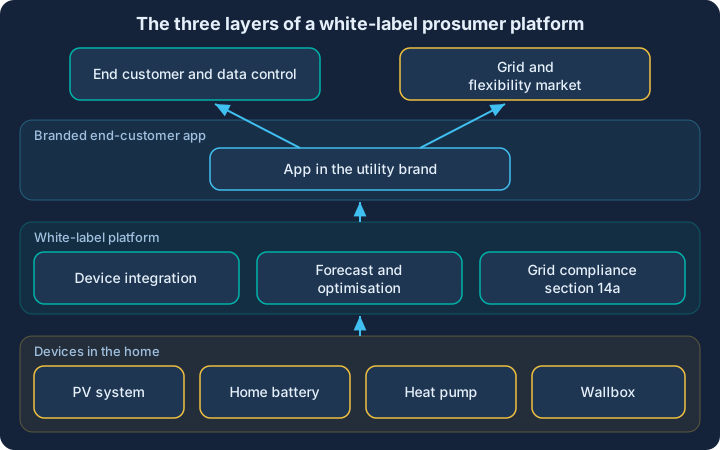
At the bottom sits the device layer: PV inverter, home battery, heat pump and wallbox as controllable building blocks. In the middle sits the platform, which connects these devices via standards like EEBUS and the smart meter gateway, forecasts consumption, and runs the control in a grid-compliant way under section 14a. At the top sits the app in the utility's design, with visualisation, a dynamic tariff and automatic control. Only the top layer is what the customer sees. The real value creation sits in the middle.

What this gives the customer can be put in numbers. Vattenfall reports a saving potential of more than 1,000 euros per household per year from active energy management, depending on the equipment. The value comes from shifting loads automatically into the cheap hours, not from the tariff alone. Without control, the dynamic tariff stays an abstract promise for most people.
The regulatory tailwind: section 41a and 14a
Two rules turn a niche product into a must-have topic. They work together, and neither does much without the app.
Suppliers with more than 100,000 customers have had to offer at least one dynamic electricity tariff since 1 January 2025. The price follows the exchange. The benefit only kicks in when energy management shifts the devices into the cheap hours automatically.
Loads above 4.2 kilowatts such as heat pumps and wallboxes are grid-controllable, with reduced network charges attached. The rollout of control boxes and smart meters begins on 1 January 2026.
The link is simple: section 41a creates the price signal, section 14a the controllability. The app is the tool that brings both to the customer. A network-charge discount nobody uses, because the heat pump runs at the wrong time, is worthless. That is why regulation is the real driver behind the platform market. It forces utilities to offer dynamic tariffs and makes the new tariff models useful only with control.
The market: providers and models
The market for white-label platforms tightened noticeably through 2025 and 2026. Four names keep coming up with utilities, each with a different focus.

A branded app for utilities that visualises and automatically steers PV, storage, heat pump and wallbox. It won the Digital Innovation Pitch Award in 2024.
Live since 16 June 2026 with over 100 manufacturers and more than 1,000 devices, AI-based control and dynamic tariffs. Customers include Stadtwerke Dortmund and EnBW.
An EEBUS-certified HEMS for utilities and installers. The certification proves grid- and market-compliant energy management in the prosumer segment.
A connectivity and flexibility platform with modules for self-consumption, analytics, grid compliance and flexibility marketing.
The shared direction stands out. All four rely on open device standards, all couple the app to dynamic tariffs, all prepare for section 14a. The difference is the business model: pure platform or full package, with or without flexibility marketing. How flexible loads are pooled into marketable bundles is covered in the piece on Redispatch 3.0 and market-based congestion management.
Why utilities must act now
Roughly 900 utilities in Germany face the same decision, and the big ones are already pulling ahead. At an industry event run by m3 LAB with around 40 utilities, one calculation stuck: 3,000 prosumer customers deliver more value than 10,000 traditional tariff customers. The business models are expected to turn profitable in two to three years.
Utilities that build prosumer and flexibility skills now avoid a strategic failure, as the tone at m3 LAB put it. The finding is uncomfortable: smaller and mid-sized utilities lag well behind, while the full-service providers bind customers. This is not about chasing every trend. It is about not losing your own customer base to an app someone else provides.
The decisive question is not whether demand for dynamic tariffs will grow, but who is prepared when it does.
Martin Germann, Stadtwerke VölklingenChallenges and risks
The move is not a sure thing. A HEMS costs money up front, and the return comes later. Profitability only appears in the bundle of dynamic tariff, procurement optimisation and flexibility marketing, not from the app alone.
Then there is the internal silo question. A prosumer offer touches sales, network operations, metering, IT and procurement at once. A utility that does not settle these responsibilities beforehand fails not on the technology but on the organisation. And the dependence on the provider is real: open standards and data control here are not technical details but the condition for keeping a switch to another platform possible at all.
What companies should do now
The decision is strategic more than technical. To keep the customer interface, you need a prosumer offer before demand for dynamic tariffs tips over. Four steps help.
-
Settle make-or-buy honestly
In-house development is unrealistic for most utilities. White-label is the pragmatic path. What matters is making the choice deliberately rather than letting it drift.
-
Pick the provider on the right criteria
Check device coverage, EEBUS compliance, section 14a capability and above all who keeps data control. Comfort from a single source is fine, as long as an exit stays possible.
-
Bundle tariff, control and marketing
The HEMS only pays off together with a dynamic tariff and flexibility marketing. Offer the app not on its own but as a package that saves the customer money and earns the utility revenue.
-
Set internal responsibilities first
Settle the roles across sales, network, metering, IT and procurement before the product goes live. Otherwise your own organisation slows the launch more than any competitor.
Prosumer platforms are not an app topic but a question of customer retention. A utility that treats tariff, metering and control as one offer and secures data control keeps access to the flexibility revenue. One that waits hands the interface to the full-service providers. How value emerges from pooled flexibility is covered in the piece on virtual power plants and battery storage.
Further reading
Frequently asked questions
A prosumer platform bundles a household's energy devices, meaning the PV system, battery storage, heat pump and wallbox, into one app and steers them by electricity price, weather and self-consumption. Prosumer means a household both generates and consumes electricity. The platform turns many separate devices into one controllable system.
A white-label app is a ready-made prosumer platform without a brand. A utility buys the software and offers it under its own name and design to end customers. Providers such as Vattenfall, Zählerfreunde and beegy deliver these solutions. The utility avoids building the software and connecting hundreds of device manufacturers itself.
Whoever owns the app holds the daily customer contact, sees the consumption data and steers the flexible devices. The future flexibility revenue from heat pump, wallbox and storage hangs on that. If a utility loses the interface to providers like Enpal or 1KOMMA5°, it becomes a plain electricity supplier in the background.
Section 14a of the German Energy Act makes controllable loads above 4.2 kilowatts such as heat pumps and wallboxes grid-controllable and ties reduced network charges to that. The rollout of control boxes and smart meters begins on 1 January 2026. A prosumer platform implements this control and makes the network-charge discount usable for the customer.
For most of the roughly 900 utilities in Germany, building it in-house is unrealistic, because connecting hundreds of device manufacturers and maintaining the system is very demanding. White-label is the pragmatic path. What matters is device coverage, EEBUS compliance, section 14a capability and the question of who keeps data control.