Tariff Models 2026: Germany's Electricity Market Becomes Steerable
Within a few months dynamic spot tariffs, time-variable grid fees under Section 14a and the new energy sharing start to interlock. Since 1 June 2026 neighbours may share solar power, and on 17 July 2026 the last transposition deadline of the EU electricity market directive expired. For you as a decision-maker this means the tariff models become so granular that they yield little without automatic control.
Germany's electricity market is leaving the fixed-rate model behind in 2026. Three time-variable price signals interlock: dynamic spot tariffs, mandatory since January 2025 and priced quarter-hourly since October 2025; time-variable grid fees under Section 14a Module 3, which grid operators have had to offer since April 2025; and energy sharing under the new Section 42c of the Energy Industry Act, whose application starts on 1 June 2026. Two-sided contracts for difference follow in 2027: under Article 19d of the EU electricity market regulation, direct support for new wind, solar and other listed generation plants must take this form for contracts concluded from 17 July 2027. Because these signals overlap every quarter hour, the cheapest moment to consume can no longer be found by hand. An AI-supported energy management system takes over the control of heat pump, wallbox and storage. The bottleneck stays the smart meter rollout: by mid-2026 only 5.9 percent of all metering points were equipped, and the federal network agency opened the first 77 enforcement proceedings on 27 March 2026. For companies this means thinking of tariff, metering and control together rather than as separate products.
What changes in Germany's market in 2026
Germany's electricity market is decoupling from the fixed rate in 2026. Three sets of rules now interlock, and all three make the electricity price time-dependent: dynamic spot tariffs, time-variable grid fees and energy sharing. The result is a market in which the real price per kilowatt-hour can change every quarter hour, depending on the exchange, grid load and neighbourhood offer.
These changes do not arrive all at once but in a dense sequence of effective dates. The timeline shows how close the steps sit between early 2025 and summer 2026.
Dynamic tariffs become mandatory
Every supplier must offer at least one tariff whose price follows the exchange spot price (Section 41a EnWG).
Time-variable grid fees
Grid operators must offer Section 14a Module 3: lower grid fees in low-load periods for controllable consumers. It is not in place everywhere.
Quarter-hourly pricing
Billing no longer follows an hourly but a quarter-hourly interval of the EPEX Spot power exchange, the same cadence in which the 15-minute day-ahead market has traded since October 2025.
Energy sharing starts
Under Section 42c EnWG neighbours may share solar power across the public grid.
EU electricity market directive
By this date, free choice of supplier with several supply contracts and the right to energy sharing had to be transposed; the rest of the EMD directive's consumer protection was due by 17 January 2025. Contracts for difference come from the EU regulation and only become mandatory from 17 July 2027.
The difference from the classic electricity contract is fundamental. Until now the bill showed one price per kilowatt-hour that held for a year. Now the moment of consumption decides the cost. How this connects with aggregating storage into larger units has been framed by innobu in the article on virtual power plants and battery storage.
The new market and tariff models in detail
Behind the headlines stand four different price signals that can be combined. Once you understand them, it becomes clear that there is no longer a single electricity tariff but a toolkit. Three of them act directly on the end-customer price, the fourth changes the revenue side of generators over the medium term. A fifth, regional signal would arrive with a German bidding zone split.
The energy price follows the spot market. Suppliers pass through the quarter-hourly EPEX Spot price. The requirement is an intelligent metering system, that is a smart meter.
In Module 3 the grid-fee share falls during low-load periods. This applies to controllable consumption devices such as heat pumps and wallboxes.
Owners of a solar installation supply surplus directly to neighbours within the same balancing zone. Instead of the feed-in tariff of around 7.78 cents per kilowatt-hour, higher freely agreed prices are possible.
Under the EU electricity market regulation, direct support for new generation plants has to run through two-sided contracts for difference from 17 July 2027. They balance generator revenues up and down and so dampen market prices indirectly.
Why there is little gain without automatic control
A person cannot track these price signals by hand every quarter hour. As soon as spot price, grid fee and sharing price overlap, the question of when the heat pump runs and when the car charges becomes a calculation problem. This is where an AI-supported energy management system comes in, combining consumption, generation forecast and tariff curve and shifting devices automatically into the cheap windows.
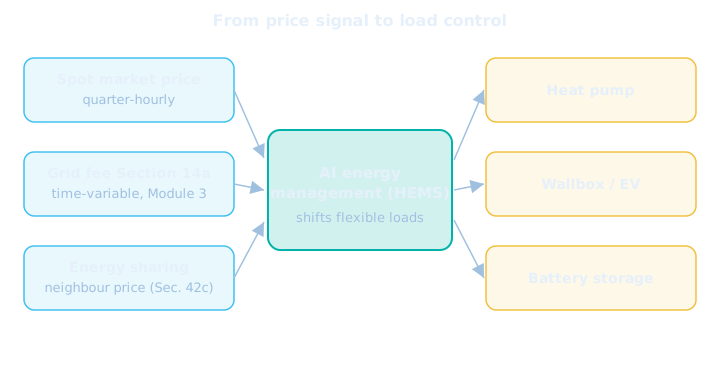
For devices from different manufacturers to work together, common standards are needed. Interfaces such as EEBUS and OpenADR let an energy management system address heat pump, wallbox and storage without being tied to a single manufacturer. The benefit comes from combining tariff and control, not from the tariff alone.
The core of the shift: The new tariff models move the value from the cheap price to the right time. Whoever consumes flexibly and controls automatically benefits. Whoever consumes rigidly may pay more than under the old fixed-rate model. That is exactly why the digitisation of the energy transition becomes the precondition for the market models to work at all.
German and EU perspective
In 2026 Germany transposes European law and rebuilds its market design in parallel. The EU market design reform consists of two acts. Directive (EU) 2024/1711 mainly covers consumer rights and was largely due for transposition by 17 January 2025; for free choice of supplier and energy sharing the deadline expired on 17 July 2026. Contracts for difference and long-term power purchase agreements sit in Regulation (EU) 2024/1747, which applies directly without transposition. The new Article 19d it inserted into Regulation (EU) 2019/943 requires two-sided contracts for difference for direct support of new wind, solar and other listed generation plants, for contracts concluded from 17 July 2027. At the same time the sector debates the future market design including a capacity market that pays for firm capacity. For especially energy-intensive companies the industrial electricity price adds a separate, state-capped relief on top.
The contracts for difference are the largest lever here. Unlike the previous market premium, they work in both directions: if the market price sits below the agreed value, the generator receives the difference, if it sits above, the generator pays it back. This lowers support costs in high-price phases and provides planning certainty.
A central study puts the possible savings from a better market design at up to 120 billion euros in system costs. For municipal utilities and suppliers this means treating the new tariff models not as an isolated product but as part of a system of generation, grid and flexibility. How AI takes over grid operation itself is shown in the article on agentic AI in grid management.
The bottleneck: the smart meter rollout
All the new models depend on the intelligent metering system, and this is exactly where it stalls. Without a smart meter there is no dynamic tariff, no time-variable grid fee and no energy sharing, because Section 42c requires quarter-hourly metering at producer and consumers. The rollout therefore decides whether the market models reach the wider public.

The real risk: The legislator builds the market models on the assumption that households have a smart meter. As long as that holds for only a small share of metering points, dynamic tariffs, energy sharing and time-variable grid fees stay an offer for the few. The fragmented network operator structure, high IT requirements and resource shortages slow the rollout.
Challenges and risks
The new models do not bring savings automatically, and for many households the switch hardly pays off. An honest assessment belongs here, because the real advantages arise only with a certain consumption profile. Finanztip tends to advise households with normal consumption and no large flexible loads against dynamic tariffs.
There is also the risk of too tight a dependence on a single energy management platform, a live question for prosumer platforms and white-label apps. Whoever buys tariff, metering and control from one hand gains comfort but can fall into a lock-in. Open standards and data sovereignty are therefore more than technical details. How much the grids come under strain from new loads is shown in the article on AI-supported blackout prevention in the power grid.
What companies should do now
For municipal utilities, energy suppliers and energy-intensive businesses the new models are less an end-customer topic than a platform question. Whoever thinks of tariff, metering and control together gains room to manoeuvre. Four steps help to be prepared.

-
Couple tariff and control
Do not offer dynamic tariffs in isolation but together with an energy management system. Only automatic load control makes the tariff valuable for customers.
-
Prioritise the smart meter rollout
The intelligent metering system is the precondition for every new revenue model. Whoever speeds up installation creates the basis for dynamic tariffs, Section 14a and energy sharing.
-
Identify flexible loads
In businesses, check which consumers can be shifted in time and couple them to the price signals. That turns flexibility into a measurable advantage.
-
Insist on open standards
Choose energy management systems that support EEBUS and OpenADR and leave data sovereignty with the operator. At the same time keep an eye on the EMD transposition and the rules on contracts for difference.
The tariff models of 2026 are not a pure pricing topic but a control topic. Whoever drives the smart meter rollout, connects tariff and energy management and relies on open standards can use the new flexibility instead of being overrun by it. How the growing electricity demand from data centres fits into this picture is deepened in the article on the data centre strategy and AI energy demand.
Further reading
Frequently asked questions
A dynamic electricity tariff links the energy price to the exchange spot price instead of charging a fixed rate per kilowatt-hour. Since 1 January 2025 every supplier in Germany must offer at least one such tariff. Since October 2025 pricing follows a quarter-hourly interval, referenced to the EPEX Spot power exchange. The requirement is an intelligent metering system, that is a smart meter.
Energy sharing lets owners of a solar installation supply surplus electricity directly to neighbours within the same balancing zone without taking on full supplier duties. The rule sits in Section 42c of the Energy Industry Act and has applied since 23 December 2025 (BGBl. 2025 I No. 347). From 1 June 2026 distribution network operators must enable sharing within their own balancing zone, from 1 June 2028 also with the directly adjacent grid area. The generation unit and every supplied consumption point need interval metering, usually a smart meter, or quarter-hourly load metering.
Since April 2025 grid operators have had to offer time-variable grid fees under Section 14a Module 3; implementation is slow, and the Bundesnetzagentur is taking enforcement action. The grid-fee share of the electricity price falls during periods when the grid is lightly loaded. This affects controllable consumption devices such as heat pumps and wallboxes. Whoever shifts consumption into low-load windows pays less.
The spot price, the grid fee and the energy-sharing price change every quarter hour and overlap. A person cannot track these signals by hand. An AI-supported home energy management system combines consumption, generation forecast and tariff curve and shifts heat pump, wallbox and battery storage automatically into the cheapest time windows. The benefit comes from combining tariff and control, not from the tariff alone.
No. For households with normal consumption and no large flexible loads the saving is only around 1 to 3 percent, which is why Finanztip tends to advise against it there. A prosumer household with photovoltaics, storage, heat pump and wallbox, by contrast, saved around 370 euros after four months in 2026, roughly 1,100 euros per year. Anyone on a dynamic tariff also carries the price risk during peaks.
Let's collaborate
One contact, a team behind it
Thirty minutes on what you're working on, whether grid, metering, market processes, IT architecture or AI. Afterwards you'll know how we'd approach it and who would sit at the table.
Energy and measurement technology since 2010 · innobu GmbH since 2014 · Based in Schleswig-Holstein, Germany
Whoever pitches also delivers: whoever leads the first call stays your contact right through to the steering committee, with established partners in the project. Direct: info@innobu.com