
Gas metering operator framework contract: what applies since 1 October 2026 and what changed from 2017
On 1 October 2026 ruling BK7-17-026 lapsed, and with it the gas metering operator framework contract of 23 August 2017. Its place is taken by Annex 8 of the German gas cooperation agreement in version KoV XV, adopted by BDEW, VKU and GEODE on 27 March 2026. Gas network operators and metering point operators have to move their contracts onto it, and gas network operators must also publish it.
The gas metering operator framework contract (Messstellenbetreiberrahmenvertrag Gas) is the standard contract under Section 9(1) no. 3 MsbG between a German gas network operator and every metering point operator that runs metering points in its network; since 1 October 2026 the version in Annex 8 of the gas cooperation agreement (KoV XV) applies. The legal basis is ruling BK7-24-01-009 of the Federal Network Agency of 12 September 2025: it revoked the contract set in 2017 with effect from 1 October 2026 and obliges gas network operators and metering point operators to conclude the new contract in its current version and to adapt existing contracts; gas network operators must publish it. Compared with 2017 the main additions concern termination, amendment and liability: termination for cause can be limited to single metering points and only reaches the whole contract once breaches affect at least 10 per cent of the metering points, and changes required by neither law nor ruling count as accepted unless the metering point operator objects within 30 working days. Six weeks after the deadline there is no publicly documented operating experience yet.
What applies since 1 October 2026
Since 1 October 2026 only one contract governs the relationship between gas network operators and metering point operators: Annex 8 of KoV XV. Ruling BK7-24-01-009, known in the market as GeLi Gas 3.0 (not to be confused with the GeLi Gas 2.0 supplier switching processes in force since April 2026), sets this out in four operative items. Item 13 revokes ruling BK7-17-026 with effect from 1 October 2026; item 14 obliged gas network operators and metering point operators to draw up a new contract under Section 9(1) no. 3 MsbG by that date; item 15 requires them to conclude it in its current version and adapt existing contracts; and item 16 requires every message on conclusion, performance and termination to be signed and encrypted.
The contract applies wherever network operator and metering point operator are different companies (Section 1 sentence 1 of the contract; sections without a statute named refer to the contract from here on). That covers every competitive metering point operator, and the default operator too when a municipal utility runs metering in a company of its own next to the network company. On the same day the WiM Gas 2.0 application guide came into force, which the new contract cites in Sections 4 and 12. The reference to WiM Gas is new; GeLi Gas and the EDI@Energy formats were already cited in the 2017 contract.
Why the Federal Network Agency let go of the contract
Ruling Chamber 7 wants the contract to change faster than a ruling procedure with consultation allows. In its reasoning (para. 92) it points to the expected connection of new gas meters to the electricity smart meter gateway, for whose sector-specific content it wants more flexibility, and to the links with the gas supplier framework contract that the associations already maintain as Annex 3 of the KoV. If the same associations write the contract, the supplier framework contract and the switching processes, all three can be amended in one go.
The chamber set this date later than the rest of GeLi Gas 3.0 on purpose. The replacement of the gas network access ordinance (GasNZV) took effect on 1 January 2026; the chamber considered 1 January 2026 too tight for a new contract and chose 1 October 2026 (para. 95). The associations delivered the text six months before the deadline, which is also the implementation period of KoV XV: adopted on 27 March 2026, in force on 1 October. KoV parties that did not want to accept the changes had one month from receiving the notice to use the special termination right in Section 61 KoV.
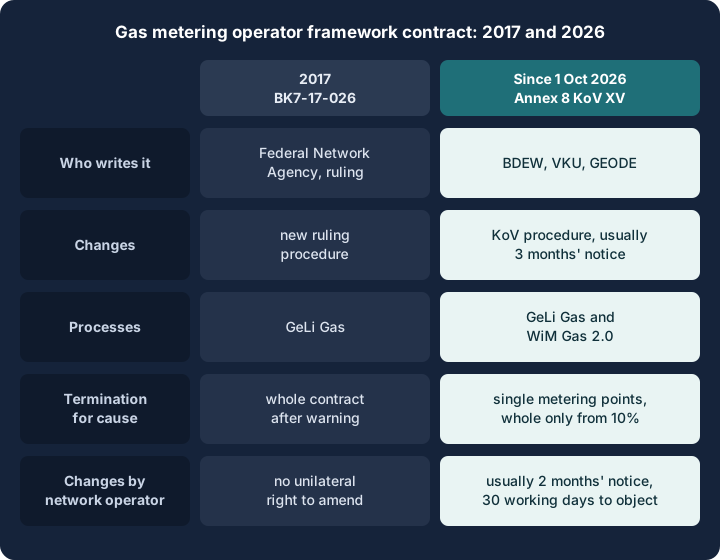
Electricity goes the other way. There Ruling Chamber 6 set the framework contract again with BK6-24-125 and for the first time prescribed metering contracts with connection users and suppliers, effective since 1 July 2026. Anyone metering both electricity and gas has worked with two contract regimes since October, each changed differently: in electricity a ruling procedure with consultation, in gas the KoV procedure, in which BDEW, VKU and GEODE usually send changes to the KoV parties three months before they take effect, sooner where the law requires it, and which since KoV XV is no longer tied to 1 October (the three associations' information note on KoV XV, item 3.10).
What changed from 2017
The new contract changes little about technical metering; sealing, fault clearance and verification testing follow the 2017 wording almost word for word. One exception matters in practice: in 2017 the network operator decided where the meter is mounted, now the metering point operator decides after consulting the connection owner or user (Section 2 no. 1). Also new are rules for disputes and for amendments, and the reference to the WiM Gas application guide.
| Rule | 2017 (BK7-17-026) | Since 1 Oct 2026 (Annex 8 KoV XV) |
|---|---|---|
| Mounting location (Section 2) | set by the network operator (Section 22(2) NDAV) | set by the metering point operator after consulting the connection owner or user |
| Process basis (Section 4) | GeLi Gas, EDI@Energy formats | also the WiM Gas application guide; if one party fails to implement key requirements, the other may terminate under Section 15; gaps are closed by the published "implementation questions" on the rulings, where network operators, metering point operators and suppliers drew them up together and rated them consensual |
| Installation (Section 5) | network operator's technical connection conditions | minimum technical requirements under Section 8(2) MsbG or a ruling under Section 47(2) no. 14 MsbG |
| Equipment on change of operator (Section 6) | offer to buy or use | new operator chooses the equipment, previous operator chooses between sale and use |
| Meter readings (Section 7 nos. 11 and 12) | not covered | arithmetic split when network charges, levies or surcharges change; all reasonable efforts to fix faults such as recurring reading failures without delay |
| Minimum requirements (Section 11) | objectively justified, non-discriminatory | also transparent and published on the network operator's website |
| Data exchange (Sections 12, 17) | "electronic"; formats via Section 4 | processes and deadlines from WiM Gas and GeLi Gas, EDI@Energy formats; new: EDI agreement as annex |
| Power of attorney and liability (Sections 13, 14) | liability under Section 18 NDAV | new: a metering point operator acting for a third party warrants its authority and indemnifies the network operator if it is missing; fault-based liability, capped at typical foreseeable damage for slight negligence |

The references in Sections 4 and 12 have practical effects. Because the WiM Gas guide applies "in its current version", every process change the associations make flows into the contract without anyone signing. If either party, network operator or metering point operator, fails to implement key requirements, the other may terminate under the conditions of Section 15. Unchanged are the duty to keep operating a metering point for up to three months when the connection user changes, the nine-working-day realisation window and the clause under which earlier agreements on metering become void when the contract starts (Section 16 no. 9, in 2017 Section 15 no. 6).
Termination and amendment: the new rules
The new contract protects metering point operators better against losing all their metering points, but for the first time allows the network operator ordinary termination and gives it a unilateral right to amend. The 2017 version covered termination for cause in a single sentence: repeated serious breach despite a warning. Now, where the cause is a breach of duty, a written warning or deadline to remedy stating that termination will follow is normally required, and identical breaches before the warning count as one; in special circumstances, for instance where the other party seriously and finally refuses to perform, neither is needed (Section 15 no. 4). The network operator can limit termination to single metering points; it may terminate the whole contract only if that milder step achieved nothing or was unsuitable and breaches affect at least 10 per cent of the metering points the operator is responsible for in that network area (Section 15 no. 5). Every termination for cause must be reported to the regulator in text form without delay (Section 15 no. 6).
Three ways to amend or end the contract
Change required by law
If a law, ordinance, ruling or recognised technical rule requires a change, the network operator may amend the contract with immediate effect and must inform the metering point operator without delay. Facing material economic disadvantages, the metering point operator can terminate at 15 working days' notice to the end of the month following the date the change takes effect, with no compensation (Section 16 no. 5).
Any other change
Usually two months' notice, shorter in justified cases, in text form and on the website. If the metering point operator does not object within 30 working days, the change counts as accepted; if it objects, the old terms stay (Section 16 no. 6).
Ordinary termination by the network operator
New: at three months' notice to the end of a month, where there is no longer a duty to operate the metering point or a new framework contract that complies with the law is offered at the same time (Section 15 no. 2). In 2017 only the metering point operator could terminate ordinarily.
For competitive metering point operators active in dozens of network areas, the objection procedure is where most of the effort lies. Anyone who does not log change notices centrally and assess them in time is bound after 30 working days by terms nobody reviewed. The flip side for network operators: they must point out when the objection period starts and what silence means (Section 16 no. 6 sentence 7); the contract does not say what applies if they do not.
Six weeks in
The contract is in force, and network operators publish it, in the versions we have seen mostly identical to Annex 8 with a cover sheet of their own; nothing has been published about how it works in practice. Up to 11 November 2026 we found neither a Federal Network Agency notice nor a trade press report about disputes over the new contract or abuse proceedings. Not much could have surfaced yet anyway: terminations for cause normally require a prior warning, and changes under Section 16 no. 6 normally need two months' notice.
Nobody publishes how many existing contracts have actually moved to KoV XV. It is also open how network operators will use their right to amend, and when the associations will write into the contract the connection of gas meters to the electricity smart meter gateway that the Federal Network Agency named as its reason for self-regulation. Today's text has no rule of its own on that.
For switching existing contracts the associations provide a model letter (KoV XV information note, item 3.8). Section 16 no. 9, worded the same in 2017, matters for the inventory: when the contract starts, earlier agreements on metering between the two parties become void. If the contract is concluded anew, special arrangements in old individual contracts fall away; whether a mere adaptation under operative item 15 has the same effect, the text leaves open. Supplementary rules remain possible, but only if the network operator offers them to every metering point operator without discrimination and does not make the framework contract conditional on them (Section 1 sentences 3 and 4).
What applies if the contract has not been switched
Ruling BK7-24-01-009 sets no penalty of its own. Failing to conclude the contract in its current version, or failing as a gas network operator to publish it, breaches a ruling, which the Federal Network Agency can enforce under Section 76(1) and (4) MsbG with coercive fines of EUR 1,000 to EUR 10 million. For network operators such a breach is also an abuse of their market position under Section 30(1) sentence 2 no. 1 EnWG: the regulator can require it to stop and can establish it after the fact, and the law provides for fines of up to EUR 1 million (Section 95 EnWG). For distribution system operators with fewer than 100,000 customers whose network does not extend beyond one federal state, the state regulatory authority is responsible (Section 54(2) no. 8 EnWG). An affected metering point operator can apply for abuse proceedings (Section 31 EnWG) and claim removal, injunctive relief or, where there is fault, damages (Section 32 EnWG). Whether a specific case falls under these rules is not assessed in this overview.
Where the switch gets stuck
Most of the work comes from the number of contractual relationships. A gas network operator has to write to every metering point operator in its network, a competitive metering point operator to every network operator where it runs gas meters, and both then have to track the other side's change notices. At the same time the switch to the GeLi Gas 2.0 supplier switching processes has been running since April, to WiM Gas 2.0 since October and to the electricity contracts from BK6-24-125 since July, often in the same small regulatory team.
Self-regulation drops the public consultation in which every market participant can comment and the comments are published afterwards. Changes to the KoV are made in the committees of BDEW, VKU and GEODE. Network operators learn of them from the associations' information letter, usually three months ahead; competitive metering point operators are not parties to the KoV and only learn of a change through the network operator's notice under Section 16. We found no public statements by competitive metering point operators on the gas contract specifically. For them two new rules pull in opposite directions: the network operator's unilateral right to amend in Section 16 and the protection against termination of the whole contract in Section 15.
What gas network operators and metering point operators should do now
The duty has applied since 1 October. Anyone who has not yet compared the contract inventory with KoV XV is behind and should do it now; the next KoV change can arrive with three months' notice or less. The steps depend on the role.
Five steps by role
Gas network operator: check the publication
Check that the KoV XV version dated 27 March 2026 is on the website. Operative item 15 of the ruling requires its publication, Section 11 of the contract that of the minimum technical requirements. The EDI agreement is part of the contract (Section 17); publishing it as well saves queries.
Gas network operator: reconcile the inventory
Check the list of all metering point operators with gas metering points in the network against the letters sent. Identify old individual arrangements that Section 16 no. 9 voids on a new conclusion, and decide whether to continue them as a non-discriminatory offer to all.
Default metering point operator as a separate company
Move the contract with your own network company onto KoV XV. Being in the same group does not change the duty under operative item 15.
Competitive metering point operator: keep deadlines central
Record for each network area which version applies, and log incoming change notices with their 30-working-day deadline in one register. For economically material changes under Section 16 no. 5 the notice period is 15 working days to the end of the month after the change takes effect.
Everyone: prepare for disputes
Warning, deadline to remedy and partial termination under Section 15 need a fixed procedure with named owners, as do fault reporting and fixing recurring reading failures under Section 7 no. 12. The same check covers signing and encrypting every message on conclusion, performance and termination of the contract under operative item 16; the details are in the annex to ruling BK7-06-067.
Our article on gas network deadlines from the KoV, market area conversion and gas storage covers the other gas dates up to 2028; the rulings that replaced the GasNZV are explained in the article on the GasNZV replacement.
Deadline, market roles, systems
1 October 2026Gas: new metering point operator framework contractRegulatory ruling · in force
If the deadline is missed: Regulator can enforce Ruling BK7-24-01-009 sets no penalty of its own. Failing to conclude the framework contract in its current version, or as a gas network operator failing to publish it (operative item 15), breaches a ruling; the Federal Network Agency can enforce this under Section 76(1) and (4) MsbG with coercive fines of EUR 1,000 to EUR 10 million. For network operators a breach is also an abuse of their market position (Section 30(1) sentence 2 no. 1 EnWG). The regulator can require it to stop (Section 30(2)) and can also establish it after the fact (Section 30(3)); for distribution system operators with fewer than 100,000 customers whose network does not extend beyond one federal state, the state regulatory authority is responsible (Section 54(2) no. 8). Section 95(1) nos. 4 and 3(b) EnWG threaten fines of up to EUR 1 million for the abuse and for breaching an order to stop it (Section 95(2) no. 3). Those affected can apply for abuse proceedings (Section 31) and claim removal, injunctive relief or, where there is fault, damages (Section 32 EnWG). Legal basis ↗
- Gas grid operatorrole obligationApplies the new framework contract and moves existing arrangements with metering point operators onto it.Typically affected: Market communication gateway (EDIFACT, AS4, API), Customer and grid connection portal
- Default metering point operatorrole obligationConcludes the new framework contract with gas network operators.Typically affected: Market communication gateway (EDIFACT, AS4, API)
- Competitive metering point operatorrole obligationConcludes the new framework contract to keep operating gas metering points.Typically affected: Market communication gateway (EDIFACT, AS4, API)
A classification for typical market roles, not a review of your individual case and not legal advice. Whether an obligation applies to your company (thresholds, exemptions) is for your legal department or counsel to confirm. The calendar doesn't replace your own deadline review. Information as of: 1 November 2026.
Further reading
Frequently asked questions
It is the standard contract under Section 9(1) no. 3 of the German Metering Point Operation Act (MsbG) between a gas network operator and a metering point operator running metering points in that network. Since 1 October 2026 the version in Annex 8 of the gas cooperation agreement (KoV XV) of 27 March 2026 applies.
Gas network operators and metering point operators. Under operative item 15 of ruling BK7-24-01-009 they conclude the contract in its current version and adapt existing contracts. It applies to every metering point operator that is not the network operator itself, so to competitive metering point operators and to a default metering point operator run as a separate company.
Ruling Chamber 7 handed the contract to industry self-regulation. Its reasons are flexibility, above all for the expected connection of new gas meters to the electricity smart meter gateway, and the chance to amend contract, processes and the supplier framework contract together (BK7-24-01-009, para. 92).
Yes, in two cases. Where a law, ordinance or ruling requires a change, it applies immediately; the metering point operator may terminate at 15 working days' notice if it suffers material economic disadvantages. Other changes are usually announced two months ahead and count as accepted unless the metering point operator objects within 30 working days (Section 16 nos. 5 and 6).
Only under tight conditions. Termination for cause normally needs a prior warning or a deadline to remedy and can be limited to single metering points. The whole contract may only be terminated if that limitation failed or was unsuitable and breaches affect at least 10 per cent of the operator's metering points in the network area; the network operator must report the termination to the regulator (Section 15 nos. 5 and 6).
In electricity the framework contract remains set by ruling. Ruling Chamber 6 amended it with BK6-24-125 and also set metering contracts with connection users and suppliers, effective since 1 July 2026.
Let's collaborate
One contact, a team behind it
Thirty minutes on what you're working on, whether grid, metering, market processes, IT architecture or AI. Afterwards you'll know how we'd approach it and who would sit at the table.
Energy and measurement technology since 2010 · innobu GmbH since 2014 · Based in Schleswig-Holstein, Germany
Whoever pitches also delivers: whoever leads the first call stays your contact right through to the steering committee, with established partners in the project. Direct: info@innobu.com