
The GasNZV Replacement 2026: KARLA Gas, GaBi Gas, GeLi Gas 3.0 and ZuBio
The Gas Grid Access Ordinance loses its legal basis. After the CJEU judgment C-718/18, rule-setting on grid access belongs to the independent regulatory authority, and the GasNZV expires on 31 December 2025. The Bundesnetzagentur transfers its content into four rulings of Ruling Chamber 7: KARLA Gas 2.0, GaBi Gas 2.1, GeLi Gas 3.0 and ZuBio. This article explains why the ordinance is expiring, what the four rulings govern, how GeLi Gas 2.0 is distinguished from 3.0, what risks the splitting and the biogas regulatory gap carry, and what gas suppliers, grid operators and municipal utilities should do now.
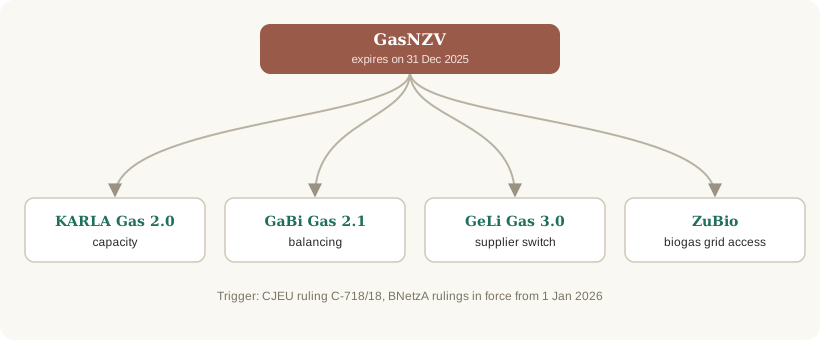
The GasNZV replacement is a regulatory rebuild with a hard deadline. The trigger is the CJEU judgment C-718/18 of 2 September 2021, under which rule-setting on grid access belongs to the independent regulatory authority and not the federal government. As a result, the ordinance-making power under section 24 EnWG fell away, the Bundesnetzagentur received its own ruling power under section 29 EnWG, and the Gas Grid Access Ordinance expires on 31 December 2025. Instead of one consolidated overall regulation, BNetzA Ruling Chamber 7 replaces the ordinance with four rulings that were adopted in September 2025 and mostly take effect from 1 January 2026: KARLA Gas 2.0 (BK7-24-01-007) for capacity, GaBi Gas 2.1 (BK7-24-01-008) for balancing, GeLi Gas 3.0 (BK7-24-01-009) for supplier switching and ZuBio (BK7-24-01-010) for biogas grid access. What matters is the distinction between GeLi Gas 2.0, the real process reform of 1 April 2026, and GeLi Gas 3.0, which transfers the GasNZV rules content-neutrally. Operationally, the replacement is above all a contract and reference task: where contracts once pointed to GasNZV sections, grid connection, balancing group, supplier and capacity contracts as well as the cooperation agreement must in future point to the ruling decrees. Criticised are the splitting into four separate rulings and a regulatory gap in biogas grid connection, formerly section 33 GasNZV, for which a transitional rule until 30 June 2026 is provided. Whoever maps the four rulings cleanly and adjusts the contracts avoids legal uncertainty at the turn of the year.
Why the GasNZV is expiring
The Gas Grid Access Ordinance loses its legal basis. The trigger is the CJEU judgment C-718/18 of 2 September 2021, under which rule-setting on grid access belongs to the independent regulatory authority and not the federal government. As a result, the federal government's ordinance-making power fell away, and the GasNZV expires on 31 December 2025. Read correctly, the replacement is a regulatory rebuild with a hard deadline, not a formal footnote.
Legally, rule-setting on grid access shifts from the ordinance maker to the authority. With the Act adapting energy industry law, the ordinance-making power under section 24 EnWG fell away, and the Bundesnetzagentur received its own ruling power under section 29 EnWG. With this, Ruling Chamber 7 takes on the task of transferring the former ordinance content into rulings. Along with the GasNZV, several ordinances lose their competence basis, and open questions remain about the democratic legitimacy of this new regulatory power.
The four rulings at a glance
The BNetzA replaces the ordinance not with an overall regulation but with four topic-specific rulings of Ruling Chamber 7. They were adopted in September 2025 and mostly take effect from 1 January 2026. Whoever knows the four building blocks can assign their contracts and processes to each decree in a targeted way.
| Ruling | File number | Content |
|---|---|---|
| KARLA Gas 2.0 | BK7-24-01-007 | Capacity: capacity rules and the handling of grid access including auction procedures |
| GaBi Gas 2.1 | BK7-24-01-008 | Balancing: balancing in gas, including the extended balancing settlement |
| GeLi Gas 3.0 | BK7-24-01-009 | Supplier switch: content-neutral transfer of the GasNZV rules, no new formats |
| ZuBio | BK7-24-01-010 | Biogas grid access: grid access for biogas including quality requirements |
The split follows the major topic areas of the former ordinance. KARLA Gas 2.0 bundles capacity and grid access handling with the auction procedures, GaBi Gas 2.1 the balancing including the extended balancing settlement. GeLi Gas 3.0 transfers supplier switching content-neutrally, and ZuBio governs biogas grid access with the quality requirements. For practice this means every former GasNZV reference must in future be assigned to the matching ruling decree.
GeLi Gas 2.0 or 3.0? The distinction
The similar names cause confusion, but they mean different things. GeLi Gas 2.0 is the real process reform of supplier switching from 1 April 2026. GeLi Gas 3.0 is the purely legal transfer of the GasNZV rules into a ruling, without new processes or formats.
For planning this means: GeLi Gas 2.0 is the real project with new processes, formats and its own deadline, on which IT, processes and tests depend. GeLi Gas 3.0, by contrast, is a content-neutral transfer of the former GasNZV supplier-switching rules and only one of four pillars of the replacement. Whoever confuses the two plans duplicate IT projects without reason. The details of the process reform are in the innobu article on GeLi Gas 2.0 , which covers the operational reform of supplier switching on its own.
What changes for market participants
Operationally, the replacement is above all a contract and reference task. Where contracts once pointed to GasNZV sections, they must in future point to the ruling decrees. Whoever knows the affected contracts can steer the switch in a targeted way, rather than touching everything at once.

In concrete terms the switch affects grid connection, balancing group, supplier and capacity contracts as well as the gas cooperation agreement. All references from GasNZV sections to the matching ruling decrees must be switched over, as must the relevant terms and conditions. A gap analysis per process makes sense, recording which former section was transferred into which decree. The de facto deadline is 1 January 2026, from which the rulings take effect. Whoever maps this cleanly keeps contracts and processes legally sound at the turn of the year.
Challenges and risks
The rebuild brings new uncertainties. The splitting into four rulings makes the overview harder, and in biogas a real regulatory gap remains. An honest view has to name this, rather than painting the replacement only as an orderly transfer.
Instead of one consolidated overall regulation, four separate ruling decrees emerge, which creates interface and overview risks: whoever wants to check a process may have to look it up in several texts. In biogas grid connection, formerly section 33 GasNZV, a real regulatory gap remains, for which a transitional rule until 30 June 2026 is provided. On top of this comes the tight time window, because the decisions were only adopted in September 2025 but already take effect from 1 January 2026. In addition, parallel gas releases such as GeLi Gas 2.0 and the AS4 migration burden the already scarce resources.
Watch the splitting and the biogas case: Four separate rulings instead of one overall regulation raise the risk of overlooking references or assigning decrees wrongly. In biogas grid connection, formerly section 33 GasNZV, a regulatory gap opens up that is only bridged by a transitional rule until 30 June 2026. Whoever does not actively track this special case risks uncertainty precisely with connection requests.
The GasNZV replacement is not a mere change of form but brings three real risks: the splitting instead of consolidation, the biogas regulatory gap with a transition until 30 June 2026, and the deadline pressure from the decision in September 2025 and validity from January 2026. Whoever maps the four decrees cleanly, tracks the biogas special case and coordinates the parallel gas releases keeps the transition manageable.
What companies should do now
The GasNZV replacement is a compliance and contract task with a hard deadline. Whoever maps the four rulings cleanly and adjusts the contracts avoids legal uncertainty at the turn of the year. A regulatory mandatory deadline then becomes an orderly step.

-
Obtain the four ruling texts and map them
Obtain the four ruling texts on KARLA Gas 2.0, GaBi Gas 2.1, GeLi Gas 3.0 and ZuBio, and map each process against the old GasNZV sections. Only with this assignment can you trace which former section was transferred into which decree.
-
Switch contracts, terms and cooperation agreement over
Switch contracts, terms and conditions and the gas cooperation agreement over to the new rulings. Grid connection, balancing group, supplier and capacity contracts should point to the decrees by the start of validity on 1 January 2026, no longer to the expired GasNZV sections.
-
Bundle the gas releases and separate GeLi 2.0 from 3.0
Bundle the gas releases in a shared plan and separate GeLi Gas 3.0 cleanly from GeLi Gas 2.0. That keeps the resources where genuinely new processes arise, namely with the reform GeLi Gas 2.0, while the transfer GeLi Gas 3.0 stays content-neutral.
-
Track the biogas special case and the transitional rule
Actively track the biogas special case and the transitional rule until 30 June 2026. With the regulatory gap in biogas grid connection, formerly section 33 GasNZV, it is important to keep connection requests and deadlines in view until the gap is closed.
At heart the GasNZV replacement is a compliance and contract task with a regulatory clock. Whoever maps the four rulings, switches the contracts over and separates GeLi Gas 3.0 from GeLi Gas 2.0 avoids legal uncertainty at the turn of the year. Whoever wants to go deeper into supplier switching in gas sets it alongside the GeLi Gas 2.0 supplier switch from 1 April 2026 and recognises the deliberate differences.
Further reading
Frequently asked questions
The Gas Grid Access Ordinance (GasNZV) loses its legal basis. The trigger is the CJEU judgment C-718/18 of 2 September 2021, under which rule-setting on grid access belongs to the independent regulatory authority and not the federal government. As a result, the ordinance-making power under section 24 EnWG fell away, and the Bundesnetzagentur received its own ruling power under section 29 EnWG. The GasNZV therefore expires on 31 December 2025.
The Bundesnetzagentur replaces the ordinance not with a single overall regulation but with four topic-specific rulings of Ruling Chamber 7. They were adopted in September 2025 and mostly take effect from 1 January 2026: KARLA Gas 2.0, GaBi Gas 2.1, GeLi Gas 3.0 and ZuBio. With this, the former GasNZV content moves into four separate ruling decrees.
The four rulings each cover one topic area of the former GasNZV. KARLA Gas 2.0 (BK7-24-01-007) governs capacity rules and the handling of grid access including auction procedures. GaBi Gas 2.1 (BK7-24-01-008) concerns balancing in gas. GeLi Gas 3.0 (BK7-24-01-009) transfers supplier switching content-neutrally. ZuBio (BK7-24-01-010) governs biogas grid access including quality requirements.
GeLi Gas 2.0 is the substantive process and format reform of supplier switching with its own deadline of 1 April 2026 and new data formats. GeLi Gas 3.0 is part of the GasNZV replacement and transfers the former GasNZV supplier-switching rules content-neutrally into a BNetzA ruling, without new processes or formats. Whoever confuses the two plans duplicate IT projects without reason.
The GasNZV replacement is above all a compliance and contract task with a hard deadline. Companies should first obtain the four ruling texts and, process by process, map them against the old GasNZV sections. After that the task is to switch contracts, terms and conditions and the gas cooperation agreement over to the rulings, to bundle the gas releases and to separate GeLi Gas 3.0 cleanly from GeLi Gas 2.0. The biogas special case with the transitional rule until 30 June 2026 belongs on the active watch list.