The AgNes Network Tariff Reform: New Power Pricing from 2029
The Allgemeine Netzentgeltsystematik Strom replaces the expiring StromNEV and redistributes the costs. The draft ruling has been out since 6 August 2026, and adoption is planned for 2026.
The AgNes network tariff reform restructures German power network charges from 1 January 2029. AgNes stands for Allgemeine Netzentgeltsystematik Strom and replaces the StromNEV, which expires on 31 December 2028. The reform is being developed in the determination procedure of the Grosse Beschlusskammer Energie under the reference GBK-25-01-1#3. It concerns a cost block of around 37 billion euro per year. The Bundesnetzagentur published the full draft ruling on 6 August 2026, and the deadline for comments closed on 18 September 2026. As of October 2026 the ruling had not been adopted.
The AgNes network tariff reform is the fundamental redesign of German power network charges, taking effect from 1 January 2029. The Allgemeine Netzentgeltsystematik Strom replaces the StromNEV, which expires on 31 December 2028, and is developed in the determination procedure of the Grosse Beschlusskammer Energie under the reference GBK-25-01-1#3, not by Ruling Chamber 8. The trigger is the ruling of the Court of Justice of the European Union C-718/18 of 2 September 2021, since when the Bundesnetzagentur sets the network charges by determination in its own competence. It concerns a cost block of around 37 billion euro per year, which makes up roughly 30 percent of a household power bill. The most important structural change is cost allocation by net grid consumption rather than by the volume of electricity transported. For the first time, generators, storage and electrolysers are also to contribute to network costs, for example through a capacity price. Under the draft of 6 August 2026, generation plants above 30 kW pay a nationally uniform feed-in charge, which the Bundesnetzagentur's sample calculation puts at around 5 euro per kW and year. At low voltage up to 100,000 kWh a standing charge and an energy charge remain, and prosumers pay a surcharge of 70 to 90 percent of the standing charge; above that a capacity price applies to the booked capacity. The draft provides dynamic network charges only for storage (2030, at the latest 2033) and generation (2032, at the latest 2035), not for final customers for now. As of October 2026 the ruling had not been adopted. AgNes is to be distinguished from Section 14a EnWG, which governs discounts for controllable consumers, and from the end-customer tariffs. The reform redistributes burdens and is contested, several associations such as VKU, BDEW, BDI and BEE reject core points, the ongoing process creates planning uncertainty, and capacity prices and the new allocation require an IT and billing adaptation. Whoever calculates their own exposure against the draft, checks the legacy and exemption rules and prepares IT and billing keeps the transition manageable.
What AgNes is and why the reform is coming
AgNes fundamentally restructures German power network charges. The Allgemeine Netzentgeltsystematik Strom replaces the expiring StromNEV from 1 January 2029. The background is the ruling of the Court of Justice of the European Union C-718/18, since when the Bundesnetzagentur sets the network charges in its own competence. The responsible body is the Grosse Beschlusskammer Energie under the reference GBK-25-01-1#3, not Ruling Chamber 8.
Behind the reform stands a clear legal trigger. Since the ruling of the Court of Justice of the European Union C-718/18 of 2 September 2021, the Bundesnetzagentur sets the network charges by determination in its own competence, rather than through an ordinance of the federal government. For that reason the StromNEV power network charges ordinance expires on 31 December 2028 and is replaced by AgNes. The determination procedure is run by the Grosse Beschlusskammer Energie under the reference GBK-25-01-1#3, and proceedings were opened on 12 May 2025. In substance the reform addresses three points: the uneven regional distribution of network charges, the growing need for flexibility in the grid and the so far missing cost-reflective contribution from feeders. The chamber published the full draft ruling on 6 August 2026, and comments were due by 18 September 2026. The Bundesnetzagentur says it still intends to adopt the ruling in calendar year 2026.
Who pays for the grid in future
The biggest break lies in who bears the network costs. So far it is mainly consumers who pay, in future generators, storage and electrolysers are also to contribute. In addition, cost allocation is reorganised around net grid consumption. The figures come from the draft ruling of 6 August 2026.
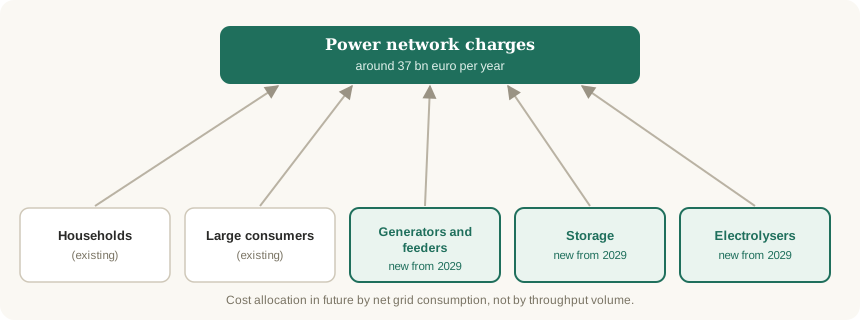
In detail, AgNes shifts the distribution of network costs on two levels. First, who pays at all changes: so far it is mainly households and large consumers who bear the network charges, from 2029 generators and feeders, storage and electrolysers are for the first time also to make a contribution, for example through a capacity price. Under the draft, generation plants above 30 kW pay a feed-in charge on their contractually agreed feed-in capacity, which the transmission system operators set nationwide each year and publish by 15 October for the following year; grid-coupled storage and electrolysers producing green or low-carbon hydrogen pay a capacity price of the same amount. The draft's sample calculation arrives at 5.14 euro per kW and year as the rolling average for 2022 to 2026. Second, the logic of cost allocation between grid operators changes: in future the costs are allocated by net grid consumption rather than by the volume of electricity transported. This means the distribution follows more closely the actual draw from the respective grid, which is intended to rebalance the regional burden. That is how operative point 5 of the draft puts it; consumption covered by self-generation does not count towards the allocation key.
The main reform building blocks
The reform rebuilds the price components. The draft of 6 August 2026 draws the line at 100,000 kWh of annual offtake at low voltage: below it a standing charge and an energy charge, above it and at all higher levels a capacity price. Feeders above 30 kW pay a charge of their own.

At low voltage up to 100,000 kWh a standing charge and an energy charge remain, with the standing charge to carry 20 to 40 percent of the revenue from this customer group. Anyone generating behind the connection pays a prosumer surcharge of 70 to 90 percent of the standing charge, plug-in solar devices excepted, and from 1 April 2028 suppliers must show prosumer status on the bill. Above that threshold, final customers pay a capacity price per kW on their booked capacity and two energy prices: AP1 for volumes within the booked capacity and AP2, at 200 to 350 percent of AP1, for everything above it. The baseload privilege under § 19 StromNEV is phased out as a result; for final customers with a valid agreement on 31 December 2028 it still applies until the end of 2031. Generation plants commissioned before the ruling is notified (1 January 2027 under the draft), or with a final investment decision by then and commissioning by 4 August 2029, pay the feed-in charge only 20 years after commissioning; the investment decision has to be proven to the network operator by 31 March 2027. The draft provides dynamic network charges only for storage (not before 2030, at the latest 2033) and generation (not before 2032, at the latest 2035), not for final customers for now; time-variable charges under Section 14a EnWG (module 3) are unaffected. For distribution system operators the work therefore starts in master data: by 1 April 2028 they have to identify every offtake point with generation behind the connection and report it to the supplier (operative point 17.8), the first of the AgNes deadlines in the draft. For energy-intensive large consumers this network charge burden overlaps with the industrial electricity price, which caps only the procurement price, not the network costs.
AgNes, Section 14a and tariffs: the distinction
The topics are easily mixed up but sit on different levels. AgNes governs the system of network charges, Section 14a the discounts for controllable consumers, tariff models the end-customer tariffs, and untouched by all of it the annual duty to publish the 2027 network charges by 15 October 2026 runs on. Whoever separates them plans the projects correctly. The handbook chapter on dynamic tariffs and grid charges puts all three levels side by side, from the dynamic tariff through the § 14a modules to AgNes.
For practice this means: AgNes governs the overarching system of power network charges from 2029, that is how the network costs are structured, allocated and distributed across the contributors. Section 14a EnWG, by contrast, governs reduced network charges for controllable consumption devices and is therefore a discount rule on the end-customer side, which is explored in the innobu article on the control box and Section 14a. The end-customer tariffs in turn, such as dynamic tariffs in the controllable electricity market, are covered by the innobu article on tariff models 2026. AgNes is the regulation of the network charges themselves, not the end-customer tariff. The shared legal trigger with the GasNZV replacement is the ruling of the Court of Justice of the European Union C-718/18.
Challenges and risks
The reform redistributes burdens and is correspondingly contested. Several associations reject core proposals, and the ongoing process creates planning uncertainty. An honest view has to name this, rather than painting the reform only as an orderly modernisation.

In detail the risks lie on several levels. First, there are winners and losers: prosumers, generators and storage tend to be burdened more, while flexible consumers tend to be relieved. Second, the association criticism is broad. VKU, BDEW, BDI and BEE reject core points, above all the feed-in charges, because they see additional investment risks for renewable facilities and storage, even if the envisaged legacy protection is partly acknowledged as confidence protection. Third, the ongoing procedure creates planning and investment uncertainty as long as figures and design are interim positions. Fourth, a concrete IT and billing adaptation is added, because capacity prices, the booked capacity and the new allocation have to be represented in the systems. A balanced view therefore recognises both the goal of a more cost-reflective distribution and the real burdens and open points.
Watch planning certainty and exposure: The AgNes figures come from a draft that had not been adopted as of October 2026. Whoever bases investments or tariffs firmly on specific feed-in charges or capacity prices risks false assumptions. Generators, storage operators and prosumers in particular should follow the framework ruling, which the Bundesnetzagentur intends to adopt in 2026, and the legacy and exemption rules closely before fixing assumptions.
At heart AgNes is a distributional reform with winners and losers, not a purely technical modernisation. The burden on prosumers, generators and storage, the broad association criticism from VKU, BDEW, BDI and BEE, the planning uncertainty in the ongoing procedure and the necessary IT adaptation belong honestly on the table. Whoever sees both, the goal of a more cost-reflective distribution and the real burdens, places AgNes correctly and can help shape the open design.
What companies should do now
AgNes is a regulatory and strategy task with a hard deadline in 2029. Whoever now calculates their own exposure and submits a position helps shape the open design. This turns an abstract reform into a concrete plan.
-
Check the framework ruling against the draft
The deadline for comments on the draft closed on 18 September 2026. The Bundesnetzagentur intends to publish the comments received, minus trade secrets, and to adopt the ruling in 2026. Compare the adopted version point by point with the draft, above all on the feed-in charge, legacy protection and the dynamic component. What can still be shaped after that are the follow-up rulings in 2027, most effectively through the associations.
-
Quantify your own exposure
Calculate your own load and generation profiles against the discussed models. Only once the capacity price, the booked capacity and the new allocation are applied to your own profiles does it become visible whether the company tends to be burdened or relieved. This calculation is the basis for every position and every investment decision.
-
Check the legacy and exemption rules
Check the legacy and exemption rules for storage, electrolysis and generation, such as the grid-fee exemption for battery storage and its window to 2029. The legacy protection in the draft (20 years from commissioning, investment decision to be proven by 31 March 2027) co-determines how strongly existing facilities are affected by the new charges. Whoever knows the rules early avoids false assumptions in ongoing and planned projects.
-
Prepare IT and billing
Prepare IT and billing for the capacity price, the booked capacity and the new allocation. The change to the network charge systematics feeds directly into the billing systems, because new price components and a changed allocation logic have to be represented. Whoever plans the adaptation early avoids time pressure at the 2029 deadline.
Deadline, market roles, systems
18 September 2026AgNes: consultation on the grid charge reform closesConsultation · closed
If the deadline is missed: No direct legal consequence Comments were voluntary. Anyone who did not submit by 18 September 2026 can no longer bring objections into this consultation; the ruling is due to be adopted in 2026. Legal basis ↗
- Electricity grid operatoraffectedCould comment on the draft electricity network charge framework until 18 September.Typically affected: Regulatory management, controlling
End of 2026AgNes: framework ruling on electricity grid chargesRegulatory ruling · expected
If the deadline is missed: No direct legal consequence The date is the Federal Network Agency's. Its notification, set for 1 January 2027 in the draft (operative point 20), starts other cut-offs, such as grandfathering for storage and generation plants with an investment decision before notification, to be proven to the network operator by 31 March 2027. Legal basis ↗
- Electricity grid operatoraffectedPlans billing and tariff systems for the prosumer surcharge, capacity prices and feed-in charges from 2029; under the draft, prosumers are to be identified and reported to suppliers by 1 April 2028.Typically affected: Grid usage and customer billing, Regulatory management, controlling, SAP IS-U / S/4HANA Utilities
- SupplieraffectedPrepares products and billing to pass new network charge components on to customers; under the draft, prosumer status appears on the bill from 1 April 2028.Typically affected: Grid usage and customer billing
2027AgNes: follow-up rulings that fill in the detailRegulatory ruling · expected
If the deadline is missed: No direct legal consequence The Federal Network Agency issues the follow-up rulings. If they slip, less time remains to convert price sheets, billing and systems before the new system applies from 2029. Legal basis ↗
- Electricity grid operatoraffectedAligns billing and systems with the follow-up rulings once they are published.Typically affected: Grid usage and customer billing, SAP IS-U / S/4HANA Utilities
- Suppliercheck applicabilityChecks which new charge components change tariffs and customer billing.Typically affected: Grid usage and customer billing
1 January 2029AgNes: new grid charge system takes effectRegulatory ruling · not yet adopted
If the deadline is missed: Regulator can enforce Under the draft ruling (operative point 1.2), only grid charges under the AgNes system are permitted from 1 January 2029. A network operator that bills otherwise can be ordered by the regulator to comply under Section 65 EnWG. Legal basis ↗
- Electricity grid operatoraffectedBills network charges from 2029 under the Federal Network Agency's new framework instead of the StromNEV.Typically affected: Grid usage and customer billing, Regulatory management, controlling
- SupplieraffectedPasses the new network charge structures on in tariffs and bills from 2029.Typically affected: Grid usage and customer billing
A classification for typical market roles, not a review of your individual case and not legal advice. Whether an obligation applies to your company (thresholds, exemptions) is for your legal department or counsel to confirm. The calendar doesn't replace your own deadline review. Information as of: 27 October 2026.
Further reading
Frequently asked questions
AgNes stands for Allgemeine Netzentgeltsystematik Strom. It is the determination procedure of the Bundesnetzagentur that fundamentally restructures the system of German power network charges from 1 January 2029. AgNes replaces the StromNEV power network charges ordinance, which expires on 31 December 2028. The responsible body is the Grosse Beschlusskammer Energie under the reference GBK-25-01-1#3. It concerns a cost block of around 37 billion euro per year. The building blocks are set out in the draft ruling of 6 August 2026. As of October 2026 the ruling had not been adopted.
AgNes is intended to take effect from 1 January 2029. On that date the new system replaces the StromNEV, which expires on 31 December 2028. The procedure has been running since the opening of proceedings on 12 May 2025, with key points and orientation papers, the full draft ruling of 6 August 2026, whose comment period closed on 18 September 2026, a planned framework determination at the end of 2026 and follow-up determinations in 2027. As of October 2026 the framework determination had not been adopted.
The most important structural change is that cost allocation in future follows net grid consumption rather than the volume of electricity transported. For the first time, generators, storage and electrolysers are also to contribute to network costs, for example through a capacity price. Under the draft of 6 August 2026, generation plants above 30 kW pay a nationally uniform feed-in charge, which the Bundesnetzagentur's sample calculation puts at around 5 euro per kW and year. So far it is mainly households and large consumers who pay for the grid.
AgNes governs the overarching system of power network charges from 2029, that is how network costs are structured, allocated and distributed across the contributors. Section 14a EnWG, by contrast, governs reduced network charges for controllable consumption devices such as heat pumps and wallboxes. Tariff models in turn concern the end-customer tariffs in the controllable electricity market. AgNes is the regulation of the network charges themselves, not the end-customer tariff. The shared legal trigger with the GasNZV replacement is the CJEU ruling C-718/18.
AgNes is a regulatory and strategy task with a hard deadline in 2029. Companies should check the framework ruling at the end of 2026 against the draft, calculate their own load and generation profiles against the discussed models, check the legacy and exemption rules for storage, electrolysis and generation, and prepare IT and billing for the capacity price, the booked capacity and the new allocation. The follow-up rulings in 2027 can still be shaped through the associations.
Let's collaborate
One contact, a team behind it
Thirty minutes on what you're working on, whether grid, metering, market processes, IT architecture or AI. Afterwards you'll know how we'd approach it and who would sit at the table.
Energy and measurement technology since 2010 · innobu GmbH since 2014 · Based in Schleswig-Holstein, Germany
Whoever pitches also delivers: whoever leads the first call stays your contact right through to the steering committee, with established partners in the project. Direct: info@innobu.com