
Germany's solar tender on 1 December 2026: the last round under EEG 2023
Up for tender are 2,226 megawatts for ground-mounted plants and structures, at a ceiling of 5.53 cents per kilowatt hour set by the Federal Network Agency. In July the average award was 4.79 cents, and almost a third of the capacity bid went away empty-handed. For municipal utilities with their own solar parks and for direct marketers, this round decides whether a project still lands in the EEG 2023 under the government bill or has to bid again in March 2027 under new rules.
The tender for first-segment solar plants on 1 December 2026 is the last solar round under Germany's EEG 2023; it is open to ground-mounted plants and to plants on structures that are neither buildings nor noise barriers. Bids must reach the Federal Network Agency in Bonn by Tuesday, 1 December 2026, midnight, with the security of 50 euros per kilowatt (25 euros with an adopted development plan) and the fee paid in full. The volume is 2,226,308 kilowatts at a ceiling of 5.53 cents per kilowatt hour. Three points are open: whether the awards count as notified before the state aid approval expires on 31 December 2026, which, for notification via publication, would require publication by 24 December; whether the European Commission approves the Solar Package I rules by 30 November, without which bids stay capped at 20 megawatts; and whether the Bundestag passes the transitional rule that keeps these awards under the old law. Projects without an award can bid again on 1 March 2027 at the earliest under the government bill, then under the EEG 2027.
The 1 December 2026 round in numbers
Section 28a(1) EEG sets three dates a year for first-segment solar, 1 March, 1 July and 1 December, and in 2026 the last one falls on a Tuesday. It is open to ground-mounted plants and to solar on structures that are neither buildings nor noise barriers (Section 3 no. 41a EEG). The law spreads 9,900 megawatts a year evenly across the three dates and deducts, among other things, capacity commissioned outside tenders the year before (Section 28a(2) and (3)); 2,226,308 kilowatts remain for this date.
At 5.53 cents, the ceiling is well below July's 5.90 cents. Under Section 37b the Federal Network Agency (BNetzA) takes the average of the highest bid still awarded in each of the three previous rounds, 5.30, 5.10 and 4.97 cents, and adds 8 percent. Falling award values drag the cap down with them; in July no bid above 4.97 cents won anyway.
| Bid date | Volume | Bids | Awards | Average award | Results published |
|---|---|---|---|---|---|
| 1 December 2025 | 2,328 MW | 634 with 5,247 MW, 61 excluded | 262 with 2,341 MW | 5.00 ct/kWh (4.40 to 5.30) | 13 February 2026 |
| 1 March 2026 | 2,295 MW | 532 with 4,622 MW, 39 excluded | 268 with 2,299 MW | 4.94 ct/kWh (3.99 to 5.10) | 12 May 2026 |
| 1 July 2026 | 2,135 MW | 401 with 3,170 MW, 48 excluded | 261 with 2,135 MW | 4.79 ct/kWh (4.38 to 4.97) | 18 August 2026 |
Bid volumes have been shrinking for a year, yet every round is still oversubscribed. The agency's most recent breakdown by land type in a press release covers March: most of the awarded capacity went to strips along motorways and railways (1,026 MW), followed by arable and grassland in disadvantaged areas (760 MW) and special solar plants such as agrivoltaics (439 MW, a record). A park on a roadside strip therefore bids in the largest group. Disadvantaged areas are eligible in every federal state because no state government has issued an ordinance under Section 37c(2). Ground-mounted plants on farmland are capped at 80 gigawatts added since 2023 (Section 37(4)); 21.7 gigawatts were registered at the end of August.
What has to be ready by Tuesday midnight
Eleven days out, the paperwork decides whether a bid is evaluated at all. In December 2025 the agency excluded 61 of 634 bids, in July 2026 48 of 401, between one in ten and one in eight, and an exclusion now costs the last round under the old law.

What counts is receipt in Bonn, not dispatch. On 1 December the gatehouse at Tulpenfeld 4 accepts bids until midnight. Only the forms for this specific date are accepted (bid, authorised representative, additional site details, guarantee), filled in on a computer; handwritten fields do not meet the format rules.
- The security is 50 euros per kilowatt of bid volume, so 1 million euros for 20 megawatts. If the bid includes an adopted development plan for the site, it is 25 euros (Section 37a read with Section 37(2) no. 2). It can be an on-demand guarantee or a cash payment to the agency's escrow account, one per bid and clearly labelled (Section 31).
- Security and fee must be in place in full by the bid date (Section 33(1) no. 3). What counts is receipt by the agency, not the transfer date; the fee amount and payment route are in the bidding notes on the bid date page. A cash security or fee should therefore go out the week before.
- Each bid needs a declaration that the bidder owns the land or bids with the owner's consent (Section 37(2) no. 1), and for disadvantaged areas a declaration on protected sites as well (no. 2a).
- A bid above 5.53 cents or with conditions or side agreements is excluded (Section 33(1) nos. 4 and 5). It can be withdrawn until the deadline; after that the bidder is bound until told it has no award (Section 30a(3) and (4)).
At a municipal utility the pieces can sit in three places: the guarantee with treasury or the project company's bank, the land contracts with the developer, the forms with the generation team. If not everything is together on Friday, 27 November, send the courier on Monday, 30 November, at the latest rather than Tuesday evening.
Open question 1: will the award come in 2026?
The European Commission approved support under the EEG 2023 until 31 December 2026, and the law firm Prometheus Rechtsanwälte expects no extension (post of 29 October, updated to 19 November). Under Section 35(2) EEG an award counts as notified one week after publication. For that route to work in 2026, the agency has to publish by Thursday, 24 December, 23 days after the deadline. According to Prometheus, an award can also be notified by service on the bidder; the agency gives no date for that.
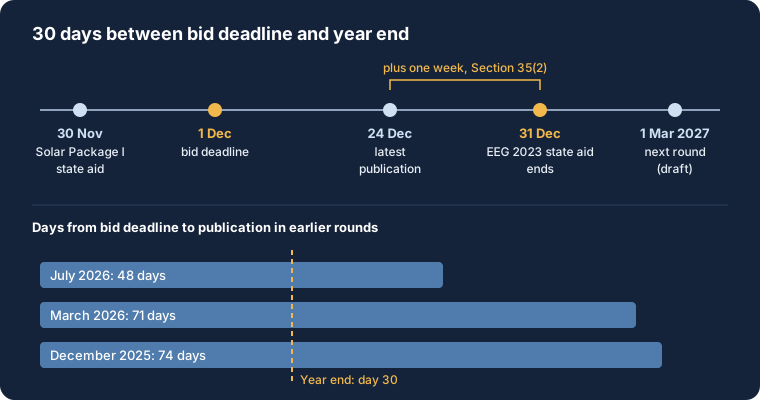
That would beat every ground-mounted round of the past twelve months: July took 48 days to publication, March 71 and December 2025 a full 74. The second segment for rooftops was faster; its 1 October 2026 round, with 143 awards, was published after 33 days. On its overview page the agency says it intends to publish the results of all 2026 bid dates by the end of the year. It gives no date before 24 December.
Law firms differ in how cautiously they read a slip into January. Rosin Büdenbender wrote on 11 November that support claims already validly established are unaffected by the expiry, but that state aid cover for awards that only count as notified in 2027 still has to be resolved. Prometheus treats only claims established by 31 December as safe under the old law. Bidders should therefore plan for two cases: an award published by 24 December, and one that comes later, including between Christmas and New Year, whose market premium depends on a rule in the EEG 2027 or a Commission decision. In the second case support is not secured until then, and that belongs as a risk in the financing model and in the paper for the supervisory board or shareholders.
Open question 2: Solar Package I without state aid approval
Solar Package I put several rules for ground-mounted plants into the law that may only be applied once the Commission approves them, which is why the agency announces each round with a caveat. For 1 December the cut-off is 30 November: with approval by then, the new regime applies, otherwise the old one. So far approval has not come, and the 1 December page still lists it as pending (as of 22 October).
In practice, plan with 20 megawatts, twice over: without approval the cap applies not only per bid but also to the payment authorisation of a ground-mounted plant (Section 38a(1) no. 5 as in force on 15 May 2024, Section 101(1) EEG). Several bids each need their own security and form, and each can lose on its own. Without approval, agrivoltaics and peatland PV compete in the same pot as roadside strips, which are usually cheaper to build. The agency says it will post any approval on its page before the bid date. Anyone who wants to submit one larger bid of up to 50 megawatts if approval comes needs forms and guarantees for both variants, because the decision can fall on 30 November. The surcharge values and the higher ceiling are in the bid date notice.
Open question 3: which law governs the awards
If an award comes, the EEG as it stands on 31 December 2026 is meant to apply to it. That's what Section 100(1) no. 1(b) of the government bill (Bundestag document 21/7867) says for plants whose value was set in a bid round before 1 January 2027. A solar park from this round would keep the market premium, payment authorisation and deadlines of the EEG 2023, and the EEG 2027 contracts for difference would not touch it.
None of this is law yet. Martin Winkler, scientific head of the Clearingstelle EEG|KWKG, said the Bundesrat, whose consent is required, cannot approve the bill before its 18 December session (pv magazine, 6 November). On 20 November no date for the final Bundestag readings had been set. The transitional rule secures the old EEG via the bid date. Whether the Commission's approval covers that, it does not settle (open question 1).
Even the old law has a risk of its own: under Section 51(1) EEG the value drops to zero for every period with a negative spot price, and solar parks feed in at noon, exactly when every other solar plant does too. Two drafts that are not tender rules still change the numbers. The grid package, a government bill on grid connection and expansion, would cap the simultaneous feed-in of first-segment solar plants at 70 percent of installed capacity for grid connections from 2027 (Rosin Büdenbender, 11 November); that trims the midday peak, not annual yield by 30 percent. And the agency's draft determination on the AgNes grid tariff reform (general grid tariff system for electricity) of 6 August 2026 introduces a feed-in charge for generators from 2029. Plants are exempt for 20 years if the final investment decision was taken before the determination is announced and they are running by 4 August 2029. For tenders with penalties the bid date counts as that decision (item 17.4 of the draft), so 1 December 2026 for a project awarded in this round; proof is due to the grid operator by 31 March 2027. The agency points to this draft on the bid date page itself; it has not been adopted.
Fallback routes without an award
In July almost a third of the capacity bid got nothing, and after 1 December there is no further round under the old law for those projects. The government bill keeps the three dates, extends Section 28a to 2027 through 2032 and raises the annual volume to 14,000 megawatts, of which 500 megawatts go into a resilience tender for first-segment solar every 1 September (Sections 28a(3) and 28e of the bill), a separate segment with extra supply chain requirements under Article 26 of the EU Net-Zero Industry Act. The next regular date would be 1 March 2027.
Two changes affect preparation now. The project must be registered in the market master data register before the bid date (Section 37(1b) of the bill), and the separate payment authorisation disappears for awards from 2027; the award then lapses 24 months after notification unless the plant is at least partly running on the stated land parcels (Section 37e of the bill). Any rule that contains state aid may only be applied after Commission approval (Section 104 of the bill). Prometheus points out that the bill shifts volume from the first 2027 wind round if approval is missing, but has no such rule for solar. If approval is missing in March 2027, volume could be lost instead of moving to later dates.
For bids without an award, securities are released after publication, and the federal treasury usually takes up to six weeks to pay out, according to the agency. With publication just before Christmas, a cash security can stay tied up until early February 2027. Another route leads out of support altogether: power from a plant without an award can be sold through a supply contract (PPA) in other direct marketing. That contract alone then carries the financing, and the buyer takes on the midday profile of a single solar park. This route rules out a later tender, because a payment authorisation is only issued for plants commissioned after the award (Section 38a(1) no. 1).
After the award: payment authorisation and 24 months
After an award, 24 months remain until commissioning. The award lapses to the extent the plants are not running within 24 months or the payment authorisation has not been validly requested within 26 months of notification; the law calls this a substantive cut-off (Section 37e EEG).

A payment authorisation is only issued for plants commissioned after the award and before the request, registered, on land of the category bid, and for ground-mounted plants up to 20 megawatts per plant, or 50 megawatts once Solar Package I is approved (Section 38a(1) no. 5, Section 101(1)). A request after the 18th calendar month following notification costs 0.3 cents per kilowatt hour, and so does a site that does not at least partly match the parcels in the bid (Section 54(1) and (2)). At an award value around 4.8 cents, that's a little over 6 percent of the value, for 20 years.
Solar has no staggered penalty for late commissioning. A penalty applies only when more than 5 percent of an award's volume is cancelled, at 50 euros per kilowatt, or 25 euros where the security was reduced (Section 55(2)). A project that is still not running after 24 months because of a late grid connection loses the award and the security at the same time.
What direct marketers should prepare now
Only directly marketed power earns the market premium (Section 20 EEG), and a solar park with an award is hard to finance without a marketing contract. Bidders with an award are therefore likely to approach direct marketers between Christmas and February, including the marketing unit in their own utility.
With award values between 4.38 and 4.97 cents as in July, the midday hours decide the margin. Because Section 51 sets the value to zero at negative prices, the contract has to settle who curtails in those hours, who pays for balancing energy and how forecasts are built for a park with no operating history. If the grid package's feed-in cap comes, the profile the marketer prices changes too. The bill also requires in Section 10b(7) that direct marketing contracts set a threshold at which the marketer curtails the plant remotely, and say who bears the cost if it does not. Under Section 100(3) this applies to new direct marketing contracts from 2027, which covers most parks from this round, and to contracts signed before 2027 and amended afterwards; a framework agreement drafted now can include both points.
With the results, the agency publishes bidder, site and awarded volume (Section 35(1) no. 2). A marketer who checks the list against its contacts on the day of publication reaches the developer earlier than one waiting for enquiries, although with publication on 23 or 24 December that day falls in the middle of the holidays.
What happens if the deadline is missed
A bid that reaches Bonn after 1 December 2026 is not opened (Section 30a(2), Section 32(1) sentence 2 EEG), and a bid without the fee or security paid in full is excluded (Section 33(1) no. 3). Because it is the last solar round under the EEG 2023, the next attempt leads into the EEG 2027.
What utilities with solar projects should do now
Until Tuesday only a complete bid counts, after that planning for two outcomes. The open questions match those of the onshore wind tender in November, only the window to year end is shorter for solar.
The coming weeks
-
By Friday, 27 November: check each bid against Section 33
Forms for this date, price no higher than 5.53 cents, no conditions, bid size no more than 20 megawatts, one security per bid with the bid number, fee transferred.
-
Monday, 30 November: read the agency's page, then submit
If the agency reports approval of Solar Package I, 50 megawatts and the two-stage procedure apply, and the prepared variant with one larger bid goes into the envelope. Without a notice the part bids go; the courier leaves the same day.
-
December: two business cases
For every project, model the award under the EEG 2023 and a bid on 1 March 2027 under the new law, each with and without the grid package's feed-in cap and an AgNes feed-in charge. Prepare the market master data registration so it is in place for March.
-
From publication: plan construction against 18 and 24 months
Schedule grid connection, module delivery and the payment authorisation request so the request is in before the 18th month ends.
-
By 31 March 2027: AgNes proof
For projects awarded in this round: if the determination is adopted as drafted, show the grid operator the bid date as the investment decision. A utility that is also the grid operator decides who submits the proof and who checks it.
Deadline, market roles, systems
1 December 2026EEG first-segment solar tender: bid deadline 1 December 2026Law · adopted
Applicability: Developers and operators of first-segment solar plants under Section 3 no. 41a EEG above 1 MW. The maximum bid size is 20 MW as long as state aid approval for 50 MW is missing.
If the deadline is missed: Exclusion or loss of role Bids must reach the Federal Network Agency by the bid date (Section 30a(2) EEG); only bids received in time are opened (Section 32(1) sentence 2 EEG), so a late bid gets no award in this round. A bid is also excluded if the fee or security has not been paid in full by then (Section 33(1) no. 3 EEG). Legal basis ↗
- Direct marketercheck applicabilityDirect marketers prepare marketing and profile valuation for awarded solar parks.Typically affected: Direct marketing and remote control, Trading and procurement system (ETRM)
- Plant operator (generation)check applicabilityPlant operators with sites and a grid connection commitment assess participation and bid value.Typically affected: Plant master data and MaStR, Regulatory management, controlling
A classification for typical market roles, not a review of your individual case and not legal advice. Whether an obligation applies to your company (thresholds, exemptions) is for your legal department or counsel to confirm. The calendar doesn't replace your own deadline review. Information as of: 18 November 2026.
Further reading
Frequently asked questions
In this tender the Federal Network Agency (BNetzA) decides which ground-mounted solar plants and plants on structures that are neither buildings nor noise barriers (Section 3 no. 41a EEG) receive a market premium, and at what level. Bidders name a price in cents per kilowatt hour, and the agency awards the cheapest admissible bids until the volume is reached. Under current law the rounds take place on 1 March, 1 July and 1 December each year until 2029 (Section 28a(1) EEG).
By Tuesday, 1 December 2026, midnight. What counts is receipt at the agency's Bonn office; the gatehouse at Tulpenfeld 4 accepts bids until midnight on that day. The fee and the security must be paid in full by then (Section 33(1) no. 3 EEG) and clearly assigned to the bid (Section 31(2)).
Nobody knows yet. The Federal Network Agency says it intends to publish the results of all 2026 bid dates by the end of the year. A published award, however, only counts as notified one week later (Section 35(2) EEG), so for notification this way in 2026 the agency would have to publish by 24 December, 23 days after the deadline. The three previous rounds took 48 to 74 days until publication. The state aid approval of the EEG 2023 expires on 31 December 2026.
20 megawatts, as long as the European Commission has not approved the Solar Package I rules. If approval arrives by 30 November 2026, the limit rises to 50 megawatts and special solar plants such as agrivoltaics get the two-stage award procedure. Without approval, the general award procedure under Section 32 EEG and the old surcharges for elevated agrivoltaics and peatland PV apply. The agency says it will announce any approval on the bid date page.
50 euros per kilowatt of bid volume, so 1 million euros for a 20 megawatt bid. If the bid includes an adopted development plan (Bebauungsplan), it drops to 25 euros per kilowatt (Section 37a EEG). It is provided as an on-demand guarantee or as a cash payment to the agency's escrow account, separately for each bid. Without an award, the agency releases it after publication; the federal treasury usually pays out within six weeks, according to the agency.
Ground-mounted plants need a payment authorisation from the agency, which can only be requested after commissioning (Sections 38 and 38a EEG). The award lapses to the extent the plants are not running within 24 months or the payment authorisation has not been requested within 26 months of notification (Section 37e). A request after the 18th calendar month costs 0.3 cents per kilowatt hour (Section 54(1)). If more than 5 percent of the bid volume is cancelled, a penalty of 50 euros per kilowatt applies (Section 55(2)).
Let's collaborate
One contact, a team behind it
Thirty minutes on what you're working on, whether grid, metering, market processes, IT architecture or AI. Afterwards you'll know how we'd approach it and who would sit at the table.
Energy and measurement technology since 2010 · innobu GmbH since 2014 · Based in Schleswig-Holstein, Germany
Whoever pitches also delivers: whoever leads the first call stays your contact right through to the steering committee, with established partners in the project. Direct: info@innobu.com