EEG tenders 2027: four bid dates for rooftop solar, biomass, biomethane and innovation
Solar on buildings on 1 February and biomass on 1 April survive the draft. Whether any of the four rounds runs on time depends on state aid approval, because the approval for the EEG 2023 expires on 31 December 2026. They matter to municipal and regional utilities building rooftop systems, biogas and biomethane CHP units or plants with storage.
EEG tenders are the procedures in which Germany's Federal Network Agency (Bundesnetzagentur) sets the support level for larger renewable plants through competitive bids; under the current Renewable Energy Sources Act (EEG) four of them take place in the first half of 2027: solar on buildings and noise barriers (second segment) on Monday, 1 February, biomass and biomethane on Thursday, 1 April, and the innovation tender for plant combinations on 1 May 2027, a Saturday and public holiday (Sections 28b to 28e EEG). A bid has to reach the agency by the bid date with the fee and security paid in full; otherwise it gets no award in that round. The government draft of the EEG 2027 (Bundestag printed paper 21/7867 of 7 September 2026) keeps the dates for solar on buildings, with 1,500 megawatts a year, and for biomass, with 1,000 megawatts in 2027, but deletes the biomethane tender and the innovation tender; the Innovation Tender Ordinance (InnAusV) is to lapse on 1 January 2027. As of 27 October 2026 the Bundestag had not passed the draft, and under the draft the tender rules may only be applied once the European Commission has approved them under state aid law, while the approval for the EEG 2023 ends on 31 December 2026.
Four bid dates in the first half of 2027
Germany's current EEG writes the bid dates into the statute itself, identical every year. For the first half of 2027 that gives four dates spread over three sections and one ordinance, and one rule applies to all of them: the bid must reach the Bundesnetzagentur by the bid date at the latest (Section 30a(2) EEG). Exact date, volume and ceiling price are announced by the agency no earlier than eight and no later than five weeks ahead (Section 29(1)), so for 1 February 2027 between 7 and 28 December 2026.
| Date | Segment and bidders | Volume under current law | Legal basis | Draft EEG 2027 | If missed |
|---|---|---|---|---|---|
| Mon, 1 Feb 2027 | Second-segment solar: operators of systems on buildings and noise barriers | applied in 2026: 1,100 MW, split evenly over three dates | Section 28b(1) EEG | stays, 1,500 MW a year until 2032 | no award in this round |
| Thu, 1 Apr 2027 | Biomass: operators of new and existing biomass plants | 326 MW in 2027, split over two dates | Section 28c(1) EEG | stays, 1,000 MW in 2027 | no award in this round |
| Thu, 1 Apr 2027 | Biomethane: operators of new biomethane plants | 600 MW a year, split over two dates | Section 28d(1) EEG | dropped, Section 28d deleted | no award in this round |
| Sat, 1 May 2027 (public holiday) | Innovation: operators of plant combinations such as solar with storage | 1,000 MW in 2027, split over two dates | Section 28e(1) EEG, InnAusV | dropped, InnAusV lapses on 1 Jan 2027 | no award in this round |
These volumes are starting values: the agency adds quantities left unawarded in earlier years and deducts plants built outside the tenders; if undersubscription looms, meaning fewer bids than volume, it cuts the volume of a round. It did that twice for biomethane in 2026, so hard that by September only 20,887 of 300,000 kilowatts remained.
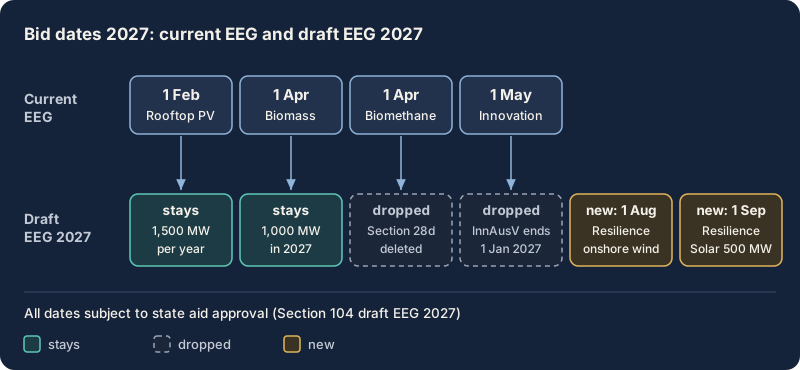
Which of these matters to a utility depends on its own fleet. A municipal utility with pools, bus depots and office buildings bids in the second segment once a rooftop system exceeds the tender threshold. A utility planning a new CHP unit for a heating network bids on 1 April either with its own biogas in the biomass segment or with biomethane from the gas grid in the biomethane segment, and the second option is to disappear in 2027. Anyone planning a solar park with a battery would so far have gone to the innovation tender, and the draft offers no successor built on the same logic.
What has to be in place before each bid date
Receipt by the agency counts, not the date of dispatch. In its 2026 announcements the Bundesnetzagentur states that bids must have arrived at its Bonn site and can be handed in at the gatehouse at Tulpenfeld 4 until midnight on the bid date. A bidder can withdraw a bid only until the bid date; after that it is bound until the agency informs it that the bid was unsuccessful (Section 30a(3) and (4)).

Section 33(1) EEG lists four more grounds for exclusion, and each can be settled before the date. Each bid has to follow the format requirements in the announcement, which means using the forms for exactly that round. Fee and security, or the project security contribution in the second segment, have to be paid in full by the bid date; if they cannot be matched clearly to the bid, the agency may exclude it as well. A bid value above the ceiling price is excluded, and so is a bid containing conditions or side agreements.
If a date falls on a weekend or public holiday, the agency sets the end of the deadline. For the onshore wind round on Sunday, 1 November 2026, it moved it to Monday, 2 November, under Sections 188 and 193 of the German Civil Code. For the innovation tender on Saturday, 1 May 2027, the same logic would give Monday, 3 May 2027; only the announcement makes it binding.
Second-segment solar: 1 February 2027
Solar systems on, at or in a building or a noise barrier form the second segment (Section 3 no. 41b EEG). Its first round of the year is on Monday, 1 February 2027, followed by 1 June and 1 October; Section 28b(1) sets these dates for every year up to 2029. For utilities this mostly means large roofs they already own: bus depots, swimming pools, warehouses and workshops.
What the statute says about volume is not what applies. Solar Package I raised the 2026 volume to 2,300 megawatts, but that increase still lacks state aid approval from the European Commission, so the agency applies the version in force on 15 May 2024 and tendered 1,100 megawatts in total in 2026, about 296 megawatts per round after adjustments. For the same reason the minimum bid size stayed at 1,001 kilowatts in 2026 instead of the 751 kilowatts in Solar Package I.
A project security contribution of 35 euros per kilowatt is due with the bid, paid as money into an escrow account of the agency (Section 38d), and the grid operator refunds it after commissioning. In 2026 the agency set the ceiling price at 10.00 cents per kilowatt hour; in June, 108 bids totalling 208,572 kilowatts won awards at an average of 9.72 cents, so the round's 296,269 kilowatts were not filled.
Under the EEG 2027 draft the segment continues until 2032, with 1,500 megawatts a year written into the statute. From 2028, systems above 750 kilowatts built outside the tenders would be deducted from the volume. For a municipal utility, little changes about the date itself; the open questions are which version applies on 1 February and whether the agency can announce the round in December at all.
Biomass: 1 April 2027
Biomass plants bid on 1 April and 1 October, under current law until 2028 (Section 28c(1) EEG); in 2027 the first round falls on Thursday, 1 April. New plants can bid, and so can existing plants whose support is running out and that are seeking follow-up support; the agency sets a separate ceiling for each, in 2026 19.43 cents for new and 19.83 cents for existing plants.
Eligibility is decided four weeks before the date. By then the permit under the Federal Immission Control Act or the building permit has to be granted and the plant registered as permitted in the market master data register (Section 39(1) nos. 2 and 3), so for 1 April 2027 by Thursday, 4 March 2027. A plant may not exceed 20 megawatts and the security is 60 euros per kilowatt (Section 39(4), Section 39a). Biogas plants awarded in 2026 to 2028 also face a maize cap: grain and maize may make up at most 25 percent by mass of the input used to produce the biogas (Section 39i(1) no. 4).

On volume, current law and the draft are far apart. Section 28c(2) provides only 326 megawatts for 2027, split over two dates, whereas the draft sets 1,000 megawatts for 2027 and 2028, then 750 and 500 megawatts, so that installed biomass capacity reaches 9.5 gigawatts in 2030 and 2035. April 2026 shows how thin the segment still is: for a volume of 726,653 kilowatts so few bids came in that, under the statutory rule, only 80 percent of the admitted quantity won an award, 388 bids with 491,219 kilowatts at an average of 18.46 cents.
Biomethane: 1 April 2027
Biomethane is the segment the draft removes entirely. Under current law new biomethane plants bid on 1 April and 1 September, until 2028 with 600 megawatts a year (Section 28d EEG). Biomethane is upgraded biogas fed into the natural gas grid (Section 3 no. 13 EEG); a biomethane plant is, for example, a CHP unit that draws this gas from the grid. Only plants commissioned for the first time after the award may take part (Section 39k(1)), and an award lapses if the plant is not running within 42 months of its publication (Section 39j(2)).
Plants above 10 megawatts permitted after 30 June 2023 need an extra proof: from 1 January 2028 they must be convertible to run on hydrogen alone at no more than 10 percent of the cost of a new build (Section 39k(2)). Biomass's four-week permit rule also applies here, which for 1 April 2027 means 4 March.
Demand in 2026 was low. For April the agency cut the volume from 300,000 to 60,908 kilowatts; six bids with 38,024 kilowatts won awards at an average of 23.08 cents. In September it cut to 20,887 kilowatts, and three bids with 6,033 kilowatts won at 23.12 cents, against a ceiling of 23.13 cents.
In printed paper 21/7867 the government gives a short reason: "Biomethane will urgently be needed in other sectors in future." The German Renewable Energy Federation (BEE) disagrees in its statement: "The separate biomethane tenders should be kept and held in addition to the biomass tenders." (Both quotes are our translation.) Anyone planning a biomethane CHP unit for a 2027 round is, under the draft, planning for a segment that no longer exists from 1 January 2027. We would therefore not treat an investment decision taken before the law is promulgated as sound.
Innovation tender: 1 May 2027
Plant combinations are what the innovation tender is for: several renewable sources, or a plant with storage, at least one of them onshore wind or solar, feeding in through a shared grid connection point (Section 2 no. 1 InnAusV). Under Section 28e(1) EEG the rounds take place on 1 May and 1 September, in 2027 with 1,000 megawatts between them. 1 May 2027 is a Saturday and a public holiday.
Its conditions are stricter than elsewhere. A storage unit needs at least 25 percent of the combination's installed capacity and must be able to absorb two hours at rated power, or the market premium drops to zero; it may only be charged from the other plants in the combination (Section 13(2) and (4) InnAusV). At negative prices the reference value, meaning the support level set by the award, falls to zero (Section 9), and an award lapses after 30 months if the combination is not in operation by then (Section 13(1)). Its ceiling started at 7.5 cents and has fallen by 1 percent a year since 2022, to 7.13 cents in 2026.
In 2026 the segment was fully subscribed. In May, 27 bids with 482,421 kilowatts won at an average of 5.34 cents; in September, 32 bids with 480,111 kilowatts won at 5.14 cents, with 475,000 kilowatts on offer each time. Even so, the government wants to abolish it: Article 5 of the draft brings the lapse of the Innovation Tender Ordinance forward from 31 December 2028 to 1 January 2027. Its explanatory memorandum says plant combinations have "increasingly become established as standard" and a separate segment is no longer needed.
In its place the draft puts no segment for combinations but a resilience tender under Article 26 of the Net-Zero Industry Act (Regulation (EU) 2024/1735): 3,500 megawatts of onshore wind, first on 1 August 2027, and 500 megawatts of first-segment solar on 1 September. A developer planning a solar park with storage would then bid in the first segment against plain solar parks, and the battery has to pay its way without the special rules of the innovation tender. For project developers at utilities this weighs more than losing one date, because it reaches into the design of projects being planned as combinations today.
What happens when a bid date is missed
A missed bid draws no fine under the EEG; it is simply out of the round. Bids must reach the agency by the bid date (Section 30a(2) EEG), the agency opens only bids received in time (Section 32(1) sentence 2), and it also excludes any bid whose fee, security or project security contribution has not been paid in full by that date (Section 33(1) no. 3). Its next chance is the segment's next round, for biomass 1 October 2027. Under the draft there would be no next round for biomethane and innovation. This is a general description of the statutory rule, not an assessment of any individual case.
EEG 2027 and state aid: two legal positions for the same dates
As of 27 October 2026 the Bundestag had not passed the EEG 2027 draft. First reading was on 24 September and the hearing in the Committee on Economic Affairs and Energy on 5 October 2026; the law is to enter into force on 1 January 2027 (Article 7). Even then the agency may only apply the tender rules once the European Commission has approved them under state aid law: Section 104 of the draft puts all of Part 3, where the tenders sit, under that reservation.
Current law offers limited help. Thorsten Müller, scientific director of Stiftung Umweltenergierecht, told the hearing that state aid approval for the EEG 2023 expires on 31 December 2026, after which no new support claims could be validly established under state aid law. "Under EU law it would not, however, be ruled out for the European Commission, at Germany's request, to grant a further, again short-term state aid approval for the current EEG 2023," Müller said (our translation). In its memorandum on Section 103 the government names the risk itself: because tenders must be announced at least five weeks ahead, the law might enter into force too late to prepare the onshore wind round on 1 February 2027. Section 103 covers that case for wind, but not for solar on buildings on the same day.
Biomass draws the sharpest dispute. Sandra Rostek of Hauptstadtbüro Bioenergie told the hearing that the draft does "in no way" do justice to the aim of securing existing plants and encouraging flexibility (our translation). Ursula Heinen-Esser, president of the BEE, calls for at least 2,500 megawatts of tender volume a year until 2032 and for the maize cap to go. Against that, the government sets 1,000 megawatts for 2027, a little over three times the current figure, and justifies the amount with a target of 9.5 gigawatts installed. Neither the biomethane nor the innovation tender appears in the Bundestag's report on the hearing; opposition to dropping the biomethane round appears only in the BEE's written statement.
What plant operators should prepare now
For solar on buildings and for biomass, preparation pays off either way, since both segments stay. For biomethane and the innovation tender we recommend preparing the bid technically but tying the investment decision to the promulgation of the EEG 2027, and checking a fallback route.
Steps until May 2027
-
By early December 2026: get rooftop projects bid-ready
List roofs above 1,000 kilowatts in your own portfolio with the owners' consent, budget the project security contribution of 35 euros per kilowatt and test the bid value against the 2026 ceiling of 10.00 cents. An announcement for 1 February is due between 7 and 28 December 2026, provided an applicable legal basis with state aid approval exists by then.
-
By 4 March 2027: permit and register
For biomass and biomethane, the permit has to be granted and the plant registered in the market master data register.
-
Biomethane CHP: check the fallback
A CHP unit drawing biomethane from the gas grid cannot simply move to the biomass segment: an award for biogas there only pays if no biomethane is used in the plant (Section 39i(1a) EEG). Anyone testing that option therefore calculates with biogas from their own production, the 25 percent maize cap and the draft's volume.
-
Solar with storage: run a second calculation
Projects planned for the innovation round on 1 May should also be calculated for the first segment or the resilience round on 1 September 2027, without the storage conditions and the zero-at-negative-prices rule of the InnAusV, but also without a segment in which only combinations compete.
-
Direct marketing: match offers to the legal basis
Direct marketers who are to sell power from 2027 awards need to know which version the award was granted under, because the draft moves support to contracts for difference.
For second-segment bids, revenue after the award depends on the new support mechanism; how the contract for difference works is covered in our piece on EEG 2027 and contracts for difference. Grid connection, which comes before the bid for many projects, is the subject of the article on the 2026 grid package and EEG reform, and the technical link to the direct marketer that of the piece on remote control via the smart meter gateway. A similar pattern in another law is the innovative CHP tender gap, where a tender ends before its successor rule is in place.
Deadline, market roles, systems
1 February 2027EEG tender solar second segment (rooftop): bid date 1 February 2027Law · adopted
If the deadline is missed: Exclusion or loss of role Bids must reach the Federal Network Agency by the bid date (Section 30a(2) EEG); a late bid gets no award in this round. A bid is also excluded if the fee or security has not been paid in full by then (Section 33(1) no. 3 EEG). Legal basis ↗
- Direct marketercheck applicabilityPrepares marketing of awarded rooftop systems.Typically affected: Direct marketing and remote control, Trading and procurement system (ETRM)
- Plant operator (generation)check applicabilityAssesses participation and bid value for larger rooftop systems.Typically affected: Plant master data and MaStR, Regulatory management, controlling
1 April 2027EEG tender biomass: bid date 1 April 2027Law · adopted
If the deadline is missed: Exclusion or loss of role Bids must reach the Federal Network Agency by the bid date (Section 30a(2) EEG); a late bid gets no award in this round. A bid is also excluded if the fee or security has not been paid in full by then (Section 33(1) no. 3 EEG). Legal basis ↗
- Plant operator (generation)check applicabilityAssesses participation and bid value for new biomass plants and follow-up support.Typically affected: Plant master data and MaStR, Regulatory management, controlling
1 April 2027EEG tender biomethane: bid date 1 April 2027Law · adopted
If the deadline is missed: Exclusion or loss of role Bids must reach the Federal Network Agency by the bid date (Section 30a(2) EEG); a late bid gets no award in this round. A bid is also excluded if the fee or security has not been paid in full by then (Section 33(1) no. 3 EEG). Legal basis ↗
- Plant operator (generation)check applicabilityAssesses participation and bid value for biomethane CHP units.Typically affected: Plant master data and MaStR, Regulatory management, controlling
1 May 2027EEG innovation tender: bid date 1 May 2027Law · adopted
If the deadline is missed: Exclusion or loss of role Bids must reach the Federal Network Agency by the bid date (Section 30a(2) EEG); a late bid gets no award in this round. A bid is also excluded if the fee or security has not been paid in full by then (Section 33(1) no. 3 EEG). Legal basis ↗
- Plant operator (generation)check applicabilityAssesses plant combinations such as solar with storage for the innovation tender.Typically affected: Plant master data and MaStR, Regulatory management, controlling
- Storage operatorcheck applicabilityAssesses the storage component in plant combinations.Typically affected: Plant master data and MaStR
A classification for typical market roles, not a review of your individual case and not legal advice. Whether an obligation applies to your company (thresholds, exemptions) is for your legal department or counsel to confirm. The calendar doesn't replace your own deadline review. Information as of: 27 October 2026.
Further reading
Frequently asked questions
In an EEG tender the Bundesnetzagentur sets the support level for larger renewable plants through competitive bids. Bidders state a bid value in cents per kilowatt hour and a capacity; the agency ranks admissible bids from the lowest value up and grants awards until the round's volume is reached (Section 32 EEG). Each award value becomes that plant's reference value, and the dates for every segment are written into Sections 28 to 28e EEG.
Under the current EEG: Monday, 1 February 2027, for solar on buildings and noise barriers (second segment); Thursday, 1 April 2027, for biomass and for biomethane; and Saturday, 1 May 2027, for the innovation tender. Exact date, volume and ceiling price follow in an announcement five to eight weeks ahead. Rounds for onshore wind and first-segment solar run alongside.
Under current law yes, with dates on 1 April and 1 September until 2028 (Section 28d EEG). The government draft of the EEG 2027 (printed paper 21/7867) deletes Section 28d from 1 January 2027, however, because support for generating power from biomethane is not to continue. If the draft becomes law as it stands, the 1 April 2027 round will not take place. As of 27 October 2026 the Bundestag had not decided.
No segment for plant combinations. Instead, the draft lets the Innovation Tender Ordinance lapse on 1 January 2027 and introduces resilience tenders: 3,500 megawatts for onshore wind, first on 1 August 2027, and 500 megawatts for first-segment solar, each year on 1 September. Combinations of solar and storage would then bid in the regular segments.
Four weeks before the bid date, so by Thursday, 4 March 2027. By then the permit under the Federal Immission Control Act, under another provision of federal law or the building permit has to be granted and the plant registered as permitted in the market master data register with the required data (Section 39(1) EEG); biomethane plants fall under the same rule.
It gets no award in that round. Bids must reach the agency by the bid date (Section 30a(2) EEG), and the agency opens only bids received in time (Section 32(1) sentence 2). A bid is likewise excluded if its fee, security or project security contribution has not been paid in full by that date (Section 33(1) no. 3). The EEG provides no fine for this; the bidder can bid again in the segment's next round.
Let's collaborate
One contact, a team behind it
Thirty minutes on what you're working on, whether grid, metering, market processes, IT architecture or AI. Afterwards you'll know how we'd approach it and who would sit at the table.
Energy and measurement technology since 2010 · innobu GmbH since 2014 · Based in Schleswig-Holstein, Germany
Whoever pitches also delivers: whoever leads the first call stays your contact right through to the steering committee, with established partners in the project. Direct: info@innobu.com