Onshore wind tender of 1 November 2026: the last round under EEG 2023
Germany's Federal Network Agency is tendering 2,495 megawatts at a ceiling of 7.25 cents per kilowatt hour, and in both November 2025 and August 2026 bidders wanted to build more than twice the capacity on offer. For municipal utilities with their own wind projects and for direct marketers, this round decides whether, under the government draft, a project still gets in under EEG 2023 or only under the contract for difference of EEG 2027.
The onshore wind tender for the bid date of 1 November 2026 is the fourth and last round of the year under Germany's Renewable Energy Sources Act in its 2023 version (EEG 2023). Projects may take part if their permit under the Federal Immission Control Act was granted and registered in the market master data register by 5 October 2026. Because 1 November is a Sunday, bids must reach the Federal Network Agency (BNetzA) in Bonn by midnight on Monday, 2 November 2026. The round offers 2,495,009 kilowatts at no more than 7.25 cents per kilowatt hour; in August the average award was 4.79 cents. Three points are open: whether the awards are announced before the EU state aid approval of EEG 2023 expires on 31 December 2026, whether the Bundestag passes the rule in the government draft that keeps the old law for these awards, and whether the bid date protects projects from the feed-in charge that the agency's draft grid tariff reform (AgNes) plans from 2029. Bidders without an award can bid again on 1 February 2027 at the earliest under the draft, then under EEG 2027 with a contract for difference.
The 1 November 2026 round in numbers
German law fixes the bid date but not the deadline. Section 28(1) EEG sets 1 February, 1 May, 1 August and 1 November for onshore wind every year, and since 1 November 2026 is a Sunday, the Federal Network Agency has moved the deadline to Monday, 2 November, under Sections 188 and 193 of the Civil Code. Only projects that held their permit under the Federal Immission Control Act (BImSchG) four weeks before the bid date, and were registered as permitted in the market master data register by then, may bid (Section 36(1) EEG); the agency gives 5 October 2026 as that date.
BNetzA has not cut the volume of 2,495,009 kilowatts under Section 28(6) EEG. It could have done so if bids below the volume had been expected, and nothing points that way: BDEW counts the August round as the ninth oversubscribed one in a row.
| Bid date | Volume | Bids | Awards | Average award value | Results published |
|---|---|---|---|---|---|
| 1 November 2025 | 3,450 MW | 905 for 8,155 MW, 37 excluded | 415 for 3,456 MW | 6.06 ct/kWh | 8 January 2026 |
| 1 May 2026 | 2,495 MW | 628 for 6,409 MW | not stated in the sources | 5.06 ct/kWh | 25 June 2026 |
| 1 August 2026 | 2,520 MW | 461 for 5,250 MW, 17 excluded | 237 for 2,523 MW | 4.79 ct/kWh (4.49 to 4.98) | 17 September 2026 |
Award values keep falling because too many permitted projects compete for too little volume. "Despite the lower bid volume, this tender was again clearly oversubscribed," said Klaus Müller, president of the Federal Network Agency, in September. Most August awards went to Lower Saxony (836 MW), North Rhine-Westphalia (430 MW) and Rhineland-Palatinate (336 MW). For November, the German Wind Energy Association (BWE) expects especially strong participation, since many bidders see it as the last round without a contract for difference.
What must be ready by Monday midnight
Five days before the deadline, form decides whether a bid gets into the ranking at all. In November 2025 the agency excluded 37 of 905 bids, in August 2026 17 of 461, and an exclusion now costs a round that will not come back under EEG 2023.
Receipt at the Bonn site counts, not the postmark; the gatehouse at Tulpenfeld 4 accepts bids on 2 November until midnight. BNetzA wants the forms for exactly this bid date, filled in on a computer, with no handwritten fields. It does not need copies of the permit, register extracts, land registry extracts or articles of association.
- Security is 30 euros per kilowatt of bid volume (Section 36a EEG), so 600,000 euros for 20 megawatts. It is either a first-demand guarantee issued in favour of the transmission system operator and lodged with BNetzA, or a payment into the agency's escrow account (Section 31(3)); every bid needs its own guarantee.
- Security and fee must be paid in full by the deadline and clearly assigned to the bid (Section 31(2), Section 33(1) no. 3 and sentence 2); the law speaks of the bid date, which here moves to Monday as well. The fee amount and payment route are set out in the agency's notes on submitting bids. A cash security or fee transferred only on Monday may not be credited in time.
- BNetzA excludes bids above the 7.25 cent ceiling or with conditions and side agreements (Section 33(1) nos. 4 and 5).
- A bid can be withdrawn until the deadline, in writing and clearly assigned; after that the bidder is bound until the agency says the bid has not won (Section 30a(3) and (4)).
At a municipal utility the guarantee may sit with treasury or with the house bank of a project company, while the forms sit with the project developer. If both are not on the same desk by Friday, send the courier on Monday morning rather than in the evening, so there is time to supply a missing form.
Open question 1: will the award come in 2026?
The European Commission approved support under EEG 2023 until 31 December 2026 (state aid case SA.102084). In its position paper on EEG 2027 of 24 September, the BWE concludes that this round's awards must be announced in 2026: the payment claim only arises with the award notice to the bidder (Section 35(3)), which according to the BWE the agency serves close to publication, and the new approval for EEG 2027 will "not automatically" cover the November round.
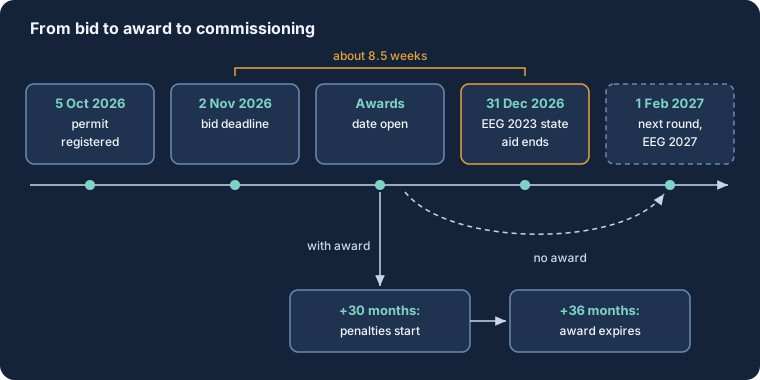
EEG sets no deadline for announcing awards. Section 35(1) only says that BNetzA publishes them online, and under subsection 2 they count as announced one week later; successful bidders are told "without delay" under subsection 3. Recent rounds show the range: in August, 45 days passed between the deadline and publication, in November 2025 it was 66. At the August pace, BNetzA would publish around 17 December and the awards would count as announced around 24 December; at last year's pace, even publication would fall in the first week of January 2027. A round with more bids tends to need more checking, not less.
That is why the BWE asks for a transitional rule in EEG 2027 covering the November awards even if they are issued in 2027, and for a statutory 30-day limit on announcing awards in general. Whether the Bundestag takes this up is open. The final readings are expected in the week of 9 to 13 November, the Bundesrat on 20 November (German Renewable Energy Federation, BEE, as reported by Solarserver on 16 October). For planning, that means running two cases: an award in December with EEG 2023 support, and an award in January where, until a transitional rule or a Commission decision, it is open whether the market premium is covered by state aid approval.
Open question 2: EEG 2023 instead of a contract for difference
If the award comes, the law of the bid date is meant to apply. Section 100(1) no. 1b of the government draft (Bundestag printed paper 21/7867) says so; the explanatory memorandum quoted by the BWE calls this appropriate "because bidders prepare their offers on the basis of this legal situation". A wind farm from this round would get the one-way market premium of EEG 2023 for 20 years and would pay nothing back in years of high market values, unlike projects that fall under the two-sided contract for difference of EEG 2027 from 2027.
Some risk stays under the old law too. Under Section 51(1) EEG, the reference value drops to zero for every period with a negative spot price, and that hits wind farms feeding in at night and on windy public holidays, in exactly the hours when many other plants run as well.
Two rules of the draft barely touch this round. The lease cap (Section 36d of the draft), which would limit lease payments to 3.5 percent of site yield times reference value, only applies to award values from tenders held in 2028 or later. And anyone raising capacity by more than 15 percent later submits an additional bid under Section 36j after commissioning; the draft does not say explicitly whether that bid stays under the old law, and the BWE asks for a clarification.
Open question 3: the bid date as investment decision under AgNes
On the bid date page, BNetzA itself points to its draft determination on the general grid tariff system (AgNes) of 6 August 2026, because bidders asked about it. From 2029 the draft adds a feed-in charge for generation plants above 30 kilowatts, whose level the transmission system operators will only set in 2028. Item 17.4 of the draft exempts plants for 20 years if their final investment decision came before the determination is announced (planned for 1 January 2027) and they start operating by 4 August 2029.
For tenders with a duty to build backed by penalties, sentence 3 of that item treats the bid date as the date of the investment decision, because the bid can no longer be withdrawn after it; a longer realisation period does no harm under sentence 4, so a wind farm from this round may start operating after 4 August 2029 as long as it starts operating within the realisation period of Section 36e, including any extension. A bid for 1 November 2026 would fall before the cut-off, a bid for 1 February 2027 after it. The draft wants proof at the responsible grid operator by 31 March 2027. AgNes has not been adopted, and wording and cut-off may change before it is. What the AgNes grid tariff reform means for generators and storage otherwise is covered in its own article.
Fallback options without an award
With more than double oversubscription, roughly half the bid volume wins nothing, and those projects get no fifth round under the old law. Under the government draft, 2027 has regular bid dates on 1 February, 1 May and 1 November, plus a resilience tender for onshore wind with 3,500 megawatts on 1 August 2027, a separate segment with extra supply chain requirements from the EU Net-Zero Industry Act, (Sections 28 and 28e of the draft, as summarised by the BWE). All of them depend on EEG 2027 entering into force in time and on Commission approval.
A project without an award first needs a new calculation, since a bid value built on market premium logic does not fit a contract that claims money back in good years. Next comes the permit: it lapses if construction has not started within the period the authority set (Section 18(1) no. 1 BImSchG), and an extension has to be applied for beforehand. BNetzA releases securities after the results are published, and payout by the Federal Treasury usually takes up to six weeks, according to the agency. Anyone who posted a cash security should not count on the money before February 2027.
There is also the route out of support altogether: power from a plant without an award can be sold through other direct marketing under a power purchase agreement (Section 21a EEG). Without a market premium, the supply contract alone then carries the financing, and the offtaker takes on the generation profile of a single wind farm, with no balancing from solar or other sites.
After the award: 30, 36 and 18 months
Announcing the award starts two clocks. After 36 months the award expires for any turbine not yet in operation (Section 36e(1) EEG). Penalties start earlier: for capacity not running within 30 months the bidder pays the transmission system operator 10 euros per kilowatt, after 32 months 20 euros and after 34 months 30 euros (Section 55(1)). For 20 megawatts not yet in operation after 34 months, that is 600,000 euros, exactly the security deposited.

On an application made before the 36 months run out, BNetzA extends the deadline if a third party has lodged a legal remedy against the permit after the bid was submitted, or if insolvency proceedings have been opened against the maker of the generator or another essential component, by no more than 18 months in total (Section 36e(2) and (3)). Even then, the support period starts no later than 30 months after the announcement (Section 36i), so an extension costs years of support. The BWE considers 36 months too short, because grid equipment can usually only be ordered firmly after the award and grid connections slip, and asks for 42 months for both realisation and penalty; the EEG 2027 draft does not include that so far.
What direct marketers should prepare now
The market premium is only paid for directly marketed power (Section 20 EEG), in practice usually through a direct marketer, and according to the BWE developers only finalise financing and turbine purchases after the award. For direct marketers inside a utility, that means offers will be in demand between mid-December and mid-January for projects that until then existed only as a bid number.

With award values like August's, between 4.49 and 4.98 cents, how negative hours are handled decides the margin. Because Section 51 sets the reference value to zero in those hours, the plant operator carries the risk, and a marketing contract has to settle who curtails then, who pays for balancing energy and how forecasts are built for a wind farm with no operating history. With the results, BNetzA publishes bidder, site and awarded volume (Section 35(1) no. 2); a direct marketer that checks the list against its contacts on publication day sits down with the developer earlier than one waiting for enquiries.
A utility that holds both roles, its own wind farms and a marketing unit, does well to draft the internal contract now. Otherwise its own project waits in January for its own department.
What applies if the deadline is missed
A bid arriving in Bonn after 2 November 2026 is not opened (Sections 30a(2) and 32(1) sentence 2 EEG), and a bid without the fee or security paid in full is excluded (Section 33(1) no. 3). EEG provides no fine for this; but since it is the last round under EEG 2023, the next attempt leads into EEG 2027.
What utilities with wind projects should do now
Until Monday only a complete bid counts; after that, planning for two outcomes. The dates set the order.
The coming weeks
-
By Friday, 30 October: check the bid against Section 33
Form for this bid date, bid value at most 7.25 cents, no conditions, security posted for each bid and labelled with the bid number, fee paid.
-
Monday, 2 November: deliver in the morning
The gatehouse accepts bids until midnight; a courier in the morning leaves time if a form is missing.
-
By end of November: two calculations
For each project, model the case of an award under EEG 2023 and the case of a February 2027 bid under a contract for difference, each with and without the AgNes feed-in charge. Check the Bundestag decision on EEG 2027 expected in mid-November for a transitional rule covering the November awards.
-
December: have marketing and financing ready
Prepare the direct marketing offer, turbine contract and loan documents so they can be signed on the day of the award.
-
By 31 March 2027: AgNes proof
If the determination is adopted as drafted, prove the bid date to the grid operator as the investment decision. A municipal utility that is also the grid operator decides who submits the proof in which role and who checks it.
Deadline, market roles, systems
2 November 2026EEG onshore wind tender: bid deadline 1 November 2026Law · adopted
Applicability: Developers and operators of onshore wind turbines with a federal immission control permit granted and registered in the market master data register by 5 October 2026.
If the deadline is missed: Exclusion or loss of role Bids must reach the Federal Network Agency by the bid date (Section 30a(2) EEG); only bids received in time are opened (Section 32(1) sentence 2 EEG), so a late bid gets no award in this round. A bid is also excluded if the fee or security has not been paid in full by then (Section 33(1) no. 3 EEG). Legal basis ↗
- Direct marketercheck applicabilityDirect marketers prepare marketing offers for awarded projects.Typically affected: Direct marketing and remote control
- Plant operator (generation)check applicabilityPlant operators with permitted wind projects assess participation, bid value and security deposit.Typically affected: Plant master data and MaStR, Regulatory management, controlling
A classification for typical market roles, not a review of your individual case and not legal advice. Whether an obligation applies to your company (thresholds, exemptions) is for your legal department or counsel to confirm. The calendar doesn't replace your own deadline review. Information as of: 25 October 2026.
Further reading
Frequently asked questions
In the tender, the Federal Network Agency (BNetzA) decides which permitted onshore wind turbines receive a market premium under the EEG, and at what level. Bidders state a bid value in cents per kilowatt hour; the agency awards the cheapest admissible bids until the volume is reached, and each bid keeps its own value (Sections 3 no. 51 and 32 EEG). Under current law the bid dates for 2023 to 2028 are 1 February, 1 May, 1 August and 1 November (Section 28(1) EEG); the EEG 2027 draft changes them from 2027.
By midnight on Monday, 2 November 2026. 1 November is a Sunday, so under Sections 188 and 193 of the German Civil Code the deadline moves to the next working day. What counts is receipt at the agency's Bonn site; the gatehouse at Tulpenfeld 4 accepts bids until midnight that day. Fee and security must be paid in full by then.
Not according to the government draft. It applies the law in force on the bid date to bidders (Section 100(1) no. 1b of the draft EEG, Bundestag printed paper 21/7867). Awards from the 1 November 2026 round would therefore keep the one-way market premium of EEG 2023, with no clawback in years of high market values. EEG 2027 has not been passed yet; the BEE expects the final readings in the Bundestag in the week of 9 November 2026.
That is legally open. The European Commission's state aid approval of EEG 2023 ends on 31 December 2026. The German Wind Energy Association (BWE) argues that the payment claim arises only with the award notice, so the awards must be announced in 2026; it asks for a transitional rule in EEG 2027 that covers awards made in 2027. Whether the legislator adds one is still not settled on 28 October 2026.
30 euros per kilowatt of bid volume (Section 36a EEG), so 600,000 euros for a 20 megawatt wind farm, as a first-demand guarantee or as a payment into the agency's escrow account. Bidders without an award get it back after the results are published; according to the agency, payout by the Federal Treasury usually takes up to six weeks. With an award, it secures the penalties under Section 55 EEG.
The Federal Network Agency's draft AgNes determination of 6 August 2026 introduces a feed-in charge for generation plants above 30 kilowatts from 2029. Plants whose final investment decision was taken before the determination is announced (planned for 1 January 2027) and that start operating by 4 August 2029 pay it only after 20 years. For tenders with penalties, the bid date counts as the date of the investment decision (operative item 17.4). Under the draft, a longer realisation period in the tender does no harm. The draft requires proof to the grid operator by 31 March 2027.
Let's collaborate
One contact, a team behind it
Thirty minutes on what you're working on, whether grid, metering, market processes, IT architecture or AI. Afterwards you'll know how we'd approach it and who would sit at the table.
Energy and measurement technology since 2010 · innobu GmbH since 2014 · Based in Schleswig-Holstein, Germany
Whoever pitches also delivers: whoever leads the first call stays your contact right through to the steering committee, with established partners in the project. Direct: info@innobu.com