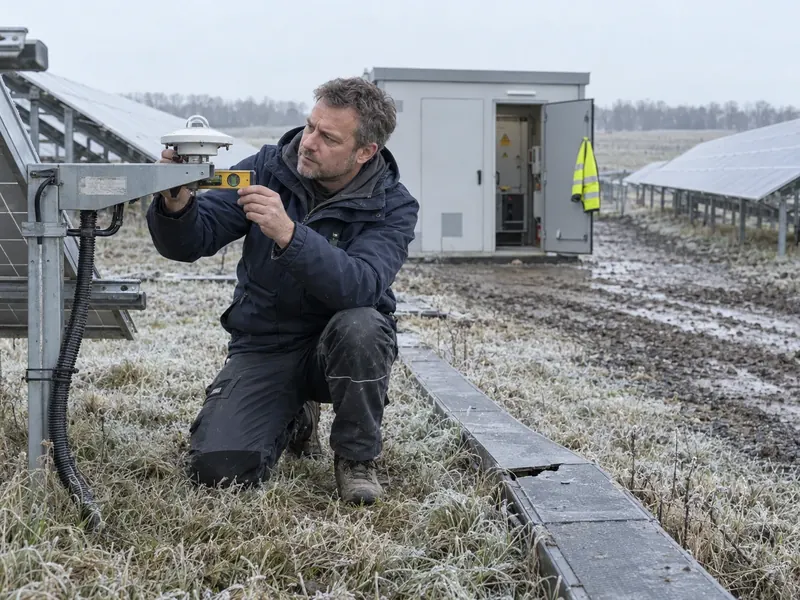
Redispatch 2.0: choosing the settlement method for 2027 by 30 November
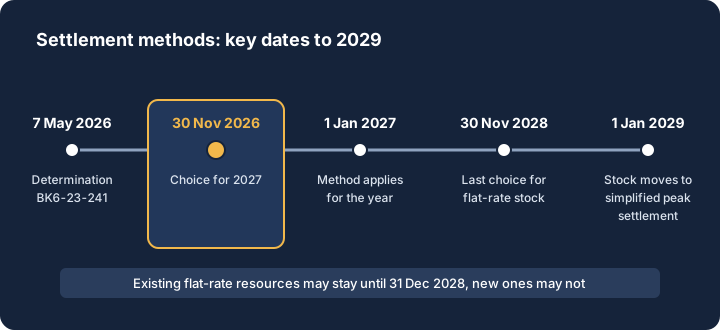
Since determination BK6-23-241 of 7 May 2026, the annual choice sits in section 3.2.1 of the new annex BilAReM (balancing of redispatch measures), and flat-rate settlement ends for existing resources on 31 December 2028. It affects operators of wind and solar plants from 100 kW, many of them municipal utilities with their own parks, their direct marketers, and the distribution system operators that calculate curtailed energy as connecting grid operators.
The settlement method is the procedure used to calculate the curtailed energy of a wind or solar plant from 100 kW in negative redispatch in Germany; the operator sets it per technical resource by Monday, 30 November 2026, for the whole of 2027. The options are peak settlement with weather data measured at the plant, simplified peak settlement with data from a weather service or a reference plant, and, for existing resources only, flat-rate settlement. Without a decision, simplified peak settlement applies. Flat-rate settlement ends for existing resources at the end of 31 December 2028, unless feed-in is not metered quarter-hourly. In 2025, grid operators curtailed 3,225 GWh of onshore wind and 2,704 GWh of solar, almost twice as much solar as the year before.
What is decided by 30 November
By Monday, 30 November 2026, every operator of a wind or solar plant from 100 kW sets, for each technical resource, the procedure that will determine its curtailed energy in 2027. That's in section 3.2.1 of BilAReM, the annex to determination BK6-23-241, with which ruling chamber 6 of the Federal Network Agency (BNetzA) merged the three Redispatch 2.0 determinations from 2020 and 2021 into one document on 7 May 2026. The annual choice already existed under the predecessor BK6-20-059; what's new is that new resources can no longer choose flat-rate settlement.
Curtailed energy (Ausfallarbeit) is the electricity a plant would have fed in had the redispatch measure not happened. The financial compensation under section 13a(2) of the Energy Industry Act (EnWG) depends on it, and the ruling chamber made explicit that it is calculated per technical resource rather than per controllable resource, because individual resources often carry different costs. Under the GPKE determination a technical resource is the individual technical unit, so a wind park usually consists of several, and each needs its own method. Section 3.2 only covers negative redispatch with fluctuating generation: onshore and offshore wind and solar.
An operator may assign a method during the year only at the start of a month and only in three cases: for a new or substantially changed resource, when the plant operator changes, and when the market location moves into the balance group of another balance responsible party.
Three settlement methods and their data sources
The curtailment volumes above show how much electricity is compensated through these formulas, and for solar the volume almost doubled within a year. The three methods differ on one question: where the data come from that are used to calculate what the plant could have produced during the measure. The closer the data source sits to the plant, the more accurately curtailed energy matches the electricity actually lost, and the more the operator has to measure and deliver itself.
| Method | Onshore wind | Solar | Available for |
|---|---|---|---|
| Peak settlement | wind speed at nacelle or rotor hub, resolution of at least 0.1 m/s, certified power curve | irradiance from a sensor at the plant; the ratio of feed-in to irradiance on a day without a measure serves as the yardstick | all resources, including the plan-value model |
| Simplified peak settlement | wind speed from a meteorological service provider or a nearby reference plant | irradiance values from a meteorological service provider, for example from satellite images using the Heliosat-2 method | resources without their own suitable weather measurement; default method |
| Flat-rate settlement | the last fully metered quarter hour before the measure is carried forward | installed capacity times a fixed plant factor by season and time of day | existing resources only, until 31 Dec 2028 at the latest, without quarter-hourly metering also beyond that and for new resources; not in the plan-value model |
The solar plant factor shows how coarse the flat rate is. Between March and October, BilAReM assumes 0.6189 from 9 am to 3 pm (UTC+1, so 10 am to 4 pm in summer time): if a 1 MW park is curtailed completely, roughly 155 kWh per quarter hour count as curtailed energy, whether the sun is out or fog lies over the modules. On a clear June noon the operator is compensated too little, on a dull one too much. For wind, the flat rate carries forward the last quarter-hour value and so assumes the wind blows the same throughout the measure. The ruling chamber therefore considers both flat rates unsuitable for longer measures.

One restriction is tucked away at the end of the section: simplified peak settlement requires that no suitable weather data are measured at the resource. How this condition applies to wind turbines with their own nacelle anemometer, the determination leaves open. The reasoning explicitly rejects forcing operators into peak settlement against their will, and calls the simplified method the default because weather data are always available. Operators who measure at the plant are best advised to agree the choice explicitly with the connecting grid operator. If an operator on peak or simplified peak settlement does not deliver its weather or reference data by the end of the fourth working day of the following month, the connecting grid operator forms substitute values from reference plants or weather data.
Who decides and who calculates
The plant operator makes the decision; the connecting grid operator has to calculate curtailed energy. At many municipal utilities both roles sit under one roof, often together with direct marketing and a balance group of their own. Decide which department files the report.
Four roles, one report
Plant operator
chooses per technical resource, reports the choice to the connecting grid operator and, on the peak methods, delivers weather or reference data by the fourth working day of the following month.
Direct marketer
agrees the method with the operator, because curtailed energy determines the financial compensation, and checks the effect on imbalance costs with the balance responsible party.
DSO as connecting grid operator
records the chosen method per resource, calculates on that basis, forms substitute values and agrees curtailed energy with the plant operator; by the end of the third following month it must be settled or the disagreement established after clearing (BilAReM 6.4.3).
Transmission system operators
develop, with DSOs and industry, the processes that will handle method changes and weather data exchange electronically (BilAReM 6.4.4).
Those processes have not been published yet. The TSOs have to put them out for consultation within six months of the determination's publication, which the BDEW put at early November 2026; three months later they go to the ruling chamber, which publishes them only after review. For the 2026 deadline, the reporting channel your connecting grid operator has used so far still applies. Ask them if it is unclear, and keep a written record of the date and content of your report.
Flat-rate settlement ends in 2028
The ruling chamber abolishes flat-rate settlement for wind and solar. Only resources that were already on the flat rate when the determination was published may choose it; all others can no longer move into it. Existing resources may stay until 31 December 2028 and move to simplified peak settlement on 1 January 2029, unless the operator chooses peak settlement by 30 November 2028.
An exception applies to plants whose feed-in is not yet metered quarter-hourly. They must also be free of both obligations: the Renewable Energy Sources Act (EEG) does not require a device that lets the grid operator retrieve actual feed-in, and the Metering Point Operation Act (MsbG) does not require quarter-hourly metering. Without metered values peak settlement cannot be calculated, because it compares theoretical output with metered feed-in before or after the measure. The flat rate stays there, according to the reasoning until a smart metering system is installed at the latest. Once the exception lapses, simplified peak settlement applies from the following 1 January, provided at least three months remain until then. Biomass, CHP and other non-fluctuating plants keep the flat rate anyway.
According to the reasoning, the 2028 date gives everyone enough time to prepare for peak or simplified peak settlement, and it deliberately falls before the end of the statutory transition. Under section 14(1) sentence 3 EnWG, distribution system operators balance redispatch measures until the end of 2031 only where a determination provides for it; otherwise the balance responsible party balances itself and the grid operator pays cost reimbursement. Once the transition ends, grid operators also balance resources in the forecast model themselves. A flat rate there would, according to the expert report by Consentec GmbH commissioned in the proceedings, break the TSOs' forecasting processes. Reimbursement during this transition follows its own procedure, which we cover in the article on redispatch without balancing.
What happens if nobody reports
BilAReM provides for no fine and no supervisory procedure for a missed choice. The consequence is the assignment described in the summary above, fixed for the whole of 2027. Whether the default pays more or less than before depends on the weather during the measures: it uses weather data instead of a fixed factor, so it lands closer to the electricity actually lost, in both directions.
Operators who miss the deadline can get a different method on 1 January 2028 at the earliest, unless a special case under section 3.2.1 allows an assignment at the start of a month.
The dispute over weather data
The renewable energy federation and the regulator disagreed about the end of the flat rate mainly over weather data. In June 2025, the Bundesverband Erneuerbare Energie (BEE) wrote in its comments on the draft determination (our translation):
"Dropping flat-rate settlement, and the need it creates to procure plant-specific weather data or otherwise determine theoretically possible feed-in, causes a disproportionate additional burden, particularly for self-consumption plants."
The ruling chamber rejected the argument in its decision of 7 May 2026 (our translation):
"Insofar as it is objected that flat-rate settlement would save the effort of procuring or exchanging weather data, this is not convincing. With substitute values formed by the connecting grid operator, no exchange of weather data is required."
The burden does disappear for an operator who delivers nothing at all, but not from the system: it lands with the distribution system operator, who has to form substitute values for every resource without a delivery, and the operator hands over control of the data behind its own compensation. The ruling chamber turned down two other requests as well: a monthly switch of method, which Uniper had asked for in the second consultation, and a switch from peak to simplified peak settlement without giving reasons. Fixing the method for a year is meant to stop operators from picking the more favourable formula depending on the weather. It also did not adopt the TSOs' proposal to give peak settlement general priority.
What to get done by 30 November
Two weeks are enough for the report, not for new metering equipment. The work is a clean list and clear ownership in-house.
Five steps to the deadline
List your resources
Record every technical resource with wind or solar from 100 kW: its 2026 method, planned-value or forecast model, and the kind of weather measurement at the plant.
Flag the flat-rate stock
For resources settled at a flat rate today, decide whether to stay until 2028 or move to peak settlement as early as 2027. The solar example above shows the yardstick: if curtailment often falls on clear days, the flat rate pays too little. BilAReM does not say explicitly whether a later return to the flat rate is possible; treat the move as final.
Check your measurements
Peak settlement needs reliable values from the nacelle anemometer or the irradiance sensor, month after month, by the fourth working day.
Settle ownership
Decide who files the report in-house and who from direct marketing and the balance group signs it off.
Report on time and in writing
The report goes to the connecting grid operator by Monday, 30 November, at the latest; keep the proof while there is no electronic process.

As a distribution system operator you sit on the other side of the same reports. Prepare the master data per resource so the default applies cleanly to everyone who does not report, and plan capacity for substitute values and clearing. How many plants in your grid are controllable and when they move into the plan-value model is something you agree with the upstream TSO anyway; the dates are in our overview of TSO deadlines 2027 to 2031. We track the deadline in the energy transition deadline calendar, and it comes round again every 30 November.
Deadline, market roles, systems
30 November 2026Redispatch 2.0: choice of settlement method for 2027Regulatory ruling · adopted
Applicability: Operators of wind and solar plants from 100 kW in negative Redispatch 2.0.
If the deadline is missed: No direct legal consequence Without an assignment decision by 30 November, the simplified peak settlement applies to resources with fluctuating generation (BilAReM chapter 3.2.1); resources already on flat-rate settlement stay there until 31 December 2028 at the latest, and beyond that without quarter-hourly metering. The assignment holds for the whole following year. Legal basis ↗
- Electricity grid operatoraffectedElectricity DSOs take the assignment into the calculation of curtailed energy.Typically affected: EDM / MDM, Market communication gateway (EDIFACT, AS4, API)
- Balance responsible partyaffectedBalance responsible parties check how the chosen method affects imbalance costs.Typically affected: Trading and procurement system (ETRM)
- Direct marketeraffectedDirect marketers agree with plant operators which method best reflects the balancing compensation in the balance group.Typically affected: Direct marketing and remote control
- Plant operator (generation)affectedPlant operators decide per technical resource between peak, simplified peak or flat-rate settlement and report the choice to the connecting grid operator.Typically affected: Plant master data and MaStR, Market communication gateway (EDIFACT, AS4, API)
A classification for typical market roles, not a review of your individual case and not legal advice. Whether an obligation applies to your company (thresholds, exemptions) is for your legal department or counsel to confirm. The calendar doesn't replace your own deadline review. Information as of: 15 November 2026.
Further Reading
Frequently Asked Questions
It is the procedure the connecting grid operator uses to determine the curtailed energy of a wind or solar plant in negative redispatch, meaning the electricity the plant would have fed in without the measure. Section 3.2.1 of BilAReM provides three methods: peak settlement, simplified peak settlement and flat-rate settlement. The plant operator sets the method per technical resource by 30 November for the following calendar year.
Operators of onshore and offshore wind turbines and of solar plants from 100 kW rated electrical capacity that are covered by negative redispatch. The choice applies per technical resource and for the whole of 2027. Section 3.2 does not apply to plants with non-fluctuating generation such as biomass or CHP.
Simplified peak settlement applies. Resources that were already on flat-rate settlement when the determination was published stay there until 31 December 2028 at the latest, and beyond that if feed-in is not metered quarter-hourly. BilAReM sets no fine for a missed choice.
No, with one exception. Flat-rate settlement can only be chosen for technical resources that were already on it when determination BK6-23-241 was published. If a plant's feed-in is not metered quarter-hourly and does not have to be, flat-rate settlement continues until metering starts.
For wind, the wind speed per quarter hour at a resolution of at least 0.1 m/s, from a meteorological service provider or from a nearby reference plant of similar design. For solar, irradiance values from a meteorological service provider; the Heliosat-2 method, which converts satellite images into global irradiance, counts as suitable. If the plant operator does not deliver by the fourth working day of the following month, the connecting grid operator forms substitute values.
Only in special cases: at the start of a month for a new or substantially changed resource, or when the plant operator or the balance responsible party changes. The ruling chamber rejected a monthly switch because it would raise the workload and make it easier to pick the cheaper formula depending on the weather.
Let's collaborate
One contact, a team behind it
Thirty minutes on what you're working on, whether grid, metering, market processes, IT architecture or AI. Afterwards you'll know how we'd approach it and who would sit at the table.
Energy and measurement technology since 2010 · innobu GmbH since 2014 · Based in Schleswig-Holstein, Germany
Whoever pitches also delivers: whoever leads the first call stays your contact right through to the steering committee, with established partners in the project. Direct: info@innobu.com