District heating primary energy factor: from 2027, CHP heat counts under the Carnot method
Article 2 of the act amending the Buildings Energy Act of 23 July 2026 rewrites Section 22 and Annex 4 at the turn of the year. Since 29 July 2026 the Buildings Energy Act (GEG) has been called the Building Modernisation Act (GModG), and Section 22 still governs primary energy factors there. The change affects district heating suppliers that publish their own value for a network with combined heat and power. Because building permit applications from 2026 stay under the old version, these suppliers need two values side by side during the transition.
The primary energy factor of district heating is the figure planners use to weight district heat in a new building's primary energy demand (Section 22 GModG). From 1 January 2027, a value published by the supplier for a network with CHP heat only counts if it was determined using the method in DIN EN 15316-4-5:2017-09 section 6.2.2.1.6.3 (the Carnot method) and the publication names that method. Without such a value, planners use 0.7 from Annex 4, minus 0.002 per percentage point of heat from renewable energy, waste heat or mine gas if the supplier publishes that share. The power bonus method with its displaced electricity factor of 2.8 and the 0.3 floor both go. Building permit applications filed by 31 December 2026 stay under the old version (Section 111(2) GModG).
What Section 22 GModG says from 1 January 2027
Article 2 no. 10 of the act (Federal Law Gazette 2026 I No. 226) inserts a new sentence 3 into Section 22(5) of the Building Modernisation Act (Gebäudemodernisierungsgesetz, GModG), and Article 9(2) brings it into force on 1 January 2027. If a heat network uses heat from a combined heat and power (CHP) plant, a planner may only use the supplier's published value if the supplier determined the primary energy factor of the CHP heat with a procedure that corresponds to the method in DIN EN 15316-4-5:2017-09 section 6.2.2.1.6.3, and says so in the publication. The act does not name the method; the Federal Institute for Research on Building, Urban Affairs and Spatial Development (BBSR) calls it the Carnot method on its GModG portal.
Going by the wording, the method only concerns the heat from the CHP plant, that is, how much of the CHP fuel is assigned to heat. Peak boilers, heat pumps and other generators on the same network enter the network value under sentence 2 as before: fuels and electricity including auxiliary energy, weighted with the Annex 4 factors and related to the heat delivered.
Until 31 December 2026, Section 22 prescribes the procedure in DIN V 18599-1:2018-09 Annex A section A.4 for CHP heat, known in Germany as the Stromgutschriftmethode or power bonus method. With it, the displaced electricity factor of 2.8 leaves Annex 4. Also gone is the 0.3 floor, which a supplier could so far only undercut with its own deduction of 0.001 per percentage point of renewable heat or waste heat. Large heat pumps of 500 kilowatts and above lose their special value of 1.2 for grid electricity, because all grid electricity counts at 1.5 instead of 1.8 in the new Annex 4.
Annex 4 also measures something different from 2027. Until now it listed only the non-renewable share of an energy carrier; according to the BBSR, the primary energy demand will in future include the renewable shares as well. Wood and solid biomass therefore sit at 0.7 in Annex 4 from 2027 instead of 0.2, and networks with biomass boilers get higher values, CHP or not.
Where a network has no valid value of its own, the new Section 22(6) applies and the planner takes the district heating value from Annex 4, which is 0.7. Going below that requires the supplier to publish the share of heat from renewable energy, waste heat or mine gas; the value then drops by 0.002 per percentage point, to 0.6 at 50 percent and to 0.5 at 100 percent. It is a route without a Carnot calculation, but it never goes below 0.5. For this case the act used to give no figure and pointed instead to the value for district heat in the DIN V 18599 calculation procedure.
| Rule | Until 31 Dec 2026 | From 1 Jan 2027 |
|---|---|---|
| CHP heat in the network value | Power bonus method under DIN V 18599-1 Annex A.4, displaced electricity factor 2.8 | Fuel share under DIN EN 15316-4-5 section 6.2.2.1.6.3 (Carnot method), method named in the publication |
| Floor | 0.3, below that only with a deduction of 0.001 per percentage point of renewable or waste heat | none |
| No value of its own | District heating value from the calculation procedure (DIN V 18599), no figure in the act | 0.7 from Annex 4, minus 0.002 per percentage point if the share is published |
| Factors in Annex 4 | Non-renewable share only, wood 0.2, grid electricity 1.8 | Including the renewable share, wood 0.7, grid electricity 1.5 |
| Grid electricity for large heat pumps from 500 kW | 1.2 | 1.5, like any grid electricity |
| AGFW worksheet (association, not in the act) | FW 309-1 | FW 309-6 |
Why the Carnot method rates CHP heat higher
Under the power bonus method, electricity from a CHP plant is assumed to displace grid electricity and is credited at a factor of 2.8. Because that credit is set so high, most of the fuel ends up on the power side of the calculation and the heat carries almost no primary energy. Very small or even negative values are possible this way, which is why the legislator had added the 0.3 floor.
No reference system is needed for the Carnot method. It splits the fuel by exergy, the part of the energy that could be turned into work: electricity counts in full, heat only with the Carnot factor (1 minus ambient temperature divided by extraction temperature, both in kelvin). In its simple form, the extraction temperature is the mean of flow and return, so a colder return also lowers the value. Which temperatures and which ambient temperature an attestation uses in detail is set by the standard and the AGFW worksheet, not by the act. The lower the extraction temperature, the smaller the fuel share of the heat and the lower its primary energy factor; the Öko-Institut sees this as a physically sound incentive for low-temperature systems.
EVH GmbH, part of the Stadtwerke Halle group in Halle (Saale), shows how big the jump can be, because it publishes both values for its district heat, both based on plan data for 2030. Under the power bonus method it arrives at 0.09. Since that is below the floor, it raises the value to 0.3 and deducts 0.001 per percentage point of renewable heat, which gives the published 0.29. Under the Carnot method according to FW 309-6, the figure is 0.55. A network with a high CHP share can thus move from just under 0.3 to close to the flat value.
A value of its own only pays off while it stays below what the deduction route gives without any calculation. EVH's 0.55 beats 0.7 minus the deduction as long as the published share of renewable and waste heat stays below 75 percent. A supplier controls two levers: network temperature, which works through the Carnot factor, and the share of renewable heat, which enters the network value under sentence 2, since solar thermal, ambient heat and waste heat carry 0.0 in Annex 4.
According to AGFW, the German district heating association, factors for the GEG are calculated under FW 309-1 until 1 January 2027, and factors under FW 309-6 can be used under the GModG from then on. For applications from 2026, though, a value under FW 309-1 still governs in the new year through Section 111(2). FW 309-6 contains the work value method alongside the Carnot method. Whether the work value method corresponds to the method in section 6.2.2.1.6.3 is something neither the act nor the BBSR says; the BBSR names only the Carnot method for CHP.
Who the change affects
The GModG contains no duty to publish a network-specific primary energy factor, and no sanction either. It affects district heating suppliers that publish one anyway, because a low value helps new buildings on the network meet the primary energy requirements. A supplier with CHP heat in the network that publishes a value needs a recalculated one from 2027; a supplier that publishes none is untouched by the question of method, though not by the flat value.
Networks without CHP, for instance with a heating plant, a large heat pump or waste heat, keep calculating under Section 22(5) sentence 2. Their result still changes, because sentence 2 requires weighting with the Annex 4 factors and those are new from 2027. The law firm Becker Büttner Held (BBH) works out that the heat factor of a large heat pump with a seasonal performance factor of 2.5 rises from 0.48 to 0.60, since the special value of 1.2 disappears and grid electricity counts at 1.5. What happens to a published value still calculated with the old factors is not specifically regulated; from 2027 it no longer meets the requirements of sentence 2. Networks with electric heat generation are covered in our article on power-to-heat and large heat pumps in district heating.
The value is used on the other side of the service connection, by planners and builders proving the primary energy demand of a new building under Sections 20 and 21 GModG; by their wording, Section 22(5) and (6) refer to buildings to be erected. In 2025 district heating was the primary heating energy for 22.3 percent of the 193,900 dwellings approved for construction, and for 7.6 percent of the 62,100 residential buildings, according to figures from the state statistical offices compiled by BDEW in June 2026. In new construction, district heating is strong mainly in multi-storey housing, where one project connects many dwellings at once and the planning office needs the value early in the design. A factor of 0.55 instead of 0.29 nearly doubles the district heating part of such a building's primary energy demand; whether the building still meets the requirement is decided by its calculation.
Quite apart from the new-build calculation, Section 5(3) of the District Heating or Cooling Consumption Metering and Billing Ordinance (FFVAV) requires the supplier to make information on the primary energy factor of its district heating system available on its website and in its bills. It names no calculation method and leaves open which of the two values belongs on the bill during the transition.
Energy performance certificates see the same change of method. Annex 9 no. 1(c) already requires a published emission factor of the heat network operator to be used, so far determined under DIN V 18599-1 Annex A.4. From 2027 it has to be determined with the same DIN EN 15316-4-5 method as the primary energy factor; upstream emissions and network losses count as before. Without such a value, the factor for the fuels used from Annex 9 no. 3 applies: for local and district heating with a CHP share of at least 70 percent from gaseous and liquid fuels, 180 grams of CO2 equivalent per kilowatt hour.
The building permit application decides which version applies
Which version a calculation uses depends on the date of the building permit application, not the date of completion. Section 111(2) GModG applies the act as it stood when the application, the request for approval or the building notice was filed; for projects without a permit, the date the notification reaches the authority or construction starts counts instead. The BBSR states on its portal that these rules apply accordingly to future amendments of the GModG, and the new version from 1 January 2027 is such an amendment. An application from December 2026 is therefore calculated with the old power bonus value, one from January 2027 with the new value.
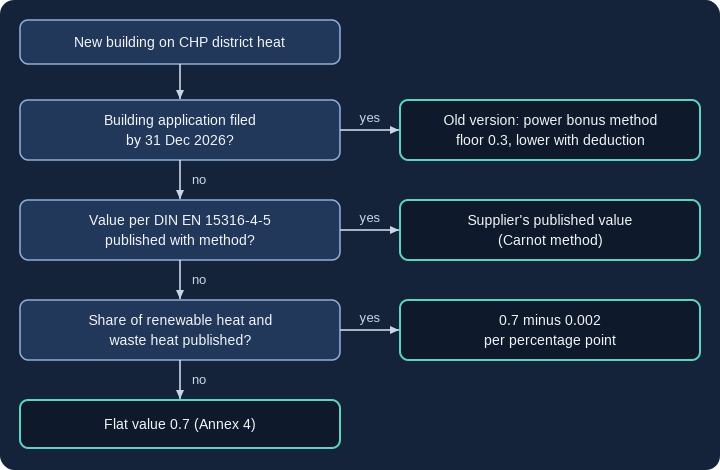
Section 111(3) also lets the builder opt for the new law as long as no final decision has been taken on the application; according to the BBSR, this works only for the act as a whole, not for individual provisions. For a while, the supplier therefore gets enquiries about both versions and needs two values, each clearly marked with the applications it applies to. The act contains no special rule for attestations already issued: an FW 309-1 attestation remains usable for applications filed by 31 December 2026 unless the builder opts for the new law, and it does not suffice for CHP heat in applications from 2027.
What the new value requires in data and systems
A Carnot calculation needs, for each CHP plant, the electricity and heat generated, the fuel input and the extraction temperature. Suppliers know volumes and fuels from sources such as their CHP Act (KWKG) reports; the temperatures, by contrast, often sit only in the control system's data historian, as flow and return per feed-in point rather than as an annual value per plant. Before a supplier has a value attested, it should check for each network whether these time series are complete and can be assigned to that network.
The act does not prescribe an expert, only a determined and published value that states the method. An attestation under AGFW worksheet FW 309-7 is still the norm. According to AGFW, attestations based on FW 309-6 may be issued by experts who have passed the FW 611 examination, and under AGFW's general rules experts employed by the supplier may also attest values for its own networks. DESI (district-energy-systems.info) lists the certified experts and lets them publish their attestations there. A supplier that so far only had experts with the FW 609 examination for the power bonus method needs someone with the new qualification.
Suppliers need the shares of renewable and waste heat several times over: for the deduction route under Section 22(6), in the decarbonisation roadmap under Section 32 WPG and in the transformation plan for Federal Funding for Efficient Heat Networks (BEW). All three figures should match.
| Building block | Content | Where it usually sits |
|---|---|---|
| Generation per plant | Fuel input, electricity and heat generation, auxiliary energy | Generation data historian, KWKG reports |
| Temperatures | Flow and return at the point of heat extraction | Control system, energy data management |
| Network balance | Heat fed in and delivered, network losses | Energy data management, billing; network losses must be published anyway under Section 1a(2) AVBFernwärmeV |
| Shares | Heat from renewable energy, waste heat, mine gas | The same figures as in the decarbonisation roadmap and the transformation plan |
| Evidence | Attestation under FW 309-7 based on FW 309-6; old value under FW 309-1 for applications up to 2026 | Website, optionally DESI |
| Emission factor | Same method, including upstream emissions and network losses (Annex 9) | Attestation, website |
| Customer information | Primary energy factor under Section 5(3) FFVAV | Bill template in the billing system, website |
The dispute over the method
The method was contested before it reached the statute book. Writing in June 2026 on the government draft, BBH said networks with renewable heat and large heat pumps would lose ground in the building balance even though nothing about the plants changes; its clearest example was wood, which rises from 0.2 to 0.7. The firm also criticised the draft for lacking transition periods and for leaving open whether attestations already issued remain valid.
"The arithmetical deterioration does not change the physical efficiency of these plants."
BBH blog, 17 June 2026 (our translation)The Öko-Institut had argued for the Carnot method back in September 2023, in an opinion published in the City of Munich's council information system. It called it an easy-to-apply procedure "whose results favour neither the power side nor the heat side" (our translation), whereas the power bonus method, with its high displaced electricity factor, assigns most of the emissions to power. Lawmakers adopted the Carnot method for CHP and did not replace the special value for large heat pumps. No separate transition period of the kind BBH missed made it into the act; the transition runs through Section 111(2) and the date of the building permit application.
Roadmap for heat network operators to the end of March 2027
At the end of November, five weeks remain until the cut-off date. That is enough to decide per network and to commission an expert; a finished FW 309-6 attestation by 1 January is ambitious if the temperature data still has to be pulled together. If the attestation comes later, you lose nothing for applications from 2026, because your old value still applies to them unless the builder opts for the new law. For applications filed in January, planners use 0.7 or the deduction value until the new value is published.

Six steps to the end of March 2027
-
By early December: take stock
For each network, record whether a value is published, under which worksheet, with which attestation and everywhere it appears: website, DESI, bill template, sample attestations for planners, sales material.
-
By mid-December: decide per network
Every network has three routes: a value of its own (under the Carnot method with CHP, under sentence 2 without), the deduction from the flat value via a published share of renewable and waste heat, or no value of its own. A small CHP network with little new construction on it can live with the deduction value; in a new development area the calculation is more likely to pay off, because planners there keep running calculations with the value. A supplier that publishes the share in December already gives planners the deduction value instead of 0.7 from 1 January, even if the attestation is still missing.
-
Before Christmas: data and expert
Pull together time series for temperatures, fuel and generation per plant and commission an expert with the FW 611 examination, in-house or external. Have the Annex 9 emission factor determined at the same time: from 2027 only a value under the same method counts in energy performance certificates, and a power bonus factor no longer fits.
-
Before 1 January: brief sales and grid connections
Both teams get a short explanation of which value applies to which application and why the new one can come out higher, because enquiries about 2027 applications can arrive from the first working day.
-
January: publish the new value and update the bill
Publish the value naming the method (DIN EN 15316-4-5 section 6.2.2.1.6.3, FW 309-6) and keep the old value next to it, marked as valid for building permit applications filed by 31 December 2026. With the same publication, switch the Section 5(3) FFVAV information in the bill template and on the website.
-
By end of March: write to planners and housing companies
Housing companies, developers and planning offices with projects on the network get both values with their validity by application date.
Deadline, market roles, systems
Applies from District heating with CHP: new calculation method for published primary energy factors
Applicability: Only district heating suppliers that publish their own primary energy factor and use heat from CHP plants in their network.
If the deadline is missed: No direct legal consequence Publishing is an option, not an obligation. Without a validly calculated value, Section 22(6) GModG as amended requires the district heating value from Annex 4 to be used. Separately, Section 5(3) FFVAV requires the district heating supplier to make information on the primary energy factor of its district heating system available on its website and in its bills. Legal basis ↗
- Heat network operatorcheck applicabilityChecks whether it publishes its own primary energy factor with CHP heat and, if so, has it redetermined using the new method by 1 January 2027, stating the method.Typically affected: Regulatory management, controlling
A classification for typical market roles, not a review of your individual case and not legal advice. Whether an obligation applies to your company (thresholds, exemptions) is for your legal department or counsel to confirm. The calendar doesn't replace your own deadline review. Information as of: 24 November 2026.
Further Reading
Frequently Asked Questions
It is the figure a planner uses to weight the district heat supplied to a new building in its annual primary energy demand. The district heating supplier can determine it for its network from the fuels, electricity and heat delivered, and publish it (Section 22 GModG). If it publishes no valid value, the flat value of 0.7 from Annex 4 applies to building permit applications filed from 1 January 2027.
From 1 January 2027, when Article 2 of the act of 23 July 2026 (Federal Law Gazette 2026 I No. 226) enters into force. From then on, a published value for a network with CHP heat only counts if the CHP heat was assessed with a procedure that corresponds to the method in DIN EN 15316-4-5:2017-09 section 6.2.2.1.6.3 and the publication names that method. The BBSR calls it the Carnot method. What matters is the date of the building permit application (Section 111(2) GModG).
Not under the GModG: a network-specific value is an option. Without one, planners use the flat value from Annex 4. Separately, Section 5(3) FFVAV requires the supplier to make information on the primary energy factor of its district heating system available on its website and in its bills.
The value under the old version, calculated with the power bonus method and subject to the 0.3 floor; with a published deduction for renewable and waste heat it may go below that. Section 111(2) GModG applies the act as it stood when the building permit application was filed. Under Section 111(3) the builder can opt for the new law as long as no final decision has been taken on the application, but according to the BBSR only for the act as a whole.
For applications filed from 1 January 2027, the district heating value in Annex 4, which is 0.7 (Section 22(6) GModG). If the supplier publishes the share of heat from renewable energy, waste heat or mine gas, the value drops by 0.002 per percentage point: to 0.6 at 50 percent and to 0.5 at 100 percent.
The GModG does not require an expert, only a determined and published value that states the method. Industry practice is an attestation under AGFW worksheet FW 309-7. According to AGFW, attestations based on FW 309-6 are issued by experts who have passed the FW 611 examination; under AGFW's general rules, experts employed by the supplier may also attest values for its own networks.
Let's collaborate
One contact, a team behind it
Thirty minutes on what you're working on, whether grid, metering, market processes, IT architecture or AI. Afterwards you'll know how we'd approach it and who would sit at the table.
Energy and measurement technology since 2010 · innobu GmbH since 2014 · Based in Schleswig-Holstein, Germany
Whoever pitches also delivers: whoever leads the first call stays your contact right through to the steering committee, with established partners in the project. Direct: info@innobu.com