BEW Relaunch 2026: New BAFA Guidance and the End of Transformation-Plan Funding
This article explains what changes on 1 April 2026, what exactly falls away and what stays eligible, what the new guidance means for documentation and data, why the federal government is cutting the funding, how the picture looks in a European context, which risks remain and what heat-network operators should do now.
Germany's Federal Funding for Efficient Heat Networks, known as the BEW, is being put on a new footing in 2026. On 1 January 2026 a consolidated BAFA guidance note replaced the previous five separate notes, and a revised version applies to applications from 1 April 2026. On the same date, funding for transformation plans under Module 1 ends; applications received by 31 March 2026 are still processed. The reason is legal: the Heat Planning Act requires operators to submit a heat network expansion and decarbonisation roadmap by 31 December 2026, and under Section 23 of the Federal Budget Code the federal government may not fund legally mandated conduct. Only the funding of the transformation plan itself falls away. Feasibility studies and planning services for HOAI performance phases 2 to 4 remain eligible, industrial process heat networks are exempt from the funding end, and construction and transformation of heat networks are still supported with a funding rate of up to 40 percent. The revised guidance brings more practical clarity, for example more flexible flow temperatures above 95 degrees where objectively justified, but it also raises the documentation and evidence burden. Applications and communication run through a new digital BAFA portal. In 2025 the BAFA approved around 1.65 billion euros in BEW funding, while the backlog of unapproved applications grew to over 1,500 by year end. For municipal utilities this means planning the decarbonisation roadmap as a mandatory task, building a clean data basis and using the final application deadline of 31 March 2026 deliberately.
What changes on 1 April 2026
Germany's Federal Funding for Efficient Heat Networks restarts in 2026 on a new footing. Two changes land on the same effective date: a revised BAFA guidance note and the end of funding for transformation plans under Module 1. Both apply to applications from 1 April 2026.
The BAFA replaced the previous five separate guidance notes with a single consolidated note on 1 January 2026. The version that applies from 1 April 2026 adds further clarifications and more practical detail. For operators this mainly means that one document now governs the funding conditions, which makes orientation easier but raises the bar for their own documentation.
The second change is the more consequential one. Funding for transformation plans under Module 1 ends on 1 April 2026. Applications received by 31 March 2026 are still processed. So anyone aiming for a funded transformation plan has a clear, narrow window.
What ends and what stays eligible
Only the funding of the transformation plan itself falls away, not all planning funding. This distinction matters for operators, because many services are still supported. Anyone who assumes the whole BEW planning funding has ended leaves money on the table.
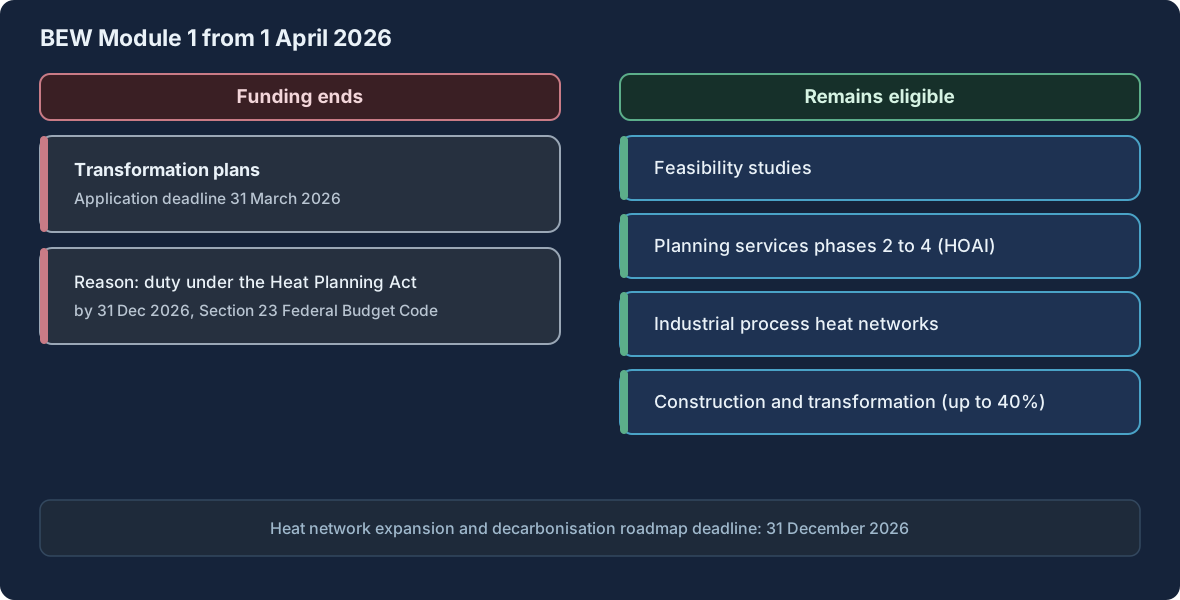
Feasibility studies under Module 1 are not affected by the discontinuation. They can still be funded after 1 April 2026, as can planning services for HOAI performance phases 2 to 4, both for new construction and for transformation projects. The reason: these services go beyond what the Heat Planning Act strictly requires.
An exception applies to industrial process heat networks, that is networks supplying commercial or industrial consumers with process heat. They are exempt from the funding end. For industrial networks exempted under Section 29(4) of the Heat Planning Act, a four-year extension is possible, which pushes their submission deadline back.
Only the transformation plan as a funded single service falls away. Feasibility studies, planning services for phases 2 to 4 and the construction and transformation of networks stay eligible at up to 40 percent. Industrial process heat networks are exempt.
The new guidance: consolidated, digital, documentation-heavy
The revised guidance brings more clarity and practical detail, but it also raises the documentation and advisory burden. In parallel, the BAFA is digitising the application and communication process through a new online portal. Staying eligible takes a solid data basis.

Several clarifications help in practice. For existing networks, the 95-degree cap on flow temperature can be exceeded where this is objectively justified, for example with heat sources that inherently require higher temperatures. Under Module 2, an early start of measures is possible in justified exceptional cases where special, project-specific reasons apply.
Evidence rules get stricter. For heat pumps in mixed systems, at least 90 percent of the annual heat must come from eligible sources and be metered separately. Efficiency is assessed via SCOP or the seasonal performance factor, no longer via the quality grade. Heat from non-eligible sources is capped at no more than 10 percent of annual heat. Such requirements can only be met with clean metering and continuous documentation.
Why the government is cutting the funding
The funding end is not a budget cut but a legal consequence of the Heat Planning Act. What becomes a statutory duty, the federal government may no longer subsidise. This logic explains why the transformation plan in particular drops out while other services stay.
Under Section 23 of the Federal Budget Code, grants may only be budgeted for purposes in which the federal government has a substantial interest. Legally mandated conduct does not qualify.
The Heat Planning Act requires operators to submit a heat network expansion and decarbonisation roadmap by 31 December 2026. That turns the transformation plan from a voluntary, funded project into a mandatory task. Funding this mandatory document can no longer be justified under budget law.
Funding therefore shifts from planning to implementation. Investment in generation, storage and the network stays the core of the BEW. The decarbonisation roadmap under Section 32 of the Heat Planning Act sits in its own legal frame, which we cover in detail elsewhere.
German and European context
The heat transition is the slow part of the energy transition. Only a small share of households is connected to heat networks, and the switch to climate-neutral sources by 2045 is capital-intensive and lengthy. That is precisely why the funding programme remains a central lever despite the cut to plan funding.

Currently only around 14 percent of dwellings in Germany are connected to district or local heating networks. Transformation plans must demonstrate the switch to a greenhouse-gas-neutral heat network by 2045. The route runs through renewable sources such as large heat pumps, geothermal energy, solar thermal and unavoidable waste heat, which the BEW continues to fund.
The political commitment to continue stands. From 2030, according to the environment ministry, 3.5 billion euros a year are to be available for the BEW. That frames the current change as fine-tuning, not a retreat. The federal government moves funding to where it does not meet a statutory duty.
Challenges and risks
The relaunch brings three tangible points of friction. They concern processing time, deadline pressure and rising administrative effort.
The approval backlog is real. By the end of 2025, over 1,500 applications had been submitted but not yet approved. Long processing times delay investment decisions and tie up planning capacity that is missing elsewhere.
The deadline pressure on 31 March 2026 hits operators that have not yet commissioned their transformation planning. Anyone who misses the deadline will bear the planning cost for the mandatory document themselves in future. On top of this comes the higher evidence and metering effort from the new guidance. Without a clean data basis and digital processes, delays in the portal and, in the worst case, clawbacks loom.
What heat-network operators should do now
The best entry point runs along the data and evidence processes, not the funding question alone. The duty under the Heat Planning Act remains, funding shifts, and the real bottleneck lies in the systems that bring metering, modelling and documentation together cleanly.
Four steps order the start. They interlock but can be begun independently.
-
Use the final application deadline deliberately
Check whether a funded transformation plan makes sense and submit the application before 31 March 2026. Feasibility studies and performance phases 2 to 4 remain eligible afterwards.
-
Plan the decarbonisation roadmap as a duty
The deadline of 31 December 2026 applies regardless of funding. Set the roadmap up early and link it to municipal heat planning instead of waiting for a grant.
-
Set up data architecture and metering concept
Prepare separate metering of heat sources, SCOP and seasonal performance factor evidence and complete documentation so the application runs through the digital BAFA portal without queries.
-
Use digital planning tools
Apply a heat cadastre and network simulation to model network areas, load profiles and the source mix reliably and to put the roadmap on a verifiable data basis.
The BEW relaunch is therefore less a funding topic than a question of data management. Operators that connect metering and modelling early, backed by clean documentation, meet the duty under the Heat Planning Act more reliably and keep funding open for studies and later implementation.
Further reading
Frequently asked questions
Two things coincide. First, a revised, consolidated BAFA guidance note applies to all applications from 1 April 2026; it replaced the previous five separate notes on 1 January 2026. Second, funding for transformation plans under Module 1 ends on 1 April 2026. Applications to fund transformation plans received by 31 March 2026 are still processed. In parallel, the BAFA is digitising the application and communication process through a new online portal.
No, the transformation plan itself is no longer funded under Module 1. Anyone who wants a funded transformation plan must submit the application by 31 March 2026. An exception applies to industrial process heat networks that supply commercial or industrial consumers with process heat; they are exempt from the funding end.
Only the funding of the transformation plan ends, not all planning funding. Feasibility studies under Module 1 remain eligible after 1 April 2026. Planning services for HOAI performance phases 2 to 4 remain eligible, both for new construction and for transformation projects, because they go beyond the statutory duty. Construction and transformation of heat networks are still supported with a funding rate of up to 40 percent.
The funding end is a legal consequence of the Heat Planning Act, not a budget cut. The act requires operators to submit a heat network expansion and decarbonisation roadmap by 31 December 2026. Under Section 23 of the Federal Budget Code, the federal government may only budget grants for purposes in which it has a substantial interest. Legally mandated conduct does not qualify, so funding for this mandatory document falls away.
They should check whether a funded transformation plan makes sense and submit the application before 31 March 2026. The decarbonisation roadmap must be planned as a mandatory task by 31 December 2026, regardless of funding. A clean data architecture and metering concept matter: separate metering of heat sources, SCOP and seasonal performance factor evidence, and complete documentation for the digital BAFA portal. Digital planning tools and a heat cadastre help to model network areas and the source mix reliably.