Heat and cooling guarantees of origin: the UBA register starts in 2026
This article frames the register: what launches in 2026, how a heat guarantee of origin works, why it is more tightly defined than its electricity and gas counterparts, the sales opportunities it opens for utilities, how it fits into the FFVAV and heat planning, where the limits are and what operators should prepare now.
Germany's environment agency (Umweltbundesamt, UBA) is set to launch the guarantees of origin register for heat or cooling in 2026. After the registers for electricity and gas, the heat market gets the third digital proof system for renewable energy. The legal basis is the Guarantees of Origin Register Act (HkNRG) of 2023 and the Gas, Heat and Cooling Guarantees of Origin Register Ordinance (GWKHV), in force since 1 May 2024, which names the UBA as the responsible body. For each megawatt-hour of thermal energy generated from renewable sources, unavoidable waste heat or thermal waste treatment, the UBA issues exactly one electronic certificate on application by the plant operator. The key difference from electricity and gas: a heat certificate may only be cancelled within the district or local heating network where the plant is located, and it expires after 18 months. Because heat is physically tied to the network, there is no cross-regional trade. If the heat comes from electricity or gas, the source certificate is cancelled at the same time so the same green energy does not count twice. For utilities this opens a new sales channel: they can disclose green heat transparently and sell it as a standalone product under Section 34 GWKHV, which industrial customers in particular need for their ESG reporting. The register fits into the FFVAV transparency obligations, which already require disclosure of the renewable share and the primary energy factor. Around 3,800 heat networks with more than 31,000 kilometres of pipe supply roughly 14 percent of households, and 30 percent of generation already comes from renewable energy and unavoidable waste heat. Open questions remain: the administrative effort of data capture, the narrow cancellation rule and the fact that the certificate alone cuts no emissions. For operators this means digitising generation volumes and metering data cleanly, connecting the certificate process to metering and billing systems, and aligning sales with green heat products early.
What happens with the heat register in 2026
In 2026 Germany's environment agency launches the guarantees of origin register for heat or cooling. It follows the registers for electricity and gas as the third system for proving renewable energy. For the first time, green heat from district heating can be documented in a legally secure way and marketed as a standalone product.
The legal basis has been in place for a while. The Guarantees of Origin Register Act has applied since 2023, and the Gas, Heat and Cooling Guarantees of Origin Register Ordinance since 1 May 2024. The ordinance names the UBA as the body responsible for running the new registers. The agency announces the exact start date in the Federal Gazette, the technical build-up is under way, and a UBA final report on the legal, procedural and technical implementation appeared in March 2026.
- Legal framework: HkNRG (2023) plus GWKHV (1 May 2024), with the environment agency in charge.
- The pilot did the groundwork: the Hamburg Institut ran a pilot register for green district heating in the IW3 project with Hamburger Energiewerke.
- The goal is transparency in the heat sector and the legally secure marketing of climate-friendly heat products.
How a heat guarantee of origin works
A guarantee of origin documents to the customer which source a delivered amount of heat or cooling comes from. For each megawatt-hour of thermal energy generated, the UBA issues exactly one electronic certificate with a unique identification number. The operator of the generating plant files the application.
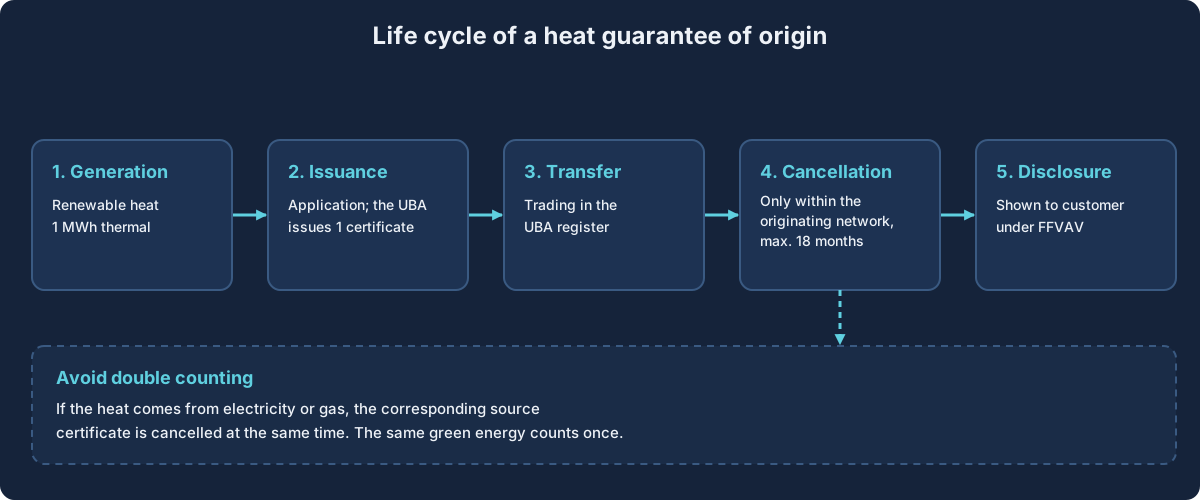
Eligible is thermal energy from renewable energy, from unavoidable waste heat and from thermal waste treatment in line with circular economy rules, governed by Section 28 GWKHV. The prerequisites are an account at the UBA and registration of the plant with its technical details. A certificate expires once more than 18 calendar months have passed since generation.
How the heat certificate differs from electricity and gas
The heat certificate is deliberately more tightly defined than its electricity and gas counterparts. It may only be cancelled within the district or local heating network where the generating plant is located. Cross-regional trade, as with green electricity, is ruled out because heat is physically tied to the network.
This link to the originating network ties the certificate to real delivery. A green electricity certificate can be traded freely across borders, while a heat certificate stays where the heat physically flows. If the heat comes from electricity or gas, for example from a large heat pump or a heating plant, the corresponding source certificate must be cancelled at the same time. That way the same green energy does not count twice.
- Cancellation only in the originating network, no free cross-regional trade.
- Double marketing ruled out: the source certificate for electricity or gas is cancelled along with it.
- Interfaces to existing systems such as Nabisy, the biogas register and the Union Database have to be clarified so volumes are not counted more than once.
The other two registers follow their own logic. How the gas and hydrogen register works is covered in the piece on guarantees of origin for gas and hydrogen. The electricity market with the HkRNDV amendment and electricity labelling is described in the piece on guarantees of origin for electricity.
New sales opportunities for district heating
For municipal utilities and district heating operators the register opens a new sales channel. They can disclose heat from renewable energy transparently and sell it as a green product, instead of only naming a blanket generation mix. Industrial customers increasingly need such reliable evidence for their ESG reporting.

Under Section 34 GWKHV, operators may market heat with properties that differ from the system-wide mix, as long as existing customer contracts and the statutory decarbonisation targets are met. That lets a premium product from geothermal energy or waste heat be separated from a basic product and helps finance the rebuild of generation.
The market is large. Around 3,800 heat networks with more than 31,000 kilometres of pipe supply roughly 14 percent of households, about 6 million dwellings. 30 percent of district heating generation already comes from renewable energy and unavoidable waste heat. Biogenic waste contributes around 10.2 terawatt-hours, biogas and biomethane together around 5.2 terawatt-hours. For these volumes the register creates a single, auditable record for the first time.
The link to the FFVAV and heat planning
The register does not stand alone but fits into the transparency obligations of district heating. Under the FFVAV, suppliers already have to disclose the share of renewable energy and the primary energy factor of their heat system, on the website and on bills. The guarantee of origin becomes a possible, not always mandatory, means of proof for this.
If suppliers commit to a customer for a specific share of renewable energy, that has to be evidenced through guarantees of origin. This matches the decarbonisation roadmaps under the Heat Planning Act, which require heat networks to reach at least 30 percent renewable heat by 2030 and 80 percent by 2040. The digital capture of these volumes connects metering, billing and sales in a single data flow.
What the transparency and metering obligations look like in detail is shown in the pieces on the FFVAV and remote-readable heat meters, on price adjustment under the AVBFernwärmeV and on municipal heat planning.
Challenges and risks
The register solves no decarbonisation problem on its own. It makes green heat visible and marketable but does not replace the actual rebuild of generation. On top of that comes a noticeable administrative effort in data capture.

Real decarbonisation of the heat network remains unavoidable even with the register, since the certificate alone cuts no emissions. Operators have to adapt data capture, reporting formats and metering processes, which ties up staff and IT. The narrow cancellation rule limits the market: a certificate from one network has no value for another. And the boundaries with Nabisy, the biogas register and the Union Database are still partly to be clarified.
The register is a sales and transparency tool, not a climate instrument in itself. Whoever uses it as evidence for green heat they are building anyway will gain. Whoever hopes to paper over missing decarbonisation is mistaken, because the mandatory shares under the Heat Planning Act apply regardless of the certificate.
What operators should do now
Operators should use the time until launch to prepare data and processes. Whoever has generation volumes, sources and metering data digitised cleanly can set up the account, plant registration and applications without friction.
Four priority steps
-
Inventory generation and metering points
Record all generation plants and metering points and document the thermal volumes per plant reliably. This is the basis for every later application and decides the data quality in the register.
-
Connect the certificate process to the systems
Connect application, issuance and cancellation to existing metering and billing systems and automate them as far as possible. Manual capture does not scale across many plants and supply relationships.
-
Rule out double counting at system level
For heat from electricity or gas, cancel the source certificates consistently. A clean link between the registers in your own system prevents the same green energy from being marketed twice.
-
Align sales with green products
Define green heat products early and plan for the ESG requirements of industrial customers. That way sales is ready as soon as the register issues certificates.
The heat guarantee of origin does not stand alone. It complements the registers for gas and hydrogen and for electricity, builds on the metering obligations of the FFVAV and feeds into the same planning as municipal heat planning.
Further reading
Frequently asked questions
It is a digital register at Germany's environment agency (UBA) that makes green heat and cooling verifiable from 2026. For each megawatt-hour of thermal energy generated from renewable sources, unavoidable waste heat or thermal waste treatment, the UBA issues an electronic guarantee of origin on application by the plant operator. The legal basis is the HkNRG and the GWKHV. It lets suppliers prove to customers which source a delivered amount of heat comes from.
The launch at the environment agency is planned for 2026. The legal basis is already in place: the Guarantees of Origin Register Act has applied since 2023, and the Gas, Heat and Cooling Guarantees of Origin Register Ordinance since 1 May 2024. The exact start date is announced in the Federal Gazette. The UBA is building the register technically, and a final report on the implementation was published in March 2026.
A heat guarantee of origin may only be cancelled within the district or local heating network where the generating plant is located. Because heat is physically tied to the network, there is no cross-regional trade as with green electricity. A certificate also expires 18 months after generation. If the heat comes from electricity or gas, the source certificate must be cancelled at the same time so the same green energy does not count twice.
Under the FFVAV, suppliers must disclose the share of renewable energy and the primary energy factor of their heat system, on the website and on bills. If they commit to a customer for a specific renewable share, that has to be evidenced through guarantees of origin. The register is a possible, not always mandatory, means of proof, but it creates a single, auditable record.
Municipal utilities and district heating operators can disclose heat from renewable energy transparently and sell it as a green product, instead of only naming a blanket generation mix. Under Section 34 GWKHV, products are possible whose properties differ from the system-wide mix. Industrial customers increasingly need such evidence for their ESG reporting. The register does not replace the actual decarbonisation of the network, though.