
The section 32 WPG decarbonisation roadmap: a duty for heat-network operators by end 2026
This is a practical analysis of the section 32 WPG duty for heat-network operators and of what it means for utilities, industry and municipalities: who is covered and by when, which targets the roadmap must evidence, what Annex 3 WPG requires it to contain, how the duty relates to a funded BEW transformation plan, where the challenges and risks lie, and what operators should do now. It is deliberately separate from municipal heat planning, which is the municipality's own coordination process, from the AI-driven network optimization of district heating, and from the generation technology, the large heat pumps and power-to-heat plants that deliver the green shares, both of which are referenced once where the roadmap connects to them.
The section 32 duty is the operator-side half of the heat transition law. The Heat Planning Act, the Wärmeplanungsgesetz (WPG), full name the Act on Heat Planning and the Decarbonisation of Heat Networks, has been in force since 1 January 2024, and under section 32 WPG every operator of an existing heat network that is not already supplied entirely from renewables or unavoidable waste heat must draw up a heat-network expansion and decarbonisation roadmap (Wärmenetzausbau- und -dekarbonisierungsfahrplan) by 31 December 2026, submit it to the authority designated by the Land under section 33(5) WPG and publish it on its own website. Networks up to one kilometre long are exempt (section 32(1)), the roadmap must be reviewed at least every five years, and this is a regulatory duty of the operator, distinct from municipal heat planning. The targets under section 29 WPG require at least 30 percent of annual net heat generation from renewables and unavoidable waste heat from 1 January 2030, at least 80 percent from 1 January 2040 and full greenhouse-gas neutrality by 2045 under section 1 WPG; the nationwide average green share should reach 50 percent already from 2030. Deadline extensions to 31 December 2034 or 31 December 2044 are possible in defined cases, with notification by the end of 2026. Annex 3 WPG sets the minimum content: an inventory, a potential analysis, a development path to 2045 with green shares for the milestone years 2030, 2035, 2040 and 2045, the measures and the economics. Under section 32(2) WPG the duty lapses if a BEW Module 1 application was filed by 31 December 2025 or a BEW Module 2 transformation plan was approved by BAFA by 31 December 2026; the practical industry deadline for the funded route is 31 March 2026, and a BEW transformation plan satisfies the Annex 3 content. The starting point is low: renewables accounted for only 21.9 percent of district-heat generation in 2024 (AGFW), and there is no direct fine, only indirect consequences through the customers' right to disconnect and through loss of funding. Germany has about 3,800 heat networks, over 31,000 kilometres of network, and about 14 percent of households on district heating.
What section 32 requires: the duty for existing networks
The Heat Planning Act obliges not only municipalities to plan but also the operators of existing heat networks to transform them. Under section 32 WPG, every operator of an existing network that is not already supplied entirely from renewables or unavoidable waste heat (the Abwärme) must draw up a heat-network expansion and decarbonisation roadmap (a Wärmenetzausbau- und -dekarbonisierungsfahrplan) by the end of 31 December 2026. This is a regulatory duty, not a funding offer, and it applies to the network itself rather than to the wider city.
The addressee is the operator of the individual network, not the municipality. That is the central distinction from municipal heat planning, which is the separate coordination process the municipality runs to zone its area into prospective heat supply categories. The operator roadmap is a transformation plan for one concrete existing network, and the two processes have to mesh, but they are different duties owed by different actors. The WPG itself has been in force since 1 January 2024, so the clock has been running on both.
The roadmap is not an internal study. It has to be submitted to the authority that each Land designates by ordinance under section 33(5) WPG, and it has to be published on the operator's own website, which turns it into a public commitment that customers, investors and the municipality can read. The operator must also review the roadmap at least every five years and update it where needed, so it is a living document rather than a one-off filing.
Two limits define the scope. Networks up to one kilometre long are exempt from the duty under section 32(1), and pure industrial process-heat networks are likewise outside it. A network that is already supplied entirely from renewables or unavoidable waste heat needs no roadmap, because it has nothing left to decarbonise. Everyone else, which in practice means the large majority of Germany's existing heat networks, is in scope and on the same deadline.
The targets behind it: 30 percent by 2030, 80 percent by 2040, climate-neutral by 2045
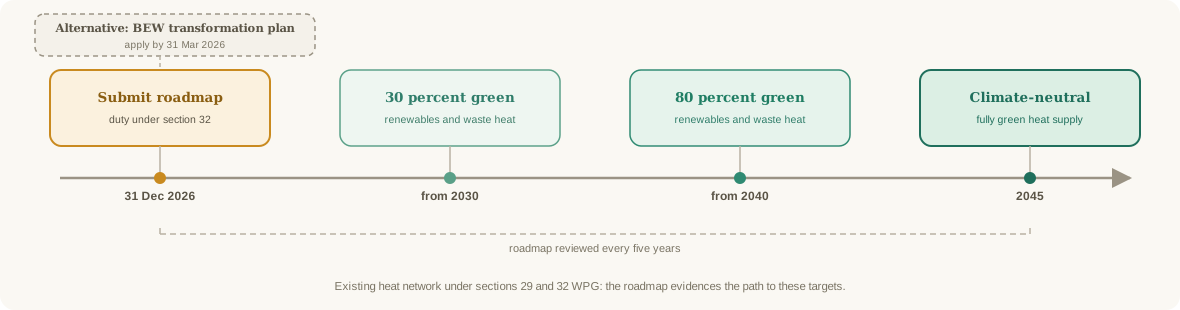
The roadmap is not an end in itself: it has to evidence how the network reaches the statutory minimum shares. Section 29 WPG sets staged quotas for existing networks, and section 1 WPG sets the overarching goal of greenhouse-gas neutrality by 2045. From 1 January 2030, at least 30 percent of the annual net heat generation must come from renewables, unavoidable waste heat or a combination of the two. From 1 January 2040, that share rises to at least 80 percent.
By 2045 the heat supply has to be fully greenhouse-gas neutral under section 1 WPG. Alongside the per-network quotas, the law sets a nationwide steering signal: the average green share across all networks should already reach 50 percent from 2030. That average is more ambitious than the individual 30 percent floor, which is the point: leading networks are expected to move faster so the system as a whole stays on the 2045 trajectory. The diagram below sets out the statutory timeline from the 2026 roadmap to climate neutrality in 2045.
The targets are not absolutely rigid. Deadline extensions are possible where the path is genuinely hard, for instance because of complex permitting, mining or water law, or investments from EUR 150 million, in which case the milestones can move to 31 December 2034 or 31 December 2044. The catch is that the operator has to notify the extension by the end of 2026, the same deadline as the roadmap itself, so the option has to be assessed now rather than later. There are also exemptions for pure industrial process-heat networks.
One boundary matters for the scope of this duty. New networks that start operating from 1 March 2025 do not fall under the existing-network regime at all: they are governed by section 30 WPG, which requires at least 65 percent of heat from renewables and unavoidable waste heat from the very start. That is a different and stricter rule, and it is worth keeping the two apart when reading the law, because the 30 percent floor discussed here applies only to networks that already existed.
What the roadmap must contain: the Annex 3 requirements
Annex 3 WPG lays down the minimum content of the roadmap in detail. The operator has to show transparently that the planned network development is consistent with the statutory targets and with the municipal heat planning, and the document runs from a hard look at the present state to a credible exit path from fossil plant. It is a data-intensive plan, which is why the data base is often the hardest part of the work.
The roadmap opens with an inventory. This covers the precise boundary of the network, spatially resolved heat-sales data for the last three years, the operating mode (energy carriers, temperature curves, hydraulics) and an energy and greenhouse-gas balance. On that foundation comes the potential analysis: a spatially resolved picture of the available potential from renewables, unavoidable waste heat, combined heat and power (CHP) and heat storage, which is where the question of what a given network could realistically draw on is answered.

The core of the document is the development path to 2045. Here the operator has to set out generation-portfolio scenarios and green shares for the milestone years 2030, 2035, 2040 and 2045, together with the planned phase-out of fossil-fired plant. This is the part that makes the abstract targets concrete for one specific network, and it is the part that depends most heavily on the generation technology that supplies the green heat, the large heat pumps and power-to-heat plants covered separately in the analysis of power-to-heat and large heat pumps for district heating.
Two further blocks complete the content. The measures section gives a plant-by-plant technical description of the network expansion and conversion works, with the next four years described in detail. The economics section sets out the projected investments, the energy and greenhouse-gas emissions saved, and the expected development of heat-generation costs and end-customer prices, so that the plan is not only technically coherent but also financially legible to the authority and to customers.
Duty or funding: the relationship to the BEW
An operator who produces a funded BEW transformation plan thereby satisfies the WPG duty. This is the economically attractive route, because the BEW, the Federal Funding for Efficient Heat Networks, the Bundesförderung für effiziente Wärmenetze, subsidises the transformation planning at about 50 percent and opens the door to investment funding. The deadline for the funded variant, however, sits earlier than the statutory roadmap deadline, which is the trap many operators are about to walk into.
Section 32(2) WPG spells out the substitution. The duty lapses if a BEW Module 1 application was filed by 31 December 2025 or a BEW Module 2 transformation plan was approved by BAFA by 31 December 2026. Because a Module 2 approval by the end of 2026 requires the application and the planning to be done well before that, the industry treats 31 March 2026 as the practical application deadline for networks that have not yet filed a Module 1 application (averdung, ENERKO). After that, the roadmap is in practice a purely regulatory duty and no longer eligible for funding.
The funding itself is substantial. The BEW grants about 50 percent for the transformation planning (Module 1), up to 40 percent for investments (Modules 2 and 3) and operating-cost support (Module 4). Crucially, the content lines up: a BEW transformation plan, with its inventory analysis, target state and four-year measure packages, satisfies the Annex 3 requirements, so an operator does not produce two separate documents but uses the funded plan to discharge the legal duty.
The reason the timing is so tight is the lead time, which is easy to underestimate. The operator has to prepare the application, wait for BAFA processing and then allow up to twelve months to produce the plan, and no funded planning may begin before approval. Working back from a Module 2 approval by the end of 2026, an operator who has not yet started is already close to the limit, which is why the BEW route has to be decided now rather than treated as a question for next year.
Challenges and risks
The starting point is demanding and the legal pressure mechanism is weak. District heating reaches about 14 percent of German households, but renewables accounted for only 21.9 percent of district-heat generation in 2024 (AGFW, Gebäudereport 2026). From that base, every individual network has to reach 30 percent by 2030, which is a steep gradient for operators still running largely on fossil fuels and CHP.
There is no direct sanction for a missing roadmap. The fine provisions foreseen in the draft, draft section 31, were dropped from the final law, a deletion the BEE (the German renewable energy federation) criticised on the grounds that duties without consequence lose their force. The pressure that remains is indirect: customers gain a right to disconnect from the network under section 29 if the targets are missed, and the funded route under the BEW is lost. For an operator, the loss of customers and of subsidy is a sharper threat than any penalty figure would have been, but it is a slower and less certain one.
The second cluster of risk is data and resources. The load-profile data, the energy and emissions balances and the generation-portfolio scenarios to 2045 demand a clean data base and planning capacity that many smaller municipal utilities simply do not hold in-house. This is precisely where digital network models and AI-supported scenario analysis change the economics of compliance, by turning a year-long manual exercise into a repeatable, data-driven one, but the gap is real for operators starting from spreadsheets.
Two further constraints compound the squeeze. The BEW funding pot is limited in both volume and lifetime, and the 31 March 2026 cut-off sharpens the competition for both consultancy capacity and grant money. And the operator roadmap depends on the municipal heat planning it has to be coordinated with, which in many places is not yet final, so operators are being asked to commit to a network development path while a key input is still moving.
What operators should do now
The first step is to plan backwards from the deadline and to test the funded route as a priority. An operator that wants the BEW path has, in practice, only until spring 2026 to file the application, so the very first task is to clarify whether the duty applies at all: check the network length and the supply status, because a network under one kilometre or one already supplied entirely from renewables carries no duty.
For networks that are in scope, the BEW application is the decisive lever. It is worth checking and filing the BEW application by 31 March 2026 to combine funding with discharge of the legal duty, rather than ending up on the unfunded regulatory route by default. In parallel, the operator should build the data base: consolidate the heat-sales, generation and emissions data of the last three years, the area where digital network models and AI-supported scenario analysis pay back fastest.

The third step is coordination with the municipality. The operator roadmap has to dovetail with the ongoing municipal heat planning to avoid duplicated work and contradictory assumptions, so the two processes should share data and milestones rather than run in parallel ignorance of each other. The final step is to prepare the publication: the finished roadmap has to be published on the operator's own website, which means it needs to be a presentable, consistent document, not an internal working file dressed up at the last minute.
One delimitation is worth keeping in view throughout. The operator roadmap concerns the heat network; the parallel question of where the gas distribution grid is wound down is decided by a different instrument under different law, set out in the analysis of the gas distribution grids' transformation plan. Keeping the two networks and their two planning regimes distinct avoids the most common confusion in a utility's heat-transition roadmap.
Further reading
Frequently asked questions
Every operator of an existing heat network that is not already supplied entirely from renewables or unavoidable waste heat must draw up a heat-network expansion and decarbonisation roadmap under section 32 WPG. The addressee is the operator of the individual network, not the municipality, which makes this distinct from municipal heat planning. Networks up to one kilometre long are exempt under section 32(1), as are pure industrial process-heat networks. The duty arises from the Heat Planning Act, the Wärmeplanungsgesetz (WPG), in force since 1 January 2024.
The roadmap must be drawn up by 31 December 2026, submitted to the authority designated by the Land under section 33(5) WPG and published on the operator's own website. It must then be reviewed at least every five years and updated where needed. Deadline extensions to 31 December 2034 or 31 December 2044 are possible in defined cases, for example complex permitting, mining or water law, or investments from EUR 150 million, but the operator must notify the extension by the end of 2026.
The roadmap must evidence the path to the targets of section 29 WPG: at least 30 percent of annual net heat generation from renewables and unavoidable waste heat from 1 January 2030, at least 80 percent from 1 January 2040, and full greenhouse-gas neutrality by 2045 under section 1 WPG. The nationwide average green share should reach 50 percent already from 2030. New networks that start operating from 1 March 2025 fall under section 30 WPG, which requires at least 65 percent from the start, a different rule from the duty on existing networks.
Yes. Under section 32(2) WPG the duty lapses if a BEW Module 1 application was filed by 31 December 2025 or a BEW Module 2 transformation plan was approved by BAFA by 31 December 2026. A BEW transformation plan, with its inventory analysis, target state and four-year measure packages, satisfies the Annex 3 content. The BEW, the Federal Funding for Efficient Heat Networks, the Bundesförderung für effiziente Wärmenetze, funds the transformation planning at about 50 percent and investments up to 40 percent. The practical industry deadline for the funded route is 31 March 2026, because no funded planning may begin before approval and BAFA processing plus production can take up to twelve months.
The WPG provides no direct fine for a missing roadmap. The fine provisions foreseen in the draft, draft section 31, were dropped, which the BEE criticised because duties without consequence lose force. The indirect consequences still bite: customers gain a right to disconnect from the network under section 29 if the targets are missed, and the funded route under the BEW is lost. The roadmap also remains a binding regulatory duty, so a missing roadmap is a continuing breach of the WPG even without a penalty figure attached.