
energy data-X: results of the Gaia-X lighthouse project and the transfer into practice 2025/2026
What did the government-funded Gaia-X lighthouse project actually deliver, and how does it move from the lab into grid operation? This article frames the consortium, the two use cases and the architecture, shows the 2025 results and the path through the successor project DataFleX. The European framework above it is covered in the piece on the European energy data space CEEDS, the process side in the piece on Redispatch 3.0 in congestion management.
energy data-X is the Gaia-X lighthouse project of the German energy sector. Led by transmission system operator TenneT, a consortium of 18 partners is building a sovereign data space where data stays with its owner and is only shared through protected connectors. The federal government funds the project under the 7th Energy Research Programme; it started on 4 October 2023 with a three-year term. Two use cases are central. The first integrates the smart meter gateway so that deviations between planned and actual feed-in become visible in near real time. Today such a deviation is only attributed to the party responsible weeks later; in future the balancing group manager can react immediately and save costly balancing energy. The second taps decentralised flexibility from charging points, battery storage and heat pumps to stabilise the grid. The core is an architecture choice: no central data silo, but federated services with identity and trust procedures based on Gaia-X and International Data Spaces. In 2025 there is no finished product, but a proven building block. The transfer into practice runs along two strands: the smart meter gateway becomes a direct control channel, broadly usable from mid-2026, and the successor project DataFleX moves the infrastructure into redispatch with decentralised flexibilities from November 2025. For grid operators and suppliers, energy data-X is therefore less a product than a direction for their own data architecture.
What energy data-X is and why it became a lighthouse
energy data-X is the Gaia-X lighthouse project of the German energy sector. The goal sounds abstract, but it is not: a sovereign data space in which generators, grid operators, suppliers and flexibility providers exchange readings without giving up control over their data. The federal government funds the project under the 7th Energy Research Programme; it was selected in the Gaia-X funding competition of the Federal Ministry for Economic Affairs.
The project rests on a broad consortium. The consortium is led by transmission system operator TenneT, with 18 interdisciplinary partners in total, from grid operators through IT companies to standardisation.
The circle includes Amprion, Power Plus Communications, Spherity, Schneider Electric, the DKE within VDE and the Fraunhofer institutes IEE and IOSB-AST, among others. Further grid operators on board are 50Hertz, TransnetBW, EWE NETZ and Westnetz, alongside technology and software partners such as Siemens, Microsoft and the International Data Spaces Association. That mix is deliberate: a data space only works when data providers, data consumers and standardisation sit at the same table.
The two use cases: smart meter gateway and decentralised flexibility
energy data-X tests the data space on two concrete cases, not on an abstract model. Both target the same problem, which grows more expensive with every new decentralised asset: missing, late or unshareable metering data.

The first use case integrates the smart meter gateway into the data space. That makes deviations between planned and actual feed-in or withdrawal visible in near real time. This is the real advance. Today such a deviation is often only attributed to the party responsible weeks later, when billing is long under way. In future the balancing group manager sees it immediately and can react before costly balancing energy accrues. How strongly this item drives costs is shown in the piece on AI-supported balancing group management and imbalance energy.
The second use case reaches deeper into the field. It taps decentralised flexibility from charging points, battery storage in electric vehicles and heat pumps. These distributed sources are meant to stabilise the grid while dispatchable power plants disappear and weather-dependent generation dominates. The data space is the precondition: without reliable, sovereign exchange of the asset data, every flexibility stays a promise on paper.
The architecture: a sovereign data space instead of a central platform
The core of energy data-X is an architecture choice. Instead of a central platform that collects all data, each data set stays with its owner. Only what has been agreed is shared, and only over secured connections. That sounds technical, but it has a concrete consequence: no operator has to hand raw data to a third party to take part in the exchange.
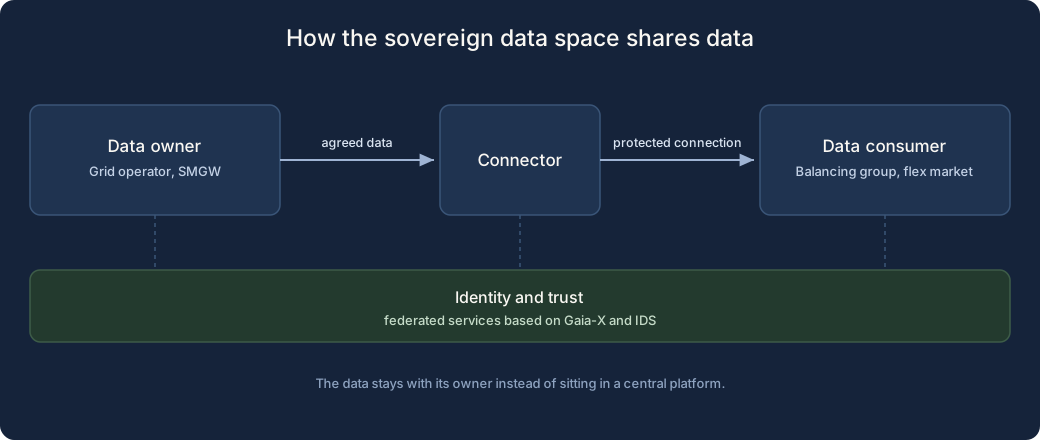
The services of the data space are federated, that is decentralised and jointly provided by many actors. An identity and trust procedure ensures that only known and trustworthy participants have access. Access itself runs through a connector that exchanges exactly the agreed scope over protected data connections.
This compatibility is not an end in itself. It decides whether a German data space later fits into the European energy data space or ends as an island. That is precisely why energy data-X relies on open building blocks rather than a proprietary in-house solution.
The 2025 results: from prototype to solid building block
By the end of the funding phase there is no finished product. What there is is worth more: a proven building block. energy data-X has shown that sovereign data exchange in the energy sector works technically and holds up on real use cases, not only on the slide.
- The data space prototype connects the two use cases with the connector and identity services into a working whole.
- The smart meter gateway integration provides the data basis to spot balancing deviations early, instead of only seeing them in billing.
- Standardisation through the DKE and the reliance on International Data Spaces connectors secure transferability to other actors.
- The prototype is deliberately built so that it does not stay in the lab but can be moved into follow-up projects and regular operation.
The last point is the decisive one. Many research projects end with a report. energy data-X ends with an infrastructure that gets reused, and that is exactly what separates a lighthouse from a finger exercise.
Transfer into practice 2025/2026: SMGW direct control and DataFleX
The real test comes after the funding. In 2025 and 2026 the ideas from energy data-X move into two visible strands: the smart meter gateway as a direct control channel and the successor project DataFleX.

The first strand turns the smart meter gateway into a control channel. Bayernwerk Netz and project partner Power Plus Communications showed in September and October 2025 that PV systems, wallboxes and storage can be controlled directly through the gateway, without a separate control box. The success rate was 99.63 percent across 1,100 control commands. Certification of the software stack at the gateway manufacturers begins in early 2026, and the function becomes broadly usable from mid-2026. The regulatory frame for this is covered in the piece on the control box and grid control under Section 14a EnWG.
The second strand is DataFleX. The successor project started in November 2025 under the lead of TenneT, with TransnetBW, Avacon Netz, Siemens and several Fraunhofer institutes. DataFleX links the energy data-X infrastructure with Catena-X and tests redispatch using decentralised flexibilities, with more than 1 megawatt aggregated across several thousand assets in the pilot. At 18 months and more than 7 million euros in funding, this is no longer a lab trial but the step toward regular operation.
What grid operators, utilities and suppliers should do now
For practice, energy data-X is less a product than a direction. Anyone building data processes today should lay them out to fit the sovereign data space, instead of rebuilding them later. Four steps make the difference.
- Rely on connector standards: align data exchange with connector and identity standards instead of building new central data silos that later have to be adapted to the data space logic.
- Prepare the gateway for control: get smart meter gateway processes into shape early for the control function that becomes broadly available from mid-2026, so direct control without a separate control box is usable.
- Treat flexibility as a good: think of flexibility from charging points, storage and heat pumps as a tradable good in the portfolio, not a footnote, because this is where the next value contribution arises.
- Check the link to Europe: test compatibility with the European energy data space so that German solutions do not run past the EU framework and have to be retrofitted at cost.
Further information
Frequently asked questions
energy data-X is the Gaia-X lighthouse project of the German energy sector. Its goal is a sovereign, decentralised data space in which generators, grid operators, suppliers and flexibility providers exchange readings without giving up control over their data. The consortium is led by transmission system operator TenneT and has 18 partners in total. It is funded by the Federal Ministry for Economic Affairs under the 7th Energy Research Programme, started on 4 October 2023 with a three-year term.
Two use cases are central. The first integrates the smart meter gateway into the data space so that deviations between planned and actual feed-in or withdrawal become visible in near real time. Today a deviation is only attributed to the party responsible weeks later; in future the balancing group manager can react immediately and save balancing energy. The second taps decentralised flexibility from charging points, battery storage in electric vehicles and heat pumps to stabilise the grid.
Instead of a central platform that collects all data, each data set stays with its owner. Only what has been agreed is shared, and only through a connector with a protected data connection. An identity and trust procedure ensures that only known participants have access. The technical basis is the principles of Gaia-X and International Data Spaces, so the data space stays compatible with the European framework.
DataFleX is the successor project that moves the results of energy data-X into grid operation. It started in November 2025 under the lead of TenneT, with partners such as TransnetBW, Avacon Netz, Siemens and several Fraunhofer institutes. DataFleX links the energy data-X infrastructure with Catena-X and tests redispatch using decentralised flexibilities, with more than 1 megawatt aggregated across several thousand assets in the pilot. The term is 18 months and funding is more than 7 million euros.
Align data exchange with connector and identity standards instead of building new central data silos. Prepare smart meter gateway processes early for the control function that becomes broadly available from mid-2026. Treat flexibility from charging points, storage and heat pumps as a tradable good in the portfolio. And check compatibility with the European energy data space so that German solutions do not run past the EU framework.