The Common European Energy Data Space (CEEDS)
This article explains the energy data space: why it is gaining momentum now, how it is built as a federated model, what the interoperability rules require, how Germany works with dena-ENDA and Redispatch 3.0, where the risks of fragmentation and data sovereignty lie, and what utilities should do now.
The Common European Energy Data Space (CEEDS) is a federated framework that makes energy data shareable across borders and market roles without storing it centrally. National and regional data spaces stay independent and are connected through a shared trust framework, a vocabulary hub, a data catalogue and a contract framework. On 3 June 2026 the European Commission presented the Strategic Roadmap for Digitalisation and AI in the Energy Sector, part of the European Technological Sovereignty Package, which anchors CEEDS as a central building block and governance framework. 14 European industry associations signed a cooperation declaration. The economic lever is large: demand-side flexibility based on shared data can save consumers around 71 billion euros per year according to the Commission, and AI-driven operational optimisation in industry around 94 billion euros per year by 2035. In parallel the EU is setting binding interoperability rules: Implementing Regulation (EU) 2023/1162 provides a reference model, on which acts for supplier switching and demand response build. Germany is developing a reference architecture with the dena project ENDA, tested on the Redispatch 3.0 use case, where data stays decentralised with the producer. The biggest risk is fragmentation: if every sector and country builds its own standards and governance, high integration costs loom instead of an open market. For utilities this means treating the data space as an architecture project, comparing their own data holdings against the reference model early, and clarifying the trust and contract framework early.
Why the energy data space is gaining momentum
The Common European Energy Data Space aims to make energy data shareable across borders and market roles without storing it centrally. With the Strategic Roadmap for Digitalisation and AI in the Energy Sector of 3 June 2026, the European Commission turned the project from a blueprint idea into a framework for action. For the energy transition this is a key piece, because decentralised generation, flexibility and sector coupling only work when data flows between many actors.
The roadmap belongs to the European Technological Sovereignty Package and names three thrusts. Data centres should be integrated sustainably into the energy system. Digital and AI solutions in the grid should reach scale faster. And there needs to be a framework for secure, cross-border data sharing.
- 14 European industry associations signed a cooperation declaration on 3 June 2026, and the AI.grids Community of Practice for AI models in grid operation was launched alongside it.
- The background is the EU action plan on digitalising the energy system from 2022, which first named the energy data space as a concrete objective.
- The economic lever is large: demand-side flexibility can save consumers around 71 billion euros per year according to the Commission, with a possible reduction in electricity costs of up to 64 percent.
How the data space is built
CEEDS is not a central data store but a federated framework that connects existing data spaces at national, regional and international level, such as the heat planning data space from the WPG amendment. The Blueprint version 2.0 of July 2024 describes the shared building blocks that all participants use. Data stays with its owner and is shared on a rule-based basis, which lowers access for new actors such as start-ups and municipalities.
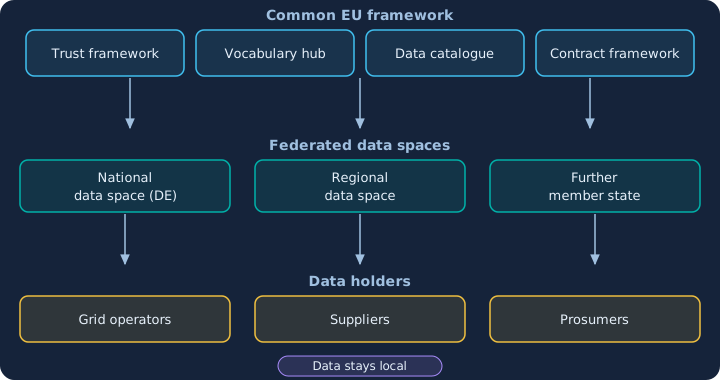
The shared building blocks are manageable. A trust framework governs identity and access, the same principle the dena project tested for digital identities in the energy system at the level of individual plants. A usage log records who used which data. A vocabulary hub keeps terms consistent, a contract framework sets the terms of use, and a catalogue lists the available data products. Technically these blocks build on open frameworks such as the Gaia-X Trust Framework and the IDSA Rulebook, the same foundations used by the German Gaia-X lighthouse project energy data-X.
The build-out is carried by the Digital Europe Programme, supported by the Data Space Support Centre and shared tools such as the Simpl software. The aim is to stop every data space from reinventing the wheel.
Interoperability as the hard core
Alongside the data space, the EU is setting binding interoperability rules for data exchange. Implementing Regulation (EU) 2023/1162 provides a reference model with a role, information and process model. On top of it sit sectoral implementing acts that regulate the concrete data exchange for supplier switching and demand response.
The data space provides the infrastructure, the implementing acts provide the binding rules. Only both together turn shared data into a working market.
- The first implementing act concerns data for customer switching, with the goal of enabling the technical supplier switch within 24 hours by 2026. The basis is Article 12(1) of the EU Electricity Directive.
- A second act for demand-response data is in preparation. The draft was expected for December 2025 and must fit the revised Network Code on Demand Response.
- A repository of national data management models has been online since July 2025 and already maps more than twelve member states.
Germany's switch from EDIFACT to API-based processes in market communication shows how much work sits behind such rules. How this switch plays out in the German market is covered in the piece on MaKo 2026 and the EDIFACT-to-API migration .
German perspective: dena-ENDA and Redispatch 3.0
Germany is working with the dena project ENDA on a national reference architecture that is meant to fit into CEEDS. It is tested on the Redispatch 3.0 use case, a further development of the Redispatch 2.0 processes. The core idea: data stays with the producer and is shared in a sovereign, traceable way rather than collected in central platforms.

The German energy data space relies on secure, sovereign and standardised exchange without central storage, with clear rules and technical traceability. Fraunhofer and dena examined the reference architecture and described sovereign data exchange as the precondition for new market participants to gain access at all.
- National regulation such as the Energy Industry Act, the law on digitalising the energy transition and the smart meter rollout provide the data sources that a data space makes usable in the first place.
- The Redispatch 3.0 use case clarifies technical questions on a concrete process rather than an abstract model. How market-based congestion management works is shown in the piece on Redispatch 3.0 .
- The German transposition of EU law through the Energy Industry Act forms the legal frame, see the piece on the Energy Industry Act amendment 2026 .
Challenges and risks
The biggest risk factor is fragmentation. Every sector and many countries build their own data spaces with their own standards, connectors and governance rules. Without alignment, high integration costs and new dependencies loom instead of an open market.

A lack of alignment across data models, ontologies and governance creates friction, especially when connecting legacy systems in the large European stock of installations. Added to that is the question of data sovereignty, which must be secured for all participants.
- Fragmentation: If data spaces are organised in silos, users have to operate different solutions. That raises integration costs and favours dominant market positions.
- Data sovereignty: Data providers need control and transparency over what happens to their data, data consumers must be able to trust source and provider.
- Young governance: The strategic framework is still emerging, and many implementing acts are still in the process. Binding force and timelines remain partly open.
- Cybersecurity: With every shared data stream the attack surface grows. The requirements from NIS2 and the BSI rules also apply in the data space, see the piece on the NIS2 and KRITIS umbrella law .
What utilities should do now
Utilities and grid operators should treat the data space as an architecture project, not a pure compliance topic. Those who align their data models with the reference framework early lower later integration costs and can offer new services faster. Three steps are the priority.
Three priority steps
-
Compare data holdings against the reference model
Inventory your own data holdings and compare them against the role, information and process model of Implementing Regulation (EU) 2023/1162. That shows where formats and roles already fit and where changes are needed.
-
Take part in pilot projects
Work in national pilots such as dena-ENDA and test use cases such as redispatch and flexibility concretely. In a real process, technical questions resolve faster than in theory.
-
Clarify the trust and contract framework early
Define early who may use which data for what purpose and how that is proven technically. Data sovereignty is the core of the federated model, not a later add-on.
The data space does not stand alone. It ties into the same digitalisation as the smart meter rollout , which delivers the measurement data a data space draws its value from. Grid side, market side and customer side only add up to a full picture together.
Further reading
Frequently asked questions
The Common European Energy Data Space (CEEDS) is a federated framework that makes energy data shareable across borders and market roles without storing it centrally. National and regional data spaces stay independent and are connected through a shared trust framework, a vocabulary hub, a data catalogue and a contract framework. The data stays with its owner and is shared on a rule-based basis.
On 3 June 2026 the European Commission presented the Strategic Roadmap for Digitalisation and AI in the Energy Sector, part of the European Technological Sovereignty Package. The roadmap anchors CEEDS as a central building block and governance framework and names three thrusts: sustainable integration of data centres, faster rollout of digital and AI solutions in the grid, and frameworks for cross-border data sharing. 14 European industry associations signed a cooperation declaration.
No. CEEDS is not a central data store but a federated model. Data stays with its respective owner and is shared only on a rule-based and traceable basis. That lowers technical access barriers and lets new actors such as start-ups and municipalities take part in the market. The technical foundation rests on open frameworks such as the Gaia-X Trust Framework and the IDSA Rulebook.
dena-ENDA is a project of the German Energy Agency that develops a reference architecture for a national energy data space, tested on the Redispatch 3.0 use case. Data stays decentralised with the producer rather than in a central platform. This national architecture is meant to fit into the federated European framework of CEEDS.
Utilities should treat the data space as an architecture project, not a pure compliance topic. In concrete terms: inventory their own data holdings and compare them against the reference model of Implementing Regulation (EU) 2023/1162, take part in national pilots such as dena-ENDA, and clarify early who may use which data for what purpose and how that is proven technically.
Let's collaborate
One contact, a team behind it
Thirty minutes on what you're working on, whether grid, metering, market processes, IT architecture or AI. Afterwards you'll know how we'd approach it and who would sit at the table.
Energy and measurement technology since 2010 · innobu GmbH since 2014 · Based in Schleswig-Holstein, Germany
Whoever pitches also delivers: whoever leads the first call stays your contact right through to the steering committee, with established partners in the project. Direct: info@innobu.com