Emissions trading 2027 to 2029: six reporting and surrender deadlines under the BEHG, the TEHG and EU ETS 2
Germany's national fuel emissions trading under the BEHG runs a year longer than planned, because the EU moved the start of the surrender obligation in EU ETS 2 to 2028. Gas suppliers therefore report twice for every year up to and including 2027: to EU ETS 2 in April and under the BEHG in July. On 15 October 2026 the Bundestag voted to keep the national carbon price in a corridor of EUR 55 to 65 in 2027 as well.
The emissions trading deadlines for 2027 to 2029 are six statutory dates on which fuel suppliers and operators of combustion installations of 20 MW rated thermal input or more report their emissions to the German Emissions Trading Authority (DEHSt) and surrender allowances. For the year 2026, installation operators in EU ETS 1 report by 31 March 2027, gas suppliers report under EU ETS 2 by 30 April 2027 and under the BEHG by 31 July 2027; allowances under the TEHG and the BEHG are due by 30 September 2027. The BEHG duties still apply to fuels placed on the market in 2027; after that EU ETS 2 takes over, with the first surrender for 2028 due on 31 May 2029. A late or incorrect report is an administrative offence with fines of up to EUR 500,000; for every tonne without an allowance the DEHSt sets a payment, and the allowance must still be surrendered.
Six deadlines in three systems
Five of the six deadlines fall in 2027, spread over four days, and they follow no common logic: the installation report comes in March, the European fuel report in April, the national one in July, both surrenders at the end of September. A municipal utility that sells gas and runs a CHP plant of 20 MW or more therefore has five duties within six months, each of which needs verified data or allowances already bought. May 2029 brings the sixth, the first EU ETS 2 surrender. Its registry account and procurement route have to be settled in 2027.
| Date | Duty | Who | Source | Legal consequence |
|---|---|---|---|---|
| Wed, 31.03.2027, then annually | Determine 2026 emissions under the approved monitoring plan and submit a verified report | Operators of EU ETS 1 installations, such as CHP and heating plants of 20 MW total rated thermal input or more | Section 21(1), Section 5(2) TEHG | Fine of up to EUR 500,000 (Section 49(1) no. 1 and (7) TEHG) |
| Fri, 30.04.2027, then annually | Submit a verified report on the emissions of fuels placed on the market in 2026 (EU ETS 2) | Obligated entities under the TEHG, such as gas suppliers | Section 43(1), Section 5(2) TEHG | Fine of up to EUR 500,000 (Section 49(1) no. 1 and (7) TEHG) |
| Sat, 31.07.2027, last time in 2028 | Submit a verified report on 2026 fuel emissions (national emissions trading) | Obligated parties under the BEHG, such as gas suppliers | Section 7(1) and (3) BEHG | Fine of up to EUR 500,000, up to EUR 50,000 if negligent (Section 22 BEHG) |
| Thu, 30.09.2027, last time in 2028 | Surrender allowances matching the reported 2026 fuel emissions | Obligated parties under the BEHG | Section 8 BEHG | Payment per missing tonne (Section 21(1) BEHG), allowances still due |
| Thu, 30.09.2027, then annually | Surrender allowances matching 2026 emissions | Operators of EU ETS 1 installations | Section 7(1) TEHG | EUR 100 per tonne, indexed (Section 46 TEHG), allowances still due, name in the Federal Gazette |
| Thu, 31.05.2029, then annually | First surrender of allowances for 2028 emissions (EU ETS 2) | Obligated entities under the TEHG, such as suppliers of natural gas and heating oil | Art. 30k(2)(d) Directive 2003/87/EC with Art. 2 Regulation (EU) 2026/667; Section 7(2) TEHG | EUR 100 per tonne, indexed (Section 46 TEHG), allowances still due, name in the Federal Gazette |
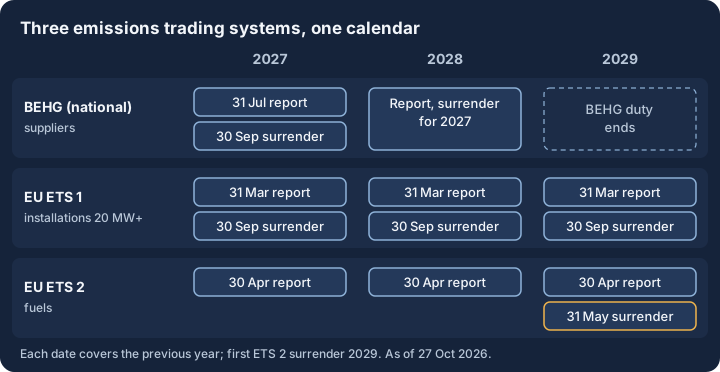
All of these dates recur every year, except the two BEHG dates, which come round once more: for fuels placed on the market in 2027, obligated parties report by 31 July 2028 and surrender by 30 September 2028. From reporting year 2028 the BEHG duties lapse for everything that is then subject to surrender in EU ETS 2.
Supplier or installation operator: who is obligated where
A municipal utility can sit in emissions trading twice, as a supplier through the fuel it sells and as an operator through its own stack. Each role has its own deadlines, its own registry and its own data, and they interlock as soon as the utility's own gas is burned in its own CHP plant.
For EU ETS 1 the installation is what counts: combustion units with a total rated thermal input of 20 MW or more (Annex 1 Part 2 no. 1 TEHG). A 12 MW heating plant is outside; it pays the carbon price through its gas bill, because its supplier surrenders allowances under the BEHG and, from 2028, under EU ETS 2. A 60 MW CHP plant is the reverse case: its operator surrenders allowances for the emissions at the stack itself.
So that the same tonne is not paid for twice, suppliers report separately the volumes they deliver to EU ETS 1 installations. Under Section 7(5), the BEHG requires such double burdens to be avoided in advance where possible, and the DEHSt's form management system has its own function for splitting off deliveries to EU ETS 1 installations. For a utility with both roles, gas billing should therefore carry the delivery to its own CHP plant as a separate item; otherwise the same volume ends up in both reports.
CHP plants in EU ETS 1: report by 31 March, surrender by 30 September
Operators of EU ETS 1 installations report their 2026 emissions by the end of 31 March 2027, a Wednesday, and surrender the matching number of allowances by Thursday, 30 September 2027. It rests on the approved monitoring plan (Section 21(1) TEHG). A verification body must have checked it (Section 5(2) TEHG).

Until the 2023 amendment of the Emissions Trading Directive the surrender date was 30 April; since then it has been 30 September, transposed in the 2025 TEHG. Report and surrender are therefore six months apart, and in that window the volume is known and only the timing of the purchase is open. For a CHP plant this is the part of the deadline that matters more: the DEHSt quotes a price of about EUR 80 per allowance on 30 June 2026, and an operator who buys the whole volume in September carries a summer's worth of price risk.
The DEHSt's VET report gives the scale: in 2025, 1,794 stationary installations in Germany had to report and surrender, with around 264 million tonnes of CO2 equivalent. Energy installations accounted for 167 million tonnes of that, almost 2 percent less than a year earlier, after two years with a combined fall of 30 percent.
EU ETS 2: report by 30 April, first surrender in 2029
Gas suppliers report the emissions of the fuels they placed on the market in 2026 by the end of 30 April 2027, a Friday, under their approved monitoring plan (Section 43(1) TEHG), and the report must be verified. For reporting year 2025 the DEHSt, in agreement with the Federal Environment Ministry, accepted reports until 31 May 2026; for reporting year 2026 its page (as of 14 July 2026) announces no such extension, so 30 April applies.
Obligated entities first surrender allowances in EU ETS 2 by 31 May 2029, for 2028 emissions. That date comes from the Emissions Trading Directive: Article 2 of Regulation (EU) 2026/667 postpones the operation of EU ETS 2 to 2028 and makes Article 30k(2)(a) to (e) of the Directive apply by analogy, and point (d) extends the deadline for the first surrender for 2028 "until 31 May 2029". The wording of Section 7(2) of the German TEHG ("from 1 January 2028 annually by 31 May") has not been adjusted to the postponement. According to the DEHSt, the postponement applies directly in Germany, and it names 31 May 2029 as the first surrender date.
EU ETS 2 allowances are auctioned on the EEX from 18 January 2027, on Mondays, Tuesdays and Thursdays from 13:00 to 15:00 (early auctions under Delegated Regulation (EU) 2026/787). Only holders of a Union Registry account can bid. Accounts from the national registry move over in batches on several cut-off dates; the first cut-off for the migration form is Monday, 2 November 2026.
Unlike the BEHG, EU ETS 2 has neither a fixed price nor a price corridor. There will be no set price ceiling, the DEHSt states explicitly; the market stability reserve only dampens movements. For suppliers with fixed-price contracts running beyond 2027 this is the real change: from 2028 the carbon share of the gas price becomes a market variable that moves during a contract's term.
One more duty is already in the law but not yet in our deadline calendar: for the years 2027 to 2029, obligated entities report by 30 April of the following year what share of their allowance costs they passed on to consumers in the previous year (Section 43(3) TEHG). Since no EU ETS 2 allowances have to be surrendered for 2027, it is open whether the first report falls due in 2028 or 2029.
BEHG: report by 31 July, surrender by 30 September
Under the BEHG, obligated parties report their 2026 fuel emissions by 31 July 2027 (Section 7(1) BEHG), verified by a verification body (Section 7(3)), and by 30 September 2027 surrender allowances matching the reported volume (Section 8 BEHG). 31 July 2027 is a Saturday. The BEHG does not say whether that moves the deadline; plan for Friday, 30 July.
The data for both fuel reports comes from the same billing system. That is why the DEHSt built EU ETS 2 data capture on the structure of the national system and offers an automatic transfer between the reports. Even so, the scope differs: EU ETS 2 covers more fuels subject to energy tax than the BEHG, but only their use in buildings, road transport and other sectors outside EU ETS 1.

For procurement, 2026 is a transition year with three prices. Until 9 September 2026 allowances were auctioned in the corridor of EUR 55 to 65, and according to the DEHSt the average clearing price was EUR 65, the ceiling; more than 170.7 million allowances had been auctioned by August. From 3 November 2026 the EEX sells unlimited 2026 allowances at the surplus price of EUR 68, with 3 December provisionally set as the last date. In 2027 obligated parties can buy up to 10 percent of their balance as of 31 December 2026 at EUR 70. Do not plan on that repurchase as a buffer, because the volume depends on the year-end account balance.
For 2027 the Bundestag passed the Third Act amending the BEHG on 15 October 2026. It keeps the corridor at EUR 55 to 65, sets the 2027 surplus price at EUR 71 and the 2028 repurchase price for 2027 allowances at EUR 73 (committee recommendation, Bundestag printed paper 21/8626). It ends the BEHG duties for fuels placed on the market after 31 December 2027 that are subject to surrender under Section 7 TEHG from 2028 (new Section 24(1)). It enters into force on the day after promulgation; we had not seen it published in the Federal Law Gazette by 27 October 2026, and gesetze-im-internet.de still shows the old version.
What applies if a deadline is missed
A missed report brings a fine, a missed surrender a payment per tonne, and in both cases the duty remains. For planning, the payment per tonne is the more expensive consequence, because it grows with the volume.
- Reports under the TEHG (EU ETS 1 and EU ETS 2): failing to submit a report, or submitting it incorrectly, incompletely or late, is an administrative offence (Section 49(1) no. 1 TEHG). The fine is up to EUR 500,000, or up to EUR 100,000 if negligent (Section 49(2) and (7)).
- Report under the BEHG: the same offence (Section 22(1) BEHG), with a fine of up to EUR 500,000, or up to EUR 50,000 if negligent (Section 22(2) and (4)). Without a proper report the DEHSt estimates the emissions, and the estimate becomes the basis of the surrender (Section 21(2) BEHG).
- Surrender under the TEHG: for every tonne without an allowance the DEHSt sets EUR 100, increased by the rise of the European consumer price index since 2012 (Section 46(1) TEHG). The missing allowances must be surrendered by 31 May of the following year (Section 46(3)), and once the decision is final the authority publishes the name in the Federal Gazette (Section 46(4)). From 2029 the same applies in EU ETS 2.
- Surrender under the BEHG: for every tonne without an allowance the DEHSt sets a payment (Section 21(1) BEHG). Under the current wording, the amount for 2026 follows the payment under Section 46 TEHG (Section 21(1) sentence 2 no. 2 BEHG). The Third Amendment Act sets it at the corridor ceiling of EUR 65 per missing allowance for the corridor years 2026 and 2027; in an obligated party's first two years under the duty, the DEHSt can cut it to 10 percent if the breach stems from the newness of the duty. Missing allowances must be surrendered by 30 September of the following year (Section 21(3) BEHG).
This is a general outline of the statutory consequences for these roles, not an assessment of your individual case.
The dispute over the price corridor and collateral
The 2027 corridor has critics on two sides: some find the price too low, others find free price formation from 2028 too risky.
The BÜNDNIS 90/DIE GRÜNEN parliamentary group criticised that, by lowering the CO₂ price, the coalition was sending the wrong price signals, entrenching dependence on oil and gas and, according to FÖS, causing a revenue shortfall of around four billion euros.
To give private households and businesses planning certainty, we call for moving away from free price formation from 2028 and setting a fixed price path that is socially and economically acceptable.
The DGB bases this on studies that expect prices of EUR 150 to 380 per tonne by 2030. Nothing in the German act touches price formation in EU ETS 2. A fixed path would need EU law.
Closer to suppliers' daily work is a third point, which the Bundestag wrote into a resolution itself. In the 2026 auctions bids exceeded the volume on offer many times over, and bidders had to post high collateral with the EEX and its clearing house ECC. For 2027 the act therefore only admits bids from compliance accounts, with at most 20 percent of the auction volume per account and auction date. Even so, the committee expects "considerable liquidity burdens" and disadvantages for smaller market participants compared with larger players; the federal government is to press the EEX and ECC for lower or alternative collateral. For a small utility with gas sales this comes down to whether it bids itself or buys through a service provider.
What to do by autumn 2027
The steps follow the deadlines; the first two fall in this year.
The next twelve months
-
Apply for the EU ETS 2 registry account
Submit the Union Registry migration form for the first cut-off on 2 November 2026, or pick a later cut-off if you do not plan to bid in the 2027 early auctions yourself.
-
Check the 2026 position before year end
By early December 2026, compare the expected 2026 fuel volume with your allowance holdings. Shortfalls can be bought at EUR 68 until the provisional last date on 3 December; the 2027 repurchase at EUR 70 is capped at 10 percent of the balance on 31 December.
-
Book verification bodies for three reports
A utility with both roles needs three verified reports in 2027, due in March, April and July. Verification bodies work to the same dates for all their clients.
-
Separate volumes by use
Carry deliveries to EU ETS 1 installations as separate items in gas billing, including deliveries to your own CHP plant, so the fuel report and the installation report do not count the same tonne twice.
-
Set the purchase timing and the liquidity
For the surrenders on 30 September 2027, decide when and through which route you buy, and include the EEX collateral in your liquidity planning.
-
Check contracts running into 2028
Review price adjustment clauses in gas supply contracts and heat prices that run beyond 2027 for how they handle a carbon price without a ceiling.
How a rising carbon share can be passed on through price adjustment clauses in district heating, and where the limits are, is covered in our article on price adjustment under the AVBFernwärmeV. According to the DEHSt, allowances are financial instruments under MiFID II, a different regime from the wholesale energy products covered by REMIT II. Where emissions trading ends and support instruments begin, such as carbon contracts for difference and CO2 storage under the KSpTG is set out in those articles.
Deadline, market roles, systems
31 March 2027EU emissions trading: 2026 emissions report for power and heating plantsLaw · adopted
Applicability: Only operators of installations covered by EU emissions trading (ETS 1) under Annex 1 TEHG.
If the deadline is missed: Fine possible Failing to submit the report, or submitting it incorrectly, incompletely or late, is an administrative offence (Section 49(1) no. 1 TEHG); the fine is up to EUR 500,000 (Section 49(7)). Legal basis ↗
- Plant operator (generation)role obligationPrepares the verified 2026 emissions report for power plants in EU emissions trading and submits it by 31 March 2027.Typically affected: Plant master data and MaStR, Trading and procurement system (ETRM)
- Heat network operatorrole obligationPrepares the verified 2026 emissions report for heating and CHP plants in EU emissions trading and submits it by 31 March 2027.Typically affected: Plant master data and MaStR, Trading and procurement system (ETRM)
30 April 2027EU ETS 2: report 2026 fuel emissions (gas suppliers)Law · adopted
If the deadline is missed: Fine possible Failing to submit the report, or submitting it incorrectly, incompletely or late, is an administrative offence (Section 49(1) no. 1 TEHG); the fine is up to EUR 500,000 (Section 49(7)). Legal basis ↗
- Supplierrole obligationPrepares the 2026 ETS 2 emissions report for fuel quantities supplied and submits it by 30 April 2027.Typically affected: SAP IS-U / S/4HANA Utilities, Trading and procurement system (ETRM)
31 July 2027BEHG: 2026 emissions report of fuel suppliers to the German Emissions Trading AuthorityLaw · adopted
If the deadline is missed: Fine possible Failing to submit the report, or submitting it incorrectly, incompletely or late, is an administrative offence (Section 22(1) BEHG); the fine is up to EUR 500,000, or up to EUR 50,000 if negligent (Section 22(2) and (4) BEHG). Legal basis ↗
- Supplierrole obligationPrepares the verified 2026 emissions report for the fuel quantities supplied and submits it to the authority by 31 July 2027.Typically affected: SAP IS-U / S/4HANA Utilities, Trading and procurement system (ETRM)
30 September 2027BEHG: surrender emission allowances for 2026Law · adopted
If the deadline is missed: Money is lost For each tonne for which no allowance was surrendered, the authority sets a payment obligation (Section 21(1) BEHG); its amount follows Section 21(1) sentence 2 BEHG. Legal basis ↗
- Supplierrole obligationBuys missing allowances in time and surrenders the amount for 2026 emissions by 30 September 2027.Typically affected: Trading and procurement system (ETRM)
30 September 2027EU emissions trading: surrender allowances for 2026Law · adopted
If the deadline is missed: Money is lost For each tonne without a surrendered allowance the authority sets a payment of EUR 100, adjusted to the European consumer price index since 2012 (Section 46(1) TEHG). Legal basis ↗
- Plant operator (generation)role obligationSurrenders the allowances for 2026 emissions by 30 September 2027.Typically affected: Trading and procurement system (ETRM)
- Heat network operatorrole obligationSurrenders the allowances for 2026 emissions of heating and CHP plants by 30 September 2027.Typically affected: Trading and procurement system (ETRM)
31 May 2029EU ETS 2: first surrender of allowances for 2028 emissionsLaw · adopted
If the deadline is missed: Money is lost For each tonne without a surrendered allowance the authority sets a payment of EUR 100, adjusted to the European consumer price index; the missing allowances must be surrendered by 31 May of the following year, and names are published in the Federal Gazette (Section 46(1), (3) and (4) TEHG). Legal basis ↗
- Supplierrole obligationBuys allowances for the 2028 fuel volumes and surrenders them by 31 May 2029.Typically affected: Trading and procurement system (ETRM), Grid usage and customer billing
- Company-wide, several rolesrole obligationAs the entity placing fuels on the market, surrenders allowances by 31 May.Typically affected: Trading and procurement system (ETRM)
A classification for typical market roles, not a review of your individual case and not legal advice. Whether an obligation applies to your company (thresholds, exemptions) is for your legal department or counsel to confirm. The calendar doesn't replace your own deadline review. Information as of: 27 October 2026.
Further reading
Frequently asked questions
The BEHG is Germany's national emissions trading system for fuels used in heating and transport; the obligated parties are the companies that place fuels on the market, such as gas suppliers. EU ETS 1 covers the emissions of installations, such as combined heat and power plants with a total rated thermal input of 20 MW or more. EU ETS 2 is the European emissions trading system for fuels used in buildings, road transport and other sectors; it replaces the BEHG from 2028. In all three systems the competent authority is the German Emissions Trading Authority (DEHSt).
By 31 July 2027, a Saturday (Section 7(1) BEHG). The report must be verified by a verification body (Section 7(3) BEHG). The allowances follow by 30 September 2027 (Section 8 BEHG). The EU ETS 2 report on the same fuels is due earlier, by 30 April 2027 under the TEHG.
Yes. Because the EU postponed the start of the surrender obligation in EU ETS 2 to 2028 (Regulation (EU) 2026/667), the BEHG duties still apply to fuels placed on the market in 2027. The DEHSt states that from 2024 to 2027 the BEHG reporting and surrender duties continue alongside the EU ETS 2 reporting duty. The 2027 report is due by 31 July 2028, the surrender by 30 September 2028.
By 31 May 2029, for 2028 emissions (Article 30k(2)(d) of Directive 2003/87/EC, applicable by analogy under Article 2 of Regulation (EU) 2026/667). After that, obligated entities surrender every year by 31 May for the previous year. Allowances are auctioned on the EEX from 18 January 2027; bidding requires an account in the Union Registry.
Installations whose combustion units have a total rated thermal input of 20 MW or more (Annex 1 Part 2 TEHG). Their operators report the previous year's emissions by 31 March and surrender allowances by 30 September. Smaller heating plants are outside EU ETS 1; their fuel carries the carbon price through the supply under the BEHG and, from 2028, under EU ETS 2.
In EU ETS 1, and from 2029 in EU ETS 2, the DEHSt sets EUR 100 per missing tonne, increased by inflation since 2012 (Section 46(1) TEHG); the allowances must still be surrendered. Under the current wording of the BEHG, the payment for 2026 follows the same amount. The Third BEHG Amendment Act, passed by the Bundestag on 15 October 2026, sets it at EUR 65 per missing allowance for 2026 and 2027.
Let's collaborate
One contact, a team behind it
Thirty minutes on what you're working on, whether grid, metering, market processes, IT architecture or AI. Afterwards you'll know how we'd approach it and who would sit at the table.
Energy and measurement technology since 2010 · innobu GmbH since 2014 · Based in Schleswig-Holstein, Germany
Whoever pitches also delivers: whoever leads the first call stays your contact right through to the steering committee, with established partners in the project. Direct: info@innobu.com