Carbon Contracts for Difference: Round 2 for energy-intensive industry
This article explains carbon contracts for difference for decision-makers in chemicals, steel, paper, glass and cement: how the mechanism works, what changes in round 2, what round 1 delivered and what companies should do now. Closely related topics are the Contracts for Difference under the EEG 2027 for power generation and the industrial electricity price 2026 to 2028, both of which have their own articles.
Germany's second carbon contracts for difference round has been running since 5 May 2026 and closes on 7 September 2026. This time EUR 5 billion is available, EUR 3 billion as base volume and EUR 2 billion as additional volume. The principle stays the same. The state signs a 15-year contract with operators of emission-intensive industrial plants and covers the extra cost of climate-friendly production. The contract is two-sided: when the CO2 price is low, the state pays the difference, and when it rises above the bid price, the company pays back. New in round 2 is that carbon capture, utilisation and storage and pure industrial steam projects are eligible for the first time. The first round shows what that achieves: 15 companies, among them BASF and Südzucker, received up to EUR 2.8 billion, with an expected saving of 17 million tonnes of CO2 over the contract term. Around 130 projects went through the preparatory procedure for round 2. Awards go by funding cost efficiency, the bid price per tonne avoided. The instrument stays contested, with economist Veronika Grimm warning of windfall effects. And because a 15-year contract has to measure emissions, production and prices continuously, it cannot be settled without solid monitoring.
What carbon contracts for difference are and why round 2 matters
Carbon contracts for difference are Germany's largest funding instrument for decarbonising energy-intensive industry. The state signs a 15-year contract with operators of emission-intensive plants and carries the extra cost that climate-friendly production has over the conventional route. Without that support, the switch does not pay off for many plants, because green steel or hydrogen-based chemistry is more expensive today than the fossil process.
The second bidding round has been running since 5 May 2026 and closes on 7 September 2026. Only companies that completed the mandatory preparatory procedure by the end of 2025 can bid, around 130 projects in total. For them the stakes are high: whoever misses the award has to carry the transformation of the plant without this backing, or postpone it. The target group is installations in the EU Emissions Trading System, mainly in steel, cement, chemicals, paper and glass.
How the carbon contract for difference works
The contract is two-sided and linked to the CO2 price. When the actual CO2 price is below the price the company set as its avoidance cost in the bid, the state pays the difference. When the CO2 price rises above that value, the direction reverses and the company pays the state back. So the state carries the price risk in the early phase but recovers the money once carbon pricing rises.
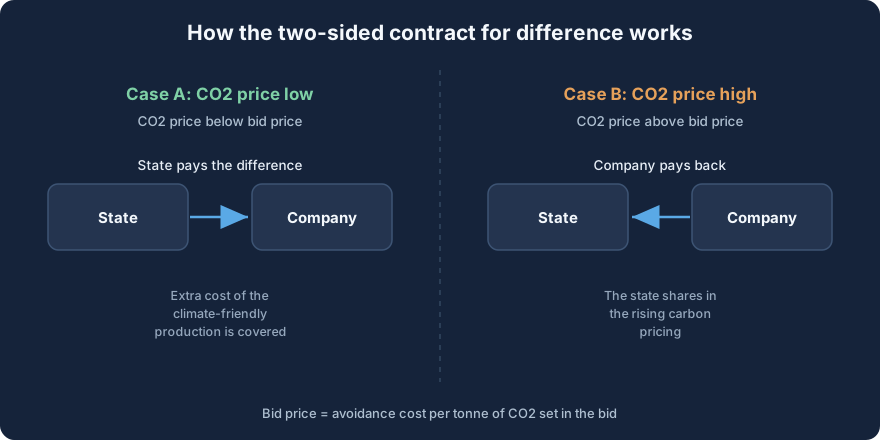
Which projects win is decided by a competitive auction. The measure is funding cost efficiency, the bid price per tonne of CO2 avoided. The bid with the lowest funding cost is awarded first, until the volume is used up. For companies this means setting their avoidance cost realistically, because a bid that is too high drops out of the allocation, while one that is too low endangers their own viability.
The 15-year term is the real value of the instrument. It gives planning security over a period in which CO2 and energy prices can swing sharply. An investment in an electrode steam boiler or a large heat pump only amortises if operating costs stay predictable. That predictability is exactly what the contract provides.
What changes in round 2
The revised funding guideline widens the range of eligible technologies. For the first time, carbon capture, utilisation and storage projects are eligible, though limited to process-related or hard-to-avoid emissions. Pure industrial steam projects come on top, along with a new partial production funding that allows a plant to switch only part of its production.
- Larger volume: EUR 5 billion instead of the up to EUR 2.8 billion from round 1, split into EUR 3 billion base volume and EUR 2 billion additional volume.
- CCU and CCS now eligible: carbon capture, utilisation and storage join as an option, for emissions that can hardly be avoided any other way. The article on CO2 transport under the KSpTG covers the detail.
- Pure industrial steam projects: switching steam generation is now eligible even without a wider process rebuild.
- Partial production funding: plants can be decarbonised step by step instead of only as a whole.
The reduction targets stay demanding. A funded project has to cut the emissions of the production concerned by 50 percent after four years and by 85 percent after fifteen years. A company that misses these targets risks its funding. This is not a plain subsidy, it is a contract with measurable obligations.
Results of the first round
The first bidding round shows how broadly the instrument works. 15 companies received contracts of up to EUR 2.8 billion in October 2024, with an expected saving of 17 million tonnes of CO2 over the term. Large corporations were in the mix alongside industrial mid-sized firms, from chemicals, paper, glass and the food industry.

A few examples make it concrete. At its main site in Ludwigshafen, BASF replaces conventional steam generation in formic acid production with one of the world's largest industrial heat pumps. The Beiersdorf site Tesa in Hamburg switches its gas-fired steam boilers step by step to a hydrogen-capable and an electric boiler. And the Adolf Jass paper mill in Fulda, a mid-sized firm, electrifies steam generation directly.
Five of the 15 funded projects rely on hydrogen. That shows the range of routes: electrification, heat pumps and hydrogen sit side by side, depending on what fits the plant technically and economically. Round 2 is meant to widen that openness further with the new technology options.
Monitoring, reporting and forecasting
A 15-year contract for difference is a data-intensive instrument. How much the state pays or the company pays back depends continuously on measured emissions, production volumes, energy use and the CO2 price. Without solid monitoring, reporting and verification, no contract can be settled cleanly. Digitalising the plant is therefore not optional, it is a precondition.
The bid calculation already needs data. A company that estimates its avoidance cost per tonne of CO2 too roughly bids wrong. Solid forecasts of CO2 and energy prices help decide whether a bid wins and whether it holds over 15 years. Digital twins and a continuous energy management help to model these costs realistically rather than guess them.
After the award, the effort shifts to ongoing measurement. Emissions and production have to be documented and verified over the whole term, often per plant. That only works with connected metering and consistent data flows. Companies that already capture their power and energy data for other funding have a head start here.
Challenges and risks
The instrument works, but it is contested. Economist Veronika Grimm calls carbon contracts for difference a very complicated instrument and points to a fundamental problem: the state always has an information deficit against the funded companies. From that deficit, windfall effects follow inevitably, meaning funding for projects that would have happened anyway without a state incentive.
On top of that comes planning uncertainty. After the coalition collapsed, the programme was put on hold for a while, and the delay hit companies in the middle of their investment planning. Critics from the opposition and academia warned that such stalling damages the reliability that industrial investments have to rely on.
In practice, complexity is the biggest hurdle. Bid calculation, state aid rules, the preparatory procedure and 15 years of reporting are a lot, especially for mid-sized firms with a thin staff function. And the whole thing hangs on approval by the European Commission under state aid law, which can tighten the framework at any time. Whoever takes part binds themselves for a long time to a moving set of rules.
What companies should do now
The 7 September 2026 deadline leaves little room. Companies that completed the preparatory procedure should finalise their bid now rather than bank on the last days. From the procedure and the situation, a short action list follows.

- Calculate the avoidance cost cleanly: work out the cost per tonne of CO2 avoided with realistic energy price scenarios, not best-case assumptions. A bid that is too high drops out of the allocation.
- Set up reporting early: clarify monitoring, metering and data flows before the award. A contract that has to prove emissions and production for 15 years needs the data basis from the start.
- Plan for the payback risk: when the CO2 price rises above the bid price, the payment flow reverses. This possible payback belongs in the financial plan, not in a footnote.
- Check the technology path: weigh electrification, heat pump, hydrogen or, for the first time, CCU and CCS against each other, depending on plant and site.
Further reading
Frequently asked questions
Carbon contracts for difference are Germany's main funding instrument for decarbonising energy-intensive industry. For 15 years the state covers the extra cost that climate-friendly production carries over the conventional route. The target group is installations in the EU Emissions Trading System, in steel, cement, chemicals, paper and glass.
The contract is two-sided and linked to the CO2 price. When the actual CO2 price is below the avoidance price the company set in its bid, the state pays the difference to the company. When the CO2 price rises above it, the company pays the state back. So the state carries the price risk in the early phase and benefits once carbon pricing rises.
The funding volume rises to EUR 5 billion, split into EUR 3 billion base volume and EUR 2 billion additional volume. For the first time, carbon capture, utilisation and storage projects for process-related emissions are eligible, along with pure industrial steam projects and partial production funding. The reduction targets are 50 percent after four years and 85 percent after fifteen years.
Only companies that successfully completed the mandatory preparatory procedure by the end of 2025 can bid. Around 130 projects went through this procedure. The bidding process itself runs from 5 May 2026 to 7 September 2026. Awards go to the bids with the lowest funding cost per tonne of CO2 avoided.
Companies that completed the preparatory procedure should finalise their bid before 7 September 2026. The key is a realistic calculation of the avoidance cost per tonne of CO2, including energy price scenarios. Monitoring and reporting processes should be set up early, not only after an award. The payback risk when the CO2 price rises belongs in the financial plan.
Let's collaborate
One contact, a team behind it
Thirty minutes on what you're working on, whether grid, metering, market processes, IT architecture or AI. Afterwards you'll know how we'd approach it and who would sit at the table.
Energy and measurement technology since 2010 · innobu GmbH since 2014 · Based in Schleswig-Holstein, Germany
Whoever pitches also delivers: whoever leads the first call stays your contact right through to the steering committee, with established partners in the project. Direct: info@innobu.com