
REMIT II: new wholesale energy reporting duties from 2026
This article explains what changes with Implementing Regulation (EU) 2026/256, how the three reporting tiers work, who is newly in scope and how traders, utilities and storage operators meet the new deadlines.
REMIT II tightens the transparency and reporting duties of the European wholesale energy market. The revised base regulation (EU) 2024/1106 has applied since 7 May 2024, but only the new Implementing Regulation (EU) 2026/256 and a Delegated Regulation, both in force since 29 April 2026, make the new reporting duties operational. The former split between continuous and ad-hoc reporting is replaced by three tiers: continuous reporting with shorter deadlines, periodic reporting and the new exposure reporting. Bilateral OTC contracts must now be reported within 10 working days instead of one month. Exposure reporting requires net positions with a 24-month forward view above a threshold of 600 GWh per year, planned from the first quarter of 2027. The scope grows to include hydrogen, battery storage and algorithmic trading. National regulators such as Germany's Bundesnetzagentur enforce the rules, and market manipulation can draw fines of at least 15 percent of annual turnover. For companies this is mainly a data project: map reporting duties cleanly, secure data quality and automate the reporting chains as far as possible.
What changes on 29 April 2026
REMIT II (also written REMIT 2) tightens the transparency and reporting duties of the European wholesale energy market. The revised base regulation (EU) 2024/1106 has applied since May 2024, but only the new Implementing Regulation (EU) 2026/256 and a Delegated Regulation, both in force since 29 April 2026, make the new reporting duties operational. For traders, generators, storage and balancing responsible parties the practical switch begins now.
REMIT stands for the EU regulation on wholesale energy market integrity and transparency. It aims to prevent insider trading and market manipulation and is overseen by the EU agency ACER and national regulators. What is new above all is that the revision aligns definitions and rules with financial market law, for instance on algorithmic trading and inside information.
- In 2025 more than 20,000 market participants reported data to ACER, mostly through registered reporting mechanisms, or RRMs.
- The new rules build on the same market processes as national market communication. How that is being rebuilt is covered in the piece on MaKo 2026 and the move from EDIFACT to APIs .
- ACER supports the transition with guidelines, a public consultation from 16 April to 12 June 2026 and webinars for market participants.
The three reporting tiers
The former split between continuous and ad-hoc reporting is replaced by a three-tier structure. The aim is better oversight with a proportionate burden for lower-risk activities. Anyone who reports should first know which trade falls into which tier.
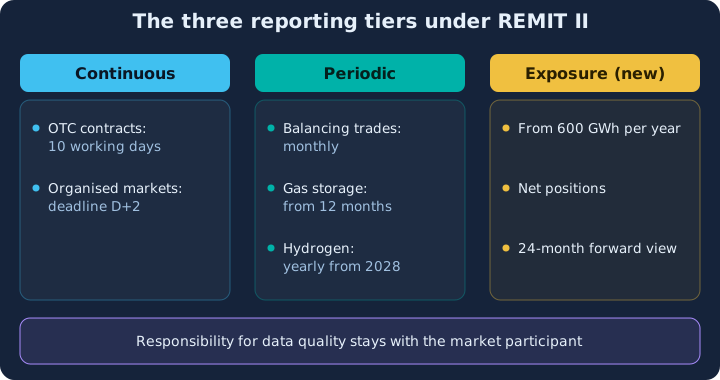
- Continuous: bilateral OTC contracts now within 10 working days instead of one month. Transactions on organised marketplaces must be reported with a D+2 deadline.
- Periodic: balancing trades now become mandatory monthly reports in aggregated form instead of on request only. Gas storage contracts from 12 months duration, hydrogen transactions annually from 1 July 2028.
- Exposure reporting: a new, forward-looking report of net positions with a 24-month forward view above a threshold of 600 GWh per year, planned from the first quarter of 2027.
A wider scope
REMIT II pulls more products and players into the reporting duty. Anyone who used to sit off the radar should re-check their status, because hydrogen and storage bring entire market segments in for the first time.
Hydrogen is captured as its own segment, with exemptions for small producers up to 50 MW and energy-intensive users below 600 GWh per year. The reporting duty starts in stages, with hydrogen transactions only from 1 July 2028.
- Battery storage counts as electricity supply and is reported without a separate category. How storage earns money in the market is covered in the piece on Redispatch 3.0 and congestion management .
- Registered reporting mechanisms (RRMs) and inside information platforms (IIPs) must be EU-established and authorised by ACER.
- Algorithmic trading and access for third-country participants are regulated clearly for the first time, following the definitions of financial market law.
National and EU perspective
In Germany the Bundesnetzagentur and its market transparency unit for wholesale electricity and gas enforce REMIT. They register market participants, monitor reporting duties and pursue breaches. Sanctioning stays national, but oversight is more tightly linked across Europe.

- ACER gains wider powers for cross-border investigations, on-site inspections and penalty payments, but may not sanction on its own.
- The sanction framework is harmonised across the EU: for market manipulation, a fine of at least 15 percent of annual turnover against a company must be possible.
- REMIT II reaches into the same data flows as balancing settlement. How that is being centralised is covered in the piece on the MaBiS hub from 2028 .
Challenges and risks
The switch is mainly a data project and less a pure legal question. The new deadlines and the exposure report raise the effort sharply, and responsibility for the data stays with the market participant.
- Shorter deadlines: 10 working days and D+2 demand reliable, largely automated reporting processes rather than manual rework.
- Forward-looking oversight: exposure reporting shifts control toward the predictive. A missing hedge on expected generation can trigger questions from the regulator.
- Full data responsibility: completeness, accuracy and timeliness stay with the market participant, even when RRMs and ENTSO data paths sit in between.
- New reporting parties: the wider scope pulls hydrogen and storage players in for the first time, often without existing reporting infrastructure.
What companies should do now
A sensible first step is an honest inventory: which trades fall under which reporting tier, and where do the new deadlines break the current processes? Four steps take priority.

Four priority steps
-
Map the reporting duties
Assign products, contract types and volumes to the three tiers and check whether the 600 GWh exposure threshold is reached, separately for electricity and gas.
-
Secure data quality and master data
Counterparties, identifiers and timestamps must be correct and available on time. Gaps in master data are the most common cause of late or wrong reports.
-
Review the RRM contract
Clarify whether the registered reporting mechanism is EU-established and ACER-authorised and covers the new formats. Switching a provider needs lead time.
-
Automate the reporting chains
Short deadlines and forward-looking reports are more reliable with data-driven, partly automated chains. Data analytics also helps to spot suspicious positions early yourself.
REMIT II is one building block of a digital energy sector, not a standalone topic. It reaches into the same market and data processes as the controllable tariffs covered in the piece on tariff models for 2026 . Only market design, reporting duties and data management together give the full picture.
Further reading
Frequently asked questions
REMIT II is the 2024 revision of the EU regulation on wholesale energy market integrity and transparency, Regulation (EU) 2024/1106. It aims to prevent insider trading and market manipulation and strengthens oversight by the EU agency ACER and national regulators. The base regulation applies from 7 May 2024, while the operational reporting duties are set out in the new Implementing Regulation (EU) 2026/256 from 29 April 2026.
On 29 April 2026 the new REMIT Implementing Regulation (EU) 2026/256 and a new Delegated Regulation enter into force. Reporting moves to three tiers: continuous, periodic and the new exposure reporting. Bilateral OTC contracts must be reported within 10 working days instead of one month, and balancing trades become mandatory monthly reports. The scope grows to include hydrogen, battery storage and algorithmic trading.
Exposure reporting is a forward-looking submission of net positions with a 24-month forward view. It applies from a threshold of 600 GWh per year, assessed separately for electricity and gas. Market participants below that threshold are exempt. The start is planned for the first quarter of 2027. The goal is to let ACER spot suspicious positions earlier, such as expected generation with no visible hedge.
In Germany the Bundesnetzagentur and its market transparency unit for wholesale electricity and gas enforce REMIT. They register market participants, monitor reporting duties and pursue breaches. ACER may investigate across borders and order on-site inspections, but only national regulators may impose sanctions. For market manipulation, a fine of at least 15 percent of annual turnover must be possible.
Start with a reporting-duty mapping: assign products, contract types and volumes to the three tiers and check whether the 600 GWh exposure threshold is reached. Then secure master data and data quality, because responsibility for completeness and timeliness stays with the market participant. Check that your registered reporting mechanism is EU-established and ACER-authorised, and automate the reporting chains, because the shorter deadlines are hard to meet manually.
Let's collaborate
One contact, a team behind it
Thirty minutes on what you're working on, whether grid, metering, market processes, IT architecture or AI. Afterwards you'll know how we'd approach it and who would sit at the table.
Energy and measurement technology since 2010 · innobu GmbH since 2014 · Based in Schleswig-Holstein, Germany
Whoever pitches also delivers: whoever leads the first call stays your contact right through to the steering committee, with established partners in the project. Direct: info@innobu.com