
AVBFernwärmeV reform: new district-heating price clauses and the heat-price index
This article sets out the reform in six steps: what the AVBFernwärmeV regulates, how a price-adjustment clause is built from a cost element and a market element, the role of the Destatis heat-price index CC13-77, the new digital transparency duties, what the courts have already decided and what suppliers should prepare now.
The planned reform of the AVBFernwärmeV mainly reshapes district-heating price-adjustment clauses and adds new digital transparency. A price-adjustment clause must contain a clear formula built from a cost element and a market element. The cost element reflects the supplier's actual procurement and generation costs, the market element reflects the general market trend. The ministry draft explicitly permits the Destatis heat-price index (code CC13-77, district-heating heat-price index including levy) as the market element and assumes appropriate consideration when the cost and market elements are weighted equally. For prices applying in 2026, the indices are taken as an average from October 2024 to September 2025. The new digital duties are concrete: suppliers must provide a sample calculation before contract conclusion and publish an interactive calculation tool on the website no later than one year after the rules take effect, and disclose price components, index sources, supply structure, network losses, energy mix and annual greenhouse-gas emissions. The ministry draft has existed since July 2024, was revised in November 2024 and is still not in force in mid-2026; the reform is being pursued together with a planned heat law and the building modernisation act. The courts sharpened the framework faster than the legislator: the Federal Court of Justice ruled on 27 September 2023 (VIII ZR 263/22) that cost and market elements must be clearly separable, and several regional and higher regional courts in 2025 rejected pure gas indices and opaque weightings. For suppliers this means: check clauses for separable elements and a clear formula, pull index data into billing automatically, and set up the sample calculation and interactive tool as a software project tightly linked to the billing system.
What this is about: new rules for district heating
The AVBFernwärmeV regulates the general terms for the supply of district heating, that is the standard contract between supplier and customer. The planned reform mainly reshapes the price-adjustment clauses and demands more digital transparency. In mid-2026 it is still in the pipeline, but the draft and the case law already make the direction clear.
Why this matters comes down to the structure of the market. District heating covers around 16 percent of dwellings in Germany, roughly 6 million dwellings over about 3,800 networks. Unlike electricity and gas, these customers cannot switch supplier, because exactly one network sits at the building connection. This captive market makes fair and traceable pricing especially sensitive, and that is where the legislator steps in.
The timeline is sobering. The ministry draft has existed since July 2024 and was revised in November 2024. It has not been adopted. The federal government announced the reform in its coalition agreement and is now pursuing it together with a planned heat law and the building modernisation act. For suppliers this means the exact wording may still shift, but the direction is set, and the most important requirements are already binding through court rulings.
The price-adjustment clause: cost element plus market element
The core of the reform concerns Section 24 of the AVBFernwärmeV. A price-adjustment clause must contain a clear formula built from a cost element and a market element. The cost element reflects the supplier's actual procurement and generation costs, the market element reflects the general market trend. Together they determine how the work price changes over time.
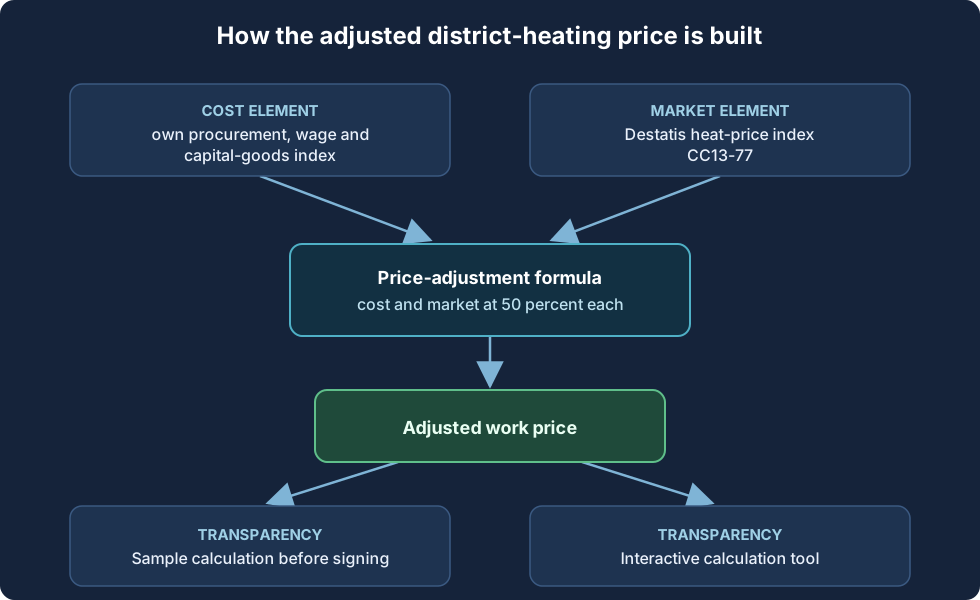
Three requirements are new or sharpened. First, the clause must show a real formula, not just a reference to indices. Second, the indices used must reflect the energy sources actually used and the supplier's procurement structure, not those of the upstream generators. Third, the draft assumes appropriate consideration when the cost and market elements are weighted equally, so each enters the formula at half.
Timing matters for billing too. For prices applying in a given year, the indices are taken as an average over a twelve-month window that ends before the price reference date. For prices applying in 2026, that window runs from October 2024 to September 2025. This fixed mechanism keeps the adjustment predictable, but it requires clean data management across several years.
The Destatis heat-price index as the anchor
The heat-price index of the Federal Statistical Office of Germany is the central official reference for the market element in many clauses. It is published monthly and ties the price adjustment to an independent figure that the individual supplier does not set. The ministry draft explicitly permits it as the market element, which gives suppliers legal certainty.
Behind the index sits a clear code: CC13-77 stands for the district-heating heat-price index including levy. In the formulas, suppliers usually combine it with further official indices, such as a wage index and a capital-goods index for the cost element and sometimes a coal or gas index. Which indices are permitted is no longer a free choice.
A pure gas index as the sole market element is not enough. Several regional courts ruled in 2025 that a single energy source does not adequately reflect the market trend when the supplier generates its heat from a broader mix. The market element must reflect the market where the supplier actually procures, and the heat-price index is the obvious anchor for that.
New digital duties: sample calculation and interactive tool
The reform turns transparency into concrete software and data tasks. Suppliers must provide a sample calculation of the price adjustment before contract conclusion and publish an interactive calculation tool on the website no later than one year after the rules take effect, so customers can trace an adjustment themselves. This is no longer a PDF, it is a calculation engine.

On top of that comes extended website disclosure. Suppliers must present price components, index sources, supply structure, average annual prices, network losses and the energy mix, and the annual greenhouse-gas emissions even graphically. This duty draws on the same data base as the automated maintenance of electronic price sheets and can only be handled sensibly if the data is kept current and machine-readable.
Communication becomes more digital as well. Changes to the supply terms must be communicated in text form and published on the website, and termination by email becomes permitted. For suppliers the upshot is this: transparency is not a one-off publication but an ongoing data duty, tightly coupled to the billing system and to the digital capture of consumption values.
What the courts have already decided
Case law has sharpened the framework faster than the legislator. Anyone building or checking a price-adjustment clause today must know these rulings, because they apply regardless of the reform. The most important standard comes from the Federal Court of Justice.
A price-adjustment clause must set out clearly and intelligibly for consumers the parameters by which the price changes. If the clause is opaque, it cannot support a price increase.
Four decisions set the line. The Federal Court of Justice required clearly separable cost and market elements in its ruling of 27 September 2023 (VIII ZR 263/22). In its ruling of 25 September 2024 (VIII ZR 20/22) it held that an early objection to a price adjustment must be reaffirmed within three years. The Higher Regional Court of Celle required on 18 November 2025 (13 UKl 3/24) that it must be clear which components reflect cost and which reflect market, and that disproportionate weightings need a sound justification. The Regional Court of Wuppertal clarified on 3 April 2025 (5 O 162/23) that the cost element must reflect the supplier's own procurement costs, not those of the upstream generators.
This creates a double pressure. The clauses must be transparent and soundly weighted, and they must match the supplier's actual procurement market. Both align with the thrust of the reform, which is why suppliers should implement the requirements today rather than wait for the rules to take effect.
Challenges and risks
The reform brings clarity, but it raises the workload and leaves points open. Consumer advocates still consider district heating too opaque. A study by the German Federation of Consumer Organisations (vzbv) found, eight months after the 2021 transparency duties took effect, that around a third of the networks examined had no complete price information, and almost two thirds did not publish network losses. The new duties are therefore not excessive, they respond to real gaps.
For suppliers the risk sits in the details. The construction-cost contribution is to fall from 70 to 50 percent, which can raise ongoing tariffs for existing customers and has to be recalculated. As long as the reform is not in force, an old ordinance text and new case law apply side by side, which creates legal uncertainty. And decarbonisation comes on top: by 2030, according to VKU, around EUR 43.5 billion of investment in heat networks is needed, and it has to be refinanced through prices without losing customer acceptance.
The biggest danger is not the single duty but the combination: an opaque clause that does not survive a ruling can void an entire price increase. A supplier that builds the formula cleanly, separably and traceably protects its revenue at the same time.
What suppliers should do now
Suppliers should not wait for the rules to take effect but prepare formula, data and software now, because the rulings already make much of it binding. Four steps are the priority.

Four priority steps
-
Check price-adjustment clauses
Review every active clause for a separable structure of cost element and market element and for a traceable formula. Where a single energy source or an unclear weighting hides, price increases risk being void.
-
Connect index data automatically
Pull the Destatis heat-price index and the other indices into billing through a clean data connection, including the twelve-month logic. This cuts errors and creates the data base for the sample calculation and the tool.
-
Set up the sample calculation and interactive tool
Plan both as a software project, tightly linked to the billing system, so customer input and the real formula use the same logic. The one-year deadline after entry into force is tight, so the lead time pays off.
-
Treat website transparency as a data duty
Feed price components, network losses, energy mix and the emissions graphic from current, machine-readable data, not from one-off documents. That keeps the disclosure accurate in the following year too.
The duty to capture consumption remotely and municipal heat planning point the same way: heat supply is becoming data-driven, and pricing is only one part of it. A supplier that builds the data architecture behind it cleanly meets several duties on one foundation.
Further reading
Frequently asked questions
The AVBFernwärmeV is the German ordinance on general terms for the supply of district heating. It sets the standard contract between a district-heating supplier and the customer, covering connection, billing, contract terms and above all the price adjustment. Because district-heating customers cannot switch supplier, the ordinance carries great weight for consumer protection. District heating supplies around 16 percent of dwellings in Germany, roughly 6 of 43 million dwellings over about 3,800 networks.
The reform reshapes Section 24 of the AVBFernwärmeV. Price-adjustment clauses must contain a clear formula built from a cost element and a market element. The cost element reflects the supplier's actual procurement and generation costs, the market element reflects the general market trend. The draft explicitly permits the Destatis heat-price index as the market element and assumes appropriate consideration when the cost and market elements are weighted equally. Indices must reflect the energy sources actually used and the supplier's procurement structure.
The heat-price index of the Federal Statistical Office of Germany is the central official reference for the market element in many clauses. The code CC13-77 stands for the district-heating heat-price index including levy. It is published monthly and ties the price adjustment to an independent figure. Suppliers usually combine it with a wage index, a capital-goods index and sometimes a coal or gas index. For prices applying in 2026, the indices are taken as an average from October 2024 to September 2025.
The reform turns transparency into concrete software and data tasks. Suppliers must provide a sample calculation of the price adjustment before contract conclusion and publish an interactive calculation tool on the website no later than one year after the rules take effect. They must also disclose price components, index sources, supply structure, average annual prices, network losses and the energy mix, and present annual greenhouse-gas emissions graphically. Changes to the supply terms must be communicated in text form and published, and termination by email becomes permitted.
In mid-2026 the reform is not yet in force. The ministry draft has existed since July 2024 and was revised in November 2024, but its adoption was delayed. The federal government announced the reform in its coalition agreement and is now pursuing it together with a planned heat law and the building modernisation act. Until then, an old ordinance text and new case law apply side by side. Many requirements are already binding through court rulings, so suppliers should not wait for the rules to take effect.