CCS and CCU in Germany: the KSpTG and the new CO2 transport infrastructure
This is a practical analysis of the new legal framework for carbon capture, storage and utilisation (CCS and CCU) and of the CO2 transport infrastructure that is now taking shape around it: the move from the dead KSpG to the KSpTG, the offshore storage regime in the exclusive economic zone with its onshore state opt-in, the unified authorisation regime for CO2 pipelines, export under the London Protocol, the emerging backbone, hubs and ship transport, and the target sectors with unavoidable process emissions. It is not a treatise on the funding side. It sets out where storage is allowed, how CO2 reaches the store, who actually needs CCS and CCU, and what operators and investors should decide now. The neighbouring funding instrument, the climate protection contracts (CCfD), sits close by and is touched in only one passage, not repeated.
The Carbon Dioxide Storage and Transport Act (Kohlendioxid-Speicherungs- und -Transportgesetz, KSpTG) is the 2025 amendment of the 2012 Carbon Dioxide Storage Act (KSpG) and has been in force since 28 November 2025 (Federal Law Gazette BGBl. 2025 I No. 282, Bundestag 6 November 2025, Bundesrat 21 November 2025). Under the old KSpG, capped volumes, an application deadline that expired in 2016 and wide state exclusion clauses meant not a single store was ever approved. The Carbon Management Strategy (CMS) was adopted by cabinet on 29 May 2024. Permanent commercial CO2 storage is now permitted only offshore, in the German exclusive economic zone (EEZ) and on the continental shelf, banned in territorial waters, in marine protected areas and in an eight-kilometre buffer around them, and offshore wind must not be materially impaired. Onshore storage is generally banned, with a research exception and a state opt-in under section 2(5): Mecklenburg-Vorpommern has excluded it, Bavaria and Baden-Wuerttemberg are open. CO2 pipelines run through a unified authorisation regime with plan approval or simplified plan approval (section 4), modelled on the energy-law logic of the EnWG, and CO2 lines and infrastructure are classed as overriding public interest (section 4(1) sentence 3, section 11), except in marine protected areas. Coal-plant operators are barred from pipeline access (section 33(5)). Cross-border export is enabled through the provisional application of the amendment to Article 6 of the London Protocol, with full bilateral use requiring ratification and the High Seas Dumping Act amendment still in process. The target sectors are unavoidable process emissions in cement, lime, parts of basic chemicals and thermal waste treatment, not the power sector. CCS stores the captured CO2 permanently underground, while CCU uses it as a feedstock for methanol, e-fuels and chemicals and links to the hydrogen economy. The emerging transport infrastructure includes an OGE Germany-wide CO2 backbone of about 1,000 km with first sections from 2028, a bayernets southern-German starter network of nearly 250 km, the Wilhelmshaven export terminal (HES) from 2029 scaling to 20 Mt per year, and ship transport of liquefied CO2 to stores such as Northern Lights in Norway. The KSpTG decides, for whole industrial sectors, whether their unavoidable process emissions can be made climate-neutral at all.
From the dead KSpG to the KSpTG: the legal framework is here
For thirteen years the Carbon Dioxide Storage Act (Kohlendioxid-Speicherungsgesetz, KSpG) of 2012 effectively prevented any CO2 storage in Germany. Capped volumes, an application deadline that expired in 2016 and wide state exclusion clauses combined to make the law a dead letter: not a single store was ever approved under it. The result was that carbon capture had nowhere to go, and an industry that could in principle capture its emissions had no legal route to transport or store them. The KSpG was on the books, but in practice it amounted to a ban.
That has now changed. The Carbon Dioxide Storage and Transport Act (Kohlendioxid-Speicherungs- und -Transportgesetz, KSpTG) is the 2025 amendment of the old KSpG: it rebuilds and renames the law, and the new name carries the words "and Transport" deliberately. It has been in force since 28 November 2025, with the reference in the Federal Law Gazette BGBl. 2025 I No. 282, issued on 27 November 2025. The Bundestag passed the act on 6 November 2025 and the Bundesrat approved it on 21 November 2025. For operators with unavoidable process emissions, this is the moment carbon management moved from a vision to a planning task.
The KSpTG did not appear out of nowhere. It sits inside the Carbon Management Strategy (Carbon-Management-Strategie, CMS), whose key points and the draft amendment were adopted by cabinet on 29 May 2024, and inside the wider European push on industrial carbon management. The government draft of the new federal government entered the legislative process on 8 September 2025, and the public hearing was held on 13 October 2025. The strategy and the law share one deliberate framing: carbon capture is to serve the emissions that cannot be avoided, not to keep fossil generation alive.
What changes in substance is that three things become legally possible at once. Permanent commercial CO2 storage offshore, a unified authorisation regime for CO2 pipelines, and cross-border export of CO2 are now all on a legal footing for the first time. None of these was available under the old KSpG. The detail of each, where storage is allowed, how pipelines are approved, how export works, is the subject of the next three sections, but the headline is simple: after thirteen years, the capture, transport and storage chain finally has a law that lets it run.
Where storage is allowed: offshore yes, onshore only by a state opt-in
The KSpTG permits permanent commercial CO2 storage only offshore, in the German exclusive economic zone (EEZ) and on the continental shelf. Storage in territorial waters, the twelve-nautical-mile zone, is banned. That is the first and most important geographic boundary: the law opens the deep offshore for storage but keeps the near-shore waters off limits, so the commercial stores that the act enables sit out in the EEZ rather than close to the coast.
Within the offshore zone, the law adds further protective limits. Marine protected areas are excluded, as is an eight-kilometre buffer around those areas, and offshore wind installations must not be materially impaired. These constraints matter for siting because they narrow the space in which a store can actually be located: a project has to find geology that is both suitable and clear of protected areas, their buffer zones and the offshore wind build-out, which is itself expanding across the same waters.
On land the picture is the opposite. Onshore storage is generally banned, with an exception only for research projects. The single route to commercial onshore storage runs through a state opt-in under section 2(5) of the KSpTG: an individual federal state can permit onshore storage in designated areas through its own state law. The states have already begun to diverge. Mecklenburg-Vorpommern has excluded onshore storage by state law, while Bavaria and Baden-Wuerttemberg have signalled openness, Bavaria with an action plan from July 2025 and a review running to the end of 2027. For an operator, this means the legal availability of an onshore store depends on the state it sits in, not on federal law alone.
One further boundary is decisive for the power sector. Coal-plant operators are barred from pipeline access under section 33(5) of the KSpTG, so coal generation cannot route its CO2 into the new infrastructure. Gas plants and other facilities can connect, but the framing of the CMS and the law is explicit: the focus is on industry with unavoidable process emissions, not on the electricity sector. The neighbouring article on the Power Plant Security Act and H2-ready power plants covers the power side of decarbonisation, where coal plants are precisely the facilities shut out of CO2 pipeline access here.
CO2 pipelines and export: the new authorisation regime
Storing CO2 offshore is only useful if the CO2 can get there, and that is what the pipeline regime is for. The KSpTG creates a unified authorisation regime for CO2 lines, with full plan approval (Planfeststellung) or, in simpler cases, a simplified plan approval (Plangenehmigung) under section 4 of the act. The procedure is modelled on the logic of energy law, the EnWG, which gives operators a familiar framework rather than a bespoke one. This unified regime replaces the legal vacuum in which CO2 pipelines previously had no clear approval path.
The law also gives CO2 infrastructure a strong legal status. The construction, operation and modification of CO2 lines, and the CO2 infrastructure as a whole, are classed as overriding public interest under section 4(1) sentence 3 and section 11 of the KSpTG. In a planning and permitting dispute, that classification weighs in favour of the project, which is meant to speed the build-out of the network. The one carve-out is that this overriding-interest status does not apply in marine protected areas, where the environmental protections take precedence.
Export is the other half of the picture, because in the near term most German CO2 will be stored abroad. Cross-border export of CO2 for offshore storage is enabled through the provisional application of the amendment to Article 6 of the London Protocol, which was agreed in 2009. Provisional application lets export begin, but full bilateral use requires that this amendment be ratified, and the corresponding amendment to the High Seas Dumping Act is still going through the parliamentary process as this article is written. The legal route to export is therefore open in principle but not yet fully finalised.
The practical consequence is a sequencing point that operators should not miss. Stores in Norway, the Netherlands and Denmark become legally reachable before German offshore storage in the EEZ is actually operational, so the first real disposal route for captured German CO2 runs across borders by ship and pipeline to foreign stores. An operator planning capture today has to plan for export first and for domestic offshore storage as the later option, not the other way round.
The emerging CO2 transport infrastructure: backbone, hubs, ships
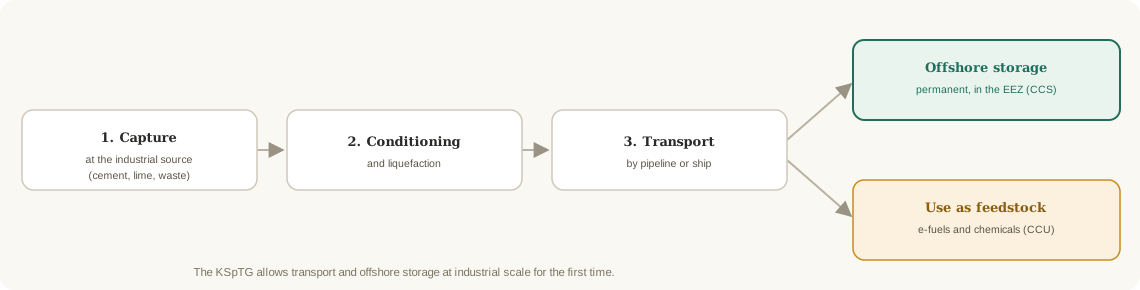
Alongside the law, a physical transport world is taking shape. The chain runs from capture at the industrial source through conditioning and liquefaction to transport by pipeline or ship, and finally to permanent offshore storage or use as a feedstock. The diagram below shows the full value chain, with the KSpTG enabling the middle and right links: the transport and the offshore storage that previously had no legal basis.
The backbone of the pipeline network is being planned by OGE (Open Grid Europe), which aims at a Germany-wide CO2 backbone in the order of about 1,000 km. The plan ties together hubs at Wilhelmshaven and Brunsbuettel, with an Elbe cluster of about 70 km linking Laegerdorf, Brunsbuettel and Heide, alongside corridors into the Rhineland and across borders to Rotterdam and Denmark. The first sections are planned from 2028, with the cluster completed towards the end of the decade, and the project brings together partners such as Equinor, Wintershall Dea, BASF, Gasunie, Shell and Fluxys.

In the south, bayernets is working on a southern-German starter network of nearly 250 km, with a first phase of about 80 km running from the Rohrdorfer cement works near Rosenheim into the Burghausen chemical triangle and on towards Linz. A feasibility study is under way, and the sources feeding the network are the same hard-to-abate industries: cement, chemicals and waste incineration. Together the OGE and bayernets plans sketch the outline of a national CO2 transport system being built region by region.
Where pipelines do not yet reach, ships carry the CO2. The Wilhelmshaven hub, developed by HES, is an export terminal for liquefied CO2 from 2029, starting at about 1.5 Mt per year and scaling up to 20 Mt per year across its combined operations with Rotterdam. From these terminals, ships move liquefied CO2 to European stores, above all Northern Lights in Norway, whose phase 2 lifts capacity to over 5 Mt per year from 2028 and which injects the CO2 more than 2,000 metres below the seabed. This is the geological underground storage that mirrors, on the CO2 side, the kind of subsurface storage analysed for hydrogen in the article on hydrogen cavern storage at H2CAST Etzel.
Who needs CCS and CCU: unavoidable process emissions
CCS and CCU are not a universal remedy. They are aimed deliberately at the emissions that cannot be avoided by other means, above all in the basic-materials industries. The target sectors are the cement and lime industries, parts of basic chemicals and thermal waste treatment, the incineration of household and industrial waste. These are the points in the economy where capture makes sense, because there is no clean substitute for the emission at source.
The reason is chemistry rather than energy. Process emissions in cement and lime arise from the chemical reaction itself, for example when limestone is burned to produce lime, and they persist even when the plant runs entirely on renewable energy. Switching the energy source does not remove them, which is exactly why these emissions are called unavoidable: only capturing the CO2, rather than not producing it, can take them out of the atmosphere. That is the dividing line between sectors that can electrify their way to zero and sectors that need carbon capture.

Once the CO2 is captured, there are two destinations, and the difference between them is the difference between CCS and CCU. CCS, carbon capture and storage, stores the CO2 permanently underground, which removes it from the cycle for good. CCU, carbon capture and utilisation, uses the CO2 instead as a feedstock for products such as methanol, e-fuels and chemicals, which keeps the carbon in use rather than burying it. For an operator, the choice between them depends on whether there is an offtaker for the CO2 and on the quality the captured stream can reach.
CCU is also where this topic meets the hydrogen economy. RFNBO and e-fuels need a carbon source, so captured biogenic or unavoidable CO2 becomes the raw material for hydrogen-based chemistry: combined with green hydrogen, it becomes methanol and synthetic fuels. That link is why the certification and accounting of these fuels matters here, and it is treated in detail in the article on RFNBO certification and mass balancing, where the CO2 source is one of the inputs that has to be documented. The opposite molecule flow, hydrogen and ammonia coming in through the same kind of coastal hubs, is covered in the article on green ammonia import via Brunsbuettel.
What operators and investors should decide now
With the KSpTG in force, carbon management has become a planning task rather than a hope. Anyone who takes the siting, offtake and connection decisions in 2026 is fixing, for one or two decades, whether the plant's process emissions can be captured and moved at all. The practical message is that capture, transport and storage have to be planned as a single chain, because a capture unit with no reachable store is a stranded investment.
The first job is to think the chain end to end. The question is which transport option, pipeline, ship or, in a transitional phase, truck or rail, and which store, the German EEZ, Norway, the Netherlands or Denmark, is actually within economic reach from the plant. Because foreign stores become reachable before the German offshore stores are operational, the realistic near-term answer for many operators is export by ship, with a later switch to pipeline and domestic storage as the network and the EEZ stores come online.
The points below turn the carbon-management logic into a near-term action list for operators and investors.
- Plan capture, transport and storage as one chain. Decide early which transport option (pipeline, ship, or transitionally truck or rail) and which store (the German EEZ, Norway, the Netherlands or Denmark) is economically reachable, and treat export by ship as the likely first route while domestic offshore storage matures.
- Secure a connection to the emerging backbone. Treat proximity to the planned OGE and bayernets routes and to hubs such as Wilhelmshaven as a siting factor, and engage with the transport operators early, since the first pipeline sections come from 2028 and capacity will be planned before it is built.
- Test CCS against CCU. Weigh permanent offshore storage against use as a feedstock, depending on whether there are offtakers in chemicals or e-fuels and on the CO2 quality the capture unit can deliver, noting that CCU ties the CO2 stream to the hydrogen economy through RFNBO and e-fuels.
- Place the funding question correctly. Recognise that the KSpTG is the legal and infrastructure framework, not a funding instrument: the additional cost of a CCS project can be supported through carbon contracts for difference (CCfD), but that is a separate instrument with its own auction and contract logic, and it should not be conflated with the authorisation and transport regime described here.
Further reading
Frequently asked questions
The KSpTG is the Carbon Dioxide Storage and Transport Act (Kohlendioxid-Speicherungs- und -Transportgesetz), the 2025 amendment of the 2012 Carbon Dioxide Storage Act (KSpG). It has been in force since 28 November 2025 (Federal Law Gazette BGBl. 2025 I No. 282), after the Bundestag passed it on 6 November 2025 and the Bundesrat approved it on 21 November 2025. It creates the first workable legal framework for carbon capture, storage and utilisation at industrial scale in Germany, where the old KSpG had effectively blocked CCS for thirteen years.
Permanent commercial CO2 storage is permitted only offshore, in the German exclusive economic zone (EEZ) and on the continental shelf. It is banned in territorial waters, in marine protected areas and in an eight-kilometre buffer around those areas, and offshore wind installations must not be materially impaired. In practice German export CO2 can also reach foreign stores such as Northern Lights in Norway, the Netherlands and Denmark through cross-border export.
Onshore storage on land is generally banned, with an exception for research projects. Under the state opt-in clause in section 2(5) of the KSpTG, an individual federal state can permit onshore storage in designated areas through state law. Mecklenburg-Vorpommern has excluded onshore storage, while Bavaria and Baden-Wuerttemberg have signalled openness, Bavaria with an action plan from July 2025 and a review running to the end of 2027.
CCS, carbon capture and storage, stores the captured CO2 permanently underground. CCU, carbon capture and utilisation, uses the CO2 as a feedstock, for example for methanol, e-fuels and chemical products. CCU links the topic to the hydrogen economy, because RFNBO and e-fuels need a carbon source, so captured biogenic or unavoidable CO2 becomes a raw material for hydrogen-based chemistry.
CCS and CCU are aimed deliberately at unavoidable process emissions, above all in the cement and lime industries, parts of basic chemicals and thermal waste treatment. These emissions arise chemically, for example from burning limestone, and remain even when renewable energy is used, so they cannot be removed by switching the energy source. The power sector is explicitly not the focus of the Carbon Management Strategy or the KSpTG.