The innovative CHP tender gap from 2026: the last auction and the missing legal framework
This article covers the innovative CHP tender gap in seven steps: what is happening now, what an innovative CHP system is in technical terms, how the last tender turned out, which legal framework applies from 2026, why digital control is the heart of the matter, where the risks lie and what operators should do now.
An innovative CHP system, iKWK in German, links three heat generators under a shared controller: a combined heat and power unit, a renewable heat source such as a large heat pump, solar thermal or geothermal, and a purely electric heat generator on the power-to-heat principle. All feed the same heat network, and the renewable source must supply at least 30 percent of the reference heat per year. Such plants are supported through tenders held by the German regulator Bundesnetzagentur. That is where the problem sits. Germany's CHP tender regulation sets annual volumes only up to and including 2025. For 2026 and beyond there is no framework yet. The tender for the 1 December 2025 bidding date was therefore the last scheduled round. The innovative CHP segment stayed undersubscribed: for the offered 34.261 megawatts only six admissible bids totalling 27.599 megawatts came in, at a volume-weighted award value of 6.67 cents per kilowatt hour. The regular CHP segment was oversubscribed, with an average that fell to 5.02 cents per kilowatt hour. The KWKG itself is cleared under state aid rules only until 31 December 2026, and an extension to 2029 depends on European Commission approval. As a bridge a light extension applies, shifting the deadline from commissioning to the permit or binding order. Associations warn of an investment standstill because innovative CHP projects need 12 to 24 months of lead time. For operators this means keeping projects decision-ready, preparing permits early and planning the digital control that decides innovative CHP economics and carbon balance from the start.
What is happening: the last scheduled CHP tender
On 15 January 2026 the German regulator Bundesnetzagentur published the results of the CHP and innovative CHP tender for the 1 December 2025 bidding date. It was the last round with a legal basis. Germany's CHP tender regulation only sets the annual volumes up to and including 2025. For 2026 and beyond there is no set volume yet.
That sounds technical, but the consequence is hard. Without set volumes the Bundesnetzagentur cannot open regular CHP and innovative CHP tenders from 2026. Anyone who wants to build a CHP unit above 1 megawatt or an innovative CHP system and have it supported under the KWKG has to win a tender. If the tender does not happen, the main support mechanism is missing.
A joint letter from B.KWK, AGFW and VKU to the responsible committee therefore warns of a planning and investment standstill from 2026. The associations call for the annual volumes for the years from 2026 to be set in good time so that the expansion of municipal district heating does not stall.
What is an innovative CHP system?
An innovative CHP system combines three heat generators under a shared controller. It is not a single machine but a coordinated system that couples power and heat while bringing a fixed share of renewable heat. This design is what sets innovative CHP apart from a conventional CHP plant.
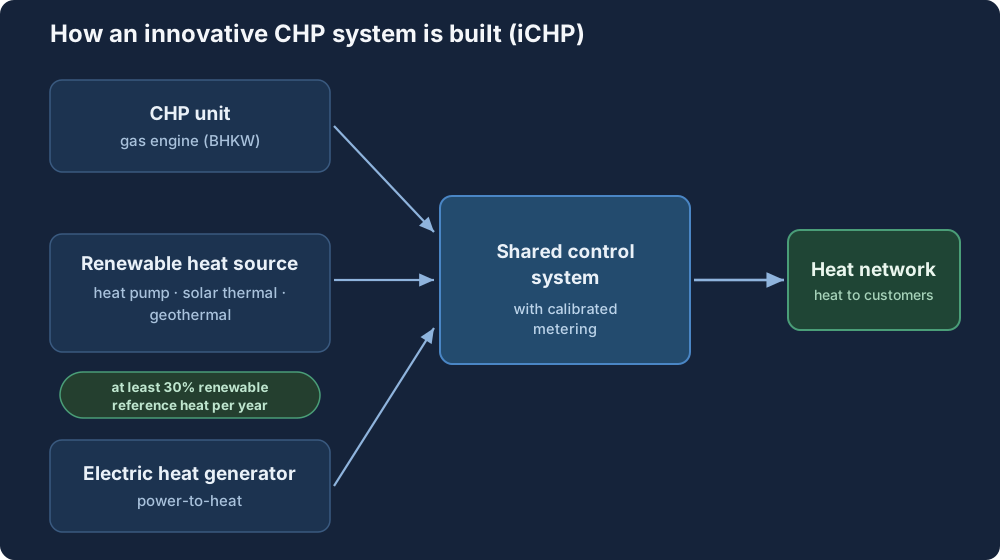
The first component is the combined heat and power unit, which produces electricity and heat at once. The second is the innovative renewable heat source, in practice usually a large heat pump that draws ambient heat from air, river water or wastewater, less often solar thermal or geothermal. The third is a purely electric heat generator, an electrode boiler or heating element that turns surplus power directly into heat.

Holding it all together is the shared control and metering technology. All components sit on the same heat network and need calibrated meters that continuously record fuels, heat produced and electricity used and generated. Without that metering there is no support.
The results: CHP oversubscribed, innovative CHP undersubscribed
The two segments of the last tender moved in opposite directions. The regular CHP tender was clearly oversubscribed, while the innovative CHP segment again stayed below the offered volume. According to the Bundesnetzagentur, low prices and the undersubscription both point to a lack of planning certainty.
| Segment | offered | bids | awarded | award value | status |
|---|---|---|---|---|---|
| CHP plants | 107.964 MW | 41 bids, 135.668 MW | 33 bids, 108.658 MW | 5.02 ct/kWh | oversubscribed |
| Innovative CHP systems | 34.261 MW | 6 admissible bids | 6 bids, 27.599 MW | 6.67 ct/kWh | undersubscribed |
For the innovative CHP systems, both the low prices and the undersubscription of the segment point to the lack of planning certainty.
The contrast is clear. In the regular segment bids of 135.668 megawatts sat well above the offered volume, and the average award value fell from 5.73 to 5.02 cents per kilowatt hour. In the innovative CHP segment six bids were not enough to fill the 34.261 megawatts. That the more climate-friendly plant type is the one struggling is the real warning sign.
The regulatory gap from 2026 and the EU perspective
The gap has two levels that are often confused. First, no tender volumes are set from 2026. Second, the state aid clearance of the KWKG itself only runs until the end of 2026. Both have to be closed, or the support mechanism stands still.
The European Commission granted state aid clearance for parts of the KWKG only until the end of 2026. An extension to 2029 needs a new clearance and is still under way. To bridge the time, lawmakers use a so-called light extension. Under it the deadline no longer counts from the plant's commissioning but from the environmental permit or the binding order. Actual commissioning can then follow up to four years later.
The CHP change also hangs on the larger package around the power plant security act and the power plant tender act, which is meant to steer the build-out of controllable and hydrogen-ready capacity. In parallel, the Court of Justice of the European Union is clarifying the basic question of whether the KWKG is state aid at all under EU law. Its ruling is expected on 9 July 2026. Until then operators face uncertainty about how support continues from 2026. How strongly the legal framework drives the build-out also shows in the power plant security act and the hydrogen-ready tenders.
Why digital control is the heart of innovative CHP
The real value of an innovative CHP system is created in the software. Three generators that supply the same network have to be run against each other by power price, heat demand and grid situation. Run the wrong component at the wrong time, and both economics and the renewable share drop at once.
The logic is easy to state but hard to control. A CHP unit produces power and heat and pays off when power is expensive. The heat pump consumes power and pays off when it is cheap. The electric heat generator absorbs short-term surpluses. The controller has to reset this schedule hour by hour, factor in the heat store and keep an eye on grid charges.
On top of that comes calibrated metering as a support condition. All fuel, heat and electricity volumes must be recorded continuously and verifiably. Combining a forecast of heat demand and power prices with a look-ahead controller cuts fuel use and lifts the renewable share above the mandatory value. The same digital base later carries the digital twin in the municipal utility and the flexibility under section 14a of the German Energy Act.
Challenges and risks
The undersubscription in the innovative CHP segment is more than a statistic. It shows that the mix of regulatory uncertainty and economic risk puts off potential bidders.
Anyone planning today needs 12 to 24 months of lead time but has to calculate without a secure legal framework for 2026. The investment in a large heat pump is high, and its economics hang on the power price. Falling award values push further on the margin. If the volume decision comes too late, projects slip or fall away, and the build-out of climate-friendly district heating loses pace.
The biggest risk is not the single plant but the gap in the calendar. An innovative CHP project cannot start from a standstill once the tender is back. Whoever prepares permit, site and control concept now can use a new volume decision at once. Whoever waits loses the 12 to 24 months of lead time a second time.
What companies should do now
Municipal utilities and district heating operators should keep innovative CHP projects decision-ready despite the regulatory gap and think about the control question early. Four steps come first.

Four priority steps
-
Bring permit and order forward
The light extension ties the deadline to the environmental permit or the binding order. Taking these steps early secures the support claim, even if commissioning comes later.
-
Run the digital feasibility case
Simulate different innovative CHP configurations of CHP unit, heat pump and electric generator with realistic power price and load profiles. That fixes the most economic design before the tender opens again.
-
Plan control and metering cleanly
Set up the control and metering concept in a calibrated, data-ready way from the start. The shared control of the three generators decides economics and renewable share, not the single component.
-
Track the legislation closely
Keep an eye on the process for the CHP tender regulation and the KWKG extension as well as the EU court ruling. Knowing the deadlines lets you bring projects into the tender at the right moment.
The innovative CHP question does not stand alone. It feeds into the same planning as municipal heat planning and the electrification of district heating with large heat pumps, it uses the federal funding for efficient heat networks and it shares the control logic with the digital operation of cold district heating.
Further reading
Frequently asked questions
An innovative CHP system links three heat generators under a shared controller: a combined heat and power unit, a renewable heat source such as a large heat pump, solar thermal or geothermal, and a purely electric heat generator on the power-to-heat principle. All components feed the same heat network. The renewable heat source must supply at least 30 percent of the reference heat per year and reach a seasonal performance factor of at least 1.25.
Germany's CHP tender regulation sets annual tender volumes only for the years 2017 up to and including 2025. For 2026 and beyond there is no set volume yet. Without that basis the regulator Bundesnetzagentur cannot run regular CHP and innovative CHP tenders. Associations such as B.KWK, AGFW and VKU warn of an investment standstill because projects need 12 to 24 months of lead time.
At the 1 December 2025 bidding date the innovative CHP segment stayed undersubscribed. For the offered 34.261 megawatts only six admissible bids totalling 27.599 megawatts came in, all of which were awarded. The volume-weighted award value was 6.67 cents per kilowatt hour. The regular CHP segment was oversubscribed, with an average that fell to 5.02 cents per kilowatt hour.
The German Combined Heat and Power Act is cleared under state aid rules until 31 December 2026. An extension to 2029 first needs European Commission approval. As a bridge, lawmakers use a light extension: the relevant deadline shifts from commissioning to the environmental permit or the binding order of the plant, and commissioning can then follow up to four years later.
The core of an innovative CHP system is the shared control of three generators that are run against each other by power price, heat demand and grid situation. Software decides when the CHP unit, when the heat pump and when the electric heat generator runs. On top of that comes calibrated metering of all fuels, heat and electricity as a support condition. Forecasting and optimisation cut fuel use and raise the renewable share.
Let's collaborate
One contact, a team behind it
Thirty minutes on what you're working on, whether grid, metering, market processes, IT architecture or AI. Afterwards you'll know how we'd approach it and who would sit at the table.
Energy and measurement technology since 2010 · innobu GmbH since 2014 · Based in Schleswig-Holstein, Germany
Whoever pitches also delivers: whoever leads the first call stays your contact right through to the steering committee, with established partners in the project. Direct: info@innobu.com