The 24h Supplier Switch (LFW24): What Changes for Utilities in 2026
The new market processes have been live since 6 June 2025, and from 1 January 2026 Section 20a EnWG requires that the technical supplier switch be possible within 24 hours and on every working day. It is set out in detail by BNetzA ruling BK6-22-024 of 21 March 2024.
The 24h supplier switch (LFW24) shortens the technical switch step at the market location to 24 hours, binding from 1 January 2026 under Section 20a EnWG. The legal basis is Article 12 of the EU electricity market directive 2019/944, and the German implementation is set out by BNetzA ruling BK6-22-024 of 21 March 2024. One distinction matters: the 24 hours cover only the technical step, while the total switch time from the customer's order stays capped at three weeks. The new market processes have been live since 6 June 2025, postponed from the original 4 April 2025. Technically, the asynchronous model of standard load profile balancing ends, so grid use and balancing run synchronously. The grid operator loses its role as the central master-data hub, the MaLo-ID becomes mandatory and is determined via an API web service with a two-hour response deadline. API web services add to EDIFACT for market location identification, EDIFACT stays, AS4 is the mandatory transport. All market roles are affected, especially municipal utilities and small suppliers with grown IT estates. In a DSAG survey of May 2025, 83 percent of respondents expected implementation problems. Whoever cleans up master data now, automates clarification cases and plans the MaKo 2026 format release of 1 April 2026 and the one that follows under notice no. 56 as follow-on projects keeps the mass operation stable.
What the 24h supplier switch means
The supplier switch in the German energy market is being sharply accelerated. From 1 January 2026 Section 20a EnWG requires that the technical switch at the market location happen within 24 hours and on every working day. This is the German implementation of an EU rule and it shifts the clock of all market communication. Read correctly, LFW24 is a process and data topic, not a pure consumer question.
The legal basis is Section 20a EnWG, which transposes Article 12 of Directive (EU) 2019/944 into German law. The accelerated switch is set out in detail by BNetzA ruling BK6-22-024, decided on 21 March 2024 and anchored in the business processes GPKE and WiM electricity. Both consuming and generating market locations are covered. The decisive distinction, often blurred in consumer coverage, is this: the 24 hours cover only the technical registration step, while the total time from the customer's order stays capped at three weeks.
What changes technically: GPKE, MaLo-ID and API
The process architecture of market communication is being recut. The switch no longer runs through the grid operator as the central master-data hub, but in a star pattern and on the basis of the mandatory market location identifier. The first productive API web service replaces the classic EDIFACT exchange here. It does not start a general replacement of EDIFACT: under Bundesnetzagentur notice no. 58, API web services are expected to remain limited to this case and to control commands for the time being.

The difference lies in the character of the processes. The switch used to be asynchronous and brokered by the grid operator; now identification, deregistration and registration run directly and in tight time windows. The MaLo-ID becomes mandatory, and without it no switch is possible. In parallel, the asynchronous model of standard load profile balancing ends, so grid use and balancing run synchronously. APERAK messages replace the former CONTRL acknowledgements, and AS4 is the mandatory transport protocol.
For IT this means a rebuild in several places at once. The supply-start lead time falls from eight working days to one, and retroactive registrations and deregistrations are gone. Whoever connects the new API path cleanly to the existing systems can serve the faster processes without endangering the proven EDIFACT route. The formats themselves keep evolving through the Bundesnetzagentur notices twice a year, with EDIFACT as the basis; the current state is covered in the piece on MaKo 2026 with EDIFACT, AS4 and API web services.
The deadlines at a glance
The schedule is tightly timed and reaches beyond the 24h date itself. Whoever knows the sequence can stage migration and format updates cleanly, rather than putting everything on one date.
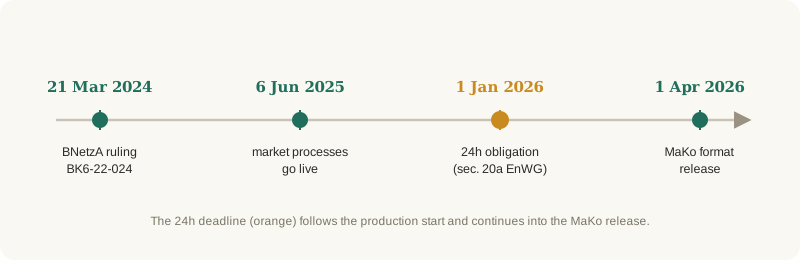
| Date | Event | Content |
|---|---|---|
| 21 March 2024 | BNetzA ruling BK6-22-024 | sets out the accelerated supplier switch |
| 6 June 2025 | go-live | new market processes, end of the asynchronous model, first API process |
| 1 January 2026 | 24h obligation | technical switch within 24 hours, Section 20a EnWG |
| 1 April 2026 | MaKo format release | UTILMD, EBD 4.2, check identifiers 3.3 as a follow-on project |
6 June 2025 was the binding operational go-live, postponed from the original 4 April 2025 by a BNetzA notice. The new market processes have run since then, the first API process for MaLo identification is mandatory and the asynchronous model has ended. 1 January 2026 is the statutory end date of the 24-hour obligation. The MaKo format release of 1 April 2026 is a separate follow-on project and should not be conflated with the LFW24 obligation. The release train has run on since then, and the next stop is small: notice no. 58 makes just three documents binding on 1 April 2027.
German and EU perspective
The acceleration is not a German special path but EU law. Article 12 of the electricity market directive requires the 24-hour switch across the EU, and Germany implements it through Section 20a EnWG. The BNetzA steers the concrete processes and data formats through its Ruling Chamber 6 and actively moved the start date from 4 April to 6 June 2025.
The market is in motion: in 2024 the BNetzA counted around 7.1 million electricity supplier switches, up about 18 percent on the previous year, plus 2.2 million gas supplier switches. Households saved around 2.2 billion euro through switches and contract adjustments. These switch volumes will run through the faster process in future, which raises the pressure for stable automation. Municipal utilities and small suppliers with grown IT estates are particularly challenged.
Why the EU origin matters: Because the 24-hour switch is anchored across the EU, it is not a negotiable national detail but a lasting direction. Whoever automates the processes cleanly now meets not only the German deadline but also stays compatible with an increasingly integrated European electricity market.
Challenges and risks
The deadline pressure meets real IT and data problems. The short processing windows demand a high degree of automation that not every house reaches. An honest view has to name the risks openly, rather than selling LFW24 only as an efficiency gain.
In a DSAG survey of May 2025, 83 percent of the energy companies surveyed expected that they could not implement the requirements fully or only to a limited extent, and 81 percent considered the deadline extension insufficient. 83 percent were still working with SAP ERP ECC, only 17 percent with S/4HANA. Data quality thus becomes the bottleneck: without clean MaLo-IDs, clarification cases pile up at the 24-hour pace. Because retroactive postings are gone, the risk of expensive replacement and default supply rises where assignments do not match. The risk of slamming through unwanted switches also grows structurally, because the checking time gets shorter.
Watch the data quality: Whoever plans LFW24 as a pure IT project and does not fix master data quality first only shifts the problem. Wrong or missing MaLo-IDs generate clarification cases at the 24-hour pace that are hard to catch manually in a tight window and quickly turn into expensive default supply.
The sanction frame is real: Section 20a EnWG provides for civil-law damages with a reversed burden of proof, and the switch must be free for customers. The supplier or grid operator has to prove that they are not responsible for a delay. That makes clean, automated processes not only an operational but also a legal duty.
What companies should do now
The economically sensible answer to LFW24 is a process and data strategy, not an isolated IT project. Whoever cleans up master data now and automates clarification cases avoids expensive emergency runs and stays able to act at the 24-hour pace. A regulatory duty then becomes a stable foundation for the further digital work in market communication.

-
Clean up master data and MaLo-IDs
Clean up MaLo-ID stocks, assignments and master data before live operation. Because the grid operator is no longer the hub, your own data quality decides whether switches run without errors at the 24-hour pace or end in clarification cases.
-
Move IT to real time
Check ERP, billing and market communication for real-time capability and put the API web service for MaLo identification and the AS4 connectivity into production. Legacy systems fit poorly with the tight two-hour and 24-hour windows.
-
Automate clarification cases and default supply
Automate clarification, cancellation and default-supply processes as far as possible, with defined approval levels for AI agents in market communication. At the 24-hour pace there is no time for manual rework, and unresolved assignment gaps quickly turn into expensive default or basic supply.
-
Plan MaKo 2026 as a follow-on project
Couple LFW24 to the wider roadmap and plan the MaKo format release of 1 April 2026 as its own follow-on project. The same clean data base carries several duties and makes the investment valuable beyond a single release.
LFW24 is at heart a process and data topic with a regulatory clock. Whoever cleans up master data, connects the API path cleanly and automates clarification cases keeps the mass operation stable. The same data base also carries the smart meter rollout and grid control under Section 14a EnWG, making the investment valuable across several duties.
Deadline, market roles, systems
1 January 202624-hour supplier switch: statutory duty since 2026Law · in force
If the deadline is missed: Regulator can enforce The Federal Network Agency can order compliance with Section 20a(2) EnWG and ruling BK6-22-024 under Section 65 EnWG and enforce it with coercive fines of up to EUR 10 million (Section 94 EnWG). If the switch is not completed in time, the final customer can claim damages from the supplier or network operator responsible for the delay, which bears the burden of proving it is not responsible (Section 20a(4) EnWG). Affected customers and market partners can also demand remedy and cessation under Section 32 EnWG, and damages where there is fault. For network operators a breach is also an abuse of their market position (Section 30(1) sentence 2 no. 1 EnWG). The regulator can require it to stop (Section 30(2)) and can also establish it after the fact (Section 30(3)); for distribution system operators with fewer than 100,000 customers whose network does not extend beyond one federal state, the state regulatory authority is responsible (Section 54(2) no. 8). Section 95(1) nos. 4 and 3(b) EnWG threaten fines of up to EUR 1 million for the abuse and for breaching an order to stop it (Section 95(2) no. 3). Those affected can apply for abuse proceedings (Section 31) and claim removal, injunctive relief or, where there is fault, damages (Section 32 EnWG). Legal basis ↗
- Electricity grid operatorrole obligationConfirms registrations and deregistrations within the 24-hour cycle and keeps MaLo ID master data current.Typically affected: Market communication gateway (EDIFACT, AS4, API), SAP IS-U / S/4HANA Utilities, EDM / MDM
- Gas grid operatorcheck applicabilityChecks how the statutory 24-hour switch is implemented for gas while the gas switching processes remain unchanged.Typically affected: Market communication gateway (EDIFACT, AS4, API), SAP IS-U / S/4HANA Utilities
- Default metering point operatoraffectedDelivers meter readings and master data fast enough for the switch to complete within 24 hours.Typically affected: Market communication gateway (EDIFACT, AS4, API), EDM / MDM
- Supplierrole obligationCompletes supplier switches via the MaLo ID within 24 hours on every working day.Typically affected: Market communication gateway (EDIFACT, AS4, API), SAP IS-U / S/4HANA Utilities
A classification for typical market roles, not a review of your individual case and not legal advice. Whether an obligation applies to your company (thresholds, exemptions) is for your legal department or counsel to confirm. The calendar doesn't replace your own deadline review. Information as of: 27 October 2026.
Further reading
Frequently asked questions
LFW24 is the accelerated supplier switch in the German energy market. It implements Section 20a EnWG, which rests on Article 12 of the EU electricity market directive 2019/944, and is set out in detail by BNetzA ruling BK6-22-024 of 21 March 2024. From 1 January 2026 the technical switch at the market location must be possible within 24 hours and on every working day. The new market processes have been live since 6 June 2025.
The statutory 24-hour deadline under Section 20a EnWG applies from 1 January 2026. The binding operational go-live of the new market processes was already 6 June 2025, postponed from the original 4 April 2025. So 1 January 2026 is the legal end date that the process start preceded.
No. The 24 hours only cover the technical registration step at the market location. The total time from the customer's order must still not exceed three weeks (Section 20a (2) EnWG). The earlier three-week switch is not abolished; its technical core is accelerated to 24 hours.
The grid operator loses its role as the central master-data hub; master data is distributed directly in a star pattern. The asynchronous model of standard load profile balancing ends, so grid use and balancing run synchronously. The MaLo-ID becomes mandatory and is determined via an API web service with a two-hour response deadline. API web services add to EDIFACT for market location identification, EDIFACT stays, AS4 is the mandatory transport protocol, and the supply-start lead time falls from eight working days to one.
The market location identifier (MaLo-ID) becomes mandatory with LFW24. Without a correct MaLo-ID no switch is possible. A preceding identification process has determined it since 6 June 2025 via an API web service with a two-hour response deadline. A clean master-data base is therefore the precondition for switches to run without errors at the 24-hour pace.
Let's collaborate
One contact, a team behind it
Thirty minutes on what you're working on, whether grid, metering, market processes, IT architecture or AI. Afterwards you'll know how we'd approach it and who would sit at the table.
Energy and measurement technology since 2010 · innobu GmbH since 2014 · Based in Schleswig-Holstein, Germany
Whoever pitches also delivers: whoever leads the first call stays your contact right through to the steering committee, with established partners in the project. Direct: info@innobu.com