German Bidding Zone Split: The 2026 Decision
One electricity price for all of Germany. It sounds fair, yet it hides that generation and demand sit far apart. The north has wind, the south has the load, and the lines between them are missing. The European Bidding Zone Review wanted that tension inside the price system and recommended five zones. The government said no. The question is not settled, though. It only moves.
Germany and Luxembourg form a single electricity bidding zone with one nationwide exchange price. The European Bidding Zone Review assessed 14 alternative configurations and recommended a split of Germany-Luxembourg into five zones on 28 April 2025, because it showed the largest efficiency gain at 251 to 339 million euro per year. The EU regulator ACER puts the benefit around 70 percent higher. The German government published its Bidding Zone Action Plan on 18 December 2025 and decided to keep the single zone. Instead of restructuring the market it relies on grid expansion and better congestion management, which cost about 2.78 billion euro in 2024. The Kopernikus project Ariadne calculates that regional prices would steer flexibility to where the grid needs it. For companies, the siting and flexibility question stays open, even without a split.
Why the decision carries such weight
On the German power exchange, one wholesale price applies, for Kiel as for Munich. This single bidding zone is the heart of the debate. It hides that the cheap wind power is generated in the north while the large load sits in the south, and that the lines between them often cannot carry the transport. The price then says nothing about local scarcity.
That is exactly what the European Bidding Zone Review set out to correct. At the end of 2025 the government decided not to split the zone. The debate is not over, though. It shifts to the question of whether the planned alternatives are enough. Anyone planning assets or building market processes today has to factor in that open flank.
Three numbers, one conflict. One zone today, five recommended, and billions every year for interventions that offset exactly the north-south gap a uniform price ignores. That is the core: the market pretends power is equally available everywhere. The grid shows every day that it is not.
The Bidding Zone Review and the five zones
The Bidding Zone Review is an EU-mandated process, not a German initiative. The transmission system operators had to check whether the existing zones still reflect the grid congestion sensibly. On 28 April 2025 they published their study, and for Germany the result was clear.
Five zones for Germany-Luxembourg, that was the recommendation with the strongest efficiency gain. ENTSO-E itself grew cautious: the result follows the methodology set by ACER and does not capture every relevant aspect. The regulator ACER, in turn, criticised the assumptions as too conservative and puts the real benefit around 70 percent higher. Two European institutions, one study, and already no agreement.
For a split market the same logic applies as across the wider EU electricity market design: the price should point to where power is scarce. Only the German debate draws a different conclusion from that than Brussels.
Why the government keeps a single zone
The German government published its Bidding Zone Action Plan on 18 December 2025 and held on to the single zone. Its core argument is the nationwide uniform price: it secures liquidity and prevents consumers and generators from paying or earning differently by region.
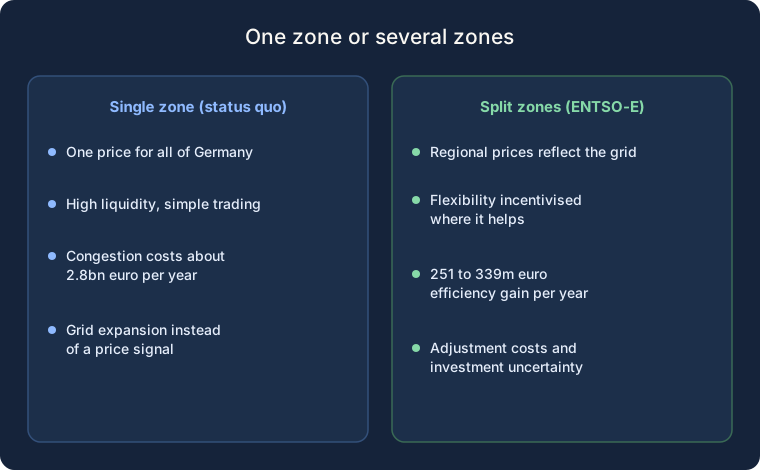
The plan names several concerns. A split would create investment uncertainty. It would question the viability of individual power plants and assets. And the simulated welfare gains for 2025 would, according to the ministry, fall well short of the estimated adjustment costs. On top of that comes an industrial-policy argument in a difficult economic climate.
Instead of restructuring the market, the action plan leans on three levers: more transmission capacity, optimised congestion management, and better coordination of grid, generation, consumption and storage. The bet behind it is that building the large direct-current corridors will shrink the congestion before a split could deliver its benefit. The government submitted the plan to the European Commission, as the electricity market directive requires. Whether Brussels accepts it is open.
The counter-position: efficiency and flexibility
Experts and the EU level push back. The independent expert commission monitoring the energy transition calls regionally differentiated prices a central efficiency lever. The Kopernikus project Ariadne followed up in March 2026 and shows what regional prices would do in practice: they steer flexibility to where it helps the grid.

The calculation is concrete. A battery in the north would reach two full charge-discharge cycles a day instead of 1.4, because buffering surplus pays off. Electrolysers would have an incentive to locate in the cheaper north rather than pull expensive power over long distances. This grid-serving siting of storage also runs through the experience with virtual power plants and battery storage. That is the real dispute: not the price today, but where it steers the next investment.
Ariadne itself tempers the fear of price jumps. In the north, wholesale prices would tend to fall thanks to the high share of renewables, in the south rise slightly, on average staying roughly at today's level. The claim that a regional price makes the south permanently expensive holds up only partly against the modelling. Regional price signals are also the core of new tariff models for a controllable electricity market.
What the congestion costs
How large the north-south problem is shows in the price of doing nothing. Because lines are missing, grid operators have to intervene daily: curtail wind turbines in the north, ramp up power plants in the south. This congestion management costs billions, and the bill lands with consumers through the grid fees.
The cost fell in 2024, that is true. But it fell for cyclical reasons, not because the underlying problem was solved. Around 74 percent of the congestion sat in the transmission grid, exactly where wind power from the north would need to travel south. A regional price would trigger curtailment earlier and market-based, instead of catching up with it through expensive emergency interventions. How this congestion management works today shows in the shift to Redispatch 3.0.
The billions for congestion management are not a minor item, they are the price of market and grid drifting apart. They flow into every electricity bill through the grid fees. The current AgNeS network tariff reform redistributes exactly these burdens.
Challenges and risks
A zone split is no sure thing, and keeping a single zone has a price too. Both paths carry risks. Anyone who counts only the upside of one side underestimates the cost of the other.
| Path | The central risks |
|---|---|
| Split into several zones | regional price differences, high adjustment costs, long implementation time, uncertainty for existing contracts and investments |
| Keep the single zone | continuing congestion costs, criticism from the European Commission, the risk that the problem grows without real reforms |
| Grid expansion as a substitute | the build-out of the large direct-current corridors is delayed and stays expensive, the promised effect arrives late |
Manfred Weber of the think tank EPICO KlimaInnovation holds against the action plan that it lacks substantive reforms. As long as those are missing, he argues, the congestion problem threatens to grow. That is the sore spot of the German position: it defers the solution to a grid build-out that is itself behind schedule.
The action plan is not a full stop, it is an interim decision. The European Commission is still assessing it, and the next Bidding Zone Review will come. A later reversal stays possible, and it is exactly that uncertainty that is the real burden for investors.
What companies should do now
Waiting for the final clarity is not an option, because price signals change even without a split. The action plan reshapes congestion management, and regional differences grow finer. Anyone planning today should think about location, not just price.
Five steps to prepare
-
Map the regional price picture
Place your sites in the north-south pattern of generation, load and congestion. Work out which assets would gain from regional price differences and which would lose. This map is the basis for every further decision.
-
Site flexibility where the grid needs it
Plan batteries, electrolysers and controllable loads where they relieve the grid. In the north that means buffering surplus, in the south bridging scarcity. Location decides the return once price signals grow more regional.
-
Upgrade market and IT processes
Design trading, forecasting and settlement systems so they can handle finer congestion management and possible regional prices. Systems that know only a nationwide price are quickly overwhelmed by a later reform.
-
Check contracts for regional risk
Review existing supply and PPA contracts for how they would react to regional price differences. Where it fits, add clauses for a later reform, so a zone split does not devalue a contract.
-
Watch the regulation
Follow the EU assessment of the action plan and the progress of the next Bidding Zone Review. The legal situation can change, and an early signal is worth more than a late reaction under time pressure.

In the end, it does not matter whether the zone is split next year or not. What matters is whether your investments can live with both outcomes. Anyone who makes their sites and contracts resilient against regional prices is prepared either way. Effort? Yes. But it starts with a map, not a billion-euro budget.
Further reading
Frequently asked questions
A bidding zone split means dividing today's single German-Luxembourg electricity bidding zone into several smaller zones, each with its own wholesale price. Instead of one nationwide exchange price there would be regional prices that show where power is scarce and where it is plentiful. The European Bidding Zone Review assessed 14 configurations and recommended five zones for Germany-Luxembourg.
The German government published its Bidding Zone Action Plan on 18 December 2025 and decided to keep the single zone. Instead of restructuring the market it relies on more transmission capacity, optimised congestion management and better coordination of grid, generation, consumption and storage. It submitted the plan to the European Commission.
The European transmission system operators published a study of 14 zone configurations on 28 April 2025. For Germany-Luxembourg they recommended a split into five zones, because it showed the largest economic efficiency gain at 251 to 339 million euro per year. ENTSO-E cautioned that the result follows the methodology set by ACER and does not capture every relevant aspect.
The government argues that a nationwide uniform price secures high liquidity and prevents regional cost differences for consumers and generators. A split would, in its view, create investment uncertainty and question the viability of individual plants. It also states that the simulated welfare gains fall short of the estimated adjustment costs.
Congestion management cost about 2.78 billion euro in 2024, down from around 3.34 billion euro in 2023. About 74 percent of the underlying congestion in 2024 sat in the transmission grid. Consumers carry these costs through grid fees. They reflect the north-south problem: wind power is generated in the north, the large load sits in the south, and lines between them are missing.
Even without a split, price signals change because the action plan reshapes congestion management. Companies should align siting decisions for batteries, electrolysers and flexible loads with the regional grid and price picture, prepare their IT and market processes for finer congestion management, and watch the EU assessment of the action plan and the next Bidding Zone Review.