Calibration-Compliant Billing of Charging Electricity for Company-Car Fleets
The German Federal Ministry of Finance has scrapped the convenient monthly amounts. Anyone who wants to keep reimbursing home charging for electric company cars tax-free now needs real kilowatt-hours.
With the BMF letter of 11 November 2025 the tax-free monthly flat rates of 70, 35, 30 and 15 euros for charging electric and hybrid company cars end on 1 January 2026. Home charging electricity can only be reimbursed tax-free under section 3 no. 50 EStG against proof of the actually charged kilowatt-hours. Two valuation paths remain: the employee's individual electricity price including a proportional base fee, or an electricity flat rate of 34 cents per kilowatt-hour for 2026. The method has to be fixed per employee for the whole calendar year. At the meter, the calibration authorities draw the decisive line: in the one-to-one setup, one user, one vehicle, one contract, a fixed, conformity-assessed MID meter that measures only the charging current is enough. A fully calibration-compliant wallbox is not needed for this, whereas a mobile meter in the charging cable is not permitted. As soon as several users or vehicles share a point, dynamic tariffs apply or billing is semi-public, the full Measurement and Calibration Ordinance applies with a calibration-compliant charging device. For fleets this means: inventory the charging points, choose the right meter per setup and document the values in an audit-proof way.
What the BMF letter of 11 November 2025 changes
For years a fixed monthly amount was enough. Anyone who drove an electric company car and charged it at home was reimbursed for the electricity tax-free at a flat rate, without a single meter reading. Convenient, but crude. That ended on 1 January 2026.
The BMF letter of 11 November 2025 scraps the four familiar flat rates and ties tax-free reimbursement to real proof. The basis remains section 3 no. 50 EStG, the tax-free reimbursement of expenses. What is new is the condition: without measuring the energy charged at home, there is no tax-free reimbursement any more. The rule applies until 31 December 2030 and covers company-owned vehicles.
The reason for the switch is simple: the flat rate often missed the real charged quantity, sometimes too high, sometimes too low. The proof is more accurate but costs effort. That effort is the new task, and it does not fall to the tax department but to the charging point.
Two paths to tax-free reimbursement
Anyone who knows the charged quantity still has to convert it into euros. For that the BMF allows two paths. Both require the measurement, they differ only in the price placed on the kilowatt-hours.
- Individual electricity price: the employee's real unit price including a proportional base fee, proven via their own electricity bill. Accurate, but maintenance-heavy, because the tariff can change.
- Electricity flat rate: 34 cents per kilowatt-hour for 2026, applied to the proven quantity. The value is derived from the household electricity price of the Federal Statistical Office for the first half of 2025 and is reviewed annually.
One detail decides the effort: the method once chosen applies per employee for the whole calendar year. Switching from month to month, whichever is cheaper at the time, is not allowed. So anyone managing many vehicles fixes the method once and sticks with it. For the technical side, how a charging park is digitally connected to the grid, separate rules apply.
Where calibration law applies and where it does not
As soon as what was measured gets billed, the next question is not a tax question but a measurement one. Which meter may deliver a commercial measured value? Here many fleets had feared an expensive full setup. The calibration authorities clarified in early 2026 that this is often not needed.

The decisive case is the one-to-one setup: one user, one vehicle, one contract. Then home charging is treated similarly to normal household electricity under calibration law.
- A MID meter is enough: a fixed, conformity-assessed meter that records only the charging current. A fully calibration-compliant wallbox is not mandatory in this case.
- Fixed, not mobile: a mobile MID meter plugged between the socket and the charging cable does not match the intended use case of the Measuring Instruments Directive and is not permitted for billing.
- Only the charging current: the meter has to separate company-car electricity cleanly from the rest of the household consumption, otherwise the quantity is not reliable.
Sounds like an all-clear. But it has a clear limit. The simple solution only holds as long as the setup really stays one-to-one. Once it no longer is, the picture changes, and in a fleet that is the normal case.
What applies to company-car fleets in practice
For a single company car at home the situation is manageable. In a fleet it quickly tips into the complex variant: shared charging points at the depot, changing vehicles at the same unit, semi-public points for guests. Then the simple MID meter is no longer enough.
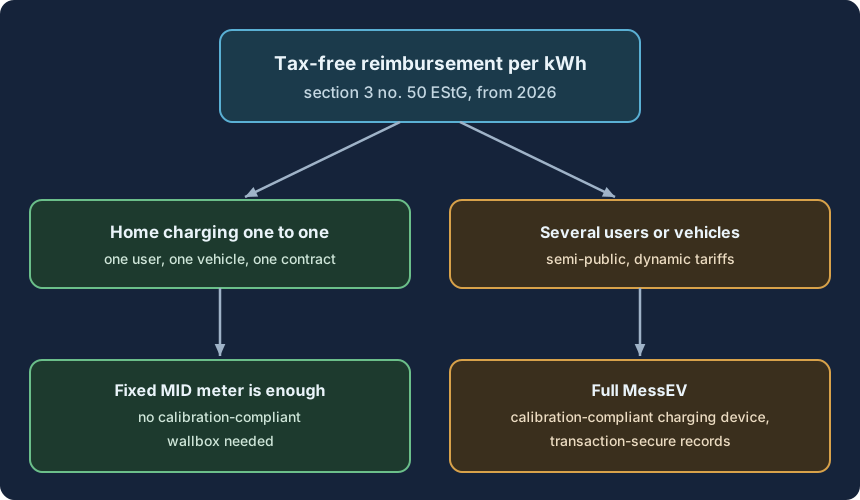
When the full Measurement and Calibration Ordinance applies can be pinned to three triggers:
- Shared charging points: if several users or vehicles share a point, a calibration-compliant charging device with transaction-secure individual records is needed. Only then can each charged quantity be clearly assigned to a vehicle.
- Dynamic tariffs: if the price changes often, the charging device has to record quantity and time reference in a legally secure way. A simple meter reading is not enough then.
- Semi-public charging: wherever billing goes beyond the own household, the same standard applies as at the public charging station.
For the public side this is nothing new. How charging points and mobility providers bill via eRoaming and OCPI shows that transaction-secure measured values have long been the standard there. For the fleet it means sorting the own charging infrastructure by the same criteria: where is it one-to-one, where is it shared.
Data handling and proof
The meter delivers the kilowatt-hours. But the tax exemption hangs on the documentation. Values that nobody records in an audit-proof way survive no tax audit, no matter how accurately the meter measures.
- Record separately: the charged quantities have to be kept per employee and per vehicle, provably separated from the rest of the household consumption.
- Document readably: the reading can be taken at the meter, via the wallbox or from the vehicle, as long as the values are verifiable.
- Store audit-proof: records, meter readings and the chosen valuation method belong in the payroll account and have to be kept for the retention periods.
The raw material for this is clean measured data, as also produced by smart charging via OCPP. The more the charging points deliver their values automatically and machine-readably, the less the monthly reading becomes manual work. That is the real lever: not the single meter, but the path from the meter reading into the billing system.
No quantity proof, no tax-free reimbursement. If the charging electricity is reimbursed anyway, the payment is taxable and contribution-liable wages. Documentation per employee and per vehicle is therefore not a by-product but the condition for the tax exemption.
What fleet operators should do now
The transition is manageable if measurement, valuation and documentation are thought through together. Anyone who first retrofits meters and then builds the processes does the work twice and has a gap in the proof in the first months of the year.

-
Inventory the charging points
Record the setup for each charging point. A private one-to-one point gets a fixed MID meter. A shared or semi-public point needs a calibration-compliant charging device. This assignment is the basis for everything that follows.
-
Fix the valuation method per employee
Decide for each driver whether the individual electricity price or the 34-cent flat rate applies, and keep the choice for the whole calendar year. A change during the year is not allowed, so it is better to decide once and cleanly.
-
Automate reading and storage
Make sure meter readings flow into the billing system monthly and audit-proof, ideally machine-readable from the charging infrastructure. The less manual work, the smaller the risk that the proof is missing at year-end.
The new obligation is not a tax question but a measurement one. Anyone who sorts the charging points by setup, fixes the valuation method per employee for the year and automates the reading keeps reimbursing charging electricity tax-free and survives the tax audit with documented figures instead of estimates.
Further information
Frequently asked questions
It scraps the previous tax-free monthly flat rates for charging electric and hybrid company cars from 1 January 2026, namely 70, 35, 30 and 15 euros depending on the vehicle and whether charging at the employer is available. From 2026, tax-free reimbursement under section 3 no. 50 EStG is tied to proof of the actually charged kilowatt-hours. The rule applies until 31 December 2030 and covers company-owned vehicles.
Not necessarily. The calibration authorities clarified on 9 January 2026 that for home charging in the one-to-one setup, one user, one vehicle, one contract, a fixed, conformity-assessed MID meter that measures only the charging current is enough. A fully calibration-compliant charging device is only required once several users or vehicles share a charging point, billing is semi-public or dynamic tariffs apply.
34 cents per kilowatt-hour. It is applied to the proven charged quantity and is derived from the household electricity price of the Federal Statistical Office for the first half of 2025. The flat rate does not replace the measurement, it only values the measured quantity.
As soon as several users or vehicles share a charging point, the full Measurement and Calibration Ordinance applies. Then a calibration-compliant charging device with transaction-secure individual records is required. Each charging point needs its own meter that can be clearly assigned to a vehicle, so that company-car electricity and household electricity stay separate. A mobile MID meter in the charging cable is not permitted for this.
Without a quantity proof, tax-free reimbursement has not been possible since 1 January 2026. If the charging electricity is reimbursed anyway, the payment is taxable and contribution-liable wages. That is why the charged quantity must be recorded separately per employee and per vehicle and documented in an audit-proof way in the payroll account.
Let's collaborate
One contact, a team behind it
Thirty minutes on what you're working on, whether grid, metering, market processes, IT architecture or AI. Afterwards you'll know how we'd approach it and who would sit at the table.
Energy and measurement technology since 2010 · innobu GmbH since 2014 · Based in Schleswig-Holstein, Germany
Whoever pitches also delivers: whoever leads the first call stays your contact right through to the steering committee, with established partners in the project. Direct: info@innobu.com