
eRoaming: Hubject Moves to OCPI and Ends Protocol Fragmentation
For years, EV charging roaming ran on two protocols in parallel: Hubject's OICP and the open OCPI. Reaching both worlds meant integrating twice. Since September 2025, Hubject supports OCPI natively. The major roaming hubs now speak the same language. This article explains what roaming actually does, why there were two worlds, what OCPI can do today, how the AFIR deadlines in 2026 fit, and what operators and mobility providers should do now.
A long-running fragmentation in EV charging roaming is ending. Hubject, the largest German roaming hub, is not abandoning its proprietary OICP protocol, but it now places the open Open Charge Point Interface next to it, natively. The hub joined the EVRoaming Foundation as a Full Contributor on 3 September 2025 and connects, by its own figures, more than 1 million public charge points and over 2,750 partners across more than 70 countries. For the first time, all major roaming hubs speak OCPI. For charge point operators (CPO) and e-mobility service providers (eMSP), the obligation to pick one protocol world, or run both, falls away. OCPI is currently at version 2.3.0, with fields for AFIR compliance, while the widely deployed base is still 2.2.1. The consolidation coincides with the AFIR deadlines in 2026: new technical requirements from 8 January, DATEX II data reporting from 14 April. But a standard does not solve everything. Data quality stays with the operators, and partner validation can take months. For companies, the message is clear: align the roaming strategy with OCPI and treat the deadlines as a fixed frame.
A single standard for charging roaming
The largest German roaming hub, Hubject, has stepped away from going it alone with its own protocol. Since September 2025 it speaks OCPI natively, the open Open Charge Point Interface. For the first time, all major roaming hubs talk in the same language. This is more than a technical detail.
The Foundation membership dates to 3 September 2025, as a Full Contributor. Hubject offers OCPI not instead of but alongside its existing OICP, a dual stack with automated protocol bridging. CEO Christian Hahn puts the reason plainly: open standards only succeed when they are accessible at scale. That scale is exactly what the hub has.
More than 1 million public charge points, over 2,750 partners, more than 70 countries. When a network of that size swings to an open standard, the market shifts. The years-long choice between two protocol worlds is gone.
Why there were two worlds
Roaming means this: a driver charges at a station whose operator is not their contract partner, and is still billed correctly. For that to work, two roles exchange data all the time. The charge point operator, CPO for short, runs the station. The e-mobility service provider, the eMSP, gives the driver a contract and an app.
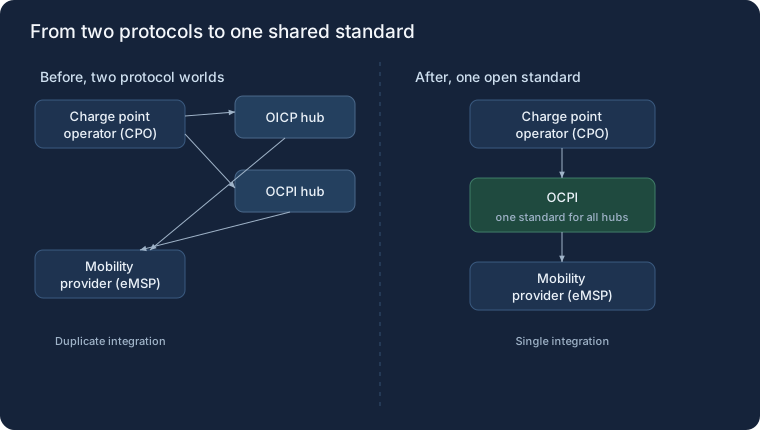
Between CPO and eMSP stood two competing protocols for a long time. OICP was tied to Hubject and hub-centric. OCPI comes from the open community and also allows direct partner-to-partner connections. Reaching both hubs meant two integrations. That costs time, money and creates errors at exactly the interface the driver notices last.

The security requirements for exactly this chain are set out in the guidance on the IT security of charging infrastructure. Roaming is the part that connects the networks in the first place. A shared protocol makes that connection simpler and easier to audit.
What OCPI can do today
OCPI is an open standard from the EVRoaming Foundation and covers the whole roaming chain: locations, tariffs, sessions, charge detail records, tokens and remote commands. The current version is 2.3.0. Many hubs still run 2.2.1 in production. The difference is not cosmetic. It is a question of regulation.
| OCPI version | Year | What it brings |
|---|---|---|
| 2.2.1 | 2021 | Widely deployed production base, calibration-law support, hub connectivity, more role flexibility. The version most connections run on today. |
| 2.3.0 | 2024 | Fields for AFIR compliance, heavy-duty and freight charging, finer pricing components, hooks for Plug and Charge. Aimed straight at EU regulation. |
| 3.0 | in development | Support for ISO 15118 and Plug and Charge, charging without a card or app. The vehicle authenticates over the cable. |
The distinction from OCPP matters here, since the two are often named in one breath. OCPP connects the charge point to its backend, OCPI connects backends to each other. One controls the hardware, the other the roaming. The next step up, charging via ISO 15118 and Plug and Charge, targets exactly where OCPI 3.0 is heading.
European perspective: AFIR 2026
The timing is no accident. The consolidation coincides with the AFIR regulation taking effect, the EU legal frame for charging infrastructure. From 8 January 2026 new technical requirements apply to public charge points. From 14 April 2026 the data reported under AFIR Article 20 must be provided in DATEX II format.
OCPI is the layer over which CPO, eMSP and roaming platforms exchange location, tariff and availability data. The state-facing reporting under AFIR ends up in DATEX II, but the data comes from the same chain. How the DATEX II data obligation for charging infrastructure works in detail is a topic of its own. A single roaming protocol lowers the barrier to meeting both obligations cleanly.
There is also a market rule with teeth. Operators may not discriminate against mobility providers on pricing, neither towards end customers nor among each other. An open standard makes that non-discrimination checkable, because everyone queries through the same interface. Across the EU, national access points and public bodies are pushing standardisation further.
Challenges and risks
A shared standard does not solve everything. It is a frame, not a guarantee. OCPI defines how data looks, not whether it is right. Wrong tariffs and stale availability stay possible, and the driver meets them at the station, not in the protocol.
The standard unifies the format. Whether tariff and location are maintained correctly still rests with the operator. This is where drivers feel the most friction today.
The real bottleneck is rarely the protocol. Partner validation, until a new connection goes live, can take up to six months according to field reports.
Hubject stays a commercial hub with SLAs, settlement and certificate handling. The open standard lowers integration cost, not the hub fee.
Then there is the transition. Different protocol versions keep running side by side in the field, 2.2.1 next to 2.3.0, OICP next to OCPI. Hubject's dual stack exists for exactly that, but it still demands bridges and tests. A standard on paper is not yet a unified field.
What companies should do now
For operators and mobility providers the course is clear: align the roaming strategy with OCPI, treat the AFIR deadlines in 2026 as a fixed frame. Anyone still on OICP alone should check the migration path without breaking existing connections. Four steps, roughly in this order.

The plan for the OCPI migration
-
Check the OCPI version
Clarify which OCPI version runs in your own backend and at your provider, 2.2.1 or 2.3.0. Only 2.3.0 carries the AFIR fields. The version decides what can be reported in compliance without a workaround.
-
Clean up data quality
Review and correct location and tariff data before the AFIR reporting. The standard transports wrong data just as reliably. Cleanliness at the source is cheaper than a correction across the whole roaming chain.
-
Agree the migration plan
Arrange the path from OICP to OCPI with the hub and use the dual stack as a bridge. Existing connections stay, new ones run over the open standard. No hard cut, a switch with a safety net.
-
Start validation early
Kick off partner validation long before the deadline bites. When onboarding can take months, the late start is the real risk, not the technology.
The eRoaming consolidation is no free ride, but a clear tailwind. One standard lowers integration cost and makes the AFIR obligations easier to meet. The rest, data quality and timely validation, stays homework. How the next charging generation builds on this with bidirectional charging and V2G is covered in its own piece.
Further reading
Frequently asked questions
eRoaming means a driver can charge and be billed correctly at a station whose operator is not their contract partner. To make this work, the charge point operator (CPO) and the e-mobility service provider (eMSP) continuously exchange location data, tariffs, availability, authorisations and billing records. Roaming hubs or direct connections handle that exchange over a shared protocol.
OCPI, the Open Charge Point Interface, is an open standard from the EVRoaming Foundation for data exchange between CPO and eMSP. OICP is the older protocol tied to Hubject. For years both ran in parallel, and reaching both worlds meant two integrations. Now that Hubject supports OCPI natively, the major roaming hubs speak the same open standard.
Hubject joined the EVRoaming Foundation as a Full Contributor on 3 September 2025 and supports OCPI natively alongside its own OICP. The hub connects, by its own figures, more than 1 million public charge points and over 2,750 partners across more than 70 countries. With the open standard, partners no longer have to pick one protocol world or run both at extra cost.
The current version is OCPI 2.3.0, released in 2024. It adds fields for AFIR compliance, heavy-duty charging and finer pricing components. The widely deployed production base at many hubs is still 2.2.1 from 2021, with calibration-law support. Version 3.0 is in development and targets ISO 15118 and Plug and Charge, charging without a card or app.
From 8 January 2026 new AFIR requirements apply to public charge points, and from 14 April 2026 the data reported under AFIR Article 20 must be provided in DATEX II format. OCPI is the layer over which operators, mobility providers and roaming platforms exchange this location, tariff and availability data. A single roaming protocol lowers the barrier to meeting these data obligations.