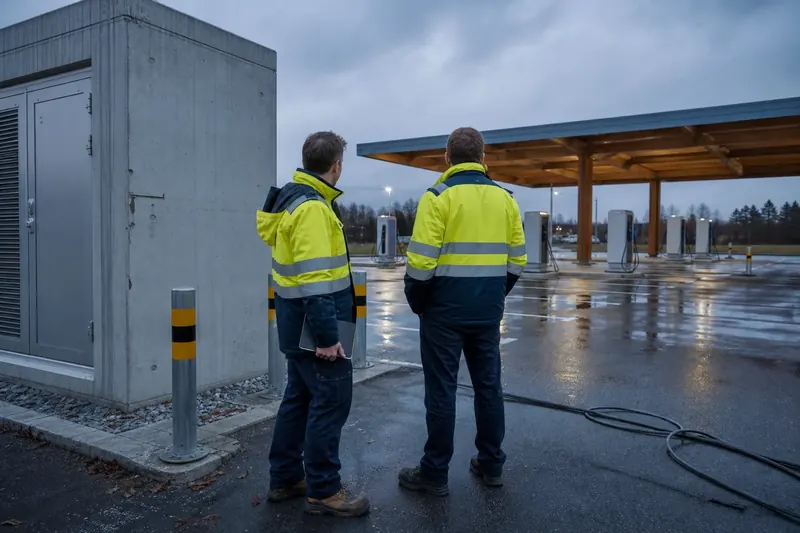
Grid Connection Bottlenecks for Charging Parks
There are enough chargers. The power still does not arrive. Germany is building charging infrastructure fast, but the grid connections cannot keep up, and for a large fast-charging park on the medium-voltage grid, many months pass between planning and commissioning. Why does the bottleneck sit with the grid operator? How does the connection under VDE-AR-N 4110 work? What does the 2026 grid connection package with the new sections 17a to 17f EnWG change, and how does digital processing help? A note up front: much of this is interim, part of an ongoing legislative process, not final.
The charging rollout in Germany is not stalling at the charging point. It stalls at the grid connection. On 1 April 2026 around 200,255 public charging points were in operation, over 51,000 of them fast-charging points, a growth of about 17 percent per year. And yet, for powerful connections, operators report waiting times of over a year. The reason lies in the physics and in the procedure. Large fast-charging parks quickly reach connection loads in the megawatt range and therefore hang directly on the medium-voltage grid, where the formal procedure under VDE-AR-N 4110 applies: a connection request, a grid compatibility check, a binding offer, according to the rule within eight weeks of a complete application. Eight weeks turns into a year in practice, because grid capacity is scarce, applications arrive incomplete and the assessment runs by hand. This is exactly where the grid connection package, passed by the Federal Cabinet on 29 July 2026, takes hold. It adds sections 17a to 17f to the EnWG, replaces the pure first-come-first-served principle with transparent prioritisation, obliges grid operators to provide capacity maps updated monthly and a status update within two months, and mandates digital procedures for capacity inquiries from 135 kW by 2028. The real lever, though, is not the law but the grid operators' back office. Standardised data sets such as the VDE FNN data set, digital portals and automated capacity checks replace PDF forms and email loops. Not everyone welcomes the package. Industry associations call it managing scarcity, because the redispatch caveat softens the unconditional connection claim. For operators the practical answer is the same: check sites early against capacity maps, submit applications fully, use load management to lower the required connection power. All dates and values cited are interim, not final.
The bottleneck is the grid connection
The charger is built, the connection is missing. For years the question was whether enough chargers stand. Today it is whether the grid delivers the power. Between site planning and commissioning of a fast-charging park, many months often pass because the grid connection is missing or its realisation takes longer than planned. The order has flipped, and many project plans still assume the old one.
The numbers show the pace and the problem at once. Around 200,255 public charging points, over 51,000 of them fast, plus about 17 percent a year. Impressive. Yet for the large connections, industry representatives report waiting times of more than a year. The parks most affected draw several hundred kilowatts, along with charging hubs for electric commercial vehicles like those the Megawatt Charging System for e-trucks requires. Anyone planning such a park does not struggle with the charging technology. The struggle is the grid connection and the processing at the grid operator.
Why large charging parks hang on the medium-voltage grid
A fast-charging park with several HPC charging points quickly reaches a connection load of one megawatt and more. Low voltage cannot carry that. So the park is connected directly to the medium-voltage grid, and that means not a simple registration as with a wallbox, but the formal procedure under the application rule VDE-AR-N 4110.
The sequence is clearly structured and still slow. The connection request is followed by the grid compatibility check, then a binding connection offer, according to the rule within eight weeks of a complete application. Low voltage falls under VDE-AR-N 4100, medium voltage under VDE-AR-N 4110. Sounds like a predictable schedule. Three factors stretch it in practice: grid capacity at the site is often scarce, many applications arrive incomplete and trigger queries, and the assessment is still done by hand at many grid operators. Each of these costs weeks. That is how eight weeks in the rulebook becomes a year and more.
What the 2026 grid connection package changes
On 29 July 2026 the Federal Cabinet passed the grid connection package. It adds the new sections 17a to 17f to the Energy Industry Act and reorders connection procedures in three directions: prioritisation, transparency, digitalisation. For charging park operators, this changes the basic rule of access to the grid.
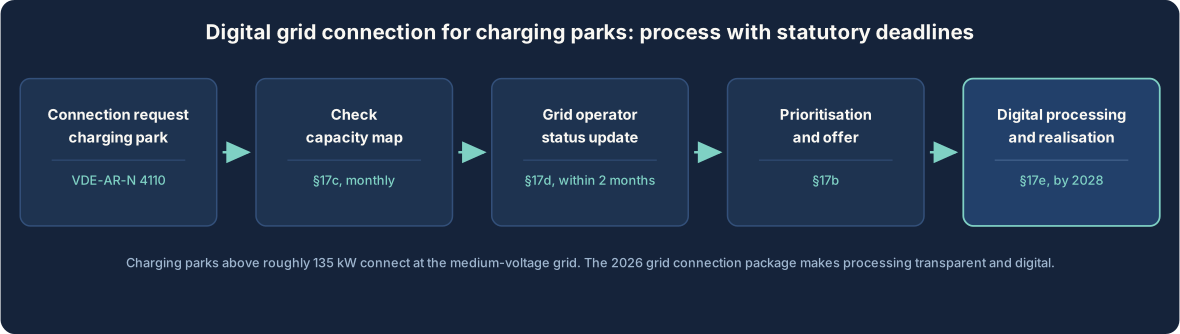
Five points matter for charging parks. First, transparent prioritisation replaces the pure first-come-first-served principle, where only the order of the application counts (section 17b). Second, grid operators must provide capacity maps with the available connection capacity and update them monthly (section 17c). Third, a status deadline applies: within two months of the application a response on the processing status arrives (section 17d). Fourth, the law mandates digital procedures for capacity inquiries from 135 kW by 2028 (section 17e). Fifth, new rules govern how capacity is reserved and released again, so blocked connection points do not clog up for good (section 17f). In short: a process that runs faster, shows more and plans better than today. Whether it holds depends on the execution.
Digital grid connection processes at grid operators
The real acceleration comes not from the law. It comes from the grid operators' back office. As long as applications arrive as PDFs and travel back and forth by email, no deadline in the world helps. Standardised data sets, digital portals, automated pre-checks: that is the lever that turns an obligation into a genuine shortening.

The building blocks are already there. The VDE FNN data set for grid connection portals, in version 3.0 since 15 April 2025, standardises the application data and also covers controllable consumption devices and their communication interfaces. Since 1 January 2024 consumption connections in low voltage must be applicable via the grid operator's website, and since 1 January 2025 generation facilities up to 30 kW must be standardised and digital too, as the grid connection portal obligation under §8 EEG sets out. You can build on that. A digital capacity map shows immediately whether power is free at the site. An automatic pre-check catches incomplete applications before they stall. Similar automation is already used by AI grid simulation for congestion analysis in network planning. And the Masterplan Charging Infrastructure 2030 points the same way: nationwide standardised digital application procedures, transparency on connection capacity, firm response deadlines including a rough realisation estimate.
Challenges and risks
The package does not solve every problem. It also creates new uncertainties. Anyone who only looks at the deadlines misses the flip side, because digitalisation alone builds no grid.
Dropping the pure first-come-first-served principle is a double-edged sword. Prioritisation can move sensible projects forward. It can also bring bureaucratic effort and non-transparent case-by-case decisions as long as federal uniform criteria are missing. Heavier still is the so-called redispatch caveat. Grid operators can classify areas as capacity-limited without an unconditional connection claim remaining and without full compensation for limited use. For the calculation of a charging park that is a risk hard to quantify. Industry associations therefore call the package managing scarcity: it administers missing grid expansion rather than fixing it. And digitalisation only works if data quality, interfaces and staff go along with it. A portal in front of unchanged manual processes stays a facade.
Caution with site calculations: A site with free capacity today can later be classified as a capacity-limited area. Reservation rules can also be abused if capacity is blocked speculatively. All rules and deadlines cited from the 2026 grid connection package are interim positions in an ongoing legislative process and not yet final.
The grid connection package shifts the bottleneck, it does not remove it. Transparency and digital processes shorten the processing, yet the available grid capacity stays limited. Those who plan early, lower their connection power and check sites against the capacity maps gain more time than any deadline alone promises.
What companies should do now
Start with the site and with your own load, not with the open detailed rules. Then the package turns into a concrete plan. Charging park operators and grid operators have different tasks here. They interlock.
A roadmap for both sides
-
Check the site early against capacity
Use the capacity maps as soon as they are available and clarify before choosing the site whether the grid carries the planned load. An early inquiry to the grid operator saves the most expensive mistake, namely planning a park where no connection is possible. This moves the check to the start rather than the end of the project.
-
Submit a complete connection request
Submit the connection request under VDE-AR-N 4110 complete from the start, with all technical details and load data. Incomplete applications are the most common reason for delays, because every query restarts the clock. A clean first application is the fastest route to the binding offer.
-
Plan load management from the start
Lower the required connection power with load management that distributes the charging power dynamically instead of sizing every charger for its full rating. Less connection power often means a simpler and faster connection. The logic of controllable consumption devices under §14a EnWG shows how load can be controlled in a grid-friendly way.
-
Grid operators: standardise and automate processes
Standardise the application data with the VDE FNN data set, automate the capacity check and connect the portal, the geoinformation system and the grid calculation. Only then can the two-month status deadline and the capacity maps be met technically. Without a clean data basis, every deadline stays a promise without cover.

Further Reading
Frequently Asked Questions
Powerful charging parks are usually connected directly to the medium-voltage grid and run through the formal procedure under VDE-AR-N 4110 with a connection request, a grid compatibility check and a binding offer. In practice operators report waiting times of over a year, because grid capacity is scarce, applications arrive incomplete and the assessment is still manual at many grid operators. The bottleneck therefore no longer lies at the charging point but at the grid connection and the processing.
The grid connection package, passed by the Federal Cabinet on 29 July 2026, adds the new sections 17a to 17f to the EnWG. It replaces the pure first-come-first-served principle with transparent prioritisation, obliges grid operators to provide capacity maps updated monthly, requires a status update within two months of the application and mandates digital procedures for capacity inquiries from 135 kW by 2028. All details are subject to the ongoing legislative process.
A fast-charging park with several HPC charging points quickly reaches connection loads of around one megawatt and more. Such loads can no longer be covered by low voltage and require a direct connection to the medium-voltage grid. This makes the application rule VDE-AR-N 4110 apply instead of VDE-AR-N 4100 for low voltage. The new digital procedure in the EnWG applies to capacity inquiries from 135 kW.
A capacity map shows publicly how much connection capacity is still available in a grid area. The 2026 grid connection package obliges grid operators under the new section 17c EnWG to provide this information and update it monthly. For charging park operators it is a planning tool: they can check sites early against the available capacity instead of learning only after the application whether the grid can carry the connection.
Check sites early against the capacity maps, submit the connection request fully under VDE-AR-N 4110, and plan load management from the start to lower the required connection power. Reducing the needed grid power shortens both waiting time and cost. Grid operators should in parallel standardise their application data with the VDE FNN data set and automate the capacity check so the new deadlines stay technically feasible.
Let's collaborate
One contact, a team behind it
Thirty minutes on what you're working on, whether grid, metering, market processes, IT architecture or AI. Afterwards you'll know how we'd approach it and who would sit at the table.
Energy and measurement technology since 2010 · innobu GmbH since 2014 · Based in Schleswig-Holstein, Germany
Whoever pitches also delivers: whoever leads the first call stays your contact right through to the steering committee, with established partners in the project. Direct: info@innobu.com