AI in grid control systems: who holds oversight in the control room
In July 2025 the power engineering society of VDE published its study on AI in grid control systems, in May 2026 the European Commission its draft on high-risk classification, and in August 2026 the draft standard on human oversight appeared. The questions land with heads of grid operations, system operators and control system IT at distribution and transmission system operators. For the grid company of a municipal utility the obligations often look different than for a large operator.
Human oversight under Article 14 of the EU AI Act is the duty to design and run a high-risk AI system so that designated people can understand its output, override it and stop the system; for AI working as a safety component in electricity, gas or heat supply it applies from 2 December 2027 under Regulation (EU) 2026/1744. Under Article 26, grid operators have to assign oversight to people with competence, training and authority, keep automatically generated logs for at least six months and inform workers' representatives before the system goes live. According to the Commission's draft guidelines of 19 May 2026, control room AI is only high-risk where the operator is a critical entity; the German KRITIS ordinance that settles this has not been issued as of October 2026. For introducing AI, VDE ETG proposes four steps: requirement profile, model development, model testing, and operation with monitoring and a fallback without AI.
What VDE ETG proposes: four steps, not autonomy levels
Anyone who reads "step model" and expects autonomy levels, from a display up to AI that switches on its own, won't find them in the VDE study. Its task force on AI in grid control systems describes an implementation process instead: requirement profile, model development, model testing, operation. Ongoing monitoring sits on top, and so does a fallback for when the AI fails or no longer fits.
Eighteen authors from universities, research institutes, control system vendors and grid operators wrote the paper, published in July 2025. Its template is procedures every grid company already knows: technical safety management (TSM), the ISMS under ISO/IEC 27001 and the V-model for software from ISO 26262-6. That's the real idea. AI goes through the same checks as any other change to the control system, with no special track.
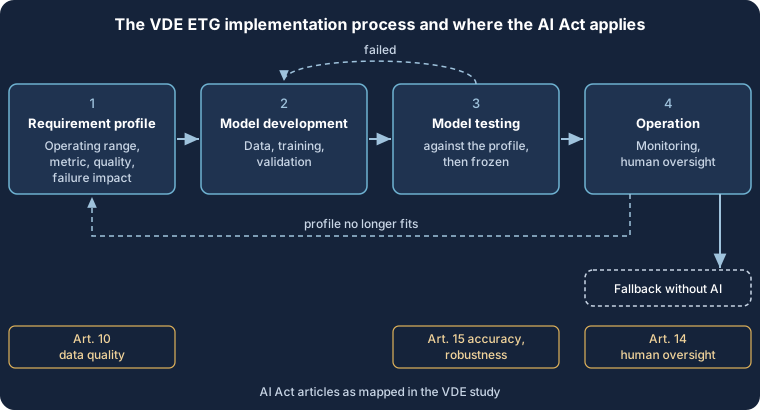
Step one is the hard one. A requirement profile in the VDE sense fixes more than a target metric such as accuracy. It also names the data and the physical model used for testing, and the failure consequences that are acceptable. The study puts three questions to the future operator. What is the operating range, and are edge cases included? Which metrics actually say something? What quality has to be reached?
Once a model passes its test, it is frozen along with its parameters. No learning in operation. If monitoring shows the profile no longer matches reality, the profile gets sharpened first and the model is tested again. Retraining a model on one exceptional case isn't enough, the study says, because the test criteria would stay the same.
Seven use cases and how the study frames their risk
Risk runs along two axes: how bad is a wrong output, and how well can it be checked? Use cases qualify when one of the two comes out favourably.
| Use case | Where the AI runs | How the study frames the risk |
|---|---|---|
| Load and generation forecast | central | errors cost balancing energy, as with classic forecasts; already in use |
| Anomaly detection | edge, for example at the substation | low, because it does not trip anything but gives the operator extra information |
| Attack detection | central | false alarms after process or configuration changes; needs to state the cause |
| Assistant for system operation | central | language models can hallucinate; train staff, curate the sources |
| State estimation in low voltage | central or local substation | low, because few established procedures exist there that could be disrupted |
| Protection setting optimisation | central or edge | looks delicate, but the established protection test with fault simulation checks it well |
| Post-mortem fault location | central or edge | not time-critical, testable with secondary test equipment |
Protection settings show how the study thinks. An algorithm with random elements computes settings for protection equipment, the very core of critical infrastructure. The paper still recommends it, because every proposed setting has to pass the same grid simulations as one calculated by hand. Testability counts for more than explainability here, and we think that's the most useful insight in the paper.
The work continues in a new VDE ETG committee on AI in electrical systems, whose kick-off was scheduled for 16 September 2026. One focus there is classifying AI systems, for instance separating generative, self-learning and static methods.
What Articles 14 and 26 require on shift
Article 14 of the AI Act addresses design, so the provider of the system. Article 26 addresses use, so the grid operator. In the control room the two meet: the vendor has to build in or describe the controls, and the grid operator has to put someone in front of them who is allowed to use them and knows how.
Article 14(4) lists what the oversight person must be able to do. We've translated the five points into control room language.
| Requirement | What it means in the control room |
|---|---|
| Art. 14(4)(a): understand capabilities and limits, detect anomalies | The shift knows the operating range the model was tested for and spots when the situation falls outside it, say after a fault has changed the switching state. |
| (b): remain aware of automation bias | Especially at night and in routine: a recommendation that has been right for months stops being read and starts being waved through. |
| (c): interpret the output correctly | Forecast bands, confidence values and anomaly scores are explained in the interface and covered in training. |
| (d): decide not to use, disregard or override | System operators may reject any recommendation without having to justify it, and the system records that they did. |
| (e): intervene or stop the system in a safe state | There is a defined way to switch off the AI function and a tested mode of operation without it. |
Article 26 turns this into deployer duties. Paragraph 1 requires use in line with the instructions for use, paragraph 2 assigning oversight to people with competence, training and authority. Paragraph 4 makes the grid operator responsible for input data as far as it controls them, meaning measurements and topology from its own control system. Under paragraph 5 it monitors operation, suspends use if it sees a risk and reports serious incidents to the provider and to market surveillance. Since 29 July 2026 that's the Federal Network Agency (BNetzA), as our piece on the KI-MIG and the BNetzA as AI supervisor explains.
Two duties reach straight into the organisation. Automatically generated logs stay available for at least six months under paragraph 6. And under paragraph 7, the employer informs workers' representatives and the affected staff before the system goes live, which in a control room means the shift crew itself.
In a control room staffed around the clock, oversight isn't a person, it's a function. Whoever holds it on the night shift needs the same training and the same authority as the day shift lead.
One duty drops out for grid control: the fundamental rights impact assessment under Article 27 expressly excludes systems under Annex III point 2.
When control room AI is high-risk at all
Articles 14 and 26 only apply to high-risk AI. Under the Commission's draft guidelines of 19 May 2026, two conditions have to meet: the AI is a safety component that directly protects the physical integrity of the installation, and the operator is designated as a critical entity under the CER Directive. The full test and all nine electricity examples are in our article on Annex III and which AI at a municipal utility is really high-risk.
Two examples decide things for the control room. Anomaly detection that supports decisions on load distribution, grid stability or shutdowns is listed as high-risk. An early fault warning to the grid control centre is listed as a counter-example, because it doesn't act on its own. An AI load forecast in the distribution grid sits clearly outside.
And what about systems already running? Article 111(2), as amended by the Digital Omnibus, covers high-risk systems placed on the market or put into service before 2 December 2027 only after a significant change in their design. Here the law touches the VDE process. If you retrain and retest a frozen model against a revised requirement profile, check first whether that counts as such a change. The regulation gives no blanket answer.
A municipal utility's grid company, a large DSO, a TSO
The same software can be high-risk at one grid operator and not at another. What decides is critical-infrastructure status, not code. Germany's KRITIS umbrella act has applied since 17 March 2026, but the thresholds come from an ordinance under Section 5. The act sets the reference value: as a rule, 500,000 inhabitants to be supplied by one facility. The draft ordinance of 26 May 2026 turns that into a measurable figure for electricity, 3,700 GWh a year withdrawn by final customers and downstream distributors, for distribution and transmission networks alike. As of October 2026 the ordinance hasn't been issued.

| Question | Grid company of a municipal utility | Large distribution system operator | Transmission system operator |
|---|---|---|---|
| Critical entity? | below 3,700 GWh of annual energy withdrawn, under the draft probably not | from 3,700 GWh of annual energy withdrawn, under the draft yes | yes, if only because of the size of the control areas |
| Typical control room AI | forecasts, assistant, anomaly detection in the vendor's control system | plus grid state estimation, congestion forecasts | system operation, stability assessment, congestion management |
| Who is the deployer under the AI Act? | often unclear when the control centre is bought as a service | the grid operator | the grid operator |
| What applies in every case | AI literacy under Art. 4 since 2 February 2025; IT security under Section 5c of the Energy Industry Act (EnWG) for all systems needed for safe grid operation | ||
Two set-ups rarely come up in high-risk debates, though they're common at municipal utilities. First, the multi-utility control room that runs electricity, gas and heat from one room. Annex III point 2 names all three, so the question comes up three times. Second, the control centre as a service: if another grid operator or a service provider runs grid control, it uses the AI system under its own authority and may itself be the deployer under the AI Act. Who carries which Article 26 duty then belongs in the contract, not in a later round of talks.
For a small grid company, "probably not high-risk" doesn't mean "nothing to do". The new Article 4 requires every deployer of an AI system to take measures supporting staff AI literacy, even though it no longer has to guarantee a set level. And Section 5c EnWG obliges every energy grid operator to protect the systems needed for safe grid operation adequately. AI inside the control system is such a system, Annex III or not. What that protection looks like in substation automation is covered in our piece on the digital substation under IEC 61850.
The human as safeguard: two readings
VDE's study and the Commission's draft give the person in the control room different roles. For the study, that person is the safeguard. For the Commission, they're part of the system being assessed.
"Qualified staff should remain the final decision-making authority even as AI use grows, and be enabled through targeted training to assess AI recommendations competently." (our translation)
Then there's the regulatory critique. Ralf Petri, managing director of VDE ETG, said at the launch on 30 July 2025: "We need a technical definition of the term AI, and the classification of high-risk use cases has to be sharpened" (our translation). The study itself speaks of a "risk of over-regulation", because the AI Act's definition of an AI system also captures long-established methods such as regression.
Eurelectric, the European electricity industry association, asked in its consultation response of July 2025 for high-risk classification to be limited to AI systems with a direct effect on safety components in electricity supply, leaving supporting and peripheral algorithms out.
In its draft of 19 May 2026 the Commission drew a different line. AI that detects anomalies in grid operation to monitor critical functions such as load distribution, grid stability or shutdown procedures, and to support decisions on them, is high-risk there, even though a human decides. And split architectures are assessed as a whole, so the rules can't be sidestepped through system design.
Article 14(4)(b) reads like an answer to the VDE position. It requires the oversight person to remain aware of the tendency of "automatically relying or over-relying" on the output, "in particular for high-risk AI systems used to provide information or recommendations for decisions to be taken by natural persons". That's exactly the role VDE ETG has in mind for AI.
Is the system operator the safeguard or the weak point? The text leaves it open. The Commission has announced the final guidelines for the end of 2026.
What the draft standard on human oversight adds
How oversight is to be demonstrated technically is meant to be described by a harmonised standard. The draft prEN 18229-3, "AI trustworthiness framework, Part 3: Human oversight", published in Germany as E DIN EN 18229-3:2026-09 on 7 August 2026, runs to 32 pages. It is aimed mainly at organisations that place AI systems on the market or put them into service, and it is not sector-specific.
Its core concept is a reaction timeframe. According to a summary by standards expert Adam Leon Smith of 30 July 2026, the provider sets, for each risk scenario, how much time a designated person has after an output before harm occurs. Short windows rule out after-the-fact review and call for continuous monitoring or pre-configured intervention. For a control room that's familiar arithmetic. A protection relay trips in fractions of a second, no human keeps up with that. A congestion seen in the day-ahead forecast leaves hours before redispatch.
The CEN enquiry closes on 22 October 2026, according to the AI Standardisation Watch newsletter (edition 16, September 2026); we found no confirmation from CEN-CENELEC itself. Another standard is further along: according to CEN-CENELEC JTC 21, EN 18286 on quality management became the first harmonised standard under the AI Act on 14 October 2026. Grid operators feel it only indirectly, through what their control system vendors have to demonstrate.
What grid operators should settle by December 2027
A little over 13 months remain until 2 December 2027, and part of the groundwork is still missing. Waiting for the KRITIS ordinance still eats time a control room needs for training and drills. Most of the points pay off even without a high-risk classification.
Nine decisions for the control room
-
Inventory AI in the control system
Which functions in the control system, forecasting and assistance count as AI under the regulation? What counts is the intended purpose stated by the vendor. Product names say little. Our AI use case map for utilities sorts typical applications by role and classification.
-
Document the KRITIS assumption
Until the ordinance arrives, work with a reasoned assumption and revisit it once it's issued.
-
One requirement profile per application
Operating range, metric, quality and failure consequences in writing, as VDE ETG describes. Without a profile there's nothing to test against, and no way to tell later whether an update is a significant change.
-
Name the oversight function per shift
Who may override, who may switch off, who reports? Authority in writing, deputies settled.
-
Train, including against automation bias
Operating the tool is the easy part. The shift has to recognise when a recommendation falls outside the tested range and practise not following it. That also covers the AI literacy measures under Article 4.
-
Drill the stop and the fallback
Actually run operation without the AI function once a year, don't just describe it.
-
Set up logs and the reporting route
Logs for at least six months, consistent with data protection; anomalies to the vendor, serious incidents also to the BNetzA. Fix the route beforehand, not during the fault.
-
Inform the works council or staff council early
Article 26(7) requires information before the system goes live. Municipal enterprises fall under state staff representation law rather than the Works Constitution Act.
-
Order oversight along with the system
Instructions for use under Article 13 and the oversight measures under Article 14(3) belong in the specification and the contract, together with how the vendor announces and tests a model update.

What the regulation provides for breaches
Breaches of deployer duties under Article 26 can be fined under Article 99(4)(e) up to €15 million or 3 percent of worldwide annual turnover, with the lower amount for small and medium-sized enterprises. The BNetzA is the market surveillance and fining authority. That describes the legal framework, not an assessment of any individual grid operator. We track the date and the roles in our energy transition deadline calendar.
How roles, register and approval route for AI fit together across the company is set out on our page on AI governance for utilities; the path from pilot AI to regular operation on AI for utilities. More pieces on the subject are collected in the topic area AI in the energy industry.
Further reading
Frequently asked questions
The duty to design and supply high-risk AI so that designated persons understand the system's capabilities and limits, stay aware of automation bias, interpret its output correctly, disregard or override it, and bring the system to a safe stop with a stop button. For Annex III systems it applies from 2 December 2027.
A four-step implementation process from the VDE study of July 2025: requirement profile, model development, model testing and operation, plus ongoing monitoring and a fallback without AI. It borrows from technical safety management, the ISMS under ISO/IEC 27001 and the V-model of ISO 26262-6. It is not a maturity model of autonomy levels.
No. Under the Commission's draft guidelines of 19 May 2026, the AI has to be a safety component that directly protects the physical integrity of the installation, and the operator has to be designated as a critical entity. The draft lists an early fault warning to the control centre as a counter-example and anomaly detection supporting decisions on load distribution or shutdowns as a high-risk example. The draft is not final.
Under Article 111(2) as amended by Regulation (EU) 2026/1744, high-risk systems placed on the market or put into service before 2 December 2027 are only covered after a significant change in their design. Whether a retrained model counts as such a change should be settled before the update.
Article 26(2) requires the deployer to assign oversight to natural persons with the necessary competence, training and authority. In a control room staffed around the clock, that is a function in every shift, usually held by the system operator or shift lead, not a single person.
For high-risk AI at the workplace, yes: Article 26(7) requires employers to inform workers' representatives and the affected staff before the system is put into service. Co-determination rights under the German Works Constitution Act or, for municipal enterprises, under state staff representation law remain unaffected.
Let's collaborate
One contact, a team behind it
Thirty minutes on what you're working on, whether grid, metering, market processes, IT architecture or AI. Afterwards you'll know how we'd approach it and who would sit at the table.
Energy and measurement technology since 2010 · innobu GmbH since 2014 · Based in Schleswig-Holstein, Germany
Whoever pitches also delivers: whoever leads the first call stays your contact right through to the steering committee, with established partners in the project. Direct: info@innobu.com