
AI-Supported Customer Service and Churn Prevention at Utilities
The record switching rate puts utilities under pressure. AI promises relief in two places: faster customer service and earlier warning signs before a cancellation. This article shows what works today, how churn score and customer value steer retention, and why automated scoring without a GDPR and EU AI Act view turns into a risk.
The German electricity market is more competitive than ever. In 2024, according to the Federal Network Agency, 7.1 million electricity customers switched supplier, up 18 percent and the highest figure since market opening, at a switching rate of around 14 percent. AI works in customer service where volume and standard inquiries tie up teams. In a case documented by PwC, average handling time fell by around 50 percent and the number of waiting tickets by up to 90 percent, while EnBW improved automatic categorisation from 48 to 64 percent. Two figures steer retention: the churn score as the probability of cancellation, and customer value as the contribution margin over the contract term. Together they focus retention on customers who are at risk of switching and valuable at once. Automated scoring is no legal grey zone, though: under the SCHUFA judgment it falls under Article 22 GDPR, and from 2 August 2026 the high-risk duties of the EU AI Act apply. Poor automation drives exactly the churn it is meant to prevent. 38 percent of customers are dissatisfied with service quality. The way in is step by step, with human approval and a data protection impact assessment from the start.
Why the record switching rate puts utilities under pressure
Competition in the electricity market has hit a new high. In 2024, 7.1 million electricity customers switched supplier, 18 percent more than the year before and the most since the market opened. That is from the Federal Network Agency's 2025 monitoring report. On top came 3.3 million customers who adjusted their contract with their own supplier, often after threatening to leave.
Why is that uncomfortable for utilities? Because holding and winning have both become more expensive. New customers are courted in 2026 with tariffs around 20 percent below the previous year. Lose an existing customer and you have to buy them back at acquisition costs that the paid-out margin rarely covers. Switching has also become technically easier, as the 24-hour supplier switch shows.
Two levers now decide retention: the contact when the customer calls, and the outreach before they cancel. AI works on both. Order matters. Service first, scoring second. A perfect churn model helps little if the customer leaves anyway after 20 minutes on hold.
Where AI helps in customer service today
AI takes hold where volume and standard inquiries tie up teams. Language models read incoming inquiries, sort them by topic and urgency, suggest replies and handle simple tasks. Change an instalment plan, update bank details, submit a meter reading. Those are the typical starting fields, and they make up a large share of the volume.
The figures from practice are clear. In a case documented by PwC, average handling time fell by around 50 percent and the number of waiting service tickets dropped by up to 90 percent. At EnBW, the hit rate of automatic categorisation rose from 48 to 64 percent, which cut duplicate work. Sounds like a lot. The honest caveat: the starting scope usually covers only a few categories, and the rest stays with people for now.
The realistic mode is agent assist, not full automation. The AI prepares, the human decides. That is not modesty but risk management, because a bot that answers wrongly on its own costs more than a minute on hold. For how broadly AI is arriving in the sector, see the overview of AI in energy utilities.
Churn prevention: from gut feeling to a score
Retention is becoming data-driven. Two figures steer the approach. The churn score estimates how likely a customer is to cancel. Customer value says what that customer contributes over the contract term. Only the combination makes it useful, because it points attention where it pays: at customers who are at risk of switching and valuable at once.
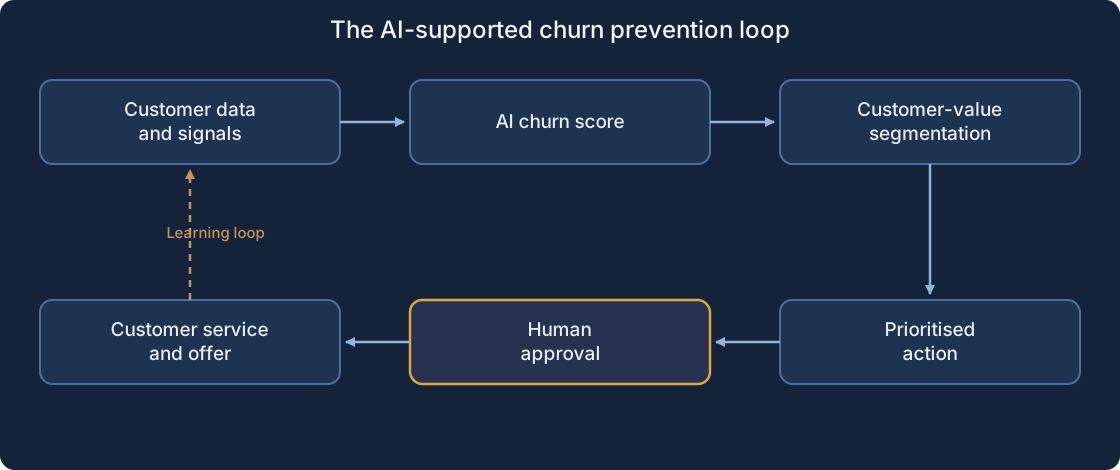

The goal is outreach before the cancellation, not a win-back after it. Whoever only reacts once the cancellation letter arrives negotiates from the weaker position and usually pays extra. A valuable customer flagged early instead gets a fitting offer, or simply better service, before they open the price comparison. That is the real difference between prevention and damage control.
The European perspective: scoring is subject to regulation
Automated customer scoring is no legal grey zone. The European Court of Justice clarified in the SCHUFA judgment that a scoring procedure falls under Article 22 GDPR once it significantly shapes a downstream decision. A churn score that automatically decides on discounts or retention offers sits squarely in that category. Data subjects then have the right to human intervention, to state their view and to contest the decision.
The figures show that consumers today have more options than ever to select the tariff that suits them.
Then there is the EU AI Act. From 2 August 2026 its high-risk duties apply, and systems that help decide access to essential services can fall under them. For utilities that means transparency about the data basis, a data protection impact assessment and documented human oversight become mandatory, not optional. The precise classification comes from the AI regulation guide for energy utilities, with details on the deadlines in the EU AI Act requirements for AI in energy infrastructure.

Challenges and risks
AI in customer service is no sure thing. It can strengthen retention or do the exact opposite. Both sides belong on the table.
One point is easily missed. Pure cost logic quickly flips into its opposite. Treat unprofitable customers systematically worse and you save in the short term and lose in the long run, because poor service measurably triggers cancellations. 38 percent dissatisfaction with service quality is no side note but a warning sign. Service quality is the retention lever, not just a cost item.
What utilities should do now
The way in is step by step and compliant. These four steps order service and scoring so that retention rises and compliance holds.
-
Start with clearly scoped use cases
Take the most frequent standard inquiries and automatic categorisation first. There the volume is high and the risk is low. Measure handling time before and after, so the benefit is provable.
-
Sort out the data basis and data quality
A churn model is only as good as the data behind it. Clean up legacy records in the CRM, define the signals cleanly and check them for bias. Without that basis the model produces expensive false alarms.
-
Couple scoring with human approval
Let the AI suggest, but the human decide on an offer or a retention call. That satisfies Article 22 GDPR and keeps a model error from landing directly with the customer. Document who may override the automated decision.
-
Classify compliance before the rollout
Run the data protection impact assessment and classify the system under the EU AI Act before it goes live. In parallel it is worth looking at broader retention levers such as the controllable tariff models 2026, which act at a different point.
AI holds no customers. People hold customers, AI makes them faster and reaches them earlier. Relieve service first, couple scoring with human approval and build in GDPR from the start, and you cut churn without gambling away trust.
Further reading
Frequently asked questions
AI classifies and prioritises incoming inquiries, suggests replies and handles simple tasks such as adjusting instalments or submitting a meter reading. In a case documented by PwC, average handling time fell by around 50 percent and the number of waiting tickets by up to 90 percent. The effect is in shorter waits and less backlog, not in replacing staff.
The churn score is a model's estimated probability that a customer will cancel. Together with customer value, the contribution margin over the contract term, it forms the basis of churn prevention. Utilities use it to focus retention on customers who are both at risk of switching and valuable, rather than spreading discounts broadly.
In 2024, according to the Federal Network Agency, 7.1 million electricity customers switched supplier, up 18 percent on the previous year and the highest figure since market opening. The switching rate was around 14 percent. A further 3.3 million customers adjusted their contract with their existing supplier.
Automated scoring falls under Article 22 GDPR once it significantly shapes a downstream decision. The European Court of Justice clarified this in the SCHUFA judgment. Data subjects have the right to human intervention, to state their view and to contest the decision. From 2 August 2026 the high-risk duties of the EU AI Act apply on top of that.
A step-by-step start with clearly scoped use cases such as standard inquiries and automatic categorisation makes sense. Churn models should be coupled with human approval rather than deciding fully automatically. Before the rollout, a data protection impact assessment and the EU AI Act classification belong on the list. Service quality stays the real retention lever.
Let's collaborate
One contact, a team behind it
Thirty minutes on what you're working on, whether grid, metering, market processes, IT architecture or AI. Afterwards you'll know how we'd approach it and who would sit at the table.
Energy and measurement technology since 2010 · innobu GmbH since 2014 · Based in Schleswig-Holstein, Germany
Whoever pitches also delivers: whoever leads the first call stays your contact right through to the steering committee, with established partners in the project. Direct: info@innobu.com