Unbundling in 2026 and 2027: two compliance reports and the end of charging points at small grid operators
Which deadline a grid operator faces depends on how many customers are connected to the distribution network of its vertically integrated undertaking. Below 100,000 it is exempt from legal and functional unbundling but not from the charging-point ban in Section 7c of the Energy Industry Act (EnWG), and the Federal Network Agency (BNetzA) currently has no way to approve continued operation. From 100,000 customers upwards, the compliance report is due every year; independent transmission operators have their own date in September.
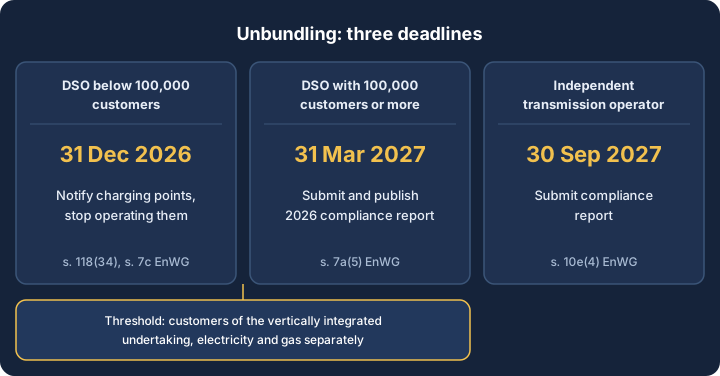
The compliance report (Gleichbehandlungsbericht) is the compliance officer's annual report on the measures a grid operator inside a vertically integrated undertaking takes to prevent discrimination in the network business. Distribution system operators whose undertaking has 100,000 or more connected customers submit it to the regulator by 31 March under Section 7a(5) EnWG and publish it, next on Wednesday 31 March 2027 for the 2026 reporting year; independent transmission operators submit theirs by 30 September under Section 10e(4) EnWG, next on Thursday 30 September 2027. For electricity DSOs below the 100,000-customer threshold, the transition period in Section 118(34) EnWG ends on Thursday 31 December 2026: activity at charging points they already developed, managed or operated before 27 July 2021 must be notified to the Federal Network Agency in text form by then and stopped, which means handing the charging points over or shutting them down. The agency cannot approve an exemption under Section 7c(2) EnWG because the ordinance it would need does not exist. None of the three deadlines carries its own administrative fine; the regulator enforces them with an order under Section 65 EnWG and coercive fines under Section 94 EnWG.
Three deadlines, one threshold of 100,000 customers
Which of the three deadlines applies comes down to one number: 100,000 customers directly or indirectly connected to the distribution network of the vertically integrated undertaking, counted separately for electricity and gas. Below that line a DSO need not be a separate company (Section 7(2) EnWG) and need not run a compliance programme (Section 7a(7) EnWG). The charging-point ban in Section 7c EnWG has no such exemption, so the first deadline lands on exactly the small electricity grid operators that barely notice the rest of unbundling.
| Date | Who | What | Primary source | Consequence if missed |
|---|---|---|---|---|
| Thu, 31 Dec 2026 | Electricity DSOs whose vertically integrated undertaking has fewer than 100,000 customers | Notify the Federal Network Agency in text form of charging points they developed, managed or operated before 27 Jul 2021, and stop operating them | Section 118(34) sentences 3 and 4 with Section 7c(1) EnWG | From 1 Jan 2027 a breach of Section 7c(1); order under Section 65, coercive fines under Section 94 EnWG |
| Wed, 31 Mar 2027 | Compliance officer of a DSO (electricity or gas) whose undertaking has 100,000 customers or more | Submit the report on compliance programme measures in calendar year 2026 to the regulator and publish it without personal data | Section 7a(5) sentence 3 EnWG | No specific offence; order under Section 65(2), coercive fines under Section 94, fines only after an enforceable order is ignored (Section 95(1) no. 3(a)) |
| Thu, 30 Sep 2027 | Compliance officer of an independent transmission operator (electricity or gas) | Submit the annual report on implementing the compliance programme to the regulator | Section 10e(4) sentence 2 EnWG | As for the Section 7a report: order, coercive fines, fines only after an enforceable order |
For the scale, look at the Monitoring Report 2025 by the Federal Network Agency and the Federal Cartel Office: 767 of the 851 registered electricity DSOs have fewer than 100,000 connected customers, and 670 of 699 in gas. Since the report counts per grid operator and the unbundling threshold per vertically integrated undertaking, so the figures show the order of magnitude, not a list of who is bound. Arithmetically, 84 electricity DSOs sit above the line and report by 31 March; the 767 below it need to establish by the end of the year whether they still own or operate charging points.
Charging points at small electricity DSOs: end on 31 December 2026
From 1 January 2027 no electricity DSO in Germany may own, develop, manage or operate a charging point for electric vehicles, except private ones for its own use. That includes the small municipal utility that runs grid and retail in one company. Section 7c(1) EnWG transposes Article 33(2) of the Electricity Directive (EU) 2019/944, which makes no exception for company size. So all the German legislator could give small grid operators was time, and that runs out on 31 December 2026.
Ban takes effect
Charging points a DSO had already developed, managed or operated count as approved for a transition period (Section 118(34) sentence 1).
End for DSOs with 100,000 customers or more
Notification to the Federal Network Agency and end of operation (sentence 2). For small DSOs, sentences 3 and 4 said 31 Dec 2024 until February 2025.
Two-year extension
The Act of 21 Feb 2025 (Federal Law Gazette 2025 I No. 51) replaces the year 2024 with 2026 in sentences 3 and 4.
End for small DSOs
Notification in text form and end of the activity by the end of the day (sentences 3 and 4).
Until then, small grid operators must give third parties access to these charging points on reasonable and non-discriminatory terms (Section 118(34) sentence 5). After that date, an application won't help either. Section 7c(2) EnWG does allow operation where a municipality has established a regional market failure through an open tender and the Federal Network Agency approves, but only on the terms of an ordinance under subsection 3, and that ordinance does not exist. In its unbundling FAQ the agency says the Federal Ministry for Economic Affairs "has not yet made use" of the power, so an exemption "cannot be granted". Anyone counting on approval by December is planning against the law as it stands.
One point is worth settling before you plan. Section 118(34) refers to charging points operated before 27 July 2021, while the agency's FAQ puts it more broadly, saying small DSOs are exempt from the Section 7c ban "until 31 December 2026". For charging points added later, agree the reading with the agency, including whether they belong in the notification. It makes no difference on 1 January: from then on the ban applies to all of them.
Where the charging points can go
The ban applies to the company in which the network is operated, not to the vertically integrated undertaking. Another company in the group may own the charging points, the Federal Network Agency writes, and for small DSOs it even accepts a subsidiary of the grid operator: the ban on the grid-parent model (grid operator as parent, retail or generation in the subsidiary) does not bite there, because grid, generation and retail may sit in one legal entity anyway. One condition applies: the subsidiary takes the strategic decisions itself and does not act as an "empty shell" of the grid operator.
Another company in the group
Sister, parent, a municipal enterprise or a new company; for small DSOs also a subsidiary with its own final say. Retail can supply it with services.
Joint company of several utilities
Several small utilities commission or set up a charging operator together. BDEW described such models as existing in isolated cases in 2024.
Sale to a third party
According to BDEW without public procurement requirements, as a package or split into normal and fast chargers.
Shutdown
The route for sites that don't pay their way. About 5 percent of the companies BDEW surveyed in 2024 expected to take it.
How much the grid operator may still do afterwards is the real design question. In the Federal Network Agency's view, services between the small DSO and the charging company are possible "within certain limits", as long as Section 7c is not circumvented. BDEW goes further and treats construction and technical operation on behalf of the charging company as permissible, provided ownership, economic risk and decisions on new sites stay away from the grid operator. A contract that leaves site planning to the grid operator would be too much under either reading.
Check subsidy notices before the transfer. Some state funding programmes prohibit transferring ownership of subsidised charging infrastructure to third parties during the earmarking period, usually eight and sometimes six years, and can claim the money back otherwise. 78 percent of the small utilities in the BDEW survey had used subsidies. Ask the funding authority whether a transfer to a group company forced by law counts as a breach before you sign.
Accounting changes too. As long as the grid operator holds charging points under Section 7c(2), it keeps them as a separate activity with separate accounts under Section 6b(3) sentence 1 no. 7 EnWG; after the transfer that activity disappears from its books and the charging point sits with its new owner.
Compliance report under Section 7a EnWG: 31 March 2027
DSOs above the threshold submit the report on calendar year 2026 by Wednesday 31 March 2027. The law puts the duty on the compliance officer, who submits the report to the regulator and publishes it without personal data (Section 7a(5) sentence 3). It sits at the end of a chain the vertically integrated undertaking has to build first: a compliance programme with binding measures for everyone doing network work, defined duties and sanctions, and an officer who monitors that the programme is kept.
Each year the Federal Network Agency sets focus topics. For the 2025/26 reporting year, each report had to cover one of four: the 24-hour supplier switch, compliance management in hydrogen network operation, the AS4 migration of market communication, and handling data in municipal heat planning, for which the WPG amendment of May 2026 creates a heat planning data space. In all four, grid operators pass data or dates to market partners, and discrimination happens where the group's own retail arm learns earlier or more than an outside supplier. Topics for the 2027 report will be announced in advance; check its unbundling page before the end of the year to see whether the list has changed.

Reports go to the Federal Network Agency by email to its unbundling unit or through the Energie Client; if you use the client, it asks for a short email with the operator number. Companies below the threshold have no reporting duty. Even so, the agency recommends a compliance programme, and informational unbundling under Section 6a applies to everyone anyway, including when grid data goes to the group's own retail business. How far that reaches for meter data and grid models is covered in our piece on whether the grid model may go to sales.
The report describes measures taken in 2026. Whatever is not documented by December (training records, checks, reports from inside the company and how they were resolved) can only be reconstructed in March.
Independent transmission operators: report by 30 September 2027
Transmission and gas transmission system operators certified under the independent transmission operator (ITO) model remain part of the vertically integrated undertaking and are supervised more closely in return. Their compliance officer prepares a report on implementing the compliance programme once a year under Section 10e(4) sentence 2 EnWG and submits it to the regulator by 30 September at the latest. That is only part of the reporting load: the officer also keeps the regulator informed of significant breaches and of the financial and commercial relations with the vertically integrated undertaking.
| Item | DSO (Section 7a) | Independent transmission operator (Section 10e) |
|---|---|---|
| Programme | set by the undertaking, made known to staff and the regulator | submitted to the regulator for approval (subsection 1) |
| Appointment | no regulatory consent required | by the supervisory board, effective only with the regulator's consent; terms and duration require approval (subsections 2 and 3) |
| Annual report | by 31 March, on the previous calendar year | once a year, by 30 September |
| Publication | yes, without personal data | not provided for in Section 10e(4) |
| Ongoing reporting | none set by law | significant breaches, relations with the vertically integrated undertaking, investment decisions no later than when they go to the supervisory board (subsections 4 and 5) |
| Governance bodies | no special rights | may attend meetings of management, supervisory board and shareholders' meeting, with a right to speak on the supervisory board (subsection 6) |
For an ITO, the September report is therefore less a summary than a reconciliation: it has to match what the officer already reported during the year. Here, too, the agency announces focus topics in advance; it has not yet published the ones for 2027.
What applies when a deadline passes
None of the three deadlines has its own offence in Section 95 EnWG; the consequences run through supervision. A small electricity DSO that still owns or operates charging points after 31 December 2026 breaches Section 7c(1), because the approval that Section 118(34) presumed has expired. Under Section 65 EnWG, the Federal Network Agency can order the breach to stop and enforce the order with coercive fines under Section 94, ranging from 1,000 euros to 10 million euros. A missing compliance report follows the same pattern: order under Section 65(2), coercive fines under Section 94. A fine only becomes possible once the company ignores an enforceable order (Section 95(1) no. 3(a)), and it can reach 100,000 euros under Section 95(2) no. 5.
In 2024 BDEW pointed to two consequences outside the EnWG. Once the transition period has ended, the auditor can qualify the audit opinion, and funding authorities can check unbundling as a condition and refuse funding in case of doubt. Both reach a municipal utility faster than administrative proceedings, which in the association's view would only become enforceable at the end of a longer legal dispute.
The dispute over municipal utilities' charging points
The charging-point ban for small DSOs has been argued over since 2021, and the positions have hardly moved. BDEW wrote on 3 July 2024 that the result was legally consistent "but paradoxical in practice: de minimis companies may supply energy (which is the core of unbundling), but may not build charging points" (our translation). The Federal Network Agency counters in its FAQ that the EU provision "provides for no de minimis exemption", and that applying the exemptions from Section 7(2) and Section 7a(7) by analogy is ruled out.
168 small utilities took part in BDEW's May 2024 survey. 93 percent ran grid and retail in one company, and 92 percent owned, operated or managed public charging points. More than 80 percent had not implemented the rules by June 2024, and 30 percent said they would stop building or running public charging stations. BDEW proposed a de minimis threshold of up to 50 charging points, a de minimis rule in the directive and a two-year extension of the transition period. Only the extension came, with the Act of February 2025.
There was also a dispute over who counts as the "grid operator" in the first place. BDEW and VKU argued that in a company running both grid and retail, only the grid unit is meant, citing Section 3 no. 2 EnWG; retail in the same company could then have kept the charging points. The Federal Network Agency, some state regulators, funding authorities and auditors read the term as the legal entity, and by 2024 the association itself no longer expected to win the argument. No further extension beyond 2026 has been passed. Planning on one means betting on a change in the law that does not exist at the end of October 2026.
What to do before the three dates
Small electricity DSOs have a little over two months, and transferring a charging point takes more than a notification: contracts, subsidy notices, land use and billing all hang on it. Both reports have more slack but depend on documentation that has to be produced during the year.
Steps to the end of 2026 and through 2027
-
Take stock of the charging points
Every site with owner, commissioning date (before or after 27 Jul 2021), subsidy notice and earmarking period, land use agreement, back-end and roaming contracts. Without this list none of the routes can be assessed.
-
Choose the route
Another company, cooperation, sale or shutdown, site by site. Management decides, in agreement with the funding authority where a notice restricts transfer.
-
Put transfer and services into contracts
Ownership, economic risk and site decisions sit with the charging company; whatever the grid operator still does technically goes into a service agreement. Whether assets are transferred one by one or carved out as a whole has tax and corporate law consequences that should be settled before December.
-
Notify the Federal Network Agency
In text form, by the end of 31 Dec 2026 at the latest.
-
Prepare the compliance report on 2026
Collect the year's evidence by December, wait for the agency's 2027 focus topics and cover one of them, and schedule sign-off and publication for 31 Mar 2027. For independent transmission operators the same applies with 30 Sep 2027 and a check against the year's ongoing reports.
Deadline, market roles, systems
31 December 2026Small electricity DSOs: notify charging points and stop operating themLaw · adopted
Applicability: Only electricity distribution system operators under Section 7(2) sentence 1 EnWG (vertically integrated undertakings with fewer than 100,000 customers) and only charging points they developed, managed or operated before 27 July 2021. For larger DSOs the deadline ended on 31 December 2023.
If the deadline is missed: Regulator can enforce From 1 January 2027 these charging points no longer count as approved; continuing to operate them breaches Section 7c(1) EnWG. The Federal Network Agency can order operations to stop under Section 65 EnWG and enforce this with coercive fines under Section 94 EnWG. Legal basis ↗
- Electricity grid operatorrole obligationNotifies the Federal Network Agency of its own charging points from before 27 July 2021 and stops or transfers their operation by 31 December 2026 unless approval under Section 7c(2) has been granted.Typically affected: Charging backend (OCPP, PKI), Regulatory management, controlling
31 March 2027Submit and publish the DSO compliance reportLaw · adopted
Applicability: Not affected are DSOs of vertically integrated undertakings with fewer than 100,000 directly or indirectly connected customers (Section 7a(7) EnWG), separately for electricity and gas.
If the deadline is missed: Regulator can enforce Section 7a EnWG sets no specific administrative offence. The regulator can enforce the duty under Section 65(2) EnWG with coercive fines under Section 94 EnWG; failing to comply with an enforceable order is an administrative offence under Section 95(1) no. 3(a) EnWG. Legal basis ↗
- Electricity grid operatorrole obligationHas the compliance officer prepare the report on 2026, submits it to the regulator and publishes it.Typically affected: Regulatory management, controlling
- Gas grid operatorrole obligationHas the compliance officer prepare the report on 2026, submits it to the regulator and publishes it.Typically affected: Regulatory management, controlling
30 September 2027Compliance report of independent transmission operators (Section 10e EnWG)Law · adopted
Applicability: Only transmission system operators (electricity and gas) organised as independent transmission operators under Sections 10 to 10e EnWG. Distribution system operators report under Section 7a(5) by 31 March.
If the deadline is missed: Regulator can enforce Section 10e EnWG sets no specific administrative offence. The regulator can enforce the duty under Section 65(2) EnWG with coercive fines under Section 94 EnWG; failing to comply with an enforceable order is an administrative offence under Section 95(1) no. 3(a) EnWG. Legal basis ↗
- Gas grid operatorrole obligationGas TSOs under the independent transmission operator model submit their compliance officer's annual report by 30 September.Typically affected: Regulatory management, controlling
- Transmission system operatorrole obligationHas the compliance officer prepare the annual report and submits it by 30 September; only under the independent transmission operator model.Typically affected: Regulatory management, controlling
A classification for typical market roles, not a review of your individual case and not legal advice. Whether an obligation applies to your company (thresholds, exemptions) is for your legal department or counsel to confirm. The calendar doesn't replace your own deadline review. Information as of: 27 October 2026.
Further reading
Frequently asked questions
The compliance report (Gleichbehandlungsbericht) is the compliance officer's annual report on the measures a grid operator inside a vertically integrated undertaking takes to prevent discrimination in the network business. Distribution system operators submit it to the regulator by 31 March under Section 7a(5) sentence 3 EnWG and publish it without personal data; independent transmission operators submit theirs by 30 September under Section 10e(4) sentence 2 EnWG.
No. Section 7a(7) EnWG exempts vertically integrated undertakings with fewer than 100,000 customers directly or indirectly connected to their distribution network from subsections 1 to 6, counted separately for electricity and gas. That removes the compliance programme, the compliance officer and the report. The Federal Network Agency still recommends a compliance programme, and informational and accounting unbundling apply regardless of the threshold.
No. For electricity DSOs under Section 7(2) sentence 1 EnWG, charging points count as approved only until the end of 31 December 2026 (Section 118(34) sentence 3 EnWG). By then the activity has to be notified to the Federal Network Agency in text form and stopped (sentence 4). From 1 January 2027 the ban in Section 7c(1) EnWG applies in full: no ownership, development, management or operation, except private charging points for the operator's own use.
Not at present. Section 7c(2) EnWG allows approval where a municipality has established a regional market failure after a tender, but only on the terms of an ordinance under Section 7c(3). According to the agency's FAQ, the Federal Ministry for Economic Affairs has not used this power so far, so no exemption can be granted.
For small grid operators below 100,000 customers, yes, according to the Federal Network Agency's FAQ. The ban on the grid-parent model does not apply to them because grid and retail may sit in one company anyway. The subsidiary has to take the strategic decisions itself and must not be an empty shell; services from the grid operator are possible within limits. For DSOs that are operationally unbundled, moving the business into a subsidiary is generally not allowed, so another company in the group is the route.
Sections 7a and 10e EnWG carry no specific administrative offence. The regulator can order the report under Section 65(2) EnWG and enforce the order with coercive fines of 1,000 euros to 10 million euros under Section 94 EnWG. Failing to comply with an enforceable order is an administrative offence under Section 95(1) no. 3(a) EnWG, with fines of up to 100,000 euros under Section 95(2) no. 5.
Let's collaborate
One contact, a team behind it
Thirty minutes on what you're working on, whether grid, metering, market processes, IT architecture or AI. Afterwards you'll know how we'd approach it and who would sit at the table.
Energy and measurement technology since 2010 · innobu GmbH since 2014 · Based in Schleswig-Holstein, Germany
Whoever pitches also delivers: whoever leads the first call stays your contact right through to the steering committee, with established partners in the project. Direct: info@innobu.com