
MaKo 2026: EDIFACT, AS4 and API Web Services
The business processes stay stable. What changes is the technology underneath, and EDIFACT remains the message format.
MaKo 2026 is the regulatory reform of German market communication (Marktkommunikation), the data exchange that runs supplier switching, metering and balancing. It is an architecture shift, not a process big bang. A binding format release took effect on 1 April 2026 under Bundesnetzagentur (BNetzA, the Federal Network Agency) Mitteilung No. 54, AS4 transport has been mandatory in the electricity market since 1 April 2024, and the first binding API process has applied since 6 June 2025. The next release follows on 1 October 2026 under Mitteilung No. 56.
MaKo 2026 reshapes the data architecture behind German energy market communication while leaving the business processes broadly intact. A binding format release took effect on 1 April 2026 under BNetzA Mitteilung No. 54, consolidating the EDIFACT formats with decision trees (EBD) 4.2, check identifiers 3.3, general specifications 6.1c and OBIS codes 2.5c under the motto consolidation rather than upheaval. In parallel, the transport layer is changing: AS4 (Applicability Statement 4), an ebMS3 and web service standard, has been mandatory in the electricity market since 1 April 2024 and replaces the earlier email and AS2 transfer, while JSON web service APIs add a second channel: the first binding API process, for determining the MaLo-ID, has been in force since 6 June 2025, and under Mitteilung No. 58 of 1 October 2026 API web services are expected to stay limited to MaLo-Ident and control for the time being. The next release follows on 1 October 2026 under Mitteilung No. 56 of 1 April 2026, with new message versions, EBD 4.3, general specifications 6.1d, check identifiers 4.0 and updated AS4 profiles; API electricity 2.0.0 was deliberately left out. The scale is large: market participants exchange millions of EDIFACT messages a day, around 6 million supplier switches happen in Germany each year, and a single cloud platform handles over 10 million messages a month. The reform affects all market roles, so the practical answer is a standing programme with clear enterprise architecture control rather than point fixes at each deadline.
What MaKo 2026 really is: an architecture shift, not a process big bang
MaKo 2026 is best treated as a data architecture and integration topic, not a pure business project. It is not a single event but a staggered rebuild of market communication that leaves the business processes broadly stable and instead modernises formats, transport paths and interfaces. The current format release took effect on 1 April 2026, and the BNetzA itself places it under the motto consolidation rather than upheaval. The handbook chapter on market communication shows how meter readings turn into processes between the market roles, from supplier switching to the MaBiS hub.
A short clarification matters here. MaKo 2026 is the regulatory reform of market communication itself, not the SAP product Mako Cloud, which is one vendor's software for handling that communication. The release under Mitteilung No. 54 brings EBD 4.2, check identifiers 3.3, general specifications 6.1c and OBIS codes 2.5c, with clearer mandatory field definitions, harmonised reference logic and less room for interpretation in the validations. It touches the core processes GPKE, WiM, MaBiS and GeLi Gas, that is supplier switching, metering, balancing and gas supply. Where a single vendor platform fits into this picture is set out in innobu's guide to the SAP Mako Cloud.
EDIFACT and API: two worlds in parallel
What is new is that synchronous API web services with JSON now sit next to the file-based EDIFACT exchange. EDIFACT messages such as UTILMD, MSCONS or INVOIC remain in place. With Mitteilung No. 58 of 1 October 2026, BNetzA made clear that API web services will not replace EDIFACT for the foreseeable future and are expected to remain limited to MaLo-Ident and control. The first binding API process, for determining the MaLo-ID (the market location identifier), has applied since 6 June 2025.

The two channels coexist, and that will not change soon. Mitteilung No. 55 put API web services electricity release 2.0.0 out for consultation, splitting the single MaLo-ID service into several functionally separate ones and moving it from Swagger to GitHub. It did not make the binding version under Mitteilung No. 56. With Mitteilung No. 58 of 1 October 2026 BNetzA changed course: UTILTS stays, the API web services for calculation formulas and location bundles consulted in July will not be introduced, and API web services are expected to remain limited to MaLo-Ident and control. For an integration team this means EDIFACT and API are not an either or but two structures to be kept in sync.
AS4: the new transport layer under the hood
While formats and APIs concern the content, AS4 governs the transport. AS4 (Applicability Statement 4) is a standard based on ebMS3 and web services that has been mandatory in the German electricity market since 1 April 2024 and replaces the earlier transfer of EDIFACT messages by email and AS2. The channel becomes more secure, acknowledged and auditable, which is decisive for the mass operation.
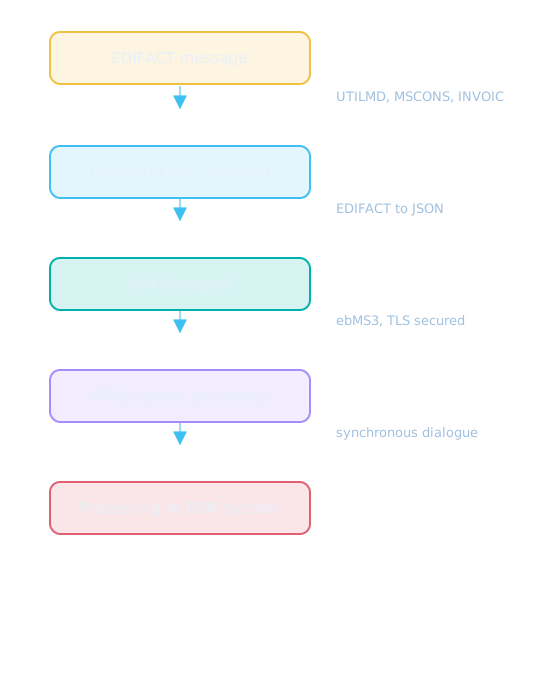
AS4 covers the core processes GPKE, MPES, WiM and MaBiS, while schedule exchange and Redispatch 2.0 are governed separately. The communication security rests on the Smart Metering PKI and the cryptography standards of the BSI (the Federal Office for Information Security), with the transport secured by TLS. Mitteilung No. 56 updates the AS4 profiles to version 1.2 and the transmission rules to version 1.10, each binding from 1 October 2026. The EDIFACT messages that carry the mass operation travel over this transport, which is why the transport layer is the part to get right first. The grid-side context, from metering to control, runs alongside this, as innobu set out for the control box and Section 14a.
Who is affected and what happens in the systems
The change touches every market role at once, from the grid operator through the energy supplier and metering point operator to the balancing group responsible party. For municipal utilities with grown IT estates this means adapting energy data management (EDM) systems, converters and interfaces in step with each deadline, without interrupting the live operation. The quality of the data architecture decides the effort and the risk.
EDM and billing systems have to support new format versions, AS4 connectors and API clients at the same time. The mapping between EDIFACT, internal structures such as IDoc and JSON APIs becomes a permanent part of the integration estate rather than a one-off conversion. The roles affected, grid operators, suppliers, metering point operators, balancing group responsible parties and municipal utilities, are in practice all market participants.
This is where data architecture stops being a back-office concern, and the same holds for the HEDWIG reporting duty under § 111g EnWG. A clean separation between the message format, the transport connector and the partner endpoint lets a team absorb a new release by changing one layer rather than rewiring the whole chain. A grown estate that mixes these concerns pays for it at every BNetzA deadline.
The roadmap: staggered deadlines, not a single cut-off date
MaKo 2026 is organised as a rolling roadmap in which the BNetzA sets consultation and binding dates in numbered Mitteilungen. The release of 1 April 2026 under Mitteilung No. 54 is followed by the next bundle of formats and services under Mitteilung No. 56, binding from 1 October 2026. Whoever sets the programme up as a standing task rather than a one-off project stays able to deliver.
The layering matters for planning. The mail-based EDIFACT transfer has been replaced step by step since late 2023, AS4 carried that shift, and API web services arrived in June 2025 as a fast B2B channel for MaLo identification. There is no single switchover date to plan against, only a sequence of binding releases that a programme has to meet one after another.
What utilities and municipal utilities should do now
The economically sensible answer to MaKo 2026 is a standing programme with clear enterprise architecture control, not point fixes at each deadline. Whoever bundles the EDIFACT, AS4 and API paths into one integrated architecture and encapsulates converters and interfaces cleanly reduces the adaptation effort at every new release. A regulatory duty then becomes a stable foundation for further digital work.

-
Define a target architecture with coexisting channels
Set out a target architecture that encapsulates EDIFACT, AS4 transport and API web services as coexisting channels, so each can change without forcing changes in the others.
-
Maintain converters and mappings centrally
Keep converters and mappings in one place, so that new format versions and API releases land in the mass operation without a break and without scattered local patches.
-
Couple the programme to the BNetzA deadlines
Tie the programme to the BNetzA binding dates and run it as a standing task, with each numbered Mitteilung treated as a planned release rather than a surprise.
-
Connect to the wider regulatory picture
Think through the links to Redispatch, the smart meter rollout and Section 14a EnWG, because the same EDM and integration estate carries those duties as well.
The releases are binding now, and the next deadline is close. Whoever defines a target architecture, maintains converters centrally and couples the programme to the BNetzA dates turns a regulatory duty into a stable foundation. The wider grid context, from the metering base outward, fits in the same plan, as innobu set out for the smart meter rollout.
Deadline, market roles, systems
1 October 2026MaKo format release, notice no. 56Regulatory ruling · in force
If the deadline is missed: Regulator can enforce The versions are binding under the market communication rulings. The Federal Network Agency can have breaches remedied under Section 65 EnWG, or Section 76 MsbG for metering point operators, and enforce this with coercive fines of up to EUR 10 million (Section 94 EnWG, applied to metering point operators via Section 76(4) MsbG); breaching an enforceable order under Section 65 EnWG is an administrative offence under Section 95(1) no. 3(a) EnWG (up to EUR 100,000). Whether this also covers orders under Section 76 MsbG is unsettled: Section 76(4) MsbG refers to Part 8 EnWG, but Section 95(1) no. 3(a) EnWG only lists orders under the EnWG, such as Section 65, and none under the MsbG. Legal basis ↗
- Electricity grid operatorrole obligationRuns the new AHB/MIG versions in production from 1 October, including UTILMD electricity 2.2 with the remote controllability flag.Typically affected: Market communication gateway (EDIFACT, AS4, API), SAP IS-U / S/4HANA Utilities, EDM / MDM
- Gas grid operatorrole obligationMoves UTILMD gas to version G1.2 and tests gas processes against the new check identifiers.Typically affected: Market communication gateway (EDIFACT, AS4, API), SAP IS-U / S/4HANA Utilities
- Default metering point operatorrole obligationMoves MSCONS, ORDERS and UTILMD to the new versions and updates the AS4 connection to profile 1.2.Typically affected: Market communication gateway (EDIFACT, AS4, API), EDM / MDM
- Supplierrole obligationProcesses switching, master data and invoice messages in the new versions and resolves rejections via APERAK.Typically affected: Market communication gateway (EDIFACT, AS4, API), SAP IS-U / S/4HANA Utilities, Grid usage and customer billing
1 April 2027MaKo format release, notice no. 58Regulatory ruling · adopted
Applicability: ActivationDocument AWT concerns only market partners involved in redispatch. Transport rules 1.11 apply to exchange via AS2, email (SMTP), SFTP and REST; AS4 has its own rules.
If the deadline is missed: Regulator can enforce The versions are binding under the market communication rulings. The Federal Network Agency can have breaches remedied under Section 65 EnWG, or Section 76 MsbG for metering point operators, and enforce this with coercive fines of up to EUR 10 million (Section 94 EnWG). If a secure connection fails because certificates are missing or invalid, the party that did not provide them or used them incorrectly bears the consequences (transport rules, chapter 12). Legal basis ↗
- Electricity grid operatorrole obligationMoves redispatch messages to ActivationDocument AWT 1.1g and updates the transport path to version 1.11.Typically affected: Market communication gateway (EDIFACT, AS4, API), EDM / MDM
- Transmission system operatorrole obligationReceives redispatch calls in ActivationDocument AWT 1.1g format and adjusts certificate use for mTLS.Typically affected: Market communication gateway (EDIFACT, AS4, API), Direct marketing and remote control
- Default metering point operatorrole obligationUpdates the transport path to version 1.11; the planned API replacement of UTILTS is dropped, so UTILTS traffic stays.Typically affected: Market communication gateway (EDIFACT, AS4, API), EDM / MDM
- Supplierrole obligationKeeps UTILTS processing for metering times and calculation formulas and adapts the transport path to version 1.11.Typically affected: Market communication gateway (EDIFACT, AS4, API)
A classification for typical market roles, not a review of your individual case and not legal advice. Whether an obligation applies to your company (thresholds, exemptions) is for your legal department or counsel to confirm. The calendar doesn't replace your own deadline review. Information as of: 25 October 2026.
Further reading
Frequently asked questions
MaKo 2026 is the regulatory reform of German energy market communication (Marktkommunikation), the data exchange that runs supplier switching, metering and balancing. It is an architecture shift rather than a process big bang: the business processes stay broadly stable, while formats, transport and interfaces are modernised. A binding format release took effect on 1 April 2026 under BNetzA Mitteilung No. 54, file-based EDIFACT stays the message format on mandatory AS4 transport, JSON web service APIs add a channel for MaLo identification and control, and the next release follows on 1 October 2026 under Mitteilung No. 56. It is not the SAP product Mako Cloud, which is one vendor's software for handling market communication.
EDIFACT is the message format, the structured content of messages such as UTILMD, MSCONS or INVOIC, exchanged asynchronously as files. AS4 (Applicability Statement 4) is the transport layer, an ebMS3 and web service standard that has been mandatory in the German electricity market since 1 April 2024 and replaces the earlier email and AS2 transfer. API web services with JSON are the new synchronous channel: they allow a near real-time dialogue with a defined start and end point. The three operate together, with the format carried over a secure transport to a partner endpoint.
AS4 transport has been mandatory in the German electricity market since 1 April 2024. It is based on the ebMS3 and web service standards, secures the channel with TLS, and relies on the Smart Metering PKI and BSI cryptography standards for communication security. AS4 covers the core processes GPKE, MPES, WiM and MaBiS, while schedule exchange and Redispatch 2.0 are governed separately. Under BNetzA Mitteilung No. 56 the AS4 profiles move to version 1.2 and the transmission rules to version 1.10, binding from 1 October 2026.
MaKo 2026 affects all market roles: grid operators, energy suppliers, metering point operators, balancing group responsible parties and municipal utilities. In practice every market participant is touched. Energy data management (EDM) and billing systems must support new format versions, AS4 connectors and API clients at the same time, and mapping between EDIFACT, internal structures such as IDoc and JSON APIs becomes a permanent part of the integration estate. For utilities with grown IT estates the challenge is to adapt converters and interfaces in step with each BNetzA deadline without interrupting the live mass operation.
MaKo 2026 runs as a rolling roadmap of numbered BNetzA Mitteilungen rather than a single cut-off date. AS4 transport has been mandatory since 1 April 2024. The first binding API process, for determining the MaLo-ID, has applied since 6 June 2025. The format release under Mitteilung No. 54 became binding on 1 April 2026. Mitteilung No. 55 was only the consultation for that release, closing on 27 February 2026. Mitteilung No. 56 of 1 April 2026 made it binding from 1 October 2026, with new message versions, EBD 4.3, general specifications 6.1d, check identifiers 4.0 and updated AS4 profiles. API electricity 2.0.0 is explicitly not part of it.
Let's collaborate
One contact, a team behind it
Thirty minutes on what you're working on, whether grid, metering, market processes, IT architecture or AI. Afterwards you'll know how we'd approach it and who would sit at the table.
Energy and measurement technology since 2010 · innobu GmbH since 2014 · Based in Schleswig-Holstein, Germany
Whoever pitches also delivers: whoever leads the first call stays your contact right through to the steering committee, with established partners in the project. Direct: info@innobu.com